The Witch's Herbarium: Seven Paths Through Plant Magic
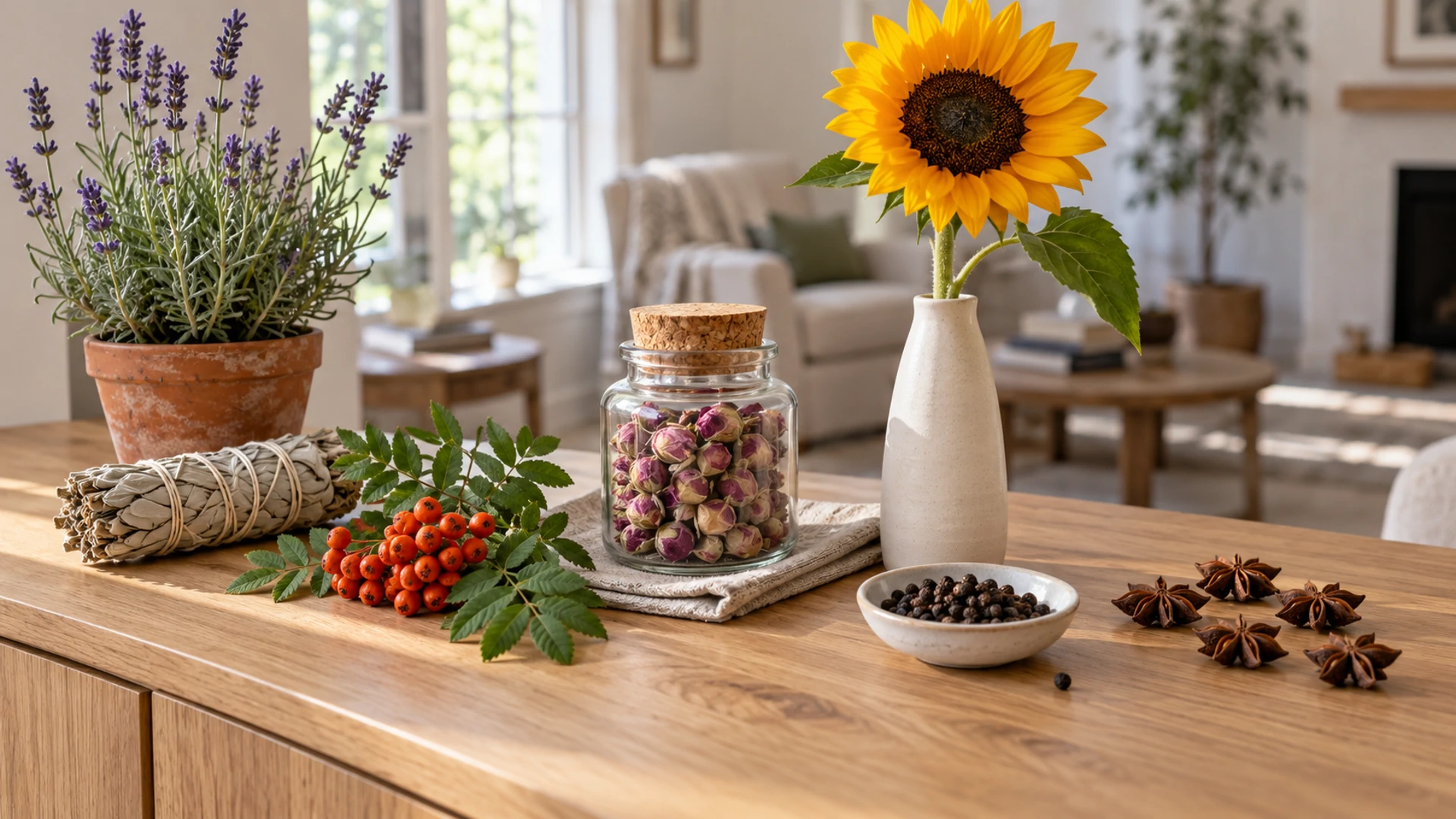
Herb magic has a disarming simplicity to it. The plants are already there — on the kitchen shelf, in the garden bed, growing through the cracks in the pavement. They have been carried into ritual spaces, stuffed into sachets, brewed as washes, and burned as smoke for thousands of years across nearly every culture on earth. That long, accumulated use is itself a kind of power: each plant has had centuries to accumulate meaning, association, and practice. You do not need rare ingredients or specialized tools to begin. You need a relationship with the plants, and a clear sense of what you are trying to do.
Every herb in this collection falls into one of seven core categories: Cleansing & Purification, Protection & Warding, Banishing & Hex-Breaking, Love & Attraction, Prosperity & Success, Divination & Spirit Work, and Healing & Peace. Many herbs have secondary qualities that reach across categories, and those are noted inside each entry rather than repeated twice. This page is designed as a reference you return to — a structured overview that links out to a full deep-dive article for each herb as those go live, so you can follow any thread as far as it goes.
Leaf, Root, Resin, and Smoke: How Herbs Carry Intention
Herbs do not act on their own. They are anchors for intention, not sources of it. The associations they carry come from observable qualities — a plant's scent, its growth habit, whether it has thorns, where it chooses to grow, what it has historically been used to treat — and from centuries of recorded practice in herbals, folk traditions, and magical manuscripts. When you burn rosemary, the sharp resinous smoke does something to your attention, your mood, your sense of readiness. The plant gives your intention something to hold onto. That is what herbal magic is: focused will, given a physical shape.
The method you choose shapes the working as much as the herb itself. Smoke releases and moves — burning an herb disperses its energy through a space, making it ideal for clearing or consecrating. Carrying an herb in a sachet keeps the intention close to your body over days or weeks. Burying an herb anchors the working to a specific place. Washing with a prepared herbal water removes what clings to a person or a threshold. Dressed candles combine an herb's correspondence with the focus of flame. Ritual teas bring the plant inside you, making the working deeply personal. Living plants on the altar or in the garden hold a slow, continuous intention. Each method has its logic, and choosing deliberately makes the working cleaner.
A few practical notes on safe use, kept short. Burn herbs in a ventilated space, and keep smoke well away from birds, small pets, and anyone with asthma or respiratory sensitivities. Not every plant used in magic is safe to eat or drink — some are toxic at any dose, and others are fine as incense but dangerous as tea. Always verify an herb's safety before it enters your body or your bath. If you are pregnant or taking prescription medication, check herb interactions before using anything internally. That applies throughout this entire page.
Cleansing & Purification Herbs: Clearing the Slate
Cleansing herbs do one primary job: they remove what has already accumulated. Stagnant energy, psychic residue, the emotional weight that settles in a space after conflict or grief — this is the category that clears it. Cleansing is not protection, which holds a boundary against what has not yet arrived, and it is not banishing, which targets a specific presence and drives it out. Cleansing is the reset. It prepares a space, a person, or an object for whatever work comes next, and it is almost always the first step in any serious ritual practice.
The herbs in this category tend to share a sharp, clean quality — aromatic, resinous, or citric scents that feel like they cut through the air. Many have long associations with sacred spaces: temples, shrines, ceremonial grounds. They have been burned, strewn on floors, hung above doorways, and brewed into purification washes across dozens of traditions. What they hold in common is a quality of opening — they do not build walls, they lift what has settled so it can move.
Smoke is the primary vehicle for cleansing herbs, and for good reason: it reaches corners, fills a room, and dissipates naturally, taking what it has gathered with it. Herbal washes — water steeped with these plants and used to wipe down surfaces or scrub a floor from back to front toward the front door — are equally traditional and particularly effective for homes and thresholds. Bath infusions with cleansing herbs work on the body the same way a floor wash works on a space. The most important ritual detail is intention: know what you are clearing and let that be the thought you hold throughout.
Twelve plants for clearing, each with its own angle of approach:
- White Sage (Salvia apiana) — Strong, unmistakable smoke that clears a space with real force. It is a sacred medicine of several Indigenous California nations, including the Chumash, and its commercial overharvesting is a genuine ecological and cultural concern; sourcing from cultivated nursery stock is the responsible choice, and garden-grown rosemary or garden sage make excellent alternatives. Burn the dried leaves in a fireproof vessel and move the smoke through the space with intention, starting at the back and working toward the door.
- Hyssop (Hyssopus officinalis) — Associated for centuries with spiritual cleansing through the Psalms, though the biblical hyssop scholars now believe was probably Syrian oregano — modern hyssop inherited that ancient liturgical reputation by name. The plant itself is a Mediterranean shrubby herb whose dried bundles have been used in aspersion rites, dipped in water and sprinkled over people or places to purify them, a method that translates cleanly into contemporary practice.
- Palo Santo (Bursera graveolens) — Lighter and warmer than white sage, with a sweet, woody resin that gives spaces a welcoming quality even as it clears them. It comes from the dry coastal forests of Ecuador and Peru, where it is used in folk healing and ceremonial cleansing; look for sustainably sourced material from naturally fallen trees, not harvested living ones. A single stick burned briefly is usually enough — this is not a plant that needs to flood a room.
- Frankincense (Boswellia sacra) — One of the oldest ritual substances on record, burned continuously in temples from ancient Egypt to the medieval Catholic church. Frankincense consecrates by lifting — its smoke seems to raise the energetic register of a space rather than just clean it, making it the go-to resin for setting sacred space before ceremonial work. Burn the resin on charcoal, not the essential oil, which does not carry the same quality of smoke.
- Rosemary (Salvia rosmarinus) — Historically one of the most versatile purification plants in European tradition, used at funerals to clear grief from a space and at weddings to bless it fresh. Its long association with remembrance, captured in Ophelia's line in Hamlet, sits alongside a secondary protective quality. Grow it yourself if you can — a pot by the door gives you fresh sprigs for threshold work any time.
- Thyme (Thymus vulgaris) — Small-leaved and underestimated, thyme has a long cleansing history in European folk practice that most people overlook because it lives in the spice rack. Its name's Greek derivation is genuinely disputed — both "to fumigate" and "courage" are proposed, and neither is settled. Steep it in hot water for a room-clearing wash, or add dried thyme to a purification bath for a quick and effective pre-ritual cleanse.
- Lemon (Citrus limon) — Sharper and more cutting than either lemongrass or lemon balm, and unrelated to both — three entirely different plant families sharing a flavor note. Fresh lemon juice in water makes a bright, incisive floor wash that feels especially effective for clearing after arguments or illness. The peel burned slowly over charcoal gives a more focused, penetrating cleansing smoke.
- Lemongrass (Cymbopogon citratus) — Where lemon cuts, lemongrass opens. It is the primary herb in Van Van oil, one of the most widely used road-opening and cleansing preparations in Hoodoo, and its secondary quality is attracting opportunity after the clearing is done. Use it as a floor wash to remove stagnation and simultaneously invite fresh energy — the same working does both.
- Vervain (Verbena officinalis) — Pliny the Elder described a harvest rite in which the Magi cut vervain at Dog Star rising, a detail often misattributed to Druids — that Druidic association is largely an 18th and 19th century embellishment. In practice, vervain's cleansing quality is ceremonial and consecrating rather than heavy-duty clearing; it suits the purification of ritual tools and altars, and its secondary protective quality makes it a natural addition to multi-purpose pre-ritual washes.
- Sandalwood (Santalum album) — Sandalwood consecrates by quieting rather than lifting. Where frankincense raises a space's energetic register, sandalwood settles and stills it, making it well suited to meditation preparation and altar clearing. Its heartwood oil comes primarily from India and Australia; look for ethically sourced material, as wild Indian sandalwood is listed as vulnerable after decades of over-harvest, and its trade is tightly regulated.
- Pine (Pinus spp.) — Pine renews and freshens with a clean, cold resin that cuts through psychic staleness rather than lifting it heavenward. Evergreen boughs brought indoors at midwinter across northern Europe carried the promise of life through the dark season, and the eastern white pine is the Tree of Peace of the Haudenosaunee Confederacy. Burn the dried needles or resin for a quick cleansing smoke, or sweep with a fresh bough.
- Thuja (Thuja occidentalis) — Thuja is the North American Eastern white cedar, one of the four sacred medicines of Anishinaabe tradition alongside tobacco, sage, and sweetgrass, and its cultural context deserves acknowledgment. It is distinct from true cedar (Cedrus) and from juniper — most North American products sold as "cedar" are thuja or eastern red cedar. Burn the dried leaf fans for a purifying smoke that is distinctly lighter and more resinous than white sage.
Protection & Warding Herbs: Holding Your Ground
Protection herbs hold a boundary. Where cleansing removes what has already settled, protection keeps unwanted influences from arriving in the first place — it is a sustained, maintained energetic boundary rather than a one-time reset. Historically, warding plants were placed at entrances, hung above cradles, grown beside doorways, and carried on the body whenever a person moved through uncertain territory. The logic is consistent across traditions: the plant marks a threshold and asserts that what is on this side is distinct from what is outside it.
What protection herbs share is a quality of firmness. Many are thorny, resinous, or strongly scented — plants that make themselves known and do not easily give ground. Several have deep roots in European folk magic, from Scottish saining with juniper to medieval herb lore around angelica. Others cross into indigenous and folk traditions worldwide, reflecting a near-universal human impulse to use the plants around you to keep a boundary safe.
The preferred methods for warding herbs are placement and carrying. Sprigs or dried bundles above the door, sachets worn or kept near the bed, boundaries made of scattered dried herb across a threshold — these keep the intention ongoing rather than releasing it all at once the way smoke does. Smudging with a protection herb works when you need to re-establish a boundary that has been crossed or worn down. The distinction from cleansing smoke is intention: you are not clearing what is already inside, you are asserting what cannot come in.
These are the plants that hold the line, each in its own way:
- Angelica Root (Angelica archangelica) — Competing legends disagree on which archangel lent this plant its name — both Michael and Raphael appear in different sources, and neither claim is settled. It is a tall, imposing plant, and its root is correspondingly assertive in protection work: it is not subtle warding but a full energetic declaration of boundary. Wild angelica foraging carries serious risk due to deadly look-alikes in the carrot family; buy from an established supplier.
- Rowan (Sorbus aucuparia) — The classic protective tree of British and Scandinavian folk magic, particularly associated with red thread and the pairing of rowan berries with red string as a warding charm against witchcraft and ill intent. In the Prose Edda, a rowan saves Thor from a flooding river.
- Rue (Ruta graveolens) — An ancient Mediterranean warding herb used across Italian, Greek, and Latin American traditions to deflect the evil eye. Fresh rue sap combined with sunlight can cause serious skin burns, so handle it with gloves; a bunch hung above the door, or dried rue kept in a sealed pouch, avoids skin contact altogether, but rue oil on skin carries the same burn risk as the fresh sap.
- St. John's Wort (Hypericum perforatum) — Harvested at Midsummer for centuries — a solar plant collected at the peak of the year to ward off evil through the dark half. Its Midsummer associations are genuine and well-documented across European folk tradition. If taken internally, it has clinically significant interactions with several prescription medications, including antidepressants and anticoagulants; check carefully before using it as anything other than a dried protective charm or smudge.
- Juniper (Juniperus communis) — At the heart of Scottish saining, a traditional New Year purification and warding rite in which juniper was burned inside the sealed house until the smoke was nearly unbearable, then the windows were thrown open. Eastern red cedar, the tree many Americans burn as "cedar", is in fact a juniper (Juniperus virginiana), distinct from both thuja and true cedar. Juniper is among the fiercest of the warding smokes — it does not simply mark a boundary, it enforces one.
- Mullein (Verbascum thapsus) — Tall, silver-leafed, and roadside-wild, mullein has a long association with carrying protective light through darkness. Its dried stalk was historically dipped in tallow and burned as a torch — called a witch's taper — making it literally a plant that holds flame. Carry the dried leaf in a sachet for quiet, sustained warding, or burn it with other protective herbs to amplify their boundary-setting quality.
- Garlic (Allium sativum) — Among the most globally consistent protective plants known, used as a ward against evil spirits, disease, and the evil eye across Europe and the Mediterranean — the ancient Greek writer Theophrastus mentions garlic left at crossroads as part of the offerings to Hecate. Hang a full bulb at the entrance for a boundary that slowly works through the month. Its secondary quality is banishing — fresh garlic at a threshold does not just hold a line, it actively repels.
- Solomon's Seal (Polygonatum spp.) — Its name is most often explained by the round, seal-like scars each year's fallen stem leaves on the rhizome, likened to the legendary seal ring of King Solomon, which in the Testament of Solomon gives him command over demons. The root has been used to seal and protect spaces, particularly against spirit intrusion, and to bind protections already set so they hold firm. It is a quieter, more ceremonial herb than most in this category — less immediate than garlic or juniper, more lasting.
- Elecampane (Inula helenium) — A tall, daisy-family plant with a root that smells faintly of violets, used in European folk tradition for protection against elf-shot and fairy mischief — a category of harm that translates in modern practice to psychic interference and intrusive energy. Work it in a sachet alongside other protection herbs for sustained warding, or use the root in a threshold-crossing charm.
- Cedar (Cedrus spp.) — True cedar — Atlas cedar, Cedar of Lebanon, deodar — is one of the Old World's most ancient sacred timbers, prized for preservation in temples, royal tombs, and sacred furniture. Note that what North Americans usually call "cedar" is actually thuja or eastern red cedar, a different plant entirely. True cedar's protective quality is less about fierce warding and more about dignified permanence: the wood preserves what it guards.
- Fennel (Foeniculum vulgare) — Among the Nine Herbs in the Old English charm attributed to an encounter with Woden, fennel has a long history as a Midsummer door herb, hung in houses to protect against witchcraft. It is a carrot-family plant and a close family relative of dill, though the two have distinct folk roles: fennel belongs to the outdoor threshold, dill to the nursery. Keep them as whole dried stems rather than ground spice for charm work.
- Dill (Anethum graveolens) — Dill's warding history is more domestic than fennel's: in English folk tradition it protected against witchcraft in the cradle, the kitchen, and the household generally. Hang dried dill above a crib or near a baby's sleeping space as a traditional protective charm. Like fennel, dill is a carrot-family plant, and foraging either in the wild risks confusion with toxic relatives.
- Mistletoe (Viscum album) — Suspended between earth and sky, parasitic and ever-green through winter, mistletoe has been a sacred plant across northern Europe since at least the classical period. Pliny's account of Druids cutting it with a golden sickle is the most famous reference, though how much of their actual practice it reflects is debated. Hang dried mistletoe in the home for ongoing protection; keep it away from children and pets as the berries are toxic.
- Wintergreen (Gaultheria procumbens) — A small, aromatic ground-cover plant used in North American folk magic for protection, with its secondary pull toward luck and prosperity sitting just underneath its primary warding role. The dried leaves and berries are the working material; wintergreen essential oil is highly toxic if swallowed and should not be used internally under any circumstances. Carry the dried herb in a sachet or burn it sparingly for a clean, sharp protective smoke.
Banishing & Hex-Breaking Herbs: Cutting What Doesn't Belong
Banishing is about removal — driving out what has taken hold, cutting ties that should not exist, reversing what has been sent. It sits between cleansing and protection: more targeted than a general clearing, less ongoing than a maintained ward. In practice, banishing work means reclaiming a space or a life from something specific: a harmful influence, an unhealthy dynamic, a pattern that will not release on its own. It is fundamentally a practice of restoration, returning things to how they should be.
The herbs in this category are almost universally aggressive in their qualities — pungent, sharp, bitter, or thorned. They are not comfortable plants, and they are not meant to be. Their discomfort is part of the point. Something unwelcome needs to leave, and these are the plants that make that demand clearly. Several have folk histories that lean toward cursing, and that history is noted honestly below; but the primary use on this page is removal and uncrossing, not harm.
Banishing herbs are typically worked through smoke, scatter-warding, hot water washes driven out the front door, and addition to reversing candle dressings. The difference from cleansing is directional: cleansing washes or wafts are moved in, lifted, and released. Banishing preparations move outward — you are expelling something specific, and the motion of the working reflects that. Burying banishing herbs at a property line, crossing them with salt at a threshold, or burning them in a fire you then extinguish are all valid methods that encode this directional logic.
For what has overstayed its welcome:
- Black Salt — Not a plant, but a folk-magic preparation of salt blackened with ash, cast-iron scrapings, or black pepper; its written recipes are modern. Scatter it at thresholds to prevent entry, or use it to dismantle an existing working. It pairs with nearly every herb in this category.
- Asafoetida (Ferula assa-foetida) — Called "devil's dung" for its overwhelming sulfurous smell, and that smell is precisely its magic: it drives out what is present simply by making staying intolerable. A staple of Indian cooking, it also has a documented folk history as a ward: in the early 20th century, children in the American South and Appalachia wore small bags of asafoetida around their necks to keep disease away. Burn it outdoors or in heavy ventilation — this is not a herb for enclosed spaces, and the smoke is genuinely unpleasant even when the working is going perfectly.
- Cayenne Pepper (Capsicum annuum) — Heat is its defining quality: urgent, fast, and impossible to ignore. Cayenne is the herb you reach for when you need something out now, when a situation has gone past the point of gentle measures. Scatter it across a threshold to block return, or add it to a banishing powder for maximum intensity. Black pepper, an unrelated plant despite the shared name, does similar work with a slower, steadier hand.
- Black Pepper (Piper nigrum) — Where cayenne is urgent, black pepper is firm and enduring. Native to India's Malabar Coast and precious enough in the ancient world that peppercorns were placed in the nostrils of Ramesses II during his mummification, it is a core ingredient of black salt and of Hoodoo powders used to drive someone off. Use whole peppercorns in banishing sachets or grind and add to black salt for a combination that holds its working over time.
- Agrimony (Agrimonia eupatoria) — Agrimony's banishing quality is specific: it is a reversal herb, used to send harmful workings back to their source. This is uncrossing and hex-breaking in the most precise sense, not general clearing. Medieval European herbalists used it in sleep and wound preparations; its magical reputation for returning ill intent built up alongside that medicinal history in folk practice. Brew it as a wash and apply it moving from the body outward.
- Nettle (Urtica dioica) — Nettle fights back. Its physical sting is not incidental to its magical character — it is the character. In Hans Christian Andersen's "The Wild Swans", a sister weaves shirts from nettles to break the curse on her brothers, and that image of the plant as a force that breaks what should not hold translates directly into practice. Throw dried nettle toward a threat, include it in banishing jars, or scatter it at a boundary you need to enforce.
- Blackthorn (Prunus spinosa) — The thorned hedgerow neighbor of rowan, with a reputation in British witchcraft as the witch's own wood rather than the herb used against them. That reputation is recorded history, not an endorsement. In contemporary practice, blackthorn thorns are used to sever ties — to physically cut cords in cord-cutting rituals, or to pierce poppets and papers that represent what needs to end. The cursing history is real; the present application is severance and release.
- Thistle (Blessed Thistle) (Cnicus benedictus) — Blessed thistle brings a paradox: named for blessing but armed with spines, used in European folk practice both to protect and to drive away evil. Its spines make it a natural ward at boundaries, and the whole dried plant can be placed at a threshold to prevent unwelcome return after a banishing.
Love & Attraction Herbs: Drawing the Heart Closer
Love magic is broader than romance. This category covers romantic love, desire, self-love, friendship, the softening of discord between people who care about each other, and the cultivation of conditions where connection can grow. Money and luck do not belong here — they have their own section, with their own herbs and their own logic. Love magic is specifically about the heart: opening it, drawing another heart toward it, or tending the one you already have.
The herbs here share warmth and sweetness in their scent profiles, and many have long associations with Venus, with the pleasure of being alive, and with beauty as a force that draws. Several have histories in love magic that stretch across multiple cultures independently — rose and jasmine in particular show up in love workings on nearly every continent where they grow. That cross-cultural consistency suggests these plants genuinely carry something in their scent chemistry that humans have recognized for a very long time.
Love herbs are most effective when used in ways that keep them close or draw them in: rose and jasmine in ritual baths, sachets worn near the heart, candles dressed with oil and petals, small offerings placed where a person will encounter them. Unlike protection herbs, which assert boundaries, love herbs dissolve them — they soften, open, and invite. The working is receptive rather than assertive, which means your own state during the ritual matters particularly. Do this work when you genuinely feel open, not when you are anxious or forcing it.
Where the heart is concerned, start with these:
- Rose (Rosa spp.) — Universally recognized as the love plant of Western magical tradition, with a history in love magic and aphrodisiac preparation going back at least to ancient Rome and the Near East. Rose's range covers romantic love, self-love, friendship, and grief — it is the full spectrum of love rather than only its heated end. Use the petals fresh in a love bath or dried in a sachet; florist roses are typically too heavily treated with pesticides for skin contact or tea.
- Jasmine (Jasminum officinale) — Jasmine operates through its scent in a way few plants match. The flowers' fragrance is deeply associated with night, with desire, and with dreams — which gives jasmine a secondary quality in spirit and dream work alongside its primary love correspondence. Dry the small flowers and add them to attraction sachets, or simmer them gently to fill a space with their quality before ritual work.
- Damiana (Turnera diffusa) — A small shrub native to Mexico, Central America, and the Caribbean with a long folk reputation as an aphrodisiac and love herb. Its magical application is desire and physical attraction specifically, rather than the deeper emotional bonding that rose governs. Use dried damiana in love sachets or add it to incense blends for workings focused on physical connection and rekindling desire.
- Cardamom (Elettaria cardamomum) — Warm, aromatic, and used in love magic across South Asian and Middle Eastern traditions, often appearing in aphrodisiac foods and perfumes intended to draw a specific person closer. Cardamom's quality is seductive warmth rather than open-hearted tenderness — it heats the space between people rather than softening it. Add crushed pods to love sachets or brew them in tea as part of an attraction working.
- Vanilla (Vanilla planifolia) — A Totonac legend from Papantla tells of a princess and her mortal lover, whose blood gave rise to the vanilla orchid — a plant born of devotion itself. Vanilla creates a sense of ease and warmth around the person who wears or carries it, making it less about drawing passion and more about making yourself someone others naturally want to be near. Its secondary quality is comfort, and the two work well together: warmth that draws people near and eases them once they arrive. Use the extract or dried pod in sachets, or anoint a love candle with vanilla oil.
- Hibiscus (Hibiscus sabdariffa and Hibiscus rosa-sinensis) — Two plants share the name: roselle (Hibiscus sabdariffa) supplies the deep red calyces brewed as hibiscus tea, while Chinese hibiscus (Hibiscus rosa-sinensis) is the showy red flower offered in worship, favored in Bengal as a sacred offering to Kali and Durga, its color matching the goddess's fierce power. For love work, brew the dried roselle calyces as a ritual tea — note that roselle tea lowers blood pressure, so check before drinking — or float a fresh Chinese hibiscus flower in a love bath. Both plants carry a correspondence of desire and emotional intensity.
- Violet (Viola odorata) — Gentle and associated with faithful, lasting affection rather than passion. In European folk tradition, violets were exchanged as tokens of constancy between lovers and friends. The plant's secondary quality is healing, and violet is particularly suited to workings that aim to restore trust or repair a relationship that has been strained.
- Sweet Orange (Citrus sinensis) — Peel and blossom both worked in love magic across Mediterranean and Latin American traditions, bringing warmth, cheerfulness, and social ease. Sweet orange suits friendship attraction and relationship warming as much as romantic love — it brightens the emotional atmosphere rather than inflaming it. Dry the peel and add it to a love sachet, or burn it for a welcoming, magnetically pleasant room scent.
- Ylang Ylang (Cananga odorata) — A powerfully sweet tropical flower whose blooms are spread on the bed of newlyweds in Indonesia, where its romantic association is literal tradition. A very small amount of the essential oil goes a long way — excess tips from alluring to overwhelming. Use it in anointing oils for love candles, added one or two drops at a time, or diffuse it lightly before a romantic working. Its primary quality is sensual attraction and confidence in intimacy.
- Geranium (Rose Geranium) (Pelargonium graveolens) — Geranium bridges love and protection in a specific way: it is used to maintain harmony within an existing relationship, to ward against outside interference in a partnership, and to soften ongoing conflict between people who love each other. The rose-scented variety carries the floral, Venus-aligned quality most strongly. Grow it in the home for a continuous stabilizing influence on household relationships.
Prosperity & Success Herbs: Money, Luck, and the Win
Prosperity herbs work with ambition, momentum, and the opening of material pathways. This category covers money attraction, career success, luck, and the general forward movement of practical life — the things you are trying to make happen in the world. It is a different category from love magic not just thematically but energetically: where love herbs soften and open, prosperity herbs tend to build heat and push.
Many of the plants here are spices — warm, dry, stimulating. Cinnamon, clove, ginger, nutmeg: these are the kitchen staples of prosperity work, and their widespread availability is part of their historical importance. In trade economies, spices were wealth, and the plants that carried wealth across continents absorbed that correspondence into their magical identity. The herbs without a spice-rack history tend to share a deep, earthy quality — patchouli, vetiver — or a solar boldness, as in bay laurel.
Prosperity herbs are most commonly worked in candle dressings, money jars, wallet sachets, and threshold preparations designed to draw money into the home. Carrying them on the body keeps the intention active. Burning them as incense before business meetings, job interviews, or financial decisions sets the energetic context for the work that follows. The key difference from love magic is that you are not waiting to receive — you are building momentum toward a specific material outcome.
Twelve herbs for money, luck, and the push toward success:
- Cinnamon (Cinnamomum verum) — One of the most widely used prosperity herbs in the world, with genuine historical weight: cinnamon was a luxury trade commodity in antiquity, and its association with wealth is at least partly literal. The practice of blowing cinnamon through the front door on the first of the month is a modern creation, not a traditional Hoodoo working, though it has spread widely. True Ceylon cinnamon and cassia are often sold interchangeably; they are different plants with different flavor and potency. Dress a money candle with cinnamon oil or sprinkle ground bark in a prosperity sachet.
- Clove (Syzygium aromaticum) — Assertive and penetrating, clove is used in prosperity work that needs force behind it — when luck has been slow or opportunity keeps sliding past. Its secondary quality is protection, and cloves are sometimes used at thresholds both to attract money and to hold it once it arrives. Simmer whole cloves, stud them into an orange for a prosperity charm, or add them to a money-drawing incense blend.
- Basil (Ocimum basilicum) — In Hoodoo, basil goes into money-drawing floor washes for homes and businesses, and a pot of basil kept by the door or the register is a common folk practice for drawing customers. Its love secondary has a literary anchor in Boccaccio's Decameron, where Lisabetta hides her murdered lover's head in a pot of basil, retold later by Keats. Basil planted alongside Venus herbs carries both correspondences at once.
- Patchouli (Pogostemon cablin) — Dense, earthy, and grounding, patchouli's prosperity correspondence is about material wealth and physical abundance rather than luck or opportunity. It draws money in the way earth holds things — slowly, with accumulation over time. Use the dried leaf in a money sachet you intend to carry for months rather than days, or add patchouli oil to a long-term prosperity candle working.
- Mint (Mentha spp.) — Fresh, fast, and movement-oriented, mint brings the kind of prosperity that circulates — money that flows in and keeps flowing rather than sitting still. Spearmint and peppermint both carry the correspondence with slight differences in intensity. Keep a fresh mint plant in the kitchen for ongoing abundance, or rub dried mint leaves between your hands before handling money or financial documents.
- Bay Laurel (Laurus nobilis) — Worn as a wreath of achievement in ancient Greece and Rome, crowning emperors, generals, and poets alike. Its prosperity correspondence is specifically about success and recognition rather than money attraction alone — bay is the herb for ambition, for the win, for the moment your work is acknowledged. Write your success intention on a dried bay leaf and burn it to release it, or keep one in your wallet as a declaration of expectation.
- Nutmeg (Myristica fragrans) — A luxury spice whose lucky-charm use belongs to American folk magic and Hoodoo, where a whole nutmeg is carried as a lucky piece, especially by gamblers, and as a money attractor. Nutmeg is toxic in quantity if eaten, so use the whole nut as a carried charm rather than consuming it, and keep it away from children. Its specific quality is luck and fortunate outcomes in financial ventures.
- Ginger (Zingiber officinale) — Ginger brings heat and speed to prosperity work, making it the go-to addition when a working has felt sluggish or when circumstances need to move faster. It is the hot momentum herb of this category in the same way cayenne is the hot urgency herb of banishing — related in quality, different in direction. Add fresh or dried ginger to a money jar to accelerate an existing working, or burn it as incense before a decisive financial action.
- Bergamot (Citrus bergamia) — Best known as the distinctive flavor in Earl Grey tea, bergamot oil and dried peel are used in modern money-drawing preparations, particularly for attracting financial opportunity through business and professional channels. Its secondary quality is optimism and mental clarity — a useful combination when you need to think clearly about money. Anoint a green or gold candle with bergamot oil for a business prosperity working; if the oil will touch skin, use a bergapten-free (FCF) version, as cold-pressed bergamot oil is phototoxic.
- High John the Conqueror (Ipomoea jalapa) — One of the most significant roots in African American Hoodoo tradition, associated with power, luck, victory, and the ability to overcome obstacles. Zora Neale Hurston's 1943 essay "High John de Conquer" tells how John returned to Africa but left his power in a root, a story that captures the way this plant holds a living cultural memory. Carry the whole root, anointed with oil, in a red flannel bag — it is never eaten, because jalap is a drastic purgative. High John has a specific cultural home in Hoodoo and should be acknowledged as such.
- Vetiver (Chrysopogon zizanioides) — A deep-rooted grass whose heavy, earthy smoke grounds prosperity workings in the long term. Where mint moves money and clove forces it, vetiver anchors it — this is the herb for financial stability and the kind of wealth that stays put. Burn the dried root chips in a prosperity blend or add them to a long-term money jar as a stabilizing base.
- Sunflower (Helianthus annuus) — Solar, expansive, and unapologetically abundant — a sunflower produces hundreds of seeds, and that generative quality is the heart of its prosperity correspondence. The seeds are carried or placed on altars for abundance and success; the whole flower head can be dried and kept in a prosperity corner of the home. Its secondary quality is joy and confidence, which amplifies any working done from a place of genuine belief in success.
Divination & Spirit Work Herbs: Opening the Inner Eye
This category spans two related kinds of work. The first is about perception: sharpening your ability to receive information through dreams, scrying, card readings, and other divinatory methods. The second is about connection: honoring ancestors, making offerings to the dead, and maintaining a relationship with spirits across the threshold. These two things belong together because both require the same quality of attention — a loosening of the rational mind's grip, a willingness to receive rather than direct.
The herbs here tend to be bitter, resinous, or psychoactively adjacent — plants that have historically been used to alter perception, deepen trance, or mark the boundary between the living world and whatever lies beyond it. Many have funerary associations: yew in the churchyard, myrrh on the altar of the dead. Others are dream herbs first: mugwort under the pillow, blue lotus in the ceremonial cup. What they share is a quality of thinning, of making the membrane between ordinary experience and altered awareness more permeable.
Divination herbs are worked close to the body and to the mind. Placing them under the pillow or in a dream sachet near the bed influences sleep perception. Burning them during a reading sets an atmosphere of receptivity. Offering them on an ancestor altar or gravesite creates a bridge across which communication can move. Ritual teas from this category draw only on the herbs safe to drink: small amounts of mugwort, eyebright, calendula, dandelion, and food-grade Chinese star anise, with mugwort and yarrow both avoided in pregnancy.
For seeing clearly, and for reaching across the veil:
- Mugwort (Artemisia vulgaris) — Placed under a pillow or burned before sleep, it is associated in modern practice with vivid, memorable, and sometimes prophetic dreams. An Artemisia — sister plant to wormwood, but softer and more approachable. Use it with care if you are pregnant or hope to be, and avoid large internal doses; as a dream sachet or light incense it is gentle enough for regular use.
- Wormwood (Artemisia absinthium) — The bitter elder sibling of mugwort, with a sharper edge in spirit work and a more commanding presence in calling. Where mugwort softens the boundary and invites dreams, wormwood asserts a summons. It is the thujone-containing herb behind absinthe's legendary reputation, and it should not be taken in quantity internally or during pregnancy. As incense for spirit communication or divination sessions, used sparingly, it is traditional and effective.
- Star Anise (Illicium verum) — Eight-pointed and immediately recognizable, star anise carries a specific divination correspondence for psychic awareness and clarity of inner sight. Japanese star anise (Illicium anisatum) is burned as temple incense in Japan but is never brewed — only food-grade Chinese star anise belongs in anything you drink. Use whole stars in a divination incense blend, or place them on a reading altar as a focusing symbol.
- Eyebright (Euphrasia officinalis) — In Milton's Paradise Lost, the archangel Michael clears Adam's sight with euphrasy and rue so that he can see the future, a scene that draws on the plant's existing reputation for clear sight. It has been used in folk medicine for eye ailments since at least the medieval period, and that history of aiding physical sight translated directly into a magical reputation for psychic clarity. Brew it as a tea before a reading or add it to a scrying water wash for the bowl.
- Blue Lotus (Nymphaea caerulea) — Sacred in ancient Egypt and depicted extensively in tomb art and ceremonial contexts. Whether it was used as a psychoactive intoxicant in Egyptian ritual is genuinely debated among scholars; the pharmacological evidence is not settled. Its contemporary use is in meditation, dreamwork, and light trance, usually as a tea or as floating flowers in ritual water. It is legally restricted in some countries, so check local regulations before sourcing.
- Dandelion (Taraxacum officinale) — Everywhere, and overlooked because of it, dandelion rewards closer attention. In folk practice, blowing the seeds while holding a question encodes the wish-and-send gesture that most people know from childhood into a genuine divination practice. Its name comes from the French dent de lion, the lion's tooth of its jagged leaves, and the roasted root makes a coffee-like tea to drink before a reading.
- Clary Sage (Salvia sclarea) — Its Latin species name sclarea derives from the medieval Latin for clarity, and it was used historically as a wash to clear debris from the physical eye. That etymology tracks directly into its magical correspondence for clear sight and vivid, lucid dreaming. It is distinct from white sage (the strong cleansing smoke) and from garden sage (the healing and longevity herb); do not use these three interchangeably. Burn it before a reading or carry a sachet during dreamwork periods.
- Yarrow (Achillea millefolium) — Called after Achilles, who is said in legend to have used it to stop bleeding on the battlefield. In divination practice, dried yarrow stalks have been used for I Ching casting for thousands of years — this is perhaps the oldest documented divinatory use of any herb on this list. Its secondary quality is healing, carried in folk names like soldier's woundwort, and it is also a traditional love-divination herb, placed under the pillow to dream of a future love.
- Calendula (Calendula officinalis) — Not to be confused with the Tagetes marigolds of Día de Muertos and Hindu garlands, a different genus entirely. Calendula takes its name from the Latin calendae, the first day of the month, because it blooms in nearly every month; and the Book of Secrets attributed to Albertus Magnus describes an herb, usually translated as marigold, that shows a robbed person the thief in a dream when placed under the pillow, and stops others speaking ill of the one who carries it. Tuck the dried petals under your pillow for prophetic dreams, or steep a calendula tea before dreamwork.
- Tobacco (Nicotiana tabacum) — One of the most significant ceremonial plants in Indigenous North American traditions, where it is used as an offering, a means of communication with spirits, and a sacred reciprocal gift. Its ceremonial context deserves acknowledgment; working with tobacco outside those traditions should be done with awareness of that weight. As an offering herb — never ingested — tobacco is placed on altars, buried at crossroads, or offered to the land before other magical work. Do not smoke it as a magical practice.
- Yew (Taxus baccata) — The churchyard tree of Britain and Europe, associated with death, rebirth, and ancestral continuity across thousands of years. Some surviving yew trees in Scottish and English churchyards predate the churches themselves by many centuries. Every part of the yew except the flesh of the berry is highly toxic; work with it only as a living tree in situ or as sealed, finished wood — never burn it or brew it. Stand beside one, make your offering, and listen.
- Myrrh (Commiphora myrrha) — The resin that descends where frankincense rises: myrrh preserves, honors, and accompanies. It was used in Egyptian mummification, in funerary rites across the ancient Mediterranean, and paired with frankincense as the sacred offering pair in temple traditions from Jerusalem to Rome. In contemporary ancestor work, myrrh burned on charcoal marks the altar as a space where the dead are welcome and honored. Its quality is solemn, unhurried, and deeply old.
Healing & Peace Herbs: Rest, Comfort, and Recovery
Healing in a magical context means restoring wholeness — energetically, emotionally, spiritually. It means comfort during grief, calm during crisis, the rebuilding of courage after it has been depleted, and the slow return of ease to a life that has been disrupted. None of the herbs in this category are presented as treatments for illness, anxiety, depression, or any medical condition. They are spiritual complements to care, not replacements for it.
Peace is the companion quality that runs through everything here. These herbs tend to be gentle and soft — lavender, chamomile, lemon balm — or consoling and steady — cypress for grief, comfrey for mending. They are not plants that demand or push; they hold. Their historical use spans the deathbed and the nursery, the sickroom and the meditation cushion, the grief ritual and the bath drawn after a long and difficult week.
Healing herbs are best used through physical contact and ingestion where safe: ritual baths, teas drawn from the herbs confirmed safe for drinking, sleep sachets, room diffusions. They suit slow, receptive ritual more than active, directed spellwork. Light the candle, steep the tea, sit with the plant, and let the working come to you rather than forcing it. This is intentional — the herbs in this category work best when you are not fighting the process.
When rest and recovery are the work:
- Chamomile (Matricaria chamomilla) — One of the nine plants of the Anglo-Saxon Nine Herbs Charm, and a flower whose apple-scented calm has been relied on across centuries of difficult moments. Chamomile's healing correspondence is solar rather than lunar — it does not lull into passivity but brings a gentle, reassuring warmth that makes recovery feel possible. Brew the dried flowers as a ritual tea before sleep or difficult emotional work, or add a chamomile infusion to a healing bath.
- Lavender (Lavandula angustifolia) — The most versatile of the healing herbs, spanning calm, peace, purification, and love in its secondary qualities. It was a strewing herb and linen scent in Tudor and Elizabethan England, laid where people slept and gathered. Keep a sachet under the pillow for sleep support, or burn it in a room where healing is needed to shift the atmosphere.
- Lemon Balm (Melissa officinalis) — Where lemon cuts and lemongrass opens, lemon balm soothes — three entirely unrelated plants sharing only a scent note, each with a completely different role. Lemon balm belongs to the mint family and has been used since at least the medieval period for sadness, low spirits, and nervous tension. In healing ritual, it is the herb for emotional recovery: grief, heartbreak, or the slow depletion that comes from long difficulty. Brew it as a gentle tea and hold the cup.
- Eucalyptus (Eucalyptus globulus) — Sharp, medicinal, and clearing in a way specific to health: eucalyptus is not a general cleansing herb but a healing one, associated with respiratory clearing, recovery from illness, and the kind of fresh start that follows long sickness. Note that eucalyptus oil is poisonous if swallowed and should be kept away from young children's faces. Hang fresh branches in the shower so that steam releases the oils, or burn dried leaves to clear a sickroom energetically after recovery.
- Comfrey (Symphytum officinale) — Called "knitbone" in folk medicine for its historical use in poultices for fractures and wounds, and that mending quality defines its magical character: comfrey is about repairing what has been broken, binding what has come apart, restoring continuity. Use it in healing sachets or as a dried altar herb; do not take it internally, as comfrey contains alkaloids that accumulate in the liver with repeated use.
- Cypress (Cupressus sempervirens) — Of all the evergreens, cypress is the mourner. It grows in Mediterranean cemeteries not by accident but by centuries of intentional planting — its association with grief, death, and consolation goes back to ancient Greece and Rome. Cypress is the healing herb for loss specifically: the death of a person, the end of a chapter, the grief of something that cannot be undone. Burn the dried wood or carry a small piece during active mourning.
- Borage (Borago officinalis) — An old Latin tag, "ego borago gaudia semper ago" ("I, borage, always bring joy"), survives in English as "I, borage, bring always courage," and its star-shaped blue flowers are associated with restored courage and the lifting of heavy spirits. Use dried borage in a healing charm for someone who has lost their confidence or nerve, or float the flowers in a ritual bath drawn for that purpose.
- Passionflower (Passiflora incarnata) — The intricate flower was named by Spanish missionaries in the Americas who saw the Passion of Christ in its structure — a piece of naming history that has nothing to do with its actual healing quality, which is calm. Passionflower is used for deep peace, sleep, and the quieting of a mind that will not stop cycling. Add it to a sleep sachet or brew it as a nighttime tea to bring an overactive mind to rest.
- Garden Sage (Salvia officinalis) — Of the three sages, this is the one most connected to longevity, wisdom, and embodied healing. Where white sage is the powerful clearing smoke and clary sage is the clear-eyed divination herb, garden sage governs the healing of time and the grace of getting older. The medieval School of Salerno posed the question still worth sitting with: why should a man die who has sage growing in his garden? In medieval and Renaissance European tradition, sage in the garden was said to reflect the health of the household; growing it is itself a healing practice. Use it as a cleansing alternative where white sage feels too heavy, or dry it for a longevity sachet.
Bringing Your Herbal Practice to Life
Seven categories give you a working framework for choosing herbs by what the practice actually needs rather than by whatever happens to be in the cabinet. That distinction matters more than it might sound. When you know whether you need to clear, to protect, to attract, or to receive, the herb choices become obvious rather than overwhelming. Start with one category — the one that reflects what you most need right now. Pick one or two plants from it, learn them thoroughly, and notice how they actually behave in your hands before you move on to the next.
If you want an approachable entry point into working with these herbs directly, spiritual tea ceremonies by intent are one of the most accessible and immediate methods available — no special tools, no elaborate setup, just an herb, hot water, and your full attention. Note that this path draws only on herbs confirmed safe for internal use, which is why the safety check near the top of this page matters before you put anything in a cup. The seven categories above are where you begin. The individual plants are where the practice lives.