Rosemary: Dew of the Sea for Weddings, Funerals, and Every Door Between
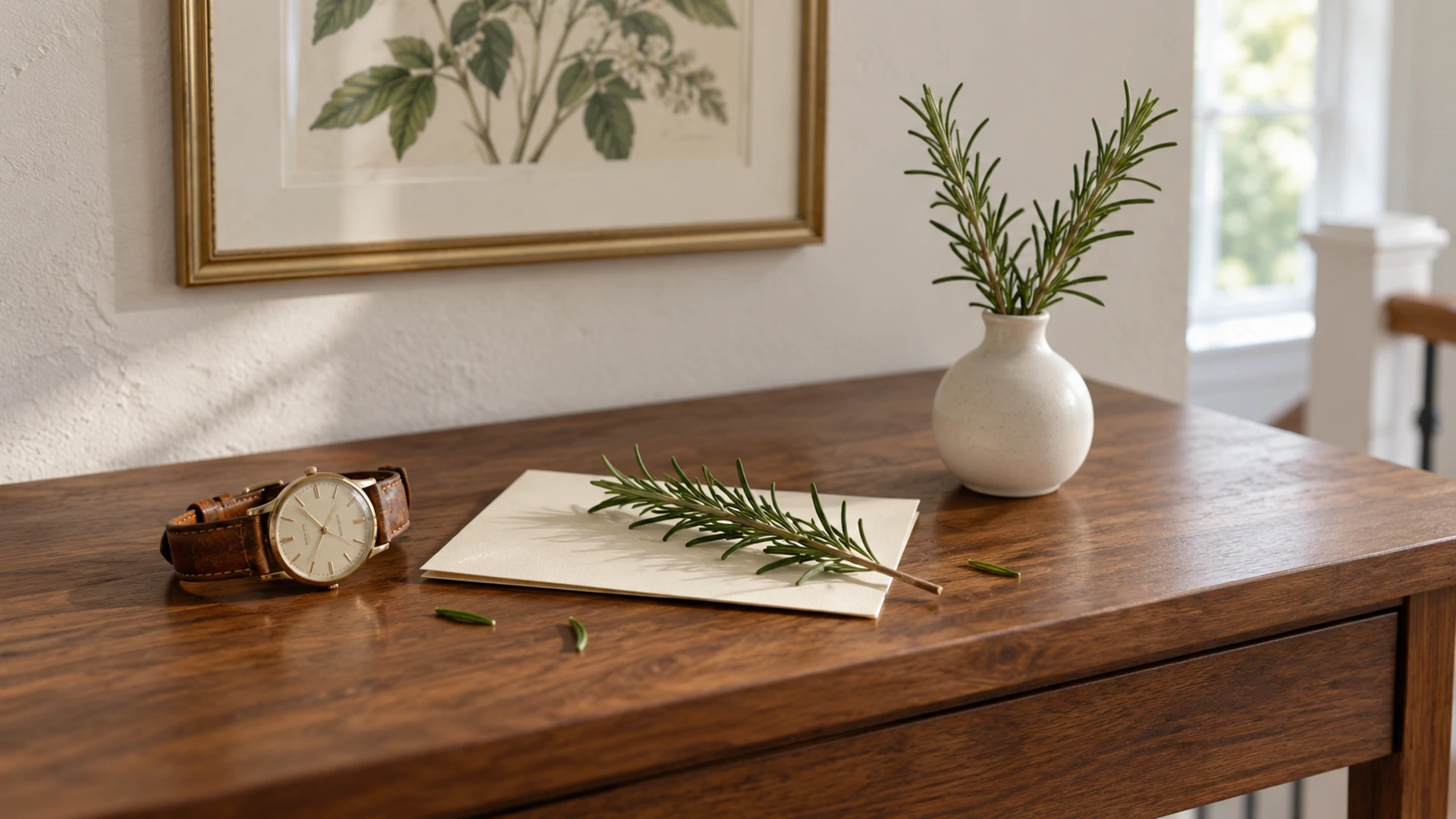
Rosemary is a garden cleansing herb for life's thresholds, clearing grief and blessing beginnings, with remembrance and protection as its companions.
Clearing at Life's Thresholds: Rosemary's Place in Cleansing
Rosemary's specific angle in cleansing work is this: it clears at life's thresholds. Not the forceful reset of a space that white sage's total atmospheric clearing delivers, and not thyme's quick, practical everyday cleanse pulled from the kitchen shelf. Rosemary occupies a different register altogether. It was carried at English weddings and laid on English coffins, burned after illness and hung above new doors. It clears grief and blesses what comes next. That dual appearance at both weddings and funerals is not a contradiction — it is the key to understanding what rosemary actually does. It marks transitions. It helps the living move through the door and honors what is being left behind.
Its correspondences place it squarely in solar, fiery territory. Culpeper and Cunningham both assign rosemary to the Sun, and fire is its element, with Sunday as its day. That solar quality gives the herb its warmth and its blessing character — this is not a cold or austere cleanse, it is a generous one. Its secondary category is Protection and Warding, and that secondary role is felt most strongly at the threshold itself. Sprigs hung over doors and carried into new homes carry both the clearing and the protective quality together, one working extending naturally into the other.
A note on the botany, because it matters: rosemary was moved out of its own genus in 2017 and reclassified as Salvia rosmarinus, which makes it formally a sage. It now belongs to the same genus as white sage and clary sage, and garden sage — though it has always occupied a distinct magical identity from all three of them, and that identity does not change with the taxonomy. Its name comes from the Latin ros marinus, meaning dew of the sea, a reference to its Mediterranean coastal habitat, and that origin is worth holding: rosemary has always been a plant of edges and margins, the line where land meets water.
Remembrance, Weddings, and the Sickroom
When Ophelia says "There's rosemary, that's for remembrance" in Hamlet, she is drawing on a cultural association that was already well established in Shakespeare's England. Rosemary appeared at both weddings and funerals — brides carried or wore it, mourners tucked it into shrouds, and it was laid into graves. That the same plant showed up at both ends of life's most significant passages says something precise: rosemary was understood as the herb that holds memory, that marks the moment for those who must carry it forward. At a wedding it blessed the beginning and sealed it into something lasting. At a funeral it honored the person who was gone and gave the living something to carry.
It was also burned in sickrooms, often paired with juniper, to clear a space after illness had passed through it. Juniper brings a fierce, warding quality to that pairing — it is among the most protective of the cleansing smokes. Rosemary brings the clearing and the renewal. Together they were a practical spiritual technology for resetting a room that had been held by illness. There is a legend attached to this herb — the Hungary Water story, of a 14th-century queen restored to health by a rosemary distillate — but it is legend only, without firm historical grounding, and is best set aside if you want to understand what rosemary actually was used for.
A Pot by the Door, and a Word on the Oil
The most useful thing to know about rosemary in practice is also the most obvious: it is the easiest cleansing smoke you can grow yourself. This is why it is the most widely available garden-grown alternative to bought smudge bundles. You do not need a supplier, a special shop, or a harvest season. You need a pot in a sunny window or a patch in a south-facing bed. Rosemary wants full sun, fast-draining soil, and restraint with water — wet roots are the usual way it fails, not drought. In climates with hard frosts it does better in a container that can come indoors for winter, because extended freezing at the roots will kill it. For practice, fresh sprigs can be cut whenever you need them, and dried bundles are simple to make by hanging sprigs somewhere with good airflow for a few weeks.
The safety picture for rosemary divides cleanly between the kitchen herb and the essential oil. Kitchen rosemary — fresh or dried, as tea or as smoke — is safe in normal use. The essential oil is a different matter: it is high in camphor and cineole, and should not be used near infants' faces, is best avoided by people with epilepsy, and should not be used medicinally during pregnancy. This applies to the concentrated oil specifically. Growing and burning the herb, or steeping it, carries none of those concerns.
Since kitchen rosemary is perfectly safe to drink, anyone drawn to working with it as a tea should know that there is a dedicated rosemary tea ceremony for protection, which fits its protective secondary category and gives the practice a more intentional ritual shape.
Three Rosemary Workings for Crossings and Farewells
The Sprig Above the Door
This working is for anyone who wants rosemary's blessing and protection woven into their home on an ongoing basis, rather than in a one-time clearing.
Cut a fresh sprig from your plant — or choose a good one from a bundle if you do not grow it — and set it above your front door, either tucked over the frame or tied with a simple length of string. Speak the intention clearly as you place it: that everyone who crosses this threshold is welcomed in, and that the home is held safe. When the sprig dries fully and loses its color and scent, replace it with a fresh one. The renewal is part of the practice. Each replacement is a small act of recommitment to the protection you have set in place. You do not need any other tools for this working. The sprig, the door, and the intention are the whole of it.
Rosemary and Juniper for a Room After Illness
This is a spiritual clearing for a room that has held illness — after a person recovers, after someone who was sick has moved on, or after a long stretch of difficulty has finally ended.
Gather dried rosemary and dried juniper — sprigs, berries, or needles of juniper all work — and burn them together in a fireproof dish, with a window in the room open. Juniper brings the fierce, warding quality to this pairing: it presses out what should not remain. Rosemary does the clearing and carries a sense of renewal, the turning of a page. Move the smoke through the room slowly, paying attention to corners and the space around the bed or wherever the person rested most. When the herbs have burned, leave the window open a little longer to let the room breathe. This is not a claim about air quality or pathogens — it is a spiritual act of resetting a space that has been held by difficulty, and it has been done in exactly this form for centuries.
The Remembrance Sprig
This working is for a funeral, a death anniversary, or any quiet day when someone you have lost is present in your thoughts.
Take a single sprig of rosemary — fresh or dried, either is right — and place it on your altar beside a photograph or an object that belonged to the person. If you are writing a card, tuck a small dried sprig inside. If you are visiting a grave, lay it there. Speak the person's name aloud. That is the whole of it. You do not need a ritual structure around this; the sprig and the spoken name are enough. Sunday, which is rosemary's day, or a Sun planetary hour can make a fitting time if you want to anchor the working in the calendar, but this one asks nothing elaborate from you.
An Herb for Every Doorway You Pass Through
Rosemary's angle — clearing at life's thresholds — is specific enough that it does not overlap with any of the other eleven herbs in the Cleansing and Purification category. It fills a gap that is genuinely its own: the crossing moments, the endings that are also beginnings, the rooms that need to be reset after something hard. And it is, practically speaking, the cleansing smoke almost anyone can grow on a windowsill, which makes it one of the most accessible starting points in all of herbal magic.
If you want to see rosemary alongside the other cleansing herbs — and the six other categories of plant magic — the Witch's Herbarium plant magic guide is the place to go next.