Black Tourmaline: The Stone That Grounds Before It Guards
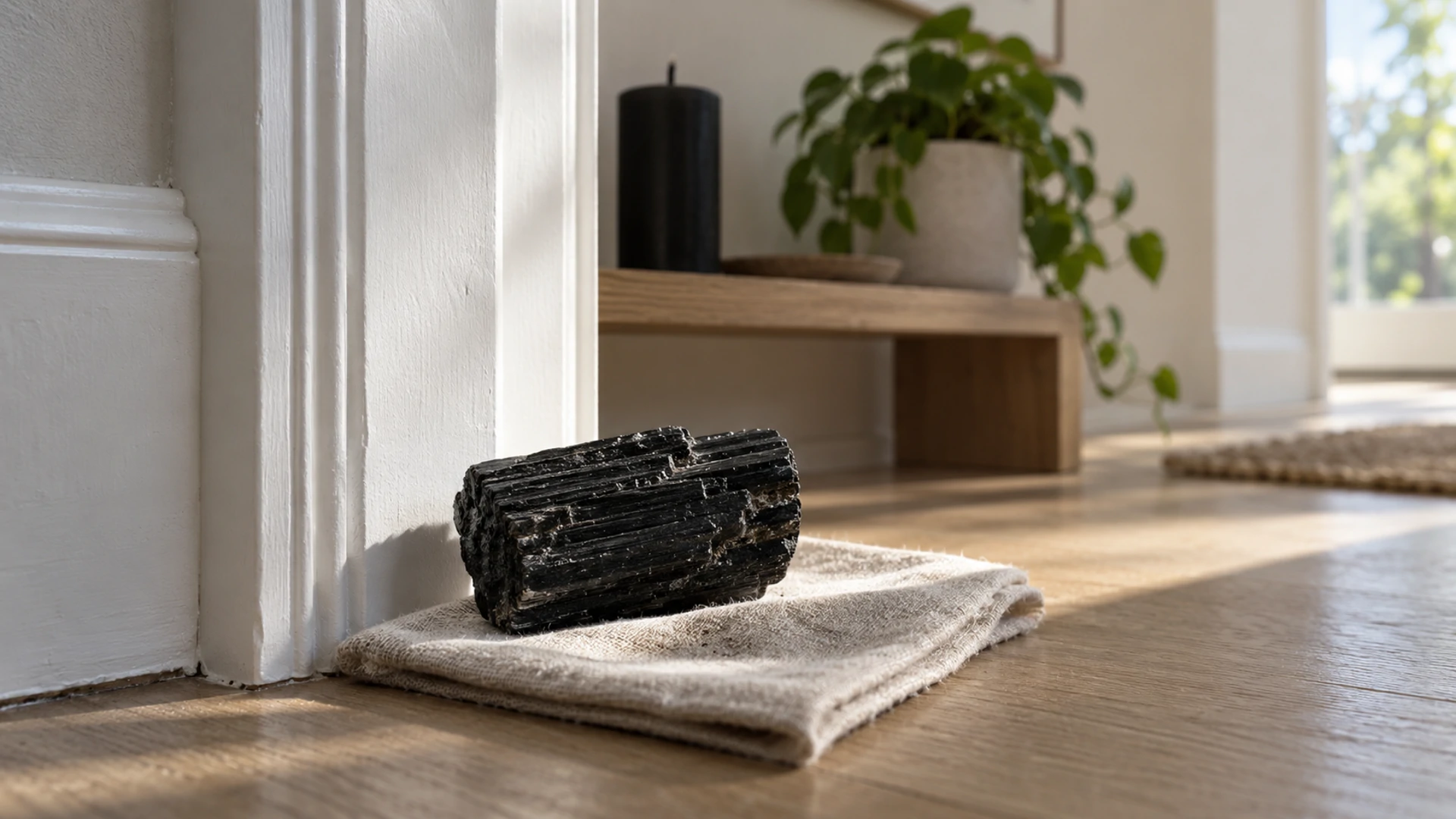
Black tourmaline doesn't start by building a wall around you. It starts by pulling you back into the ground.
Why Black Tourmaline Belongs in Protection — And How It Actually Works
There's a version of protective magic that works by adding something between you and what threatens you — a shield, a ward, a barrier. Black tourmaline doesn't primarily operate that way. Its protection is grounding-first. The logic, consistent across multiple independent traditions, is that a person who is energetically scattered and untethered is much easier to destabilize than one who is fully anchored in their own body and energy field. The stone's job is to establish that anchor before anything else happens. The guard comes second, as a consequence of the ground.
This is why black tourmaline corresponds to the root chakra — the energy center located at the base of the spine, associated with physical safety, embodiment, and belonging to the earth. When the root chakra is clear and active, you feel present, solid, and hard to knock sideways. Black tourmaline works directly with that quality. It doesn't manufacture calm or suppress fear artificially. It re-establishes your connection to the earth element itself, which is one of the most reliable stabilizers available in any system of energy work.
Its mineral character supports this completely. Black tourmaline is technically called schorl — the iron-rich variety of the tourmaline borosilicate family. That iron content is not incidental. Iron is one of the densest and most grounding materials in nature, and it's what gives schorl its deep, opaque black color and its particular physical weight. The Saturn correspondence fits here in a way that isn't just astrological decoration: Saturn governs structure, limits, and the kind of disciplined endurance that holds a boundary over time. Its associated day is Saturday, and it aligns with Capricorn — both signatures of the slow, patient, structural kind of protection rather than the dramatic or reactive kind.
Compared to the other stones in the Protection category, each of which operates on a different mechanism, black tourmaline's specific function is clear. Black obsidian acts as a mirror, reflecting and revealing rather than absorbing. Smoky quartz transmutes energy rather than blocks it. Shungite absorbs and neutralizes. Black tourmaline grounds first, then holds a boundary — which makes it the appropriate first stone for any practitioner building out a protection practice, because grounding is the prerequisite for every other protective work you might add on top of it.
Sturdier Than It Looks: Choosing and Keeping Schorl
Unlike some crystals in the protection family, black tourmaline isn't commonly faked in ways that matter practically. Most of what's sold as black tourmaline is actually black tourmaline. The more relevant purchasing question is structural integrity. Schorl forms in striated, columnar crystals — those parallel ridges running along the length of the piece — and it naturally contains internal fracture lines along those striations. A raw chunk of black tourmaline will often have visible cracks, inclusions, and uneven breaks. This is normal mineralogy, not damage. However, it does mean the stone can chip or splinter if dropped on a hard surface or stored carelessly against harder stones.
When choosing a piece, look for one where the fractures are internal and sealed within the specimen rather than running to the surface as open cracks. A piece with a large open fracture cutting through the surface is more likely to break under ordinary handling. Raw pieces are often preferable for grid and placement work since they haven't been cut or tumbled in ways that might expose those fracture lines. Tumbled pieces tend to be more durable for carrying in a pocket or bag, since the rounding process smooths off edges and surface vulnerabilities. Both work energetically — the choice is practical.
Schorl rates 7 to 7.5 on the Mohs hardness scale, which means it's hard enough to resist everyday scratching and wear. It's safe to rinse briefly under water, and a short soak to remove surface dust or debris won't harm it. That said, tourmaline can have internal fractures that create weak points, so avoid prolonged soaking or submerging pieces with visible open cracks. There's no toxicity concern with this stone — it's safe to handle with bare hands, carry directly against skin, and place anywhere in the home without precaution.
Storage is straightforward. Keep it away from stones significantly harder than itself if you don't want surface scratching on polished pieces, but it's not particularly fragile relative to most collection stones. The one thing worth doing periodically is checking a raw piece's structural lines — if an internal fracture has worked its way to the surface over time through ordinary use, you'll see it as a new crack rather than the original matte striations. At that point, the piece is still usable energetically but may be more vulnerable to breaking if handled roughly.
Three Practices Built from Black Tourmaline's Correspondences
The Saturday Threshold Ward
Use this when you want a structured, long-term protective boundary around a home or personal space — the kind that doesn't need to be renewed every few days because it's built into the physical environment rather than held in active intention.
Ideally performed on a Saturday during a Saturn planetary hour to align with the stone's Saturn rulership and the day's energy of boundaries and enduring structure. Gather one piece of black tourmaline for each primary entry point to your space — the front door, back door, and any windows that feel relevant. At each threshold, place the stone on the inside of the entry point rather than outside, so the ward is sealed from your side. Light a black candle at a central point in the space while you work, and if you're incorporating an herb, place a small amount of dried rue — a traditional Saturn herb with a long history in protective work — beneath or alongside each stone. As you place each piece, state plainly what you are asking the boundary to hold: what is unwelcome, and what remains yours. There's no specific phrase required. Clarity of intention is the actual mechanism.
The Ash-Puller's Charge
Use this when you want to program a piece of black tourmaline with a specific intention — particularly when the stone has been in use for a while and you want to refresh and re-set its charge, or when you're beginning to work with a new piece for the first time.
This practice draws from the stone's documented pyroelectric properties, described in detail in the history section below. Schorl responds to heat by generating a small electrical charge — the Dutch traders who observed this effect in the early 1700s were watching a real physical phenomenon, not folklore. You won't harness that charge in any measurable scientific way, but warming the stone is a legitimate activation method with a historical and physical basis. Hold the piece in your palms and let your body warmth build gradually, or place it near (not in or touching) a candle flame for a minute or two. As it warms, state your intention once, clearly — what you want this stone to anchor, what it's holding, what boundary it's reinforcing. Then carry it or place it in its designated position. The charging practice doesn't need to be long. The warmth and the stated intention together are enough.
The Root Anchor
Use this when your energy feels scattered, anxious, or unmoored — when you're having difficulty staying present in your body or your thoughts are running far ahead of where you actually are.
Sit or lie comfortably with a piece of black tourmaline held in your non-dominant hand or placed at the base of your spine if you're lying down. Take several slow breaths, letting the exhale be longer than the inhale. With each exhale, imagine a cord or root extending from the base of your spine downward — through the floor, through the foundation, into the earth itself. Don't force the visualization. Some people find it arrives easily; others feel it more as a physical sensation of settling or heaviness. Black tourmaline's earth element correspondence supports this practice directly: the stone's grounding quality is its most consistent attribute, and holding or touching it gives the visualization a physical anchor point that many people find significantly easier to sustain. Spend five to ten minutes here. When you're ready to close, take one deliberate breath, feel your physical contact with the floor or the ground, and release the visualization intentionally rather than letting it drift away. Carry the stone with you afterward if you're moving into a demanding or destabilizing situation.
The Ash-Puller: A Brief History of Schorl
The story most people know about black tourmaline starts with the name: schorl traces to Zschorlau, a village in Saxony, Germany, that was already being called "Schorl" before 1400 CE. A tin mine near the village produced cassiterite alongside a black mineral the local miners called by the same name as the place. The village gave the mineral its identity before anyone had worked out what the mineral actually was. That name stuck through centuries of later mineralogical classification and remains the formal name for black iron-bearing tourmaline today.
The less commonly told part of the story is more interesting, and it's where the stone's magical history connects to real physics. In the early 1700s, Dutch traders handling black tourmaline — which was being imported from Sri Lanka at the time — noticed something unusual when the stones were warmed near a fire: they would attract and then repel ash, dust, and light debris from the air. The traders nicknamed the stone "Aschentrekker" — literally, "ash-puller." What they were observing was pyroelectricity: when tourmaline is heated, the shift in temperature generates an electrical charge across the crystal's length, creating two poles that can attract lightweight particles much like a charged rod attracts small scraps of paper.
This property was first recorded in print in 1707, when the German writer Johann Georg Schmidt included the story in a book of dialogues, relaying an account he'd heard from a physician named Daumius about the Dutch traders' 1703 discovery. A decade later, in 1717, the French physician and chemist Louis Lemery gave the effect its first formal scientific description, in a paper published in the journal of the Royal Academy of Sciences. The actual physics behind it — the generation of an electrical dipole from thermal energy acting on tourmaline's non-centrosymmetric crystal structure — wasn't understood for another century and a half. But the observation was accurate from the start, and it's one of the earliest documented cases of a crystal's physical behavior being noted and recorded with enough precision that the mechanism was later verifiable. The stone's protective and grounding reputation in metaphysical traditions runs on a parallel track from this physical history, but both tracks describe the same thing: black tourmaline as a stone that actively responds to its environment rather than sitting passively within it.
Black Tourmaline as a Foundation for Your Practice
The grounding-first mechanism that defines black tourmaline's protection work isn't just an interesting detail about this particular stone. It points to something true about protection in general: effective warding almost always starts with the practitioner's own stability rather than an external barrier. Black tourmaline makes that stability its primary job. Everything else it does — the boundary-holding, the shielding, the root-chakra anchoring — follows from the ground it builds first.
If you want to see how black tourmaline fits alongside the full range of protection stones, and how the Protection category sits within the broader landscape of crystal work, The Crystal Compendium: Seven Paths to Stone Magic lays out all seven categories — Protection, Cleansing, Healing, Empowerment, Abundance, Love, and Intuition — and how to build a practice across them.