White Sage: Powerful Smoke From a Plant Worth Protecting
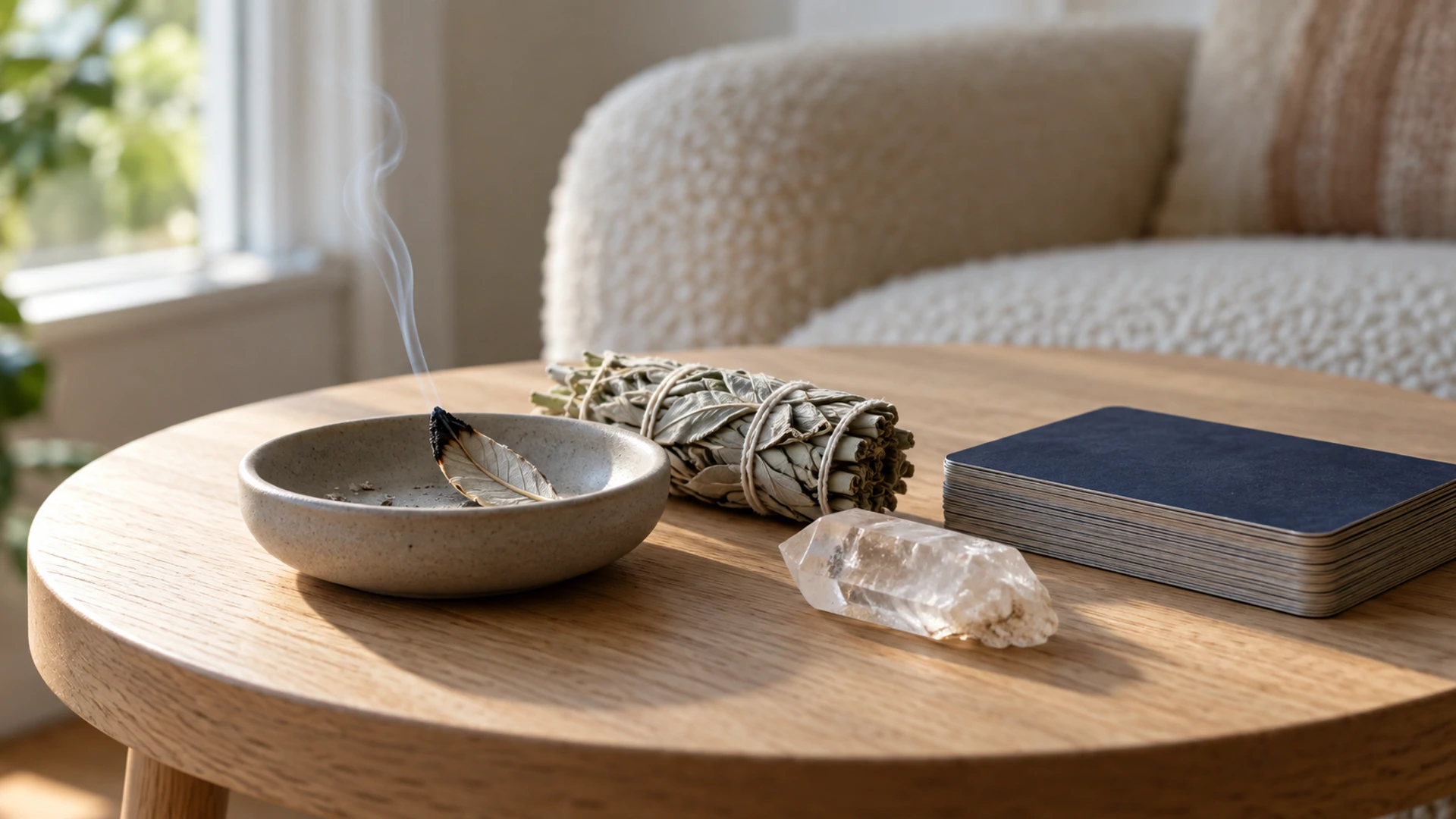
White sage is the forceful clearing smoke — a full reset of a space's atmosphere, drawn from a plant that grows wild only in southern California and northern Baja California, and used ceremonially and medicinally by Indigenous peoples of the region long before it appeared on any shop shelf.
It has earned its reputation. Among all the cleansing herbs, white sage is the one that clears a room completely — not sweetens it, not sanctifies it, but moves whatever has been sitting in the corners out through the door. That specific quality is also what makes it worth understanding thoroughly before you use it, because the plant behind the smoke has a complicated relationship with the demand now placed on it.
A Full Reset, Not a Freshening: White Sage's Place in Cleansing
White sage's cleansing angle is forceful clearing. This is not a subtle freshening of the air, and it is not consecration — it is the smoke you reach for when a space needs to be emptied out and started again. Among the Indigenous peoples of the region where it grows, including Cahuilla, Chumash, Tongva, and Kumeyaay communities, the leaves were burned on hot coals to fumigate a house after serious illness. That practice was theirs, grounded in their relationship with the land and the plant, and it tells you what white sage does best: it clears heavily, thoroughly, and completely.
Compare it to its siblings in the cleansing category and the differences become sharp. Palo santo does clearing that welcomes — it sweeps the atmosphere and leaves something warm and inviting in its place. Frankincense consecrates by lifting, raising a space toward the sacred before ceremonial work rather than simply emptying it. White sage does neither of those things. It clears. When a space has held conflict, grief, illness, or a long stretch of stagnation and you want all of it gone — not transformed, not elevated, gone — white sage is the right tool.
On correspondences: white sage has no historical planetary ruler. It was native only to the far west of North America and was completely unknown to Culpeper and to European herbal tradition, which means none of the classical planetary assignments apply to it. Modern Western practice usually borrows garden sage's Jupiter and air attribution and applies it here. That is a borrowed convention, not a tradition, and it is worth naming it honestly. Work with it if it fits your practice, but do not take it as received wisdom.
Readers frequently confuse the three sages, and it matters that you do not. White sage (Salvia apiana) is this plant — the strong clearing smoke, from California. Garden sage (Salvia officinalis) is the kitchen herb: the healing, wisdom, and longevity herb of European tradition, Jupiter-ruled, completely different in use and feel. Clary sage (Salvia sclarea) is the clear-sight and vivid-dream herb, Moon-ruled, worked with for dreamwork and scrying rather than clearing. None of the three substitutes for another. The name they share is taxonomic, not magical.
From California Hillsides to Every Shop Shelf
White sage grows wild only in coastal sage scrub habitat from southern California into northern Baja California. It is not a wide-ranging plant. It belongs to specific terrain — dry, rocky, sun-baked slopes — and to the Indigenous peoples who have lived in relationship with that terrain for generations. Among them, the Cahuilla, Chumash, Tongva, and Kumeyaay communities have used white sage both ceremonially and medicinally. Their use is the origin of its reputation. What happened next is a different story.
White sage's spread as a general-purpose cleansing smoke is a late-20th-century New Age development. It is worth knowing that Native American ceremonial practice in the United States was legally suppressed until the American Indian Religious Freedom Act of 1978. That context is not incidental. The commercialization of white sage picked up speed during the same decades that Indigenous communities were only beginning to be able to practice their traditions openly, which is a significant part of why selling it at scale feels, to many Indigenous people, like the wrong direction of travel.
The demand that followed has put real pressure on the plant. Wild stands of white sage are heavily poached for commercial bundles. No commercial harvest permit exists for white sage on US public land, and harvesting it without authorization in California is illegal. In 2018, authorities near Rancho Cucamonga confiscated around 400 pounds of illegally harvested white sage in a single operation. The plant sits on United Plant Savers' Species At-Risk list. It is not federally listed as endangered, and it is not endangered in the technical sense, but it is under genuine pressure from illegal harvest at a scale wild stands cannot sustain.
Many Indigenous voices — and views are not uniform, and no nation speaks with a single voice — ask that non-Native practitioners either use alternatives or, at minimum, never purchase wild-harvested white sage. The choice is yours, and you are in a better position to make a considered choice knowing them than not.
Buying It Honestly, Growing It Yourself, Burning It Safely
The most practical thing you can do before purchasing white sage is ask where it was grown. That is the whole test. A seller who can name a farm, a grower, a specific cultivated source — that is the seller to buy from. A seller who cannot answer that question, or who answers in vague language about wild-harvested or sustainably harvested without specifics, is a reason to walk away. Cultivated white sage exists. It is available. Finding it takes a little more effort than grabbing the first bundle you see, and that is all. One more thing worth knowing: many bundles sold as sage, especially inexpensive ones, actually contain sagebrush (Artemisia tridentata), a completely different genus with different properties. Check the label for the botanical name before you buy.
Growing white sage yourself is genuinely the cleanest option available, and it is more achievable than most people assume. The seeds need light to germinate — do not bury them, press them lightly onto the surface — and they want warmth, roughly 70 to 85°F, and consistently moist but not waterlogged soil. Germination can take one to three weeks. Once established, the plant wants full sun, fast-draining and low-nutrient soil, and very little water. This is the opposite of how most garden plants are kept, and overwatering is the most common way white sage dies in cultivation. It does not tolerate hard frost, so in colder climates it belongs in a container that can come indoors. When you harvest, take no more than a third of the plant at one time and let it recover before harvesting again.
Safety in burning is straightforward but worth stating plainly. White sage smoke is a strong respiratory irritant — more so than most other cleansing smokes. Burn it with a window open, and keep it away from birds, small pets, and anyone with asthma or respiratory sensitivities. Use a fireproof dish, and never leave it smoldering unattended. One further point: white sage is a smoke herb. It is not a tea ingredient, not used internally, and not a candidate for any internal preparation. Smoke only.
Three Ways to Work White Sage Without Wasting a Leaf
The Back-to-the-Door Reset
Use this when a room has held something heavy — conflict, prolonged illness, a long stretch of emotional stagnation — and you want a complete atmospheric reset before moving forward.
Place a few loose leaves on a lit piece of charcoal in a fireproof dish. Open a window. Start at the far back of the room from the door and carry the smoke slowly toward the exit, moving in deliberate passes — along the walls, into the corners, across the ceiling line if you can reach it. The idea is to give what you are clearing a way out: you are not just agitating the energy, you are directing it somewhere. As you work, keep your attention on the room as you want it to feel when you are finished — clear, still, genuinely empty rather than suppressed. If the working calls for it, lighting a white candle before you start marks the intention and keeps something clean burning after the smoke clears.
The One-Leaf Blessing for New Tools
Use this when a newly acquired object needs clearing before it enters your practice — a tarot deck, a second-hand ritual piece, or a crystal like clear quartz that may carry traces of its previous handling.
Take a single dried leaf. Light one end, let it catch, then blow it out so it smolders rather than burns. Pass the object slowly through the rising smoke — once, twice, however many passes feel complete — then press the leaf gently against the dish to extinguish it. That is the whole working. One leaf is enough. The smoke from a single leaf is sufficient for clearing an object, and the practice of using exactly one trains you to stop thinking of white sage as something expendable.
The Plant on the Windowsill
Use this when you want a cleansing practice that is entirely your own — sourced by you, grown by you, used only when the plant has given what it can spare.
Grow white sage in a container in a south-facing window or outdoors in full sun. Tend it: water it less than you think it needs, let it dry fully between waterings, and watch it establish. When a clearing is needed, harvest only what that single clearing requires — a few leaves at most — and let the plant recover before you take from it again. Let it flower when it wants to. The species name, apiana, refers to bees, and the flowers are forage. A plant that feeds bees is doing something useful in the world beyond your practice. The smoke you burn from that plant comes from a relationship you kept, not from an anonymous hillside. That distinction is, in the end, what responsible use actually means.
The Strongest Smoke on the Shelf
White sage's specific role in the cleansing category is total atmospheric clearing — the full reset, the strongest smoke, the one you reach for when nothing gentler will do. That role does not change regardless of where your sage came from, but knowing it helps you reach for white sage when it is actually the right tool and choose something else when it is not. Rosemary clears grief and blesses beginnings with a secondary protective quality. Cedar preserves and protects what it holds. Juniper wards fiercely. Garden sage, grown on a kitchen windowsill, burns cleanly and carries its own deep lineage of wisdom and healing. Any of these can carry a cleansing working without drawing on a plant that wild habitats cannot currently afford to lose.
White sage sits alongside eleven other cleansing herbs and six other magical categories in the full herbarium. If you want to see how it fits into the broader shape of plant magic — where it overlaps with protection, where cleansing ends and consecration begins, and which herbs do the work white sage cannot — the seven paths through plant magic is the place to continue.