Rue: The Herb of Grace That Turns Back the Evil Eye
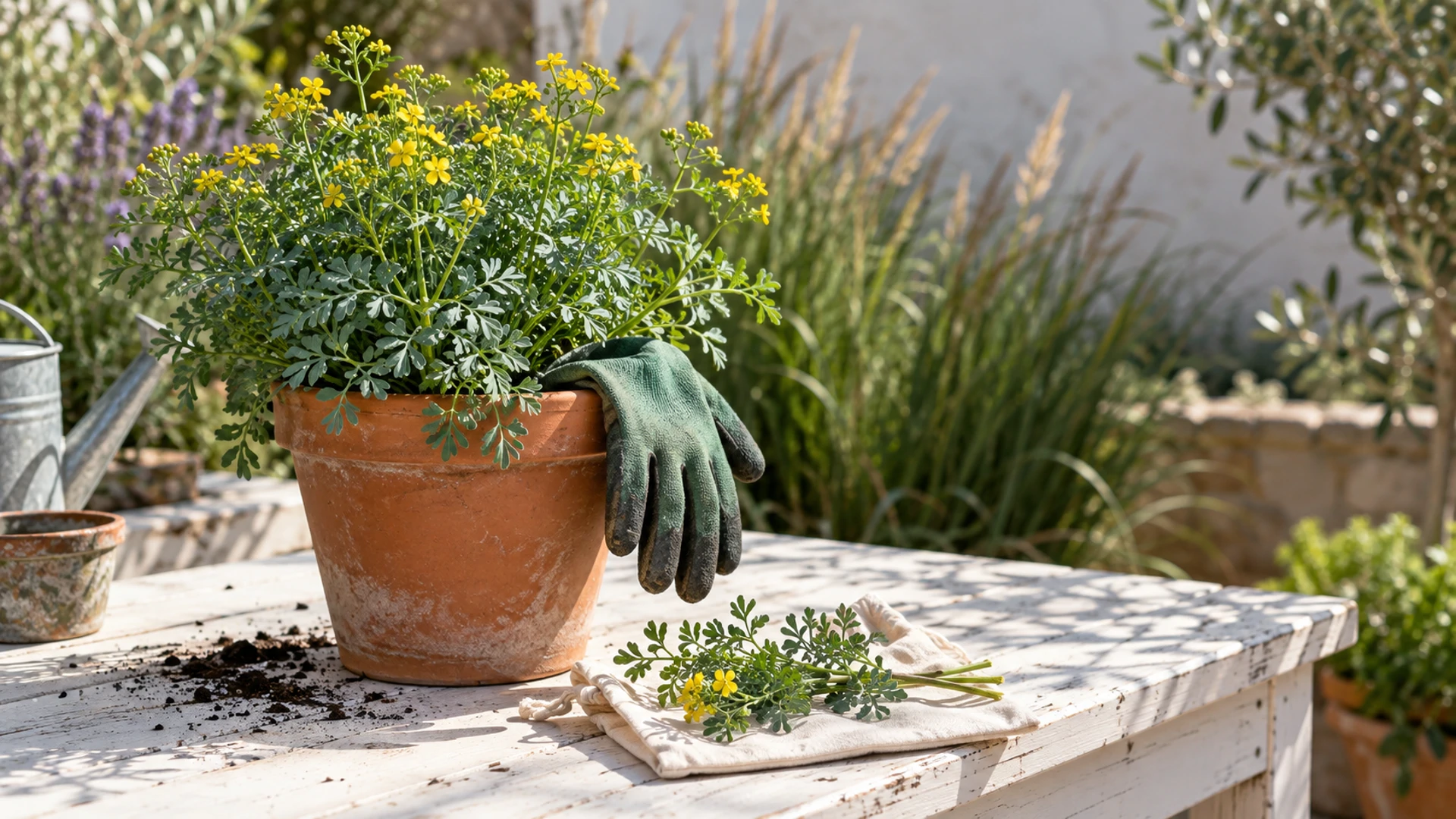
Rue is a pungent Mediterranean herb kept by the door and carried against the evil eye, one of the oldest wards against envy in Italian and Latin American tradition. Its deflecting power is specific: it turns back what envy sends.
Turning Back the Gaze: Rue's Place in Protection
Most protective herbs work in broad strokes — they ward, they block, they hold a boundary. Rue is more precise than that. Its magical angle is evil-eye deflection, the targeted turning-back of envy and its effects. When someone's admiration crosses into covetousness, or when ill will gathers behind a gaze, rue is the herb that reflects it. This is not a wall. It is a mirror. The energy that arrives is returned to where it came from, which puts rue squarely into its secondary category of Banishing and Hex-Breaking as well: the same deflection that wards also sends things back.
Compare that to the two other classic protectives. Garlic is an active repeller, the apotropaic kitchen protector that drives off what approaches the threshold rather than only holding it. It meets the threat head-on and pushes. Rue deflects; garlic drives. Then there is rowan, the red-thread ward of Scotland and northern England, where twigs bound with red thread and hung at doors and byres guard house and livestock against witchcraft. Rowan's strength is the threshold cross, made and hung. Rue's is the sprig kept alive by the door, or sealed close to the body, always oriented toward the specific harm of another person's envy. These are three different answers to three different problems, and knowing which problem you have matters.
Rue's botanical name is Ruta graveolens, and it belongs to the rue family, Rutaceae, which is also the family of the citrus herbs — lemon, sweet orange, bergamot. Its planetary attribution depends on whose tradition you follow. Culpeper assigned it to the Sun; Cunningham gave it Mars and fire. That means its day is Sunday by Culpeper's reckoning and Tuesday by Cunningham's. Both are defensible. The Sun gives it its light-reflecting, envy-turning quality; Mars gives it the edge and heat of something that actively sends back. You can hold both, or choose the one that fits the working.
The Cimaruta and the Herb of Grace
The cimaruta is a silver Neapolitan amulet, and its name means exactly what it looks like: a sprig of rue. Modeled on a rue branch, cast in silver, worn or hung to guard against the evil eye, the cimaruta is among the most recognizable protective charms of southern Italian folk tradition. Every branching point of the charm holds a different protective symbol — a crescent, a key, a hand — but the whole thing is organized around the shape of rue itself. That is not incidental. The plant was understood to be the foundation of the protection; the silver only fixed it in permanent form. The cimaruta is rue made immortal.
Rue's other inherited name, the herb of grace, comes from its Christian-era history in England. Ophelia hands it out in Shakespeare's Hamlet — "there's rue for you, and here's some for me" — and that line reflects a genuine cultural association between rue and repentance, mercy, and spiritual grace. In Milton's Paradise Lost, the archangel Michael uses euphrasy and rue to purge Adam's sight before showing him visions of the future. The euphrasy there is eyebright, whose clear-sight association runs through its entire history, and rue is its companion in that passage: together they clear the eyes for spiritual seeing. Across Latin America, ruda — the same plant — is kept in a pot or glass vase by the front door. It is tended, watered, and renewed. The practice is widespread and old, passed through families rather than written down, and it is one of the most continuous living uses of a protective herb anywhere in the Western world.
Gloves On: Handling Rue Safely
The safety fact most people miss about rue is this: fresh rue sap on skin, followed by sunlight, causes severe blistering burns. This is phytophotodermatitis, the same reaction that lemon and bergamot oil can cause, and with rue it can be dramatic. The reaction is not immediate — the skin may look fine for hours, then blister badly once the sun hits it. Rue oil carries the same risk. Fresh rue is handled with gloves, every time, and hands are washed thoroughly before going outside. This is not cautious over-hedging; it is basic safety for a plant that has injured people who did not know about it. Internally, rue is toxic and has a long documented history as an abortifacient. It is not for internal use under any circumstances, and it is absolutely contraindicated in pregnancy.
With those boundaries clear, working with rue is straightforward. Growing it in a pot by the front door is both practical and traditional — it mirrors exactly how it is kept in Latin American practice, and a living plant is easier to manage than wild-harvested sprigs. Tend it with gloves, pinch spent growth back wearing them, and replace the whole plant when it gets too woody. A sprig carried on the body should go into a sealed pouch so it never touches skin directly; the pouch also protects the plant material from damage. Dried rue goes into sachets for long-term work; gloves are still the safer habit, and hands are washed after. Dried, it can be handled with normal care, though washing hands after is still sensible.
Three Rue Workings Against Envy
Ruda by the Door
This practice is for anyone who wants ongoing, low-maintenance protection against the ordinary accumulated envy of daily life — the looks, the comments, the small ill will that neighbors and acquaintances send without necessarily meaning to.
Plant rue in a terracotta pot and place it at your front door, or keep a fresh sprig in a small vase of water by the entrance. Wear gloves every time you tend it, trim it, or change the water. When you set it in place, hold the pot or vase for a moment and state clearly — out loud, to yourself — that this plant stands at your threshold and that what is sent in envy does not cross it. The sprig in the vase will wilt within a few days. When it does, dispose of it away from your home, replace it with a fresh one, and repeat the brief statement. A potted plant at the door lasts longer but should be inspected regularly; a plant that is dying or diseased is replaced, not nursed at the threshold.
The Sealed Sprig
This is a carry for days when visibility is high and envy is a real possibility — starting a new job, sharing a public success, attending an event where you know someone who wishes you less well than they let on.
Cut a small sprig of rue from a living plant, using gloves. Let it dry slightly overnight — not fully dried, just no longer sap-wet on the cut end. Place it in a small cloth pouch, seal the pouch closed, and carry it in a pocket or bag. The pouch keeps the plant from touching your skin and keeps the protection close. This is not a replica of the cimaruta, which is a specific object with its own form and tradition. It is a carried sprig in the spirit of that same protective logic: the shape and scent of rue, kept near the body, oriented toward the specific threat of envy. When the day is done, you can return the pouch to a drawer or discard the sprig and prepare a fresh one next time. The protection is in the intention and the plant, not in accumulating material over time.
A Dried Rue Sachet for Sending Envy Back
This is rue's Banishing and Hex-Breaking secondary in direct practice: for when deflection is not enough and you need to actively return ill will to whoever sent it.
Make this sachet on a Tuesday or during a Mars hour, to align with Cunningham's martial attribution and the energy of decisive return. Place a tablespoon of dried rue into a small black or red cloth square. As you tie it closed, state clearly that this sachet holds the ill will sent against you and that it is now being returned, unaltered, to its source. Set it somewhere near your front door — a shelf, a drawer, a windowsill — where it faces outward. Replace the contents every new moon or whenever the working feels stale.
A Bitter Leaf Between You and Envy
Rue occupies a specific position in the protection category because the harm it addresses is specific. Envy is not a generalized threat. It has a source, a direction, a face, and it tends to arrive precisely when things are going well. Most protective herbs ward broadly; rue is the one you reach for when the problem is someone else's gaze on your good fortune. That precision is the whole point of keeping it by the door rather than buried in the walls.
If you want to see rue alongside the thirteen other protection herbs and understand how each of the seven magical categories relates to the others, the full overview is in the Witch's Herbarium guide. Rue earns its place there not through drama but through the long, continuous fact of people keeping a bitter-leaved plant by the door because they know what it does.