Sigil Magic: Condensing Intent Into a Symbol That Works
What Is Sigil Magic?
A sigil is a symbol you build deliberately to carry one intention. That might sound simple, but the distinction between a sigil and any other magical symbol matters. A pentagram, a planetary glyph, a rune — these carry inherited meaning accumulated over centuries of use. A sigil is different. You construct it yourself, from your own intent, for a specific working. The construction is not a preliminary step before the real magic begins. It is the magic, or at least the first essential act of it.
The logic behind sigil magic comes down to compression. You start with a fully formed desire — something specific, something you want enough to act on. Then you reduce it. Through whichever construction technique you use, that desire gets stripped of its original language and collapsed into an abstract shape. What remains is a glyph your deeper will can act on without your analytical mind constantly second-guessing the wish. The words "I want a new job" are easy to argue with. A geometric shape pressed into wax or drawn on paper gives your doubt nothing to grab onto.
This is why sigilcraft works differently from other forms of magical symbol use. You are not borrowing a symbol's existing charge. You are encoding your will into a new form, then releasing that encoded intent to operate beneath conscious attention. The mind stops rehearsing the desire and starts moving toward it. That shift — from conscious wanting to unconscious working — is what practitioners across every tradition of sigilcraft are actually after, even when they describe it in very different terms.
Sigil magic is not one technique. It is a family of distinct approaches, each with its own logic for how a symbol gets built and how it gets charged. The articles in this category cover the major ones: the letter-elimination method developed by Austin Osman Spare, planetary kamea sigils drawn from Heinrich Cornelius Agrippa's magical squares, the Rose Cross letter-to-symbol construction used in ceremonial lodge work, and the traditional Solomonic seals drawn whole from classical grimoires. Each technique suits a different kind of intent and a different kind of practitioner, and understanding the differences is what lets you choose well.
How Sigil Magic Is Used in Modern Practice
The letter-elimination method is where most people start with sigil magic, and it is the most direct expression of sigil magic for beginners. The technique comes from Austin Osman Spare, the early twentieth-century English artist and occultist who laid it out in his 1913 work The Book of Pleasure. You write your intent as a clear, positive statement — something like "I find steady work that sustains me" — then eliminate repeated letters until each letter appears only once. The remaining letters get overlaid, rotated, merged, and abstracted into a single glyph. The resulting shape carries no obvious trace of the original words, which is exactly the point. Once the glyph is drawn, you charge it in what Spare called gnosis: a state of mental blankness reached at the peak of some absorbing experience, where the ordinary internal monologue goes quiet. In that gap, the sigil is fixed into will and released. Spare's method suits personal, immediate intent — something that belongs to your own life and desires — because the construction comes entirely from you. Nothing is borrowed. The glyph is yours, and so is the charge.
Magic square sigils, often called planetary kamea sigils, take a different route. A kamea (the Hebrew term for a magical square) is a grid of numbers arranged so that every row, column, and diagonal adds up to the same sum. Each classical planet has its own kamea: Saturn's is a three-by-three grid, Jupiter's a four-by-four, Mars a five-by-five, and so on up through the Sun, Venus, Mercury, and the Moon. Agrippa documented these grids in Three Books of Occult Philosophy in 1531, and the technique for constructing sigils from them is straightforward. You convert the letters of a name or intent into numbers using a letter-to-number correspondence, then plot those numbers as a connected path across the appropriate planet's grid. The line you draw is the sigil. What makes this technique distinct is that the resulting glyph arrives already embedded in a specific planetary current. A sigil traced across Jupiter's kamea carries Jovian resonance — expansion, abundance, authority — by virtue of its construction, not just your intention. This makes planetary kamea sigils particularly well suited to workings where you want to draw on a planet's specific quality rather than simply projecting personal will. You are aligning your intent with a larger current and asking it to carry your working forward.
The Rose Cross method is the most ceremonially structured of the common sigilcraft techniques. The Rose Cross lamen — a rose set at the center of a cross, with the petals arranged in three concentric rings corresponding to Hebrew letters — was developed and standardized by the Hermetic Order of the Golden Dawn in the late nineteenth century. To construct a sigil using this method, you transliterate your intent or the name you are working with into Hebrew letters, then trace a connected path across those letters on the lamen. The resulting glyph is a unified symbol drawn from the sacred alphabet at the heart of the Qabalistic tradition. Because the lamen itself is a fixed, consecrated instrument in Golden Dawn working, sigils produced from it arrive with a different quality of weight than Spare's personal glyphs. The Rose Cross method is less improvisational and more deliberate. It suits longer-term ceremonial workings, evocation, and any intent where you want the construction to feel grounded in an established magical grammar rather than invented fresh.
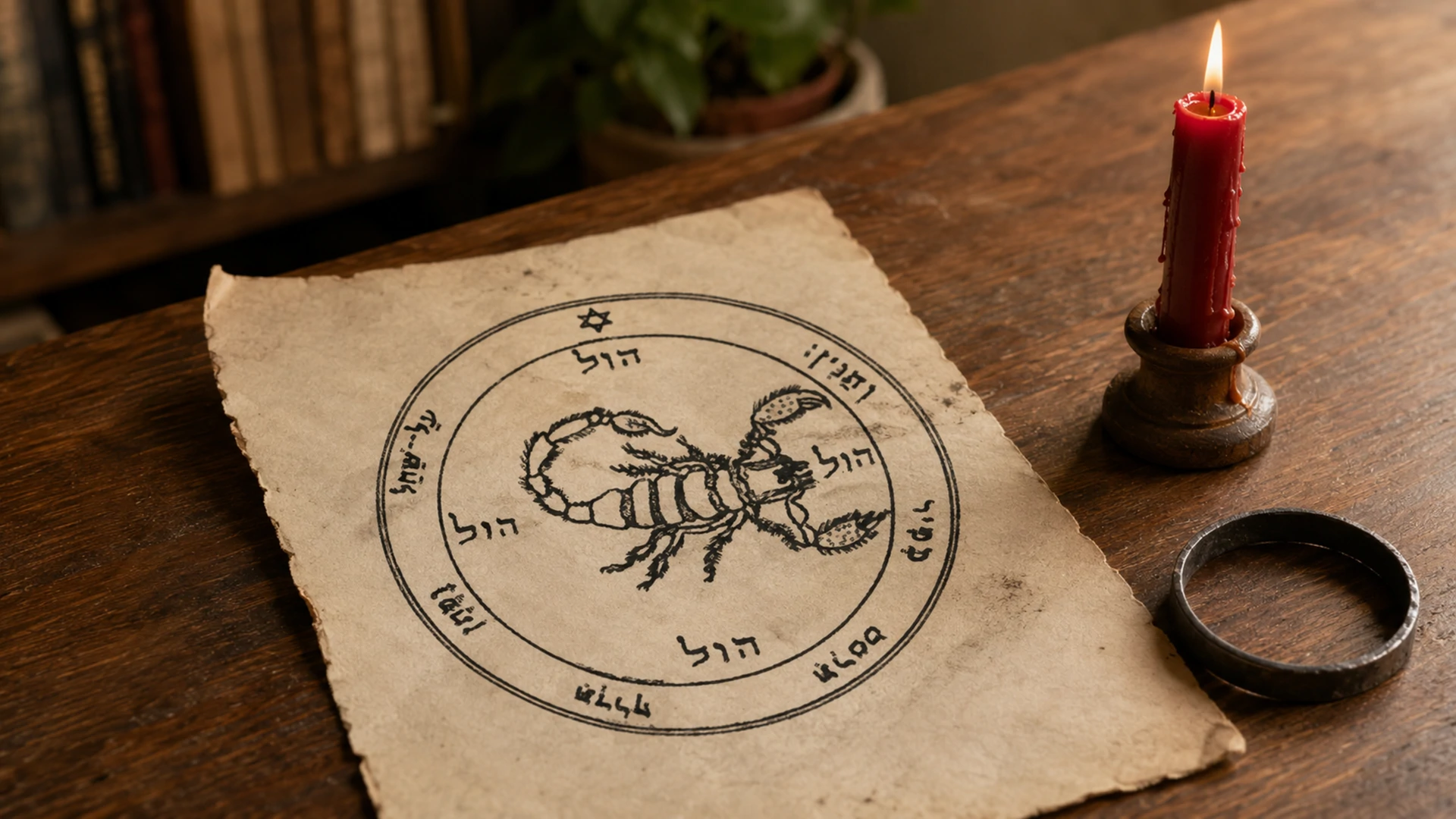
Traditional planetary seals represent a fourth path, and it is the oldest. Rather than building a sigil letter by letter, you draw a fixed seal exactly as it appears in a grimoire — the Key of Solomon, the Lemegeton, or another established text. These seals were recorded rather than invented; they are understood in their traditions as discovered images with inherent efficacy, not personal constructions. A practitioner might choose a fixed seal over a constructed one for several reasons. The seal carries the accumulated weight of historical use. It arrives already charged within its tradition. And for certain workings — calling on a specific planetary intelligence or invoking a force whose name and seal are recorded together — the fixed image belongs to the working in a way no personal glyph could. You would not construct a new symbol for a working the grimoire already specifies. You draw what has been drawn before, and trust the current it runs in.
Three Lineages That Shaped Sigilcraft
Modern sigil magic did not appear from nowhere. It is the latest development in a lineage that runs from Renaissance-era grimoires through Victorian ceremonial lodges into the chaos magic current of the late twentieth century. These three traditions are not parallel or unrelated — each one responded to and built upon what came before it.
The oldest root is the Solomonic grimoire tradition. The Key of Solomon — whose manuscripts date to the fourteenth and fifteenth centuries, though it claims far older origins — contains 44 pentacles, each a constructed magical image meant to call on specific planetary forces or spirits. These are the earliest formalized magic sigils in the Western tradition that most practitioners encounter today. Agrippa's Three Books of Occult Philosophy, published in 1531, extended the tradition by documenting the kamea method: how to derive a sigil for any name by plotting its numerological value across a planetary square. Agrippa gave practitioners a construction technique, not just a catalogue of fixed seals. This shift — from recorded image to derivable glyph — opened sigilcraft to something more flexible and personal than copying a pentacle from a book. The Solomonic tradition established that intent could be compressed into a symbol, and that symbol into a working.
The Golden Dawn, founded in London in 1888, inherited the Solomonic and Agrippan framework and systematized it within a rigidly structured ceremonial practice. Their contribution to sigilcraft was the Rose Cross method: a fixed lamen derived from Qabalistic letter correspondences, used to produce sigils for any name or intent in a repeatable, teachable way. Where Agrippa's kamea method required knowledge of numerology and planetary correspondence, the Rose Cross method offered a single instrument that any initiate could learn to use. The Golden Dawn turned sigilcraft into a lodge skill — something transmitted through grade work, governed by clear rules, and embedded in a broader magical grammar that included Tarot, astrology, and ritual invocation. Their systematization made the older Qabalistic approach consistent enough to teach, and their records shaped the ceremonial tradition that still runs today.
Austin Osman Spare stepped outside both traditions. His Book of Pleasure, published in 1913, stripped sigilcraft of its planetary hierarchies, its Qabalistic grammar, and its lodge structure. For Spare, the power behind a sigil was not a planetary current or an angelic name — it was the practitioner's own desire, compressed and released into the unconscious. His letter-elimination method required nothing but paper, ink, and the ability to reach gnosis. There was no lamen to learn, no kamea to map, no grimoire to consult. Peter Carroll and Ray Sherwin carried this approach forward in the late 1970s and early 1980s when they co-founded the Illuminates of Thanateros and Carroll published Liber Null in 1978, establishing what became known as chaos magic. Chaos magic treated Spare's method as the foundation of a wider practice: any technique drawn from any tradition was valid if it worked, and the practitioner's will and psychological clarity were the only real currency. Chaos magic sigils — the quick, personal, letter-elimination glyphs charged through gnosis — became one of the most widely practiced forms of magic in the late twentieth century, and they remain the entry point most people encounter first today. That lineage runs directly from the Key of Solomon's planetary seals through the Golden Dawn's systematized lamen to Spare's stripped-down personal glyph. One continuous current, each stage a response to what came before.
Building Your Sigil Magic Practice
The clearest starting point is Spare's letter-elimination method on a single, low-stakes intent. Not something enormous — not a career change or a healed relationship. Something small and specific: a piece of information you need to find, a social situation you want to go smoothly, an opportunity you would like to come through. The reason to start small is not caution. It is calibration. A small working lets you move through the full sigilcraft sequence — forming the intent, eliminating letters, building the glyph, reaching a charging state, releasing the sigil — without the emotional weight of a high-stakes desire making the release stage difficult. You learn what the practice feels like before you put anything precious on the line.
Charging the sigil is where most beginners stall, usually because they expect it to require an elaborate ritual. It does not. Gnosis — Spare's term for the altered mental state in which a sigil gets fixed into will — is available through anything that fully absorbs your attention and briefly empties your ordinary inner commentary. Focused breath held at the peak of an inhale. A short burst of physical effort that takes you to the edge of your capacity. A moment of total absorption in music, flame, or cold water. The state is real, and it does not require a ceremony to reach. What matters is that you plant the sigil in your awareness at the precise moment the chatter stops, then let it go before thought rushes back in.
After charging comes the part that is genuinely harder than the construction: setting the sigil aside and not checking on it. The temptation to revisit the glyph, to wonder whether it worked, to keep the intention mentally active is exactly the opposite of what sigilcraft asks of you. The compression you did at the start — turning a sentence into an abstract shape — was designed to move the working out of your conscious attention. Continuing to think about it pulls it back up to the surface where your doubt can reach it. Draw the sigil, charge it, and let it become genuinely unfamiliar. Tuck it away, burn it, bury it. The intent has been given its shape. Now you let it work.
Once you have run a few simple workings with the letter-elimination method and developed a feel for the charging state and the release, the planetary kamea techniques open naturally. A Jupiter kamea sigil for an abundance working, a Mercury kamea for communication or negotiation — these add a layer of resonance to the personal will you are already learning to direct. The articles in this category walk through each approach in detail, with specific guidance on construction, charging, and what kinds of intent each technique suits best. Start where you are. The practice builds from here.