Amethyst: Clarity Without the Noise
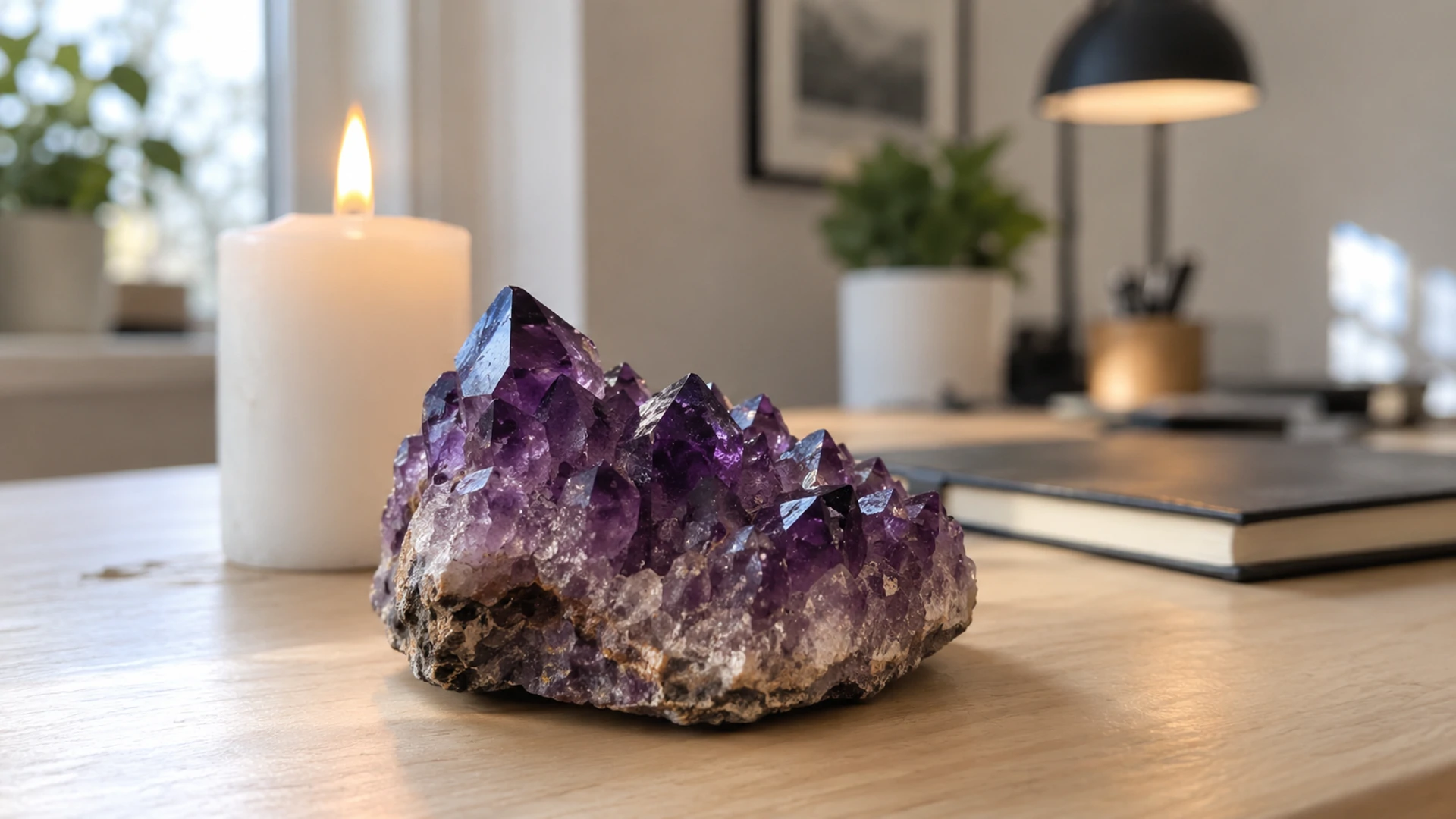
Amethyst works not by opening you up, but by quieting everything that gets in the way — its mechanism is stillness, and stillness is what lets clear perception through.
Clarity Without the Noise: Why Amethyst Belongs in Intuition & Psychic Development
Amethyst is a purple variety of quartz, colored by iron impurities and natural irradiation within the crystal lattice. That much is geology. What makes it distinct in intuitive practice is something harder to pin down but easy to recognize once you've worked with it: it doesn't activate or awaken anything. It settles. Its mechanism is quieting mental noise into clear, sober perception — psychic reception through calm rather than active awakening. The insight doesn't arrive louder. The static just drops away, and suddenly you can hear what was already there.
This distinguishes amethyst sharply from the other major stones in the Intuition & Psychic Development category. Labradorite works by awakening dormant psychic ability while shielding the aura during that opening — the protector-and-awakener stone, distinct from stones that only calm or only activate. Lapis Lazuli turns ancient wisdom into honest speech, pairing third eye insight with the throat chakra so that what you perceive becomes what you say. Amethyst does neither of those things. It doesn't push the door open and it doesn't translate what's behind it. It simply clears the room so you can be present when the door opens on its own.
The correspondences map directly onto this function. Amethyst works primarily with the third eye and crown chakras — the two centers associated with inner vision, higher awareness, and connection to something beyond ordinary waking cognition. Jupiter and Neptune both appear as planetary associations across sources, which fits: Jupiter is the planet of expanded understanding and Neptune governs mystical perception and the dissolution of ordinary mental boundaries. The element is usually water or air, both of which carry that sense of receptivity and movement rather than force. The signs most commonly linked to amethyst are Pisces, Aquarius, and Virgo — signs that variously emphasize intuitive sensitivity, visionary thinking, and discerning clarity.
It's worth being honest about where the traditions diverge, because they do. Some traditions foreground amethyst's relationship to addiction release and internal purification — the idea that it helps clear compulsive patterns and supports greater self-honesty. Others emphasize psychic protection and shielding from outside negativity, using amethyst as a kind of energetic filter rather than a window. Both readings are real. They're not contradictory — they both trace back to that same core property of sobriety and clarity — but the emphasis genuinely shifts depending on which lineage or practitioner you're reading. If you come to amethyst from an energy-protection angle, you'll find support for that use. If you come to it from a self-inquiry angle, you'll find that too. The stone is wide enough to hold both.
Fading in the Light: Choosing Amethyst
The most important care fact about amethyst is one that's easy to overlook until it's too late: amethyst is photosensitive, and prolonged exposure to direct sunlight will permanently fade its color. Not temporarily mute it — fade it, irreversibly, to a washed-out pale lilac or near-colorless quartz. If you're displaying amethyst in your space, keep it in indirect light or shadow. A windowsill that gets full afternoon sun is exactly the wrong place for it, regardless of how beautiful it looks there for the first few weeks.
On choosing a specimen: natural amethyst ranges widely, from pale lavender so soft it almost looks like rose quartz to a deep, saturated violet-purple that borders on blue. None of these is more "powerful" than another — color depth reflects mineral chemistry and formation conditions, not metaphysical potency. What matters is that the stone is actually amethyst. There's a useful piece of background knowledge here. The deep amber-orange citrine common on the market — sold widely as its own category of stone — is, in the vast majority of cases, heat-treated amethyst. The same quartz variety, exposed to enough heat, shifts from purple to orange. This says something interesting about how closely related these two stones actually are beneath their very different appearances. When you pick up a natural amethyst, you're working with a stone that sits right at the edge of that transformation.
Amethyst is a Mohs 7, which makes it durable enough for daily wear and most ritual uses without much concern. It's water-safe for brief contact — rinsing it, holding it under running water, or including it in a short cleansing ritual is fine. What you want to avoid is salt water or prolonged soaking, especially if the piece is set in jewelry. Salt water can degrade the stone's surface finish over time, and prolonged immersion can affect metal settings in ways that are hard to reverse. Keep it in indirect light, give it a gentle rinse when you feel it needs refreshing, and it will hold up for a long time.
Three Practices for a Settled Mind
The Quiet Room
Use this before any kind of intuitive work where you need to actually receive something — not generate, not push, just receive.
Hold the amethyst in your non-dominant hand and sit somewhere you won't be interrupted for at least ten minutes. Close your eyes and spend the first few minutes doing nothing except letting the mental chatter run — don't try to stop it, just let it go through. The stone's job is to settle that noise gradually, not instantly, so give it time. Once the internal weather has slowed down on its own, place the stone on your third eye (the space between and just above your brows) and lie still. Don't reach for anything. Don't try to receive anything deliberately. Let the stillness itself be the practice. Whatever comes through in that quiet space, let it. Whatever doesn't come through, that's fine too. If you want to pair this with planetary timing, the Moon hour is particularly well-suited to this kind of receptive work.
The Sober Eye
Use this when you notice a recurring thought pattern that keeps circling back without resolution — the kind that feels like it's looking for clarity but keeps producing more noise instead.
Take your amethyst and hold it at eye level for a moment, looking at it rather than through it. Then set it down on a surface in front of you. The act of placing it down is deliberate — you're setting the intention to interrupt the loop. Write the thought pattern out in a notebook exactly as it sounds in your head, without editing. Then put the pen down, pick up the stone, and read back what you wrote as if it were someone else's handwriting. The amethyst in hand isn't a fix; it's a prompt to shift perspective from inside the loop to outside it. Notice what changes in how the thought reads when you're holding the stone. You can pair this with a purple candle burning quietly nearby if you want to anchor the space, but the core of the practice is the shift in position — from inside the noise to observing it.
The Bishop's Watch
Use this when you're holding a position of responsibility that others are depending on — a decision, a role, a season of life where your judgment needs to stay clear and unswayed.
Place the amethyst where you'll see it regularly throughout the day — on your desk, on a shelf at eye level, or beside your workspace. It doesn't need to be touched constantly. Its presence is a standing reminder that the medieval clergy who wore it in their rings understood something practical: that clarity of mind is a discipline, not just a gift, and that keeping something in your field of awareness can help hold the standard. If you want to set this up more formally, light a white candle at the start of a significant week or project, hold the amethyst over the flame (safely, not in it) for a moment to charge it with the specific intention of staying clear-headed, then place it back in its position. Visit it when you feel the pressure to act from anxiety rather than judgment. The stone won't make the decision for you. But it will help you notice the difference between a reaction and a considered response.
Named for Not Being Drunk
The word amethyst comes directly from the Greek "amethystos," which translates, plainly, as "not intoxicated." Ancient Greeks believed the stone protected its wearer from drunkenness, and they acted on that belief with full seriousness — cups were carved from amethyst, and the stone was worn at drinking occasions to keep the mind clear. This isn't metaphor or modern reinterpretation. The core claim was literal: this stone keeps your head.
That reputation for sobriety and reliable judgment is exactly what carried amethyst into the medieval Christian church. The amethyst bishop's ring became a canonical part of clerical vestment from at least the ninth century CE, and the choice wasn't arbitrary. Purple was the color of episcopal rank, yes, but amethyst's specific reputation as a stone of clear, unclouded judgment made it the appropriate material. A bishop needed a mind that could be trusted — trusted by the faithful, trusted with scripture, trusted to discern correctly under pressure. The stone chosen for the ring they kissed was the one that ancient tradition already associated with that quality. The connection between these two points across more than a thousand years is not coincidence. It's the same idea, expressed in two different cultural vocabularies, about the same essential property: a settled mind is a trustworthy one.
The Stillness Behind the Insight
What amethyst offers the Intuition & Psychic Development category is something the other stones in that group don't fully cover. Some stones in this category activate. Some align. Some open. Amethyst quiets. And for a lot of people, quieting is the thing that was actually missing — not more activation, not more opening, but the mental stillness that lets what's already available come through.
If you want to see where amethyst sits alongside the other stones in this category and across all seven category paths, the Crystal Compendium: Seven Paths to Stone Magic is the place to go. Each category has its own logic, and seeing amethyst in that larger context makes its specific contribution — stillness, not activation — easier to work with intentionally.