Citrine: Wealth Called Forward by Confidence
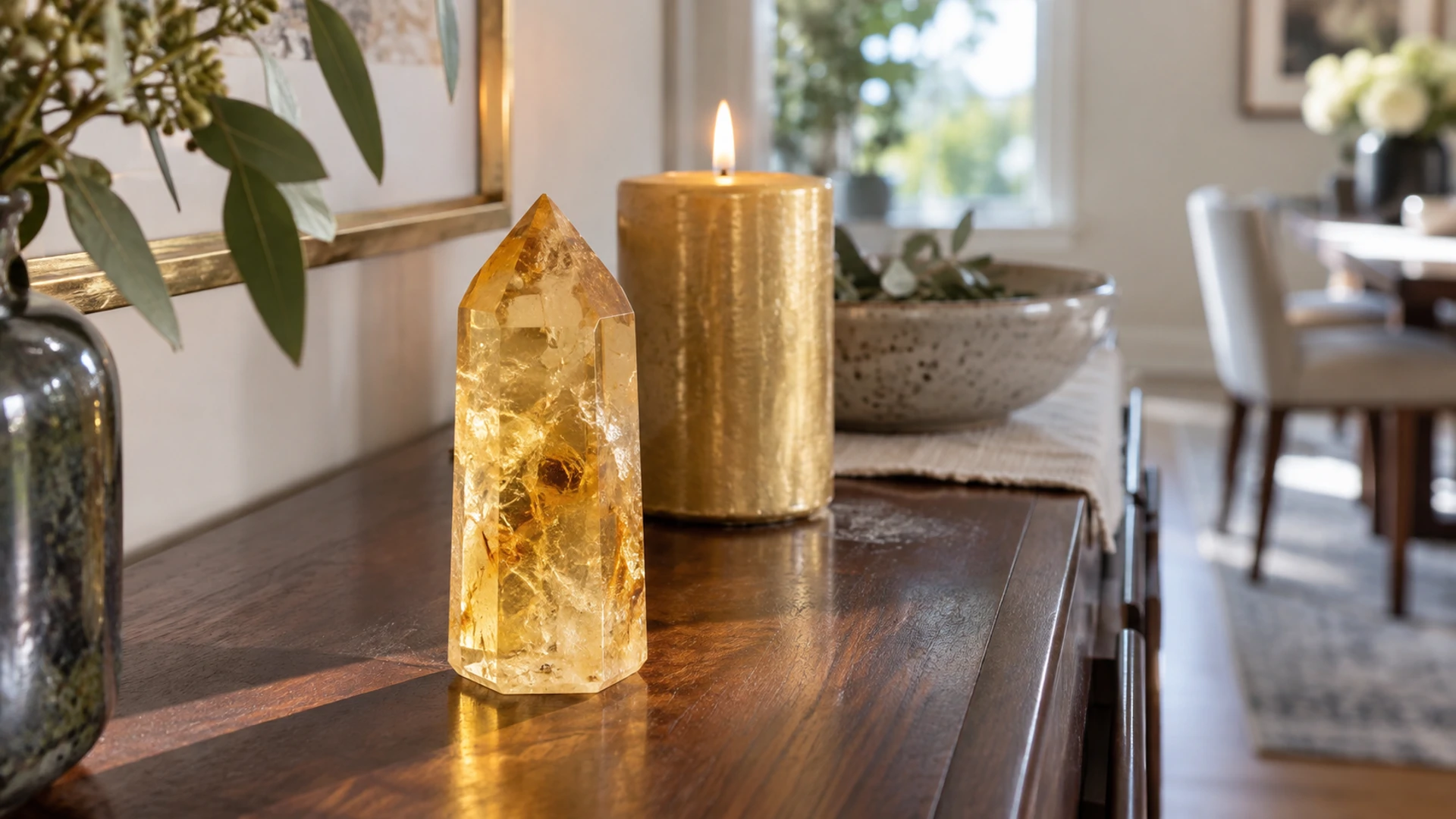
Citrine works through spontaneous manifestation — active, radiant generation of new wealth and opportunity, driven by confidence and joy rather than patience or slow accumulation. It is the Abundance stone that doesn't wait.
Wealth Called Forward by Confidence: Why Citrine Belongs in Abundance
Within the Abundance category, each stone has a distinct mechanism, and citrine's is the most immediately active. This is not a stone for tending a young venture or protecting what you've already built. Its energy is generative and outward-moving, rooted in the solar plexus, the chakra most closely associated with personal power, self-belief, and the willingness to act. When that center is firing, opportunity doesn't feel like something you have to wait for. It feels like something you're already moving toward.
That distinguishes citrine clearly from the other core Abundance stones. Pyrite's mechanism is protective, disciplined wealth-building — abundance through willpower, resolve, and safeguarding what's already been built, not spontaneous luck. Green Jade's mechanism is steady accumulated prosperity — wealth that builds over time through harmony and right conduct, not a sudden arrival. Citrine operates in neither of those registers. It is the stone you reach for when you want to generate something new, not protect or grow something already in progress.
The name "merchant's stone" traces this clearly. Traders and merchants historically kept citrine in their cash boxes and on their person not as a slow wealth-building talisman but as an active confidence anchor — something to carry when you needed to show up ready to close a deal, draw in customers, or open a new line of business. That same read shapes how citrine is understood today.
Correspondences ground this in planetary and elemental terms. The Sun governs citrine as its primary ruling body, which accounts for the warmth, confidence, and radiant energy that define its character. Jupiter appears alongside the Sun in many traditions, specifically for its themes of expansion, good fortune, and the kind of optimism that draws opportunities in rather than working narrowly toward one fixed goal. Both rulerships are worth noting because they pull in slightly different directions: Sun energy is personal and self-generated; Jupiter energy is expansive and luck-adjacent. Together they describe citrine's profile well — confidence plus openness.
The solar plexus chakra is the primary point of resonance, which makes sense given that chakra's governing of personal power and the will to act. Some traditions also cite the sacral chakra as a secondary association, particularly in contexts of creative energy and new ventures — the generative impulse before it has fully taken form. The zodiac associations for citrine are unusually broad compared to most stones: Leo, Gemini, Aries, and Libra all appear across different traditions without any one sign dominating. That breadth reflects citrine's general solar energy rather than a specific archetypal alignment, and it means you don't need to be born under any particular sign to work with it effectively.
Real Citrine, Baked Citrine: Choosing This Stone
The single most important thing to know when buying citrine is that most of what you'll see — in crystal shops, online, and at gemstone shows — is not natural citrine at all. It's heat-treated amethyst or smoky quartz, a long-standing trade practice that produces the deep orange and amber tones most people picture when they think of this stone. This isn't concealed fraud. It's a disclosed industry norm, and the material is stable and genuine quartz. But it is a different thing, and knowing which one you're holding helps you make an intentional choice.
Natural citrine is genuinely rare. Significant sources include Brazil's Rio Grande do Sul, Madagascar, Spain, Russia, and France — and in those deposits, the material tends toward pale lemon to light honey tones, sometimes with a slightly smoky undertone near the base. The color is softer, more transparent, and often more uneven than the heat-treated material. If you're looking at a piece that shows a rich, saturated orange-red concentrated near the base and fading toward the tip, you're almost certainly looking at treated amethyst. This material is sometimes marketed under names like "Madeira citrine," which sounds like a distinct variety but is simply another label for heat-treated material with a particular color profile.
Neither is worthless. Heat-treated citrine is still quartz, and quartz responds to intention and use the same way regardless of how its color was produced. But if natural citrine matters to you — either for philosophical reasons or because you want the subtler, cooler lemon energy of the genuine material — look for specimens from known natural sources, ask the seller directly, and be skeptical of deep uniform orange saturation in affordable tumbled pieces.
On care: citrine is durable and low-maintenance. It sits at Mohs 7, which means it holds up well for daily wear without significant risk of scratching under ordinary conditions. It's water-safe, has no toxicity concerns, and — unlike amethyst — its color doesn't fade in sunlight. You can display it in a sunny window or cleanse it with running water without worry. There's nothing fragile or chemically sensitive here. Citrine is, practically speaking, one of the most straightforward stones in regular rotation.
Three Practices for Calling Abundance Forward
The Open Hand
Use this practice when you want to actively invite a new income stream or a specific opportunity, rather than waiting in a passive posture for one to arrive.
Set a gold candle on your workspace and hold a piece of citrine in your dominant hand, palm open and facing upward. During a Sun planetary hour if timing matters to you, bring to mind the specific thing you want to call in — not in vague terms, but as a clear and concrete image. What does it look like when it arrives? What does it feel like to receive it? Hold that image with confidence rather than anxious hope. There's a distinction between reaching desperately and reaching with the expectation of contact. Citrine works best in the second register. Let the candle burn fully if you're using a chime or tealight. Afterward, keep the stone where your work happens — on your desk, near your register, in your bag — as a continuous signal of that open, expecting posture.
The Merchant's Ledger
Use this practice before a specific negotiation, sale, pitch, or transaction where your confidence needs to be fully present in the moment, not recovered after the fact.
The night before, write the name of the negotiation or the outcome you want on a small piece of paper and place a citrine stone on top of it. Leave it overnight. In the morning, carry the stone with you to the meeting or interaction. Before you begin, hold it in your hand for a moment — not for luck, but to remind yourself of the intention you set the night before. The pre-commitment is the point. You've already decided how this goes. Basil is a traditional Mars-governed herb for financial confidence, and rubbing a single dried basil leaf between your fingers before handling the stone adds a sensory anchor to that intention if you want one. The paper can be burned, folded into your wallet, or discarded once the transaction is complete.
The Sunlit Start
Use this practice at the very beginning of a new project, business, or creative direction — for the initial burst of confident momentum, not the slow tending a new venture needs over time.
This works best done on a Sunday morning during a Jupiter hour, when both of citrine's ruling bodies are active. Place your citrine in direct sunlight for at least an hour before the practice — you're letting the stone absorb solar energy and drawing on its natural solar-plexus resonance before you begin. Then hold the stone and speak your new beginning aloud. Not its full plan, not its every detail, but its core: what you're starting and why you believe it will succeed. Say it plainly. The act of stating confidence aloud is doing something specific here — it's engaging the solar plexus, the seat of personal authority, rather than only the imagination. An orange candle lit alongside this pulls in sacral creative energy to match. Keep the citrine in your workspace for the duration of the project's opening phase. This practice is deliberately separate from the patient, organic work that Moss Agate's growth-from-a-new-planting mechanism is built for — citrine is here for launch energy, not the long grow.
The Merchant's Stone
The name citrine comes from the French word citron, meaning lemon — a straightforward, visual etymology that anyone who's held a piece of natural pale citrine immediately understands. The stone looks like bottled sunlight, and the color alone explains why it's been associated with warmth, optimism, and active good fortune across many different periods and places.
Its reputation as the merchant's stone reflects a real historical pattern: traders and merchants carried citrine as a prosperity talisman, specifically as a confidence anchor for commercial life. The origins of this practice are diffuse — this wasn't tied to one documented event, one culture, or one named trade guild. It appears across different periods and regions in a way that suggests the association arose organically from the stone's solar character rather than being codified in one place and spread outward. What's consistent across those accounts is the function: not a stone for slow wealth-building or protection of existing assets, but one carried when you needed to show up ready to do business, make the deal, and call opportunity toward you. That's the same function it serves in contemporary practice, and the continuity is real even if the specific historical record is general rather than precise.
It's worth noting that citrine's commercial profile was historically shaped by the trade's heavy reliance on heat-treated material. By the time the "merchant's stone" reputation was most widely circulating in 20th-century crystal-healing literature, the stones being sold under that name were largely the deeper orange-amber pieces produced by heating amethyst — which is a different visual experience than the pale, lemon-toned natural material that gave the stone its name. Both carry the stone's intention forward, but it's a useful reminder that "citrine" has referred to somewhat different things depending on the era and the market.
Abundance Called, Not Awaited
What separates citrine from most other Abundance stones is that it doesn't ask you to be patient. It asks you to be ready. Spontaneous manifestation — active, radiant generation of new wealth and opportunity through confidence and joy — is the mechanism, and that mechanism requires something from you: not discipline, not tending, but genuine expectation. The belief that the thing you're reaching for is reachable. Citrine works in that exact space between intention and arrival.
If you want to see where citrine sits alongside the other Abundance stones — and how the Abundance category fits within the broader architecture of crystal magic — The Crystal Compendium: Seven Paths to Stone Magic maps all seven categories in one place.