The Crystal Compendium: Seven Paths to Stone Magic
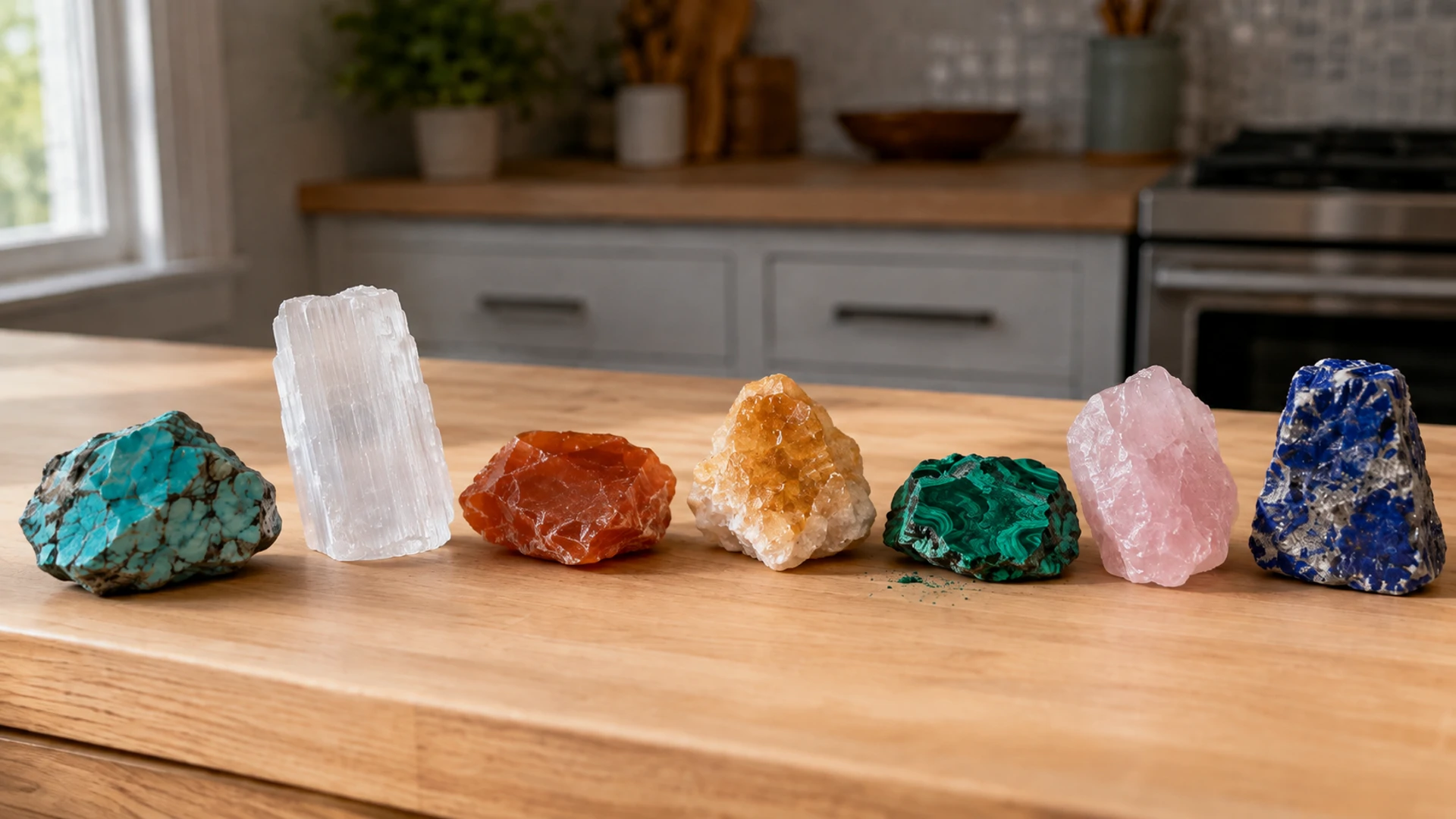
Walk into any crystal shop and you'll find yourself surrounded by handwritten tags promising love, abundance, healing, and protection — sometimes all from the same stone. It's a lot. And without any framework for making sense of it, picking crystals can start to feel like shopping by aesthetic rather than intention.
Every crystal in this tradition falls into one or more of seven core categories based on what kind of magical work they support: Protection, Cleansing, Healing, Empowerment, Abundance, Love & Relationships, and Intuition & Psychic Development. These categories aren't arbitrary. They reflect the actual energetic function of each stone — what it reinforces, what kind of working it anchors, and what your intention needs to be for the stone to do meaningful work.
Protection Crystals: Shielding Your Energy and Space
Protection in crystal magic is about establishing a boundary between your energy and whatever is pushing against it — whether that's psychic drain from other people, harsh environments, malicious intent, or the kind of low-grade energetic static that builds up over time. Protection crystals don't make you untouchable. They reinforce the edge of your field so that you are the one deciding what comes through and what doesn't. That distinction matters. A shield you consciously place is fundamentally different from a wall you build out of fear.
Most protection stones are dense, dark, and rooted in earth energy. Black and deeply grounding minerals dominate this category because their energetic signature is about solidity and containment rather than openness or expansion. They work by anchoring your own field first — a grounded person is a harder target than a scattered one — and then creating a surface that deflects, absorbs, or returns what isn't yours.
How you work with protection crystals depends on what you're protecting. Carrying a stone on your body keeps it in your personal field all day, which is ideal for people-heavy environments or when you know you're walking into something difficult. Placing stones at room corners or doorways creates a perimeter around a space rather than a person. Gridding a full perimeter of your home — a stone at each corner, set with intention — is one of the oldest and most reliable forms of domestic ward work. Some people do all three, layering personal, room-level, and property-level protection simultaneously.
Stones in this category benefit from being cleansed regularly since they're actively absorbing and deflecting. Most dark protection minerals are water-safe for brief rinses, but check individual care notes before soaking anything. Moonlight, sound, and smoke are reliable across the board.
These are the core protection crystals to know:
- Black Tourmaline — The workhorse of the protection category. Worn, carried, placed at doorways, or gridded around a home's perimeter, black tourmaline creates a firm energetic barrier against psychic attack, curses, and environmental negativity. Its iron-rich composition grounds its shielding in the root chakra, keeping you anchored even as it deflects.
- Black Obsidian — Formed from lava that cooled too fast to crystallize, obsidian carries a sharp, volcanic quality to its protection. Mesoamerican cultures knapped it into blades and used polished pieces as scrying mirrors — the Aztec "smoking mirror" associated with the god Tezcatlipoca was obsidian. It protects by reflecting rather than absorbing, which makes it particularly effective against deliberate ill will directed at you.
- Smoky Quartz — Its brown-to-black color comes from natural irradiation deep in the earth, and that geological history shows up in how it works: smoky quartz doesn't just shield, it transmutes. Stress, ambient negativity, and scattered energy get drawn down and dispersed rather than stored. Scotland's national gemstone and a long presence in traditional Highland jewelry, it's an especially good companion for travel or any situation that demands you stay grounded under pressure.
- Hematite — Its name comes from the Greek for "blood," reflecting the red streak it leaves and the red powder it produces when ground. That same iron-oxide richness gives hematite its characteristic weight and its ability to pull scattered energy back down to earth. Carry it when your thoughts are running ahead of you or when you need to hold your own in a room that's working against you.
- Black Onyx — Worn by Roman soldiers for the courage it was believed to instill before battle, black onyx is less about deflection and more about fortitude. It functions as a personal shield against draining people and environments — the kind of protection you need in long-term difficult situations rather than acute ones. Most commercial black onyx is dyed chalcedony, which works fine, but naturally uniform black material is genuinely rare.
- Jet — Not a mineral but fossilized driftwood compressed over millions of years, jet has a warm, organic quality that sets it apart from the cold density of true minerals. Whitby, England remains its finest source and the origin of its Victorian mourning jewelry reputation, after Queen Victoria wore it following Prince Albert's death. Jet is particularly well-suited to grief work, shadow work, and any practice involving ancestors or liminal spaces.
- Nuummite — Roughly three billion years old and found almost exclusively near Nuuk, Greenland, nuummite carries a protective quality that works on a deeply personal level. Its secondary function in intuition and third-eye activation makes it particularly powerful against psychic manipulation — it strengthens your sense of self as much as it shields the outer field. The Inuit people of Greenland considered it sacred and protective for centuries.
- Aegirine — Named after Aegir, the Norse god of the sea, aegirine forms in long bladed crystals and brings a quality of personal conviction to its protection. Its secondary strength is empowerment — it doesn't just shield you, it reinforces your integrity and helps you hold your position when social pressure is pushing hard against it. A strong choice for cord-cutting work and for anyone who tends to compromise their own needs under pressure.
- Black Andradite Garnet — The titanium-bearing black variety of andradite garnet, melanite, is genuinely rare compared to its red cousins despite having been formally described since 1795. Its protection is dense and grounded, reinforced by a secondary empowerment quality — strength and personal will run alongside its shielding. Use it in meditation when you want to access deep earth-connection, or wear it when you need protection that doesn't waver.
- Bloodstone — Called "heliotrope" and later "Christ's stone" in Christian legend, bloodstone's dark green body flecked with red iron-oxide spots has marked it as a warrior's amulet across cultures and centuries. Its secondary quality is empowerment — courage and physical stamina are inseparable from its protective character. Carry it as an amulet against harm in active or high-stakes situations, or when you need to sustain physical endurance over a long undertaking.
- Turquoise — Sacred to ancient Egyptians, Persians, and many Native American nations including the Navajo and Pueblo peoples, turquoise has millennia of documented use as a protective talisman, particularly for travelers. It carries a meaningful secondary quality in healing — it calms as it shields, which makes it effective for anxiety-prone people who need protection without adding tension. Most inexpensive "turquoise" is actually dyed howlite, so source with care if authenticity matters to your practice.
- Zircon — One of the oldest minerals on Earth, with some Australian specimens dating to 4.4 billion years, zircon has been used since the Middle Ages as a talisman against evil and to encourage restful sleep. Its secondary quality is abundance — wealth, honor, and prosperity appear consistently alongside its warding function in historical sources. Keep a piece under your pillow to ease insomnia and nightmares, or wear it as protection for travel.
- Sardonyx — One of the twelve stones in the biblical breastplate of Aaron and a favorite of ancient Roman soldiers, sardonyx combines banded red-brown sard with white or black onyx layers in a stone that's visually and energetically distinct. Its secondary quality is empowerment — courage, willpower, and goal manifestation strengthen the shield it provides. Grid it at the corners of a home for stable, long-term protection, or wear it when navigating adversarial situations.
- Jasper — The name means "spotted stone," and jasper encompasses dozens of named varieties formed wherever silica-rich fluids fill rock cavities across the globe. What the jasper family shares across all its variations is a nurturing, grounding quality — steady, patient, and deeply connected to the earth. Ancient cultures used it for amulets, seals, and protective carvings across nearly every tradition; folklore holds it wards off snake and spider bites. For those new to crystal work, jasper is an accessible and reliable starting point for daily grounding and protection.
- Black Kyanite — Unusually for a protection stone, black kyanite doesn't accumulate negative energy and is genuinely used to clear other stones — its cleansing function is real, though its dominant use is grounding and psychic shielding. It's structurally anisotropic, meaning its hardness varies depending on the direction you test it, so handle it gently and keep it dry. Carry it for grounding during energy work, or use its blade-like form to sweep the aura in banishing and clearing rituals.
- Shungite — A carbon-rich mineraloid found almost exclusively near Lake Onega in Karelia, Russia, shungite has been used to purify drinking water for centuries — a genuinely documented use entirely separate from metaphysical claims. Its protective and cleansing qualities overlap in practice: it grounds, absorbs environmental disruption, and is placed near electronics by those working with its EMF-shielding reputation. At roughly two billion years old, it carries an ancient, elemental quality that distinguishes it from newer protective stones.
Cleansing Crystals: Clearing Stagnant and Negative Energy
Cleansing in crystal magic addresses what accumulates. Energy stagnates in spaces, in objects, in people — the residue of stress, conflict, illness, or simply time passing without intentional attention. Cleansing crystals work to dissolve, neutralize, or lift that accumulation rather than shielding against new input. Think of the distinction this way: protection stops things from getting in, cleansing deals with what's already there.
Stones in this category tend toward translucency, light colors, and high vibrational signatures. Selenite glows. Clear quartz transmits. Fluorite clears mental fog as effectively as it clears a room. Their energetic quality is one of purification and clarity rather than density and containment. Many of them are also used to cleanse other crystals, functioning as reset tools for your whole collection rather than just standalone pieces.
Cleansing crystals are placed more than carried. A selenite slab on a windowsill or at an entryway works on the energy of a space continuously, without needing to be activated for each use. Clear quartz kept at the center of your collection will gradually maintain the clarity of the stones around it. Halite placed at doorways and corners acts as a boundary and a purifier simultaneously. For personal energetic clearing, hold a cleansing stone during meditation or run it through your aura with sweeping movements.
One important practical note: several cleansing crystals are water-soluble or moisture-sensitive. Selenite dissolves. Halite dissolves. Fluorite can fade with prolonged sun exposure. Always check care requirements before submerging or leaving these stones in humid conditions — cleanse them with sound, moonlight, or smoke instead.
The five cleansing crystals in this compendium are:
- Selenite — Named from the Greek for "moon" for its luminous glow, selenite is the most widely used cleansing stone for good reason. Place other crystals on or near a selenite slab to clear them without doing anything else. Selenite is genuinely water-soluble — it will pit and eventually dissolve with regular water contact — so cleanse it only with dry methods. Set it at your entryway, at the crown during meditation, or anywhere you want a steady, continuous clearing presence.
- Clear Quartz — Called the Master Healer, clear quartz is colorless because it lacks the trace impurities that give other quartz varieties their color — and that purity is the point. It amplifies whatever intention you set into it, cleanses and charges the stones around it, and functions as a central anchor in crystal grids. Unlike selenite, it's fully water-safe, including brief saltwater soaks.
- Halite — Rock salt in mineral form, halite has been used as currency, preservative, and ritual purifier across nearly every documented civilization. Its cleansing function is both literal and symbolic — salt dissolves impurity, draws out what needs to be released, and marks boundaries. Place it at doorways and corners for space clearing, or use prepared salt in ritual baths. Like selenite, it dissolves in water, so keep the raw crystal away from moisture.
- Fluorite — The mineral that gave the phenomenon of fluorescence its name, fluorite is called the Genius Stone for its ability to clear mental and psychic clutter specifically. Its cleansing quality is cognitive as much as environmental: it brings focus where there was fog, and order where there was overwhelm. Keep it at your workspace, use it as a coordinating hub stone in grids, or place it on the third eye when decision fatigue is running high.
- Snow Quartz — Milky and translucent rather than clear, snow quartz gets its opacity from trapped microscopic water and gas bubbles rather than any trace-element impurity. Its cleansing quality is gentler than clear quartz, which makes it better suited to recovery and transition work — clearing after grief, supporting someone moving through addiction or burnout, easing the energetic weight of major life changes. Associated in some Native American tradition with the Snow Moon of late winter, it carries a quiet, patient quality.
Healing Crystals: Supporting Emotional and Physical Restoration
The healing category in this compendium covers a specific territory: emotional recovery, physical restoration, grief, anxiety, and trauma. That's narrower than it might sound. Stones that primarily support romantic connection live in Love & Relationships. Stones that primarily sharpen psychic awareness live in Intuition & Psychic Development. The healing category is about the body and the inner life — about moving through pain rather than transcending it, and rebuilding what has been depleted or broken.
Healing crystals tend toward softer minerals with heart and sacral chakra connections. Many of them are copper-based — malachite, chrysocolla, and turquoise all owe their color to copper — which gives them a quality of conductivity in energetic terms, moving stagnant emotional energy rather than holding it in place. Others, like lepidolite, contain actual lithium within their mineral structure, a detail that's often cited when discussing their reputation for calming anxiety, though the stone itself doesn't deliver therapeutic doses of the element.
Body layouts — placing healing crystals directly on the body during meditation — are particularly effective in this category. A stone held over the heart chakra during a guided visualization, or placed at the base of the spine while you breathe through something difficult, creates a physical anchor for the emotional work you're doing. This isn't passive. The stone focuses your intention and marks the area of the body or the part of the psyche you're consciously attending to.
For ongoing healing work, carry the stone or keep it by your bed. Several healing crystals — lepidolite especially — are well-suited to sleep support and dream processing. A few important care notes apply here: malachite should never be used in elixirs, and raw malachite dust is genuinely toxic; chrysocolla is porous and copper-bearing, so no elixirs and no soaking; lepidolite's mica layers can delaminate with water exposure.
If repair or restoration is where you're starting, these are the stones to reach for:
- Blue Lace Agate — Pale blue with white banding, blue lace agate is the stone you reach for when anxiety is showing up in your throat and your words. It works on the throat chakra specifically, easing the tension that makes honest self-expression feel risky or impossible. Wear it during difficult conversations or hold it during meditation when you're working through something that's hard to articulate.
- Chrysocolla — Blue-green from its copper content and used by ancient Egyptian and Aztec metalsmiths alongside its ornamental use, chrysocolla works on relationship patterns and caretaking dynamics. Place it on the heart chakra for work around codependency or emotional over-extension, or hold it during meditation when you're trying to untangle whose feelings are whose. It's soft and porous — never submerge it, and don't use it for elixirs.
- Malachite — Ground into pigment for Egyptian eye cosmetics and used to line pharaohs' headdresses, malachite has a long history as both an ornamental material and a transformative one. It surfaces buried emotional patterns — the things you've been avoiding tend to come up with malachite in the mix, which is why it's called the Stone of Transformation and Protection. Work with it intentionally rather than casually, and respect the toxicity note: polished, sealed malachite is safe to handle, but raw dust should never be inhaled or ingested, and no elixirs under any circumstances.
- Lepidolite — A lithium-bearing mica whose lilac color comes from that same lithium content, lepidolite is consistently associated with anxiety, racing thoughts, and the bone-deep depletion of burnout. Keep it by the bed for sleep, carry it through high-stress periods, or hold it during meditation when your nervous system needs something to slow down around. Its mica layers can delaminate with water exposure, so keep it dry and don't use it for elixirs.
- Mangano Calcite — Pale pink from its manganese content, mangano calcite is particularly well-suited to inner-child work and the kind of self-worth healing that comes after trauma or long-term neglect. Hold it during meditation, or place it on the heart chakra when working through grief or the aftermath of something that cost you your sense of your own value. It's soft and reacts with acids, so avoid harsh cleaning products.
- Unakite — A granite composed of pink feldspar, green epidote, and quartz, unakite is technically a rock rather than a single mineral — its mottled pink and green appearance reflects those two dominant components. Named for the Unaka Mountains of North Carolina where it was discovered in the 19th century, it supports gradual, layered emotional healing rather than dramatic breakthroughs. Carry it for slow and steady recovery work, or place it over the heart during body layouts.
- Golden Healer Quartz — Quartz colored by iron oxide inclusions, golden healer quartz gets its warm mustard-gold tones from goethite or hematite within the crystal rather than from treatment. It functions as an all-purpose healing tool — used in body layouts, held during meditation for self-confidence, and used to restore energy that's been severely depleted. Its secondary quality is empowerment, which means it works on rebuilding your sense of personal strength alongside the physical restoration work.
- Aquamarine — Named from the Latin for "water of the sea," aquamarine has been a sailor's protective talisman for centuries, but its primary healing function is calming communication. It works on the throat chakra, easing anxiety around public speaking and honest self-expression, and carries a secondary quality in both love and protection from its long history as a gift between committed partners. Wear it when you need to speak clearly under pressure, or give it as a token in a relationship that needs a steadying influence.
- Blue Topaz — Nearly all commercial blue topaz is colorless topaz that's been irradiated and heat-treated to produce its stable blue color — a permanent treatment that doesn't affect how the stone works. Its healing function is calming and throat-centered, easing the anxiety that shows up specifically around speaking, performing, or being seen. A secondary quality in intuition and higher-self connection makes it useful in meditation work as well as in practical daily wear.
- Opal — Its signature play-of-color comes from light diffracting through a regular internal arrangement of microscopic silica spheres — a structural phenomenon rather than a trace-element one. Opal works on creativity, self-expression, and the kind of emotional processing that doesn't fit neatly into words. Its secondary quality is strongly intuitive and psychic, which is worth knowing: if opal brings up overwhelming emotion, pair it with a grounding stone like black tourmaline to keep the experience workable. The "bad luck" reputation is traced largely to a 19th-century novel rather than older tradition.
- Pearl — Organic gems formed by mollusks from layers of calcium carbonate, pearls have been prized across nearly every ancient culture as a symbol of purity. Their healing quality is calm and emotionally balancing — they're associated with gentle self-forgiveness and with new beginnings, which is why they're traditionally given at weddings. Wear them for emotional steadiness, hold a single pearl during meditation when you're working toward forgiveness, and store them carefully away from perfume or chemicals that degrade the nacre.
Empowerment Crystals: Amplifying Will, Confidence, and Manifestation
Empowerment is what you reach for when the work isn't about recovering from something but about building something. These crystals support will, confidence, courage, and the raw energy required to act on your intentions rather than just hold them. They fire up the sacral and solar plexus chakras — the centers governing desire, personal power, and the capacity to turn an idea into a reality. When you're stalled, second-guessing yourself, or facing something that genuinely requires nerve, the empowerment category is where you start.
Fire and earth dominate this category. Red, orange, and gold stones carry the signature solar and martial energy that most empowerment work calls for. These aren't subtle stones. Carnelian, tiger's eye, garnet, red jasper — they carry an assertive quality that makes them unsuitable when what you actually need is to soften or receive. Match the stone to the working, not to what feels most comfortable. Growth often doesn't feel comfortable, and these stones reflect that.
Empowerment crystals are best used actively. Carry them on your person during the specific situation you're working toward — a job interview, a difficult conversation, a performance, a deadline. Place them on your desk when you're pushing through a project that's draining your motivation. Hold them during visualization and intention-setting work. Unlike cleansing stones, which can sit quietly in a space and do their work, empowerment stones respond to your engagement. They amplify what you're already bringing.
The empowerment crystals in this compendium span a wide range of fire energy:
- Carnelian — Egyptian scribes wore it and ancient Roman senators used it for signet-ring seals — hot wax reportedly doesn't stick to carnelian, which made it ideal for sealing official documents. Its practical use in practice is similar: it cuts through hesitation and makes action feel natural rather than forced. Carry it to break procrastination, wear it during public performance, or hold it when self-doubt is louder than your actual intention.
- Tiger's Eye — A pseudomorph formed when quartz replaced fibrous crocidolite during geological time, producing its characteristic chatoyant banding, tiger's eye was worn by Roman soldiers in battle for its reputation for focus and steadiness under pressure. Its golden-brown silky sheen carries that same quality into practice: it supports decision-making when the options are murky and helps you resist manipulation or pressure to act against your own judgment.
- Sunstone — Oregon's official state gemstone and a stone with contested but intriguing historical use by Scandinavian sailors as a possible navigational aid in overcast conditions, sunstone carries an expansive solar quality. It works specifically for reclaiming personal sovereignty after periods of over-giving or self-sacrifice — when you've been pouring into everyone else and have lost track of your own wants and needs. Wear it when stepping back into leadership or visibility.
- Golden Tiger Iron — A striking banded combination of tiger's eye, hematite, and red jasper, golden tiger iron concentrates three distinct empowerment qualities into a single stone. Its layered structure makes it effective for sustained effort over time — long projects, endurance-based challenges, situations where you need consistent output rather than a single surge.
- Red Jasper — Where general jasper offers grounding and steady nurturing, red jasper is specifically about vitality and physical endurance. Its deep iron-oxide red has marked it as a warrior's stone since antiquity, and that energy is its defining quality: it sustains you through long undertakings, rebuilds physical stamina when you're running on empty, and keeps your root chakra fired when you need to keep moving.
- Orange Calcite — Soft and bright, orange calcite is what you reach for when a creative project has gone completely flat. It works on the sacral chakra specifically, reigniting the desire and enthusiasm that stalled projects drain away. Keep it at your workspace when you're grinding through something that stopped being interesting, or carry it at the start of a new creative undertaking to get momentum going before resistance has a chance to build.
- Garnet — Its name comes from the Latin for "seed," drawn from its resemblance to pomegranate seeds, and ancient warriors and traders wore it as both a protective amulet and a source of life-force. Garnet's empowerment quality is specifically about rebuilding after a setback — it restores motivation that has genuinely burned out, not just temporarily dipped. Wear it or carry it during demanding periods when you need to sustain your drive across weeks or months rather than hours.
- Amazonite — Found among Tutankhamun's tomb treasures and used by ancient Egyptians as an amulet of good fortune, amazonite bridges empowerment and communication. Its strength is in honest, non-harsh truth-telling — carrying it into a difficult conversation helps you say what needs to be said without it coming out as an attack. It also supports the courage to set and maintain boundaries, which is a form of self-empowerment that's often harder in practice than it sounds.
- Diamond — Pure crystalline carbon and the hardest natural material on Earth, diamond in magical practice is primarily an amplifier of will and intention. Its secondary quality in intuition and psychic development is real — the crown chakra associations are consistent — but its dominant function here is focused resolve. Place it near other crystals to amplify their working, or wear it when you need absolute clarity about what you want and why.
- Spinel — Several famous "rubies" in royal crown jewels, including the Black Prince's Ruby in the British Imperial State Crown, are actually spinel — it wasn't distinguished as a separate species from ruby until the 18th century. That history of being mistaken for something else doesn't diminish it. Its secondary quality is healing, and that's where its empowerment character gets interesting: spinel's primary strength is restoration and resilience, which means it works on you from both directions at once — rebuilding what's been depleted while reinforcing the will to keep going. Wear it when recovering from illness or emotional exhaustion, or carry it when you're building back after something that genuinely knocked you down.
Abundance Crystals: Attracting Prosperity, Luck, and Opportunity
Abundance magic isn't about waiting to receive. It's about aligning your energy with the frequency of growth, opportunity, and material flow — and then taking action from that aligned place. Crystals in this category reinforce that alignment. They work on the solar plexus and heart chakras, the centers governing personal will and the capacity to give and receive. Kept in wallets, on desks, at business thresholds, or placed at the center of manifestation grids, abundance stones are working tools, not passive decorations.
The solar signature dominates here — gold, yellow, and bright green stones carry the expansive, generative quality that abundance work calls for. Several of these stones have centuries of mercantile use behind them: citrine kept in cash registers, jade carried across Chinese and Mesoamerican cultures as a symbol of wealth and virtue, yellow sapphire prescribed in Vedic tradition after careful astrological consultation. The historical through-line is real. These weren't casual associations.
Placement matters a lot in abundance work. A stone you set on your desk with a specific financial intention and then ignore isn't doing the same work as one you interact with daily — hold it, look at it, revisit the intention you set into it. Combination works well too: citrine and pyrite together in a money grid amplify each other. Green aventurine placed near a business's entrance keeps luck and opportunity moving through the space rather than stagnating at the door.
Start here when the goal is building or growing something:
- Citrine — Called the merchant's stone, citrine has been kept in cash registers and tills to sustain business since at least the Victorian era. It's one of the rare stones said to never require cleansing because it doesn't accumulate negative energy. Most commercial citrine is heat-treated amethyst or smoky quartz rather than natural material — natural citrine tends toward pale yellow, while treated material shows deeper orange-red tones with a milky base.
- Pyrite — Brassy, metallic, and forming in cubic crystals so geometrically perfect they've startled miners into thinking they found gold since antiquity, pyrite carries an assertive prosperity energy rooted in the solar plexus. Keep it on a desk or at the center of a money grid, pair it with citrine or green aventurine for a full manifestation setup, and never use it for water elixirs — it reacts with moisture to produce sulfuric acid, which is a genuine chemistry concern rather than a metaphysical caution.
- Green Jade — Revered for thousands of years across Chinese, Mesoamerican, and Maori cultures as a symbol of wealth, virtue, and protection — in Chinese tradition, often valued more highly than gold — jade is a long-term prosperity talisman rather than a quick-result stone. Wear or carry it consistently over months and years rather than for single workings. Most commercial "jade" is treated or dyed; genuine untreated jadeite should be disclosed as Type A by reputable sellers.
- Moss Agate — Named the farmer's stone for its historical use buried in fields to ensure fertile harvests, moss agate's dendritic mineral inclusions resemble foliage, though they're entirely mineral rather than organic. Its abundance quality is slow and organic — it supports steady growth in businesses and creative projects rather than sudden windfalls. Plant it in your garden, bury it at the base of a new project, or carry it when you're building something that needs sustained cultivation.
- Peridot — Mined since around 1500 BCE from Egypt's Zabargad Island, peridot's olive-to-lime green comes from iron within an olivine crystal structure unusually also found in certain meteorites. Its abundance work has a specific angle: it clears jealousy and resentment that block incoming opportunity, which makes it most useful when you've noticed yourself mentally blocking what you're trying to attract. Wear it when launching a new venture or when you want to reset your relationship to someone else's success.
- Imperial Topaz — Its golden-orange color was historically restricted to Russian royalty in the 17th and 18th centuries, giving rise to the "imperial" name. The finest material still comes from Ouro Preto, Brazil. Its abundance quality is tied specifically to career advancement and visualization — it carries a secondary empowerment quality that supports the personal will needed to pursue specific financial goals rather than passive hoping.
- Rutilated Quartz — Clear or smoky quartz containing needle-like inclusions of rutile titanium dioxide, historically nicknamed "Venus's hair," rutilated quartz is specifically a manifestation accelerator. Program it with a precise financial or career intention and wear it daily to keep that intention active rather than dormant. Its secondary quality in intuition and higher-self connection means it's also useful in meditation for clarifying what you're actually trying to build, before the manifestation work begins.
- Green Tourmaline — Tourmaline's gem-trade popularity dates specifically to 1876, when a Maine specimen was sold to Tiffany & Co., and the green variety has been associated with heart-centered growth and vitality since. It's the abundance stone best suited to long-term business-building and sustained creative practice rather than immediate material gain. A secondary healing quality — particularly around physical heart health and vitality — runs alongside its prosperity work.
- Yellow Topaz — Ancient Egyptians associated its golden color with the sun god Ra and used it in protective amulets. Its abundance quality connects specifically to Jupiter's energy of recognition and reward tied to effort — it's the stone you work with when you want your contributions to be seen and compensated rather than overlooked. Carry it into negotiations, performance reviews, or any situation where fair recognition is the outcome you're working toward.
- Green Aventurine — Often called the stone of opportunity, green aventurine carries a light, luck-forward quality that makes it one of the most accessible entry points in the abundance category. Keep it near your front door to invite opportunity into your home or business, carry it when you need a run of favorable circumstances, or place it in a grid alongside pyrite and citrine for a straightforward prosperity working.
- Yellow Sapphire — One of the Navaratna, the nine sacred gems of Vedic astrology, yellow sapphire is the specific gemstone of Jupiter, the planet governing wealth and expansion. In Vedic tradition, it's worn on the index finger of the right hand on Thursdays — Jupiter's day — and only after consulting an astrologer to confirm Jupiter's placement in the wearer's chart is favorable. This is among the most heavily documented stone-to-planet correspondences in any astrological tradition, and it's worth understanding that specificity rather than treating it as a generic prosperity stone.
Love & Relationships Crystals: Opening the Heart to Connection
This category covers the full range of heart-centered work: romantic love, self-love, forgiveness, long-term partnership, and the healing that happens specifically in the context of relationships rather than in isolation. The distinction between this category and the healing category matters. Healing addresses what's broken inside you. Love & Relationships addresses what happens between you and another person, or between you and your own capacity to receive and give love. The two often overlap in practice, but the energetic focus is different.
Venus governs most of the stones here, and earth and water elements dominate. These are receptive, open-hearted stones rather than assertive ones. They soften where empowerment stones sharpen, receive where protection stones deflect. Working with them requires a corresponding internal willingness — a rose quartz placed on your altar won't do much if you're not also willing to lower your guard and look honestly at what you're bringing to your relationships.
Love & Relationships crystals are worn close to the skin and kept in personal spaces — the bedroom, the heart chakra during meditation, the pocket during a first date or a reconciliation conversation. Giving one as a gift carries its own power: emerald has been exchanged between committed partners for centuries, and pearl is traditional at weddings. The act of giving a stone with intention is itself a small ritual, marking the relationship as something you're actively tending rather than taking for granted.
The six love and relationship crystals in this compendium are:
- Rose Quartz — Ground rose quartz masks have been found in Egyptian archaeological contexts tied to beauty rituals, and its association with the heart and with self-love runs at least that deep. It's the starting point for most heart-chakra work because it opens rather than pushes — rose quartz invites love in rather than demanding it. Place it in the bedroom for relationship harmony, hold it during meditation for self-compassion work, or give it as a gift during a reconciliation.
- Rhodonite — Pink to red with distinctive black manganese-oxide veining, rhodonite is Russia's national gemstone and has been used in Russian jewelry and architecture since the 18th century. Its specific strength is forgiveness work — held during meditation when you're working through a breakup, an estrangement, or the complicated process of forgiving someone (including yourself) without excusing what happened. It doesn't rush the process or paper over what's real.
- Pink Tourmaline — Containing natural lithium in its mineral structure, pink tourmaline carries a gentle, emotionally attentive quality that makes it one of the best first heart-healing stones for sensitive people or those new to crystal work. It's associated with the heart chakra and with Venus, and its energy is receptive rather than demanding. Carry it into new relationships or reconciliations, or wear it when you want to stay emotionally open without becoming overwhelmed.
- Ruby — In Burmese warrior tradition, rubies were embedded in the skin before battle for their protective power; Sanskrit texts called them ratnaraj, king of precious stones. In the context of love and relationships, ruby works on passion and commitment — it reignites what has gone cold and marks a relationship as something worth fighting for. Its secondary empowerment quality means wearing ruby also strengthens your own vitality and leadership, so it works on you as much as on the relationship.
- Emerald — Mined in Egypt since at least 1500 BCE and associated with Cleopatra's legendary mines, emerald has been called the Stone of Successful Love across centuries and cultures. Pliny the Elder wrote about its soothing quality in the 1st century CE. It sustains long-term partnerships and loyalty, and its secondary healing quality makes it effective for emotional restoration within relationships — use it when a partnership is recovering from something difficult rather than only when things are already going well. Almost all commercial emerald is oil- or resin-treated to improve clarity, a significant care point: no ultrasonic cleaners and no harsh chemicals.
- Chrysoprase — Called the Stone of Venus by the ancient Greeks and reportedly a favorite gemstone of Alexander the Great, chrysoprase gets its apple-to-forest green from nickel rather than the copper that colors most green stones. It works on self-love and forgiveness specifically, making it a strong choice for heart-opening work aimed inward rather than toward another person. Hold it during meditation when you want to rebuild the capacity for new connection after something that closed you down.
Intuition & Psychic Development Crystals: Sharpening Inner Sight
Intuition is a skill, not a gift you either have or don't. Some people arrive at magical practice already trusting their inner knowing; others have to rebuild that trust carefully after years of being told their perceptions were wrong. Either way, the stones in this category serve the same function: they quiet the analytical layer of the mind enough for subtler information to come through, and they strengthen the channels through which that information travels — the third eye and crown chakras primarily, along with the throat for expression.
Water and air elements govern this category. These are opening, receptive, expansive stones rather than grounding ones. That's worth noting because psychic development work done without any grounding can become disorienting. The practical answer is to work with an intuition stone during a meditation session bookended by something earth-rooted — smoky quartz before and after, or simply a few minutes barefoot on solid ground. Let the intuition stone do its work within a container your nervous system trusts.
Intuition crystals are placed on the third eye during meditation, kept by the bed for dream recall, and worn during divination sessions or any practice where you want your perception sharpened. Amethyst under the pillow for dream work, labradorite on the altar during a reading, lapis lazuli held during automatic writing — these are the traditional forms, and they work because the physical presence of the stone keeps your attention anchored to the specific kind of consciousness you're trying to cultivate.
These are the stones for sharpening a sense you already have:
- Labradorite — Inuit tradition holds that labradorite fell to Earth from the frozen fire of the Aurora Borealis, and its internal flashes of blue, green, gold, and violet from its lamellar structure make that story feel almost literal. Called the most powerful protector of the mineral kingdom across many sources, it carries a strong secondary protection quality alongside its primary intuitive function. Wear it during major life transitions, carry it during divination work, and keep it close whenever you're developing a new intuitive skill.
- Amethyst — Medieval Christian clergy wore amethyst episcopal rings from at least the 9th century, connected to the stone's Greek-rooted reputation as a guard against intoxication and clouded judgment. In magical practice, it works on the third eye and crown chakras, supporting meditation, dream recall, and spiritual protection during energy work. Keep it under your pillow for vivid dreaming, place it on the third eye during meditation, or wear it as a steady intuitive anchor throughout your day.
- Lapis Lazuli — Ground into ultramarine pigment that was historically more expensive than gold, lapis lazuli colored Michelangelo's most important blues in the Sistine Chapel ceiling and was buried with Egyptian pharaohs including Tutankhamun. Its intuitive quality is specifically about wisdom and truthful expression — it works on the throat and third eye together, which makes it particularly useful for writers, teachers, and anyone whose practice involves translating inner knowing into language. Its secondary empowerment quality gives it an authority and confidence that softer intuition stones don't carry.
- Celestite — Named from the Latin for "heavenly," celestite's pale sky blue and its long association with angelic communication have made it a meditation-space staple. Its secondary healing quality — genuine calm and stress relief — means it works even when you're not specifically doing intuitive development work; it simply creates a quieter internal environment in which subtler perception becomes possible. Keep it in your meditation space and protect it from strong sunlight, which fades its delicate color.
- Apophyllite — Forming in glassy pyramid-shaped crystals in the gas cavities of volcanic rock, apophyllite is associated with astral travel, dreamwork, and angelic-connection practices. Its secondary cleansing quality is real and functional — it clears negative energy from a space in addition to its primary intuitive role. Place it on the third eye for scrying and meditation, keep it in your home for its claimed angelic-connection properties, and handle it gently since the pyramid points chip easily.
- Blue Kyanite — Where black kyanite's primary function is protective grounding, blue kyanite's dominant use is communication and intuitive development. It works on the throat and third eye together, strengthening the link between inner knowing and outer expression. Like its black counterpart, it doesn't accumulate negative energy and is considered self-clearing. Place it on the throat for honest communication practice, or hold it during meditation when you want to access what you already know but haven't been able to articulate.
- Alexandrite — Discovered in the Ural Mountains of Russia in 1830 and named after the future Tsar Alexander II, alexandrite's defining characteristic is its color change: green in daylight, red under incandescent light. That dual nature mirrors its magical function — it works on the connection between the visible and the hidden, the known and the intuited. Its secondary empowerment quality is discipline and willpower, which makes it particularly useful for building consistent intuitive practice rather than relying on spontaneous insights.
- Moonstone — Called the Traveler's Stone for its traditional protective function at night and on water, moonstone's inner glow — adularescence, caused by light scattering between two intergrown feldspar layers — has made it sacred to lunar deities across many ancient cultures. It works on intuition, cyclical awareness, and shadow work, and carries a secondary healing quality around emotional balance and hormonal cycles. Keep it by your bed for dream recall, wear it to work with your intuition across the course of a lunar month, and protect it from scratches and hard knocks given its relatively soft Mohs rating.
- Sapphire — Called Stones of Wisdom across sources, sapphire in its full range of colors carries a consistent association with the higher mind — clarity, insight, and self-mastery. Medieval European clergy and royalty wore it as a symbol of heavenly favor and wisdom; the tradition that sapphire protects against envy is at least as old as the Middle Ages. Its protective secondary quality is real, but its primary work here is mental: wear or carry it for decision-making and discernment, or hold it during meditation when you want prophetic or clarifying dreams.
- Tanzanite — Found in only one place on Earth — the Merelani Hills near Mount Kilimanjaro, Tanzania — and discovered only in 1967, tanzanite is one of the most recently significant gemstones to enter magical practice. Marketed and popularized largely by Tiffany & Co., who gave it the nickname Gemstone of the 20th Century, it activates the throat, third eye, and crown chakras simultaneously, making it particularly powerful for sustained spiritual awakening work. Its secondary healing quality in emotional release and calm suggests it works best when you're ready to feel what comes up rather than bypassing it.
Understanding all seven of these categories changes how you approach crystal work. You stop picking stones by color or aesthetic and start picking them by function — by what your practice actually needs right now. Protection when you're under pressure. Cleansing when stagnation has set in. Healing when something inside you is broken or depleted. Empowerment when the path forward requires nerve. Abundance when you're building something real. Love when the heart needs to open. Intuition when you need to trust what you already know. These seven categories give you a working vocabulary for your own practice.
If you want to explore which specific crystals connect to your birth month and what those correspondences mean in practice, the complete birthstones guide covers every month's stones in depth — both traditional and modern assignments — and explains how to actually use them.