Rose Quartz: The Love That Holds Every Kind
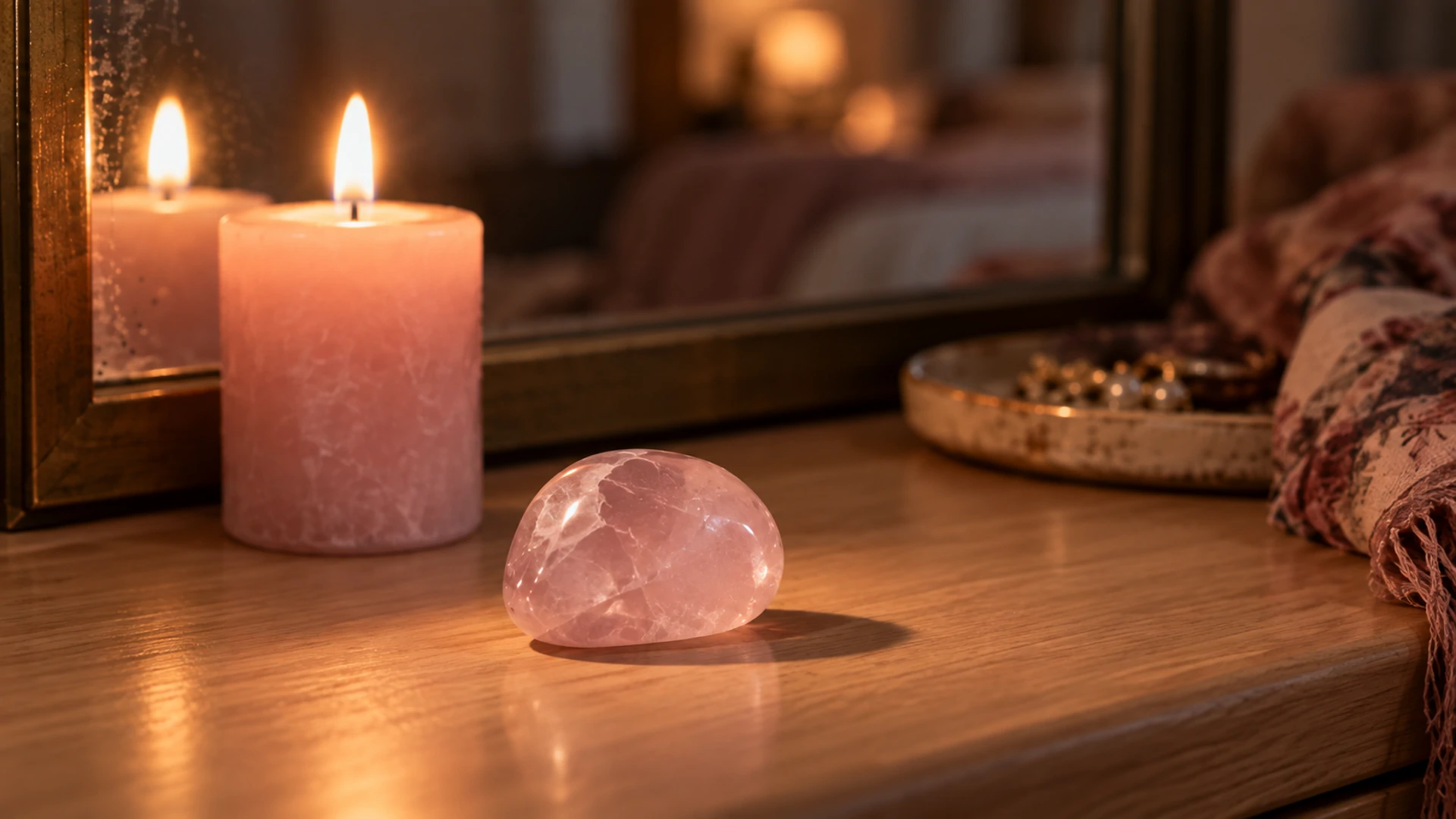
Rose quartz works with unconditional love in its broadest sense — not any one kind of love, but the current that runs underneath all of them. It is one of the most widely recognized stones in any crystal practice, and its reputation is grounded in something real.
The Love That Holds Every Kind: Why Rose Quartz Belongs in Love & Relationships
When you look at the full cluster of Love & Relationships stones, most of them are aimed at something specific. Rhodonite is about healing and forgiveness after relational wounds — it repairs what's broken rather than initiating anything new. Emerald is the stone of fidelity and loyalty in committed partnership — for marriage and domestic harmony rather than a spark. Each of those stones enters at a particular moment, in a particular register of love. Rose quartz doesn't work that way. Its mechanism is universal, unconditional love — the foundational stone for every form of love (self, family, friendship, romantic), not targeted at one register. It isn't competing with Rhodonite or Emerald. It's the ground those stones stand on.
That breadth is what makes rose quartz worth understanding carefully. Because it works across all registers of love, it rarely gives you a sharp, immediate sensation the way a more targeted stone might. What it does instead is soften the field — it lowers the internal resistance that keeps love, in any form, from moving freely. Most traditions that work with this stone frame its effect as starting with the self before it extends outward. You don't use rose quartz to attract a partner and leave yourself out of the equation. The self-love component isn't optional background material; for most practitioners, it's where the work actually begins.
Rose quartz is governed by Venus, which ties it to beauty, receptivity, and the kind of love that binds rather than competes. Its primary correspondence is the heart chakra — the energetic center associated with giving and receiving love, compassion, and emotional integration. Some traditions also cite a secondary connection to the root chakra, framing rose quartz as a stone that grounds love into the body rather than keeping it purely in the realm of sentiment. The zodiac associations most commonly cited are Taurus and Libra, both Venus-ruled signs, which reinforces rose quartz's correspondence to the full spectrum of relationship — the steady, committed love of Taurus and the relational attunement of Libra.
Cloudy, Not Clear: Choosing Rose Quartz
One of the first things worth knowing about rose quartz as a material: it almost never forms as well-defined individual crystals. The vast majority of what's mined and sold is massive rose quartz — large, structurally uniform pieces without visible crystal faces. The tumbled stones, rough chunks, spheres, and palm stones you see in most shops are all cut or shaped from this massive material. That's not a lesser version of the stone. It's simply what rose quartz is mineralogically in almost all of its occurrences. Gem-quality rose quartz that forms with actual crystal terminations and visible faces is genuinely rare — a different experience from the common material, and priced accordingly. If you come across it, it's worth noting. But don't read the cloudiness of your tumbled piece as a deficiency.
The color itself is an interesting open question. Rose quartz's pink is one of the few quartz colors whose cause is still debated in mineralogy. Some research points toward microscopic fibrous inclusions responsible for the hue; other research suggests trace elements within the crystal structure. Unlike amethyst, where iron and irradiation give a clear chemical explanation, rose quartz hasn't settled into a single agreed mechanism. It's one of those things where the honest answer is that mineralogists don't fully agree yet, and it's fine to hold that uncertainty rather than asserting one cause as fact.
On the practical side, rose quartz sits at Mohs 7 — durable enough for daily wear and handling without any special caution. It's water-safe, with no toxicity concerns for handling or cleansing. The one thing to be aware of: some rose quartz will fade with prolonged direct sunlight exposure. This doesn't happen to every piece at the same rate, but if you're planning to keep a specimen on a permanently sunny windowsill, it's worth choosing a spot with indirect light instead. The color won't vanish dramatically, but it can pale over time. A brief rinse is fine; storing it in a sun-drenched spot for months isn't ideal if preserving the stone's color matters to you.
When choosing a piece, let the tactile quality matter. Rose quartz has a particular smoothness to it — even raw chunks often have a softness to how they feel in the hand that seems consistent with the stone's reputation. Tumbled pieces are an excellent starting point because you can actually hold them and notice the weight and temperature. The pale, almost-white-pink pieces and the deeper rose pieces are the same stone; shade variation comes from the density of whatever is causing the color, not from quality. Choose what draws you rather than chasing a particular hue.
Three Practices for Love in Any Form
The Mirror Kept
Use this practice when self-directed love feels abstract or unconvincing — when you're going through the motions of self-compassion without feeling it land.
Sit in front of a mirror, ideally in low or candlelight. A pink candle on the surface near you works well here, since pink corresponds directly to the kind of love this practice is about. Hold a piece of rose quartz against your chest, over your heart, and look at your own face. Don't perform anything for the mirror — just stay. Notice what feelings arise and let them move. The stone isn't meant to force an emotion; it's meant to make it easier for the emotion to surface without immediately being pushed back down. Stay for however long feels right — three minutes is enough to feel something shift. Do this regularly rather than once, and notice what changes in how you speak to yourself between sessions.
The Open Door
Use this practice when you want to stay receptive to love arriving in whatever form is actually ready to come in — without narrowing your intention to one specific relationship or outcome.
Place a piece of rose quartz somewhere you pass every day: a nightstand, the entry of your home, beside your bathroom mirror. Before you engage with it, hold it briefly in both hands and form a clear, open-ended intention — something like "I am open to love in whatever form is meant for me." The intentional openness is the point. Many love-focused practices narrow the target too early and inadvertently close off what isn't already anticipated. Rose quartz's broad mechanism makes it particularly suited to this kind of receptive work. You can incorporate this into a Venus hour if you want to add planetary timing — Friday mornings are natural here — but the daily contact is more important than perfect timing. Let the stone be a reminder rather than a ritual object you engage with once and put away.
The Shared Room
Use this practice when you want to support harmony among people who are already in each other's lives — a household, a long-term partnership, a family home — rather than drawing new love in.
Place rose quartz in a shared space: the center of a kitchen table, a living room shelf, a bedroom nightstand shared with a partner. The placement should be somewhere people naturally gather or rest, not tucked in a corner. If you want to build a more intentional arrangement, pair the rose quartz with a small piece of green jade, which carries its own long history as a stone of steady harmony in household and family contexts. You don't need to explain the stones to anyone in the space — their function doesn't require the other people to know about or believe in it. What you're doing is setting an intention into the environment itself. Notice over weeks whether the quality of interaction in that space feels different, and refresh the intention in your own mind periodically so it doesn't go dormant.
Carried Since Assyria
Rose quartz has a genuine archaeological anchor that predates most of the spiritual tradition people associate with it. Rose quartz beads have been found in ancient Mesopotamia, and Assyrian jewelers were working the stone as far back as roughly 800 to 600 BCE. These weren't rough pieces of raw material — they were shaped, polished beads, which means someone was devoting skilled labor to this stone long before the Greek or Roman frameworks that later surrounded it. That's a meaningful anchor. It places rose quartz in human hands across several thousand years, used ornamentally and almost certainly with significance beyond decoration.
Greek and Roman tradition associated pink stones like this one with Aphrodite and Venus, their goddesses of love. This association is repeated consistently enough across sources that it's worth treating as a real piece of cultural history, though it's better framed as long-standing tradition than as a documented textual certainty — there isn't a single clean ancient source where someone says "this pink stone, rose quartz specifically, belongs to Aphrodite." What there is is a persistent, widespread alignment between the stone's color, its soft quality, and the mythological figures who governed love in the ancient world. That alignment shaped how the stone has been used and understood for centuries, and it's a meaningful part of its story even if the original source isn't cleanly traceable.
The Love Every Other Stone Assumes
Rose quartz works as a foundation rather than a specialized tool. When the other Love & Relationships stones enter — to repair, to reignite, to open a specific door — they are all assuming that some capacity for love is already present and available. Rose quartz is what builds and maintains that capacity. Without it, or without whatever it represents, the more targeted stones have less to work with.
If you want to see how rose quartz sits within the broader map of crystal magic — alongside all six other categories and the stones that serve each one — The Crystal Compendium: Seven Paths to Stone Magic is the place to orient. Rose quartz belongs in every practice that takes love seriously, in any of its forms.