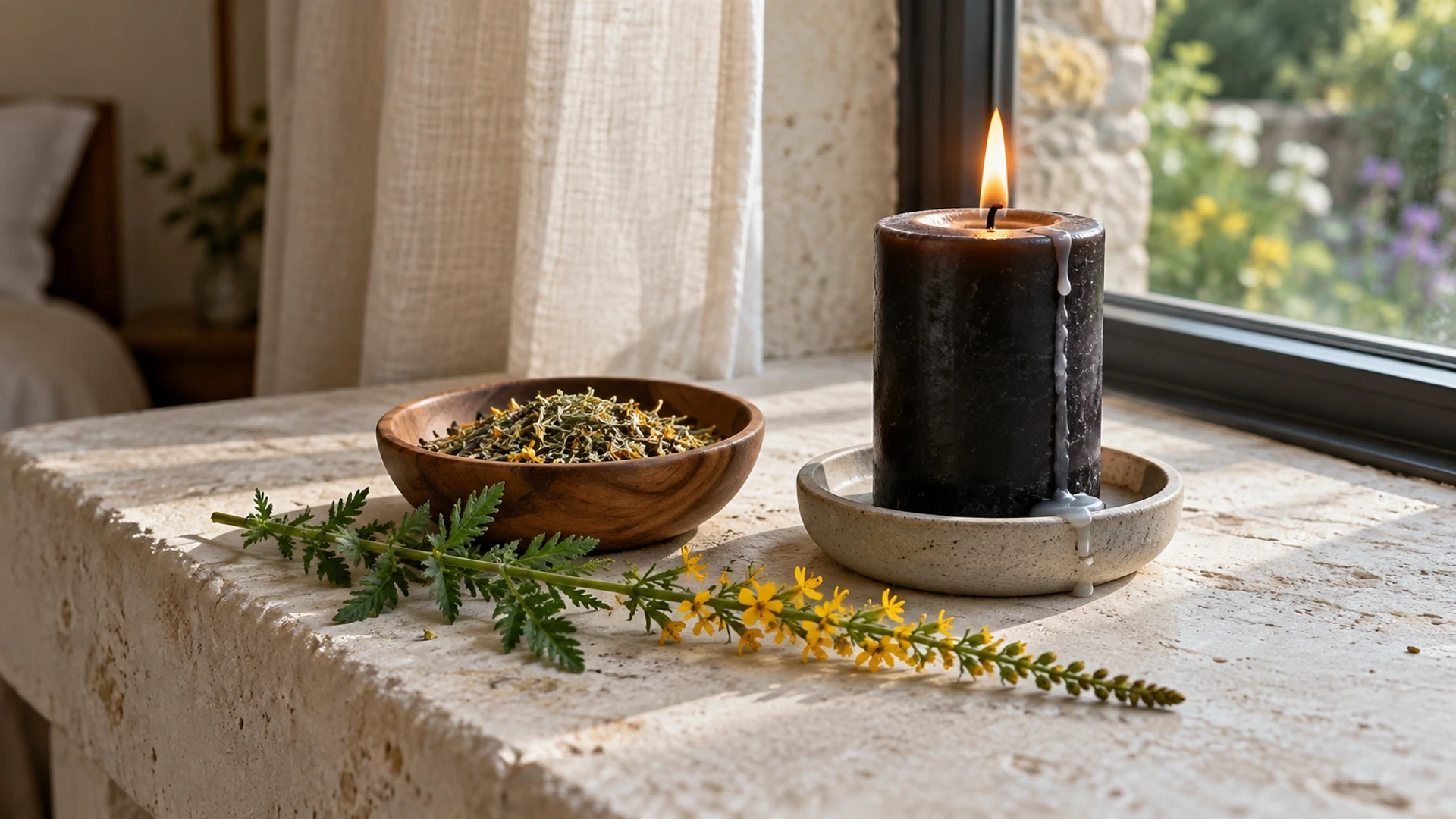
Agrimony (Agrimonia eupatoria) in Magic: Correspondences, Uses & Safety

Agrimony is one of those herbs that earns your respect the more time you spend with it. Agrimonia eupatoria — a slender, golden-flowered plant native to Europe and western Asia — has been tucked into sachets, brewed into protective washes, and burned in ritual spaces for centuries. It is not the flashiest herb in the cabinet, but in magic, reliability is its own kind of power. If you are building an herbal practice and looking for a plant that works hard across protection, cleansing, and reversal work, agrimony deserves a dedicated place in your collection. This guide will walk you through everything you need to start working with it confidently — its spiritual meaning, its correspondences, how to use it, its history, and what to watch out for.

The Spiritual Meaning of Agrimony

Agrimony carries a distinctive spiritual signature that sets it apart from other protective herbs. Where something like black tourmaline creates a hard wall, or rosemary burns away negativity with intensity, agrimony works through return and resolution. Its core spiritual quality is the ability to send back what does not belong to you — unwanted energy, psychic interference, curses, and emotional residue picked up from other people or environments. It does not just block. It redirects. That distinction matters when you are choosing the right tool for a working.


In many folk traditions, agrimony is understood as a plant of boundaries and truth. It has a long association with uncovering what is hidden — exposing deception, cutting through confusion, and restoring clarity to situations that have become muddied. This connects to its broader meaning as an herb of discernment. Working with agrimony spiritually is less about forceful defense and more about restoring right order: getting things back to where they should be, clearing the slate, and making sure what circulates in your space and your life actually belongs there.


There is also a quieter dimension to agrimony's spiritual character. Its folk name in some traditions is "church steeples" — a nod to its tall, pointed flower spikes — and it has historically been associated with rest, peaceful sleep, and release from worry. Spiritually, this connects to the idea of setting things down at the end of the day: releasing the accumulated weight of interactions, environments, and psychic noise so that you can return to your own center. Agrimony is an herb that supports the practice of energetic sovereignty — the ongoing work of knowing what is yours and releasing what is not.

Agrimony Correspondences and How to Apply Them

Understanding an herb's correspondences is how you learn to use it intelligently across different types of work. Correspondences are the symbolic and energetic associations that a plant carries — its planetary ruler, elemental alignment, and the magical intentions it supports most strongly. When you know agrimony's full profile, you can slot it into workings with real precision rather than just following a recipe you found online.


Here's the full correspondence profile at a glance:

  • Planet: Jupiter
  • Element: Air
  • Gender: Masculine
  • Deities: Jupiter, Zeus, Chiron
  • Magical properties: Protection, hex reversal, banishing, cleansing, sleep magic, truth-revealing
  • Associated crystals: Black tourmaline, amethyst, clear quartz, labradorite
  • Chakra: Solar plexus

Jupiter's rulership over agrimony tells you a lot about its energy. Jupiter is the planet of expansion, justice, and order — and agrimony's magic reflects all three. When you use it in reversal or hex-breaking work, you are not just swatting away something unpleasant. You are invoking a principle of cosmic justice: what was sent returns to its source, and right order is restored. That is a Jupiterian act. It also means agrimony carries an inherent optimism and generosity of spirit that some protective herbs lack. It is not aggressive. It is corrective.


Its elemental alignment with Air reinforces the herb's association with clarity, communication, and the realm of thought. Air herbs tend to work on the mental and psychic layers first — cutting through confusion, sharpening perception, lifting the fog that settles when you have been around too much negativity or emotional turbulence. This makes agrimony particularly useful in workings where you suspect psychic interference or emotional entanglement is clouding your judgment or draining your energy. Pair it with clear quartz to amplify the mental clarity aspect, or with black tourmaline when you want a stronger protective barrier alongside the reversal energy.


The solar plexus chakra association connects agrimony to personal power and self-trust. The solar plexus is the energetic seat of your identity, will, and confidence — and it is the chakra most commonly affected when someone feels drained, manipulated, or undermined by outside forces. Working with agrimony through this lens means using it to reclaim your sense of self-authority. If you have been in a situation that left you feeling depleted, second-guessing yourself, or unusually susceptible to other people's moods and demands, agrimony is a strong candidate for your practice.

How to Use Agrimony in Magic

Agrimony is an easy herb to work with practically. It is widely available in dried form, has a mild and pleasant scent, and is flexible enough to fit into most formats — from simple sachets to more complex ritual work. The key is to match the format to your intention so that the herb's energy is being directed in the most coherent way possible. Here are the main approaches, each with its own strengths.


Sachets and Mojo Bags
This is one of the oldest and most straightforward uses of agrimony. A protective sachet stuffed with dried agrimony — ideally combined with other protective herbs like mugwort, rue, or rosemary — can be placed under your pillow for sleep protection, carried in your bag for energetic shielding throughout the day, or hung near the front door to guard your home's threshold. If you are making a sachet specifically for sleep, add lavender to soften agrimony's protective edge and support relaxation. Set your intention clearly as you assemble it, pressing your will into the herbs as you work.


Incense and Smoke Cleansing
Dried agrimony can be burned on its own or blended into a loose incense for smoke cleansing a space. It is particularly effective when you are moving into a new home, clearing the residue of an argument or difficult visitor, or closing out a ritual space after shadow work. Because agrimony is associated with reversal and return, burning it while setting the intention that any energy not aligned with your highest good is returned to its source makes the smoke cleansing more active and targeted than a simple clearing. You are not just neutralizing — you are redirecting.


Herbal Baths and Floor Washes
Brewing agrimony as a strong tea and using it as a bath rinse or floor wash is a classic method from European folk magic. For a protective bath, steep a generous handful of dried agrimony in hot water for twenty minutes, strain it, and add the liquid to your bath. Visualize the infusion drawing out psychic residue, unwanted attachments, and any energy you have absorbed that is not yours, watching it all rinse away as you drain the tub. For a floor wash, use the same infusion diluted in a bucket of water and mop from the back of your home toward the front door, then out, symbolically sweeping what you do not want out of your space.


Candle Dressing
Agrimony pairs well with candle work, particularly for protection and reversal spells. Grind dried agrimony into a coarse powder and use it to dress a candle anointed with a protection or reversal oil — move the herb from the center of the candle outward if you are banishing, or toward the center if you are drawing something in. For hex-reversal work specifically, a black candle dressed with agrimony powder and dragon's blood oil is a strong combination. Let the candle burn in a single session if possible and hold your intention steady throughout.


Teas and Internal Preparations
Agrimony has a long history as a medicinal herb and can be consumed as a tea. From a magical perspective, drinking an herbal preparation is an act of internalization — you are taking the plant's energy into your body and asking it to work from the inside out. An agrimony tea drunk with intention before bed can support restful sleep and guard against disturbing dreams. Before any internal use, read the safety section of this guide carefully and speak with a qualified healthcare provider, especially if you are on any medications or have a health condition.


Spellwork and Ritual Use
In structured spellwork, agrimony shows up most powerfully in protection circles, reversal jars, and banishing rituals. For a simple reversal jar — a spell designed to send negative energy back to its source — layer dried agrimony with a mirror, black salt, and vinegar inside a sealed jar. Agrimony's Jupiter energy adds a note of cosmic justice to the working, reinforcing that what returns does so by right rather than out of spite. You can also incorporate agrimony into a Jupiter day working (Thursday) or during a waxing moon when your focus is building protective strength, or a waning moon when your focus is releasing and banishing.

Agrimony in the History of Magic

Agrimony has a documented magical and medicinal history stretching back thousands of years across multiple cultures. Understanding where an herb has been used — and how — gives you a deeper sense of what practitioners before you discovered through direct experience. It also grounds your modern practice in something real and tested.


European Folk Magic
In medieval and Renaissance Europe, agrimony was one of the most widely used protective herbs in folk magic practice. It appeared in herbal grimoires and household magic traditions alike, often prescribed for protection against witchcraft, evil spirits, and bad luck. One of its most persistent folk uses was as a sleep herb — bundles of agrimony placed under a pillow were said to induce such deep sleep that the sleeper would not wake until the herb was removed. This detail survives across multiple regional traditions and suggests the herb's sedative and psychically quieting properties were well-recognized. It also featured in Anglo-Saxon leechcraft, where it was combined with other herbs in preparations meant to ward off poisoning and malefic magic.


Ancient Greek and Roman Use
The ancient Greeks knew agrimony as eupatorion, a name that may reference Mithridates VI Eupator, a king of Pontus famous for his obsessive study of poisons and antidotes. Whether or not the etymology is accurate, the association is telling — agrimony was understood in the ancient world as a plant with protective and purifying qualities, particularly in the context of toxins and hidden threats. Dioscorides, the first-century Greek physician whose herbal became foundational to Western medical tradition, described agrimony's properties extensively. In both Greek and Roman contexts, the plant occupied a space where medicine and magic overlapped, used to treat internal complaints while also serving a symbolic role in protective preparations.


British Cunning Folk Tradition
In the British Isles, agrimony was a staple of the cunning folk — the herbalists, healers, and magical practitioners who served rural communities from the medieval period through the nineteenth century. Cunning folk used agrimony in their protective workings, particularly those designed to counter witchcraft laid against a client. It appeared in charm bags, protective powders, and ritual washes, often combined with herbs like rue, yarrow, and elder. This tradition is one of the most direct ancestors of modern Wiccan and contemporary witchcraft practice, which is partly why agrimony remains such a prominent herb in modern protective magic — it carries the accumulated authority of a very long line of working practitioners.

Safety Considerations for Working with Agrimony

Agrimony is generally considered a mild and low-risk herb, but responsible practice means knowing where the edges are before you start. Most topical and aromatic uses — sachets, incense, floor washes, and candle dressings — carry minimal risk for the average person. Handling dried agrimony is safe for most people, though anyone with known plant sensitivities or allergies to the Rosaceae family (which includes roses, strawberries, and apples) should exercise caution and test carefully before extended contact.


Internal use — teas or tinctures — requires more care. Agrimony contains tannins and has mild astringent properties, which means consuming it in large quantities or over extended periods could cause digestive irritation in sensitive individuals. It has traditionally been considered safe in moderate culinary or tea quantities, but this is not universal. If you are pregnant or breastfeeding, avoid internal use of agrimony without first consulting a midwife or healthcare provider. The same applies if you are taking blood-thinning medications, medications for blood sugar, or diuretics, as agrimony may interact with these.


As with any herb you plan to burn as incense, make sure your space is well-ventilated. Smoke inhalation in enclosed spaces is a consideration regardless of the herb being burned. If you have respiratory sensitivities or asthma, keep burn sessions short and work near an open window. None of these cautions should stop you from exploring agrimony — they should simply make you a more informed practitioner. Knowing your herbs thoroughly, including their limits, is part of what makes your practice genuinely powerful.

Continue Building Your Herbal Practice

Every herb you work with belongs to a broader category — cleansing, protection, attraction, or banishment — and knowing where a plant sits in that framework is what turns a shelf of dried botanicals into a real practice. If you're ready to see how Agrimony fits alongside the other foundational herbs, read Herbs in Magic: A Beginner's Guide to Magical Herbalism. It maps out the four core categories of herbal magic and walks you through the key plants in each one.

Start where you are, follow what calls to you, and trust that your practice will deepen with every plant you come to know.


FAQ - Agrimony in Magic for Beginners

What is agrimony used for in magic?

Agrimony is primarily used for protection, hex reversal, banishing, and sleep magic. It is one of the most reliable herbs for sending unwanted or hostile energy back to its source, clearing psychic residue from your space or your aura, and supporting deep, protected sleep. It also has an association with truth-revealing, making it useful when you need clarity in a confusing or deceptive situation.

Is agrimony a good herb for beginners?

Yes — agrimony is an excellent beginner herb. It is widely available in dried form, safe for most people to handle, flexible across many magical formats, and has a clear and consistent energy that is easy to work with intentionally. Its protective and cleansing properties make it immediately useful for anyone starting to build a practice, and it does not require complex ritual knowledge to use effectively.

What planet rules agrimony, and why does that matter?

Agrimony is ruled by Jupiter. In magical practice, planetary rulership tells you something about the energy and intention behind a plant. Jupiter governs justice, order, expansion, and protection — which is why agrimony's reversal and protective magic has a quality of restoring right order rather than simply striking back. Knowing this helps you time your workings (Jupiter's day is Thursday) and understand what kind of energy you are amplifying when you use it.

How do I use agrimony for protection?

There are several straightforward ways to use agrimony for protection. You can carry dried agrimony in a sachet or charm bag, burn it as loose incense to clear a space, add a strong brewed tea of it to your bath or floor wash to cleanse your home, or use powdered agrimony to dress a black protection candle. The method you choose should match your intention — a sachet is good for ongoing personal protection, while a floor wash is better suited to clearing and protecting a physical space.

Can I drink agrimony tea as part of a spell?

Yes, agrimony tea has a long history both as a medicinal drink and as part of internal magical work — particularly for sleep protection and psychic cleansing. That said, you should take some precautions before drinking it. Agrimony has mild astringent properties and may not be appropriate for everyone, especially if you are pregnant, breastfeeding, or taking certain medications. Consume it in moderate quantities, and check with a healthcare provider if you have any concerns.

What crystals pair well with agrimony in a spell?

The crystals most naturally aligned with agrimony are black tourmaline for strong protective shielding, amethyst for psychic clarity and dream protection, clear quartz for amplifying the herb's cleansing and clarifying energy, and labradorite for shielding against psychic interference and enhancing awareness. For a protection or reversal working, combining agrimony with black tourmaline is a particularly grounded and effective pairing.

When is the best time to do a spell with agrimony?

Because agrimony is ruled by Jupiter, Thursday is the optimal day of the week for working with it in ritual. For moon timing, a waning moon supports banishing, reversal, and releasing work — which is where agrimony shines most strongly. If your focus is building ongoing protection rather than removing something, the waxing moon is a better fit. You can also time work to planetary hours if you want to go deeper into astrological alignment.

Is agrimony the same as hemp agrimony?

No, these are two different plants. Agrimony (Agrimonia eupatoria) belongs to the rose family and is the herb covered in this guide. Hemp agrimony (Eupatorium cannabinum) belongs to the daisy family and is a different plant with different properties and a different magical profile. They share a common name element but are not interchangeable — always verify the full Latin name when sourcing herbs for magical or medicinal use to make sure you have the right plant.
May 16, 2026

About the Author — Claire

Claire is a New York-based magical practitioner and folklore researcher with years of study spanning mythology, astrology, tarot, herbalism, and grimoire traditions. She approaches magic as a disciplined practice rooted in will and intention — and writes about it with the same depth, honesty, and enthusiasm she brings to her own craft. Whether you're just starting out or deep in your practice, her articles give you real knowledge you can actually use.

More about the author →