Black Kyanite: The Stone With Two Strengths
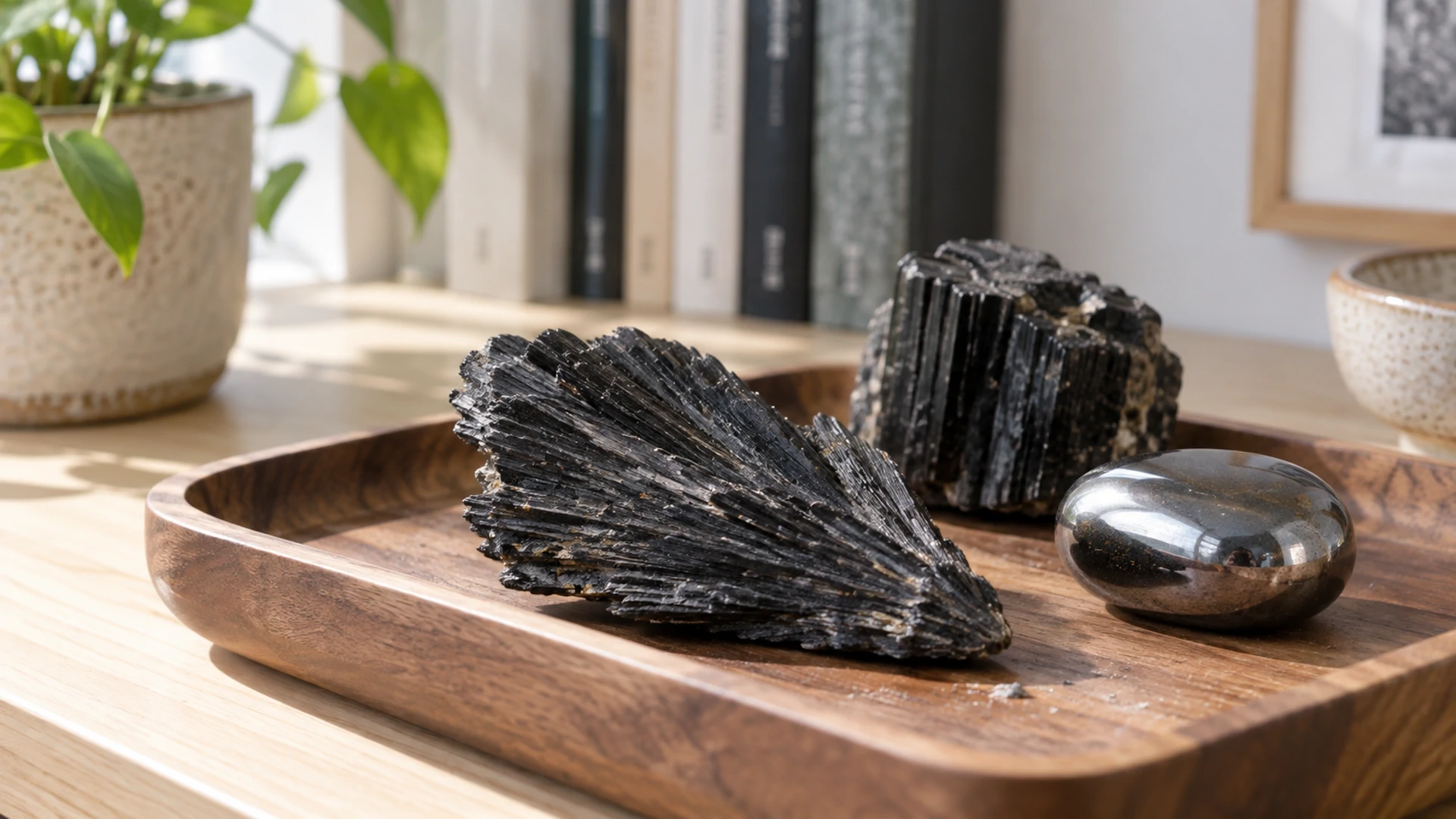
Black kyanite grounds and shields without ever accumulating negative energy — and it can clear other stones simply by proximity, a quality almost no other protection stone shares.
Disthene: Why Black Kyanite Belongs in Protection
Most dark protective stones earn their place through density, opacity, or planetary weight. Black tourmaline grounds first, then holds a boundary. Shungite absorbs and neutralizes, backed by a documented history as a genuine water purifier. Black kyanite's mechanism is different, and it comes directly from the stone's physical structure rather than its color or composition.
Kyanite is what mineralogists call anisotropic in hardness — meaning its resistance to scratching changes depending on which direction you test it. Run a steel point along the length of one of its blade-like crystals and it measures roughly 4.5 on the Mohs scale, soft enough to scratch. Turn the steel point ninety degrees and drag it across the blade instead, and the same material resists at a 6.5 to 7. Same stone, same crystal, two different strengths. This is so distinctive that the mineral's older name, disthene, is Greek for exactly that: two strengths.
That physical duality maps directly onto how black kyanite works as a protective tool. The hard axis — the direction it resists — corresponds to its grounding and shielding function. It plants you at the root chakra and holds a boundary around the field. The soft axis — the direction it yields — corresponds to something rarer: the stone doesn't grip what passes through it. Psychic residue, accumulated emotional charge, stray energetic debris — none of it adheres. Where black obsidian works as a mirror, reflecting and revealing, and smoky quartz transmutes what it touches, black kyanite simply doesn't hold on. It passes what it clears through itself and releases it, which is why the stone never needs energetic cleansing and why it can help other stones in its proximity stay clear too.
Its correspondences sit at Saturn and the Earth element, anchoring it firmly in the part of magical practice concerned with boundaries, structure, and grounded endurance. The root and earth-star chakras — the two lowest points of the energetic body, the ones most directly concerned with physical safety and connection to earth — are its primary zones of influence. Saturn governs what is solid, what holds form, what disciplines and endures. That energy runs through black kyanite's protective quality: it isn't dramatic or reactive, it's structural. It holds. It clears as it goes. It doesn't tire.
The Steel-Needle Test: Choosing and Handling Black Kyanite
The same anisotropic hardness that defines this stone's protective mechanism also gives you a simple, practical way to check whether what you're buying is genuine. A steel point — the tip of a steel nail works fine — drawn along the length of a kyanite blade will leave a visible scratch. Rotate the stone ninety degrees and draw the same point across the blade's width, and it won't. Most lookalike black stones can't reproduce that asymmetry, because most minerals have uniform hardness across their surface. If a black blade-shaped stone scratches the same in every direction, it almost certainly isn't kyanite.
Genuine black kyanite forms in long, fan-shaped or starburst clusters of blade-like crystals, sometimes called "fans" in the trade. These blades can look dramatic — almost architectural — but they're also structurally fragile along their length, which is the softer axis. This is not a stone to carry loosely in a bag with harder tumbled pieces. The blades can split or snap along their length with surprisingly little force. If you want to carry black kyanite on your person, a padded pouch or a dedicated pocket is worth it.
Water is a genuine concern here. Because of its directional softness and the fine internal structure of its blade-like crystals, black kyanite can degrade with repeated or prolonged water exposure. Brief, careful rinsing won't do significant damage, but soaking it is a bad idea, and regular water cleansing as a maintenance habit would gradually compromise the stone. Fortunately, this is rarely an issue in practice: black kyanite is one of the very few stones that genuinely doesn't need energetic cleansing by any method. Moonlight, sound, and smoke are all fine for a ceremonial reset if you feel the call to do it, but the stone is self-clearing by nature. You're maintaining a tool that maintains itself.
When selecting a specimen, look for clear blade definition and a consistent deep black or very dark gray. Some pieces will show a slightly greenish or brownish undertone in strong light — this is normal for the mineral. Stones that look uniformly matte black with no visible crystal structure are worth scrutinizing; true kyanite will usually show at least some hint of its fibrous, striated interior in good light. If a seller is marketing a smooth, rounded black tumble as kyanite, ask questions — the stone's natural form is bladed, not rounded, and while tumbled kyanite does exist, it loses the visual confirmation of its structure that makes identification easier.
Three Practices for a Stone That Never Needs Cleansing
The Aura Sweep
Use this practice after any working that leaves you feeling energetically heavy — after a difficult conversation, a demanding healing session, or a long day spent absorbing other people's emotional weather.
Hold a black kyanite blade loosely in your dominant hand, with the tip pointing downward. Starting above the crown of your head, pass the stone slowly down through the space just above your body — not touching the skin, but moving through the field just beyond it — from head to feet. Keep the motion deliberate and unhurried. You can work the front of the body first, then the back, or move down each side in turn. Let the stone's non-retentive quality do the work: what it meets, it doesn't keep. At the end, point the tip toward the earth and visualize whatever has been collected dispersing downward, returned to ground. The stone itself needs no cleansing afterward — this is part of what makes it well suited to this practice.
The Crystal Keeper
Use this practice to passively support the ongoing clarity of other stones in your collection, particularly the ones you use most often and most intensely.
Place one or more pieces of black kyanite in the same tray, shelf, or bag where you store your frequently used crystals. It doesn't need to touch them — proximity is enough. Black kyanite's self-clearing quality extends outward, helping neighboring stones shed accumulated charge without any active ritual on your part. Stones that typically require regular cleansing — black tourmaline, hematite, any stone you work hard — benefit from this kind of maintenance neighbor. You can combine this with a monthly intention check on your whole collection if you like, but the kyanite's contribution is ongoing and doesn't require your attention to function.
The Grounding Blade
Use this when you feel unmoored — scattered across too many demands, unable to settle, or physically ungrounded after dreamwork, travel, or intense meditation.
Sit comfortably on the floor or a chair with your feet flat on the ground. Hold a black kyanite blade in both hands with the tip pointing downward, or rest it flat against your lower abdomen near the root chakra. Close your eyes and breathe slowly, focusing your awareness downward — down through your feet, into the floor, into the earth below. Saturn's correspondences are useful to hold here: structure, weight, what holds its form. Let the stone's hardness along its protective axis remind you that a boundary can be firm without being rigid. Spend five to ten minutes here, or until you feel the quality of your attention change — less diffuse, more located in the body. You can time this to a Saturn hour on a Saturday for additional planetary alignment, though the practice works any time.
Two Strengths: The Naming of Kyanite
The mineral we call kyanite got its name in 1789, when the German mineralogist Abraham Gottlob Werner derived it from the Greek word kyanos, meaning deep blue. The name fit: most kyanite encountered in the mineralogical world of that era was the vivid blue variety, formed in metamorphic rock under high pressure alongside garnet and staurolite.
A more interesting name arrived twelve years later, in 1801, proposed by René-Just Haüy — a French mineralogist often described as one of the founders of modern crystallography. Haüy named the mineral disthene, from the Greek for two strengths, specifically to describe its directional hardness. He wasn't assigning metaphor. He was describing a measurable physical fact: this mineral is genuinely harder in one direction than another, and that anomaly was striking enough to him that he felt it deserved its own name, distinct from the color-based label Werner had given it.
In formal mineralogy, kyanite is now the accepted name. Disthene survives mainly in older French and German scientific literature, and in the occasional reference by collectors who know the stone's history. But the quality Haüy named is still there in every blade-shaped piece. A stone named twice, once for how it looks and once for what it does, is a stone whose defining property was visible enough that two different scientific traditions reached for it independently. That the same property now grounds a stone's protective mechanism in crystal magic is less a stretch of logic than a recognition that some things are genuinely distinctive enough to define everything else about how a material behaves.
Protection With Nothing to Clean
Black kyanite sits in the Protection category alongside some of the most robust shielding stones in the tradition — but its mechanism is quietly different from most of them. It doesn't absorb, so it doesn't fill up. It doesn't build a wall, so there's nothing to reinforce. It grounds and releases in the same motion, which means the maintenance burden most protective stones eventually demand simply doesn't apply here.
If you want to see how black kyanite fits alongside the other Protection stones — and how the six other stone categories compare to one another — The Crystal Compendium: Seven Paths to Stone Magic is the place to start.