Sunstone: Permission to Want Things for Yourself
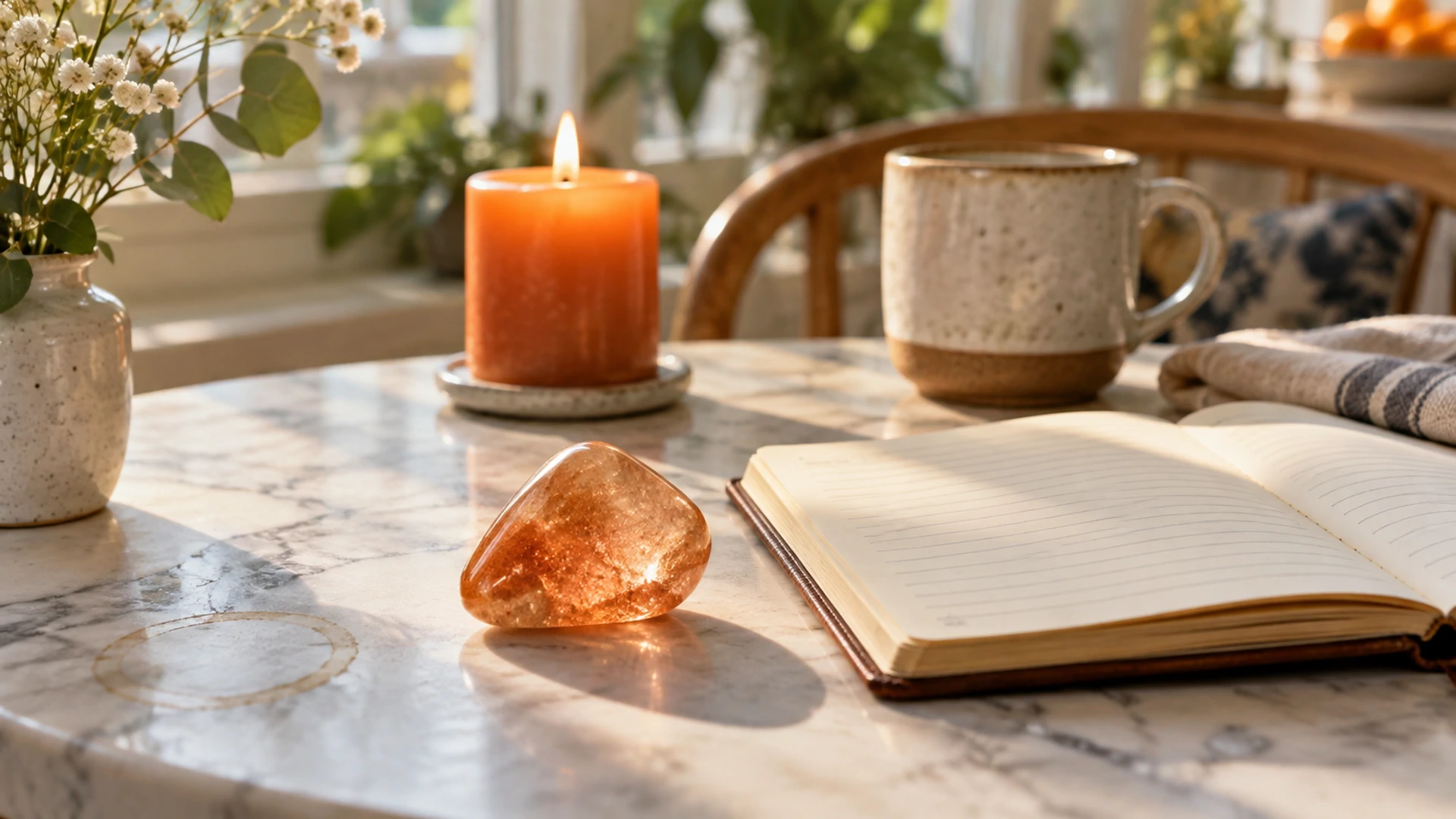
Sunstone is a feldspar gemstone whose internal shimmer comes from microscopic metallic inclusions — copper in Oregon specimens, hematite or goethite in most others. It belongs in the Empowerment category not because it's bold or fiery in the warrior sense, but because its specific work is restoring your ability to want things for yourself without guilt.
Permission to Want Things for Yourself: Why Sunstone Belongs in Empowerment
There's a kind of depletion that doesn't look like weakness from the outside. You're still showing up, still giving, still keeping things running for everyone around you. But somewhere in the process of being reliable and selfless and available, you stopped being a person with your own wants. You forgot what you even wanted. That's the specific territory sunstone works in, and it's why this stone belongs in the Empowerment category even though it doesn't share the aggressive, action-now energy of many of its neighbors.
Most empowerment stones operate on a more outward axis. Carnelian is immediate activation — it overcomes procrastination and hesitation and sparks bold, decisive action right now. Garnet is about rebuilding motivation after a setback, restoring drive specifically following failure or defeat. Sunstone is neither of those. Its mechanism is reclaimed personal sovereignty — specifically for those who've fallen into patterns of self-sacrifice or over-giving, restoring the ability to want things for yourself in the first place. It's an internal permission stone. The action comes after. First, you have to remember that you're allowed to want.
This lands in the solar plexus chakra, the seat of personal will and identity, but it also reaches into the sacral chakra, where desire, pleasure, and joy live. Both need to be functioning for this stone's work to be felt. The solar plexus is what lets you claim something as yours; the sacral is what helps you feel it as something worth claiming. When either is depleted — and chronic over-giving tends to hollow out both — the result is that muted, disconnected quality where you genuinely don't know what you want, even when someone asks directly.
Sunstone's elemental correspondence is fire, and its ruling body is the Sun. That combination tends toward warmth rather than combustion — it's the Sun as the source of light and life, not as scorching heat. The sign most commonly associated with this stone is Leo, which carries the themes of visibility, creative expression, and unapologetic self-presentation. All of that is consistent with sunstone's core function: it doesn't make you aggressive or loud, it makes you visible to yourself first. From there, you can decide how visible you want to be to others.
What makes sunstone stand out even among fire-and-solar-register stones is its specific emotional texture. It feels genuinely warm rather than urgent. People who work with it often describe a sense of lightness — something like joy returning after a long absence, or a quiet internal recognition that their own needs count. That quality is the stone doing exactly what it's meant to do. It's permission made tangible.
Copper Schiller or Treated Glass? Choosing Sunstone
When you're sourcing sunstone, the first distinction worth knowing is what's actually creating that shimmer. The technical term for it is aventurescence (sometimes called schiller in the trade), and it describes the glittery, metallic flash visible inside the stone when light hits it at the right angle. In most sunstone found worldwide, that effect comes from flat, reflective platelets of hematite or goethite suspended inside the feldspar. That material is entirely natural and genuine — the inclusions just happen to be iron-based rather than copper.
It's also worth knowing that "sunstone" is a trade name for an optical effect, not the name of a single mineral. The first specimens ever called by this name were oligoclase, a plagioclase feldspar. Since then, the same shimmering effect has turned up in labradorite, another plagioclase, and in orthoclase, a potassium feldspar that belongs to an entirely different branch of the feldspar family. So if you ask "what mineral is sunstone," there's no one clean answer. It's a handful of related but genuinely distinct feldspars that happen to produce the same visual effect, unified by that shimmer rather than by a shared chemical identity.
And while we're here: the word aventurescence itself has a stranger origin than you might expect. Italian glassmakers in Murano produced a copper-flecked glass by accident sometime in the 18th century and named it after the Italian phrase "a ventura" — meaning by chance. That glass became known as goldstone. When gem cutters later encountered the same glittering effect occurring naturally in quartz and in feldspar, they borrowed the glassmaker's name for it rather than coining a new one. The naming ran backward — a manufactured imitation gave its name to the natural stones it was imitating, sunstone included.
Oregon sunstone is different, and the difference is mineralogically specific. The gem-quality deposits in Oregon's high desert produce sunstone whose schiller comes from microscopic copper platelets rather than iron. Copper creates a warmer, sometimes more intense flash, and the stone can also carry natural color — from champagne and pale gold to deep red-orange — depending on how much copper is present. No other sunstone deposit in the world produces this combination of copper-based schiller and natural color in the same way. When you buy Oregon-origin material from a reputable seller, that origin should be disclosed explicitly.
The market issue to know about: some feldspar has been artificially diffused with copper to imitate the look of natural Oregon sunstone, and this material has circulated under invented trade names. The treatment isn't always disclosed. Natural material and treated material can look similar to the untrained eye, especially in finished jewelry. Buying from a seller who is transparent about both geographic origin and treatment status matters here more than with most stones. If a price seems too low for claimed Oregon sunstone with strong schiller and vivid color, that's worth questioning.
On the practical side, sunstone is a Mohs 6 to 6.5, which puts it in the durable-enough-for-jewelry range but softer than quartz. Brief water contact is fine — it's water-safe with no toxicity concerns — but you wouldn't want to leave it submerged for extended periods, and it won't appreciate sharp impacts or abrasive cleaning. A soft cloth is sufficient for polished pieces. Store it away from harder stones like quartz or topaz that could scratch its surface. Beyond that, it's a low-maintenance stone that asks very little of you in terms of care — which, given its job of restoring your attention to yourself, feels appropriate.
Three Practices for Reclaiming Your Own Joy
The Self-Permission
Use this when you've spent a long stretch prioritizing everyone else's needs and you've genuinely lost track of your own wants — not as a temporary forgetting, but as a settled pattern that needs to be actively named and reversed.
Hold your sunstone in your dominant hand and sit somewhere quiet. Before you do anything else, write down three things you want — not things you think you should want, not things that would be good for someone else, but things that are simply and purely for you. They can be small. The act of naming them is the practice. After you write them, read each one aloud while holding the stone, and follow it with the words: "I am allowed to want this." This isn't affirmation for its own sake — it's using the spoken word as a declaration, with sunstone as a witness to the shift. An orange candle lit before you begin helps reinforce the sacral-solar plexus connection this stone works through. Let it burn while you write and speak.
The Joyful Step Forward
Use this when you've deliberately kept yourself in the background — out of habit, out of fear, or because staying small felt safer — and you're ready to step into visibility or take on a role that requires you to be seen.
On a Sunday morning, during a Sun planetary hour, place your sunstone in front of you and spend a few minutes with your eyes closed, imagining yourself in the specific situation where you want to show up more fully. Don't imagine the outcome — imagine the moment of stepping forward, the feeling of your own presence in the room. When you open your eyes, pick up the stone and hold it against your solar plexus for a count of ten slow breaths. Carry it with you for the rest of the day, ideally in a pocket over your solar plexus if possible, as a physical anchor for that imagined moment of visibility. Do this on three consecutive Sundays before the situation you're preparing for.
The Giving Ledger
Use this as a regular check-in — monthly works well — to notice whether the balance between what you give to others and what you allow yourself has quietly tipped in a direction that's costing you more than you've acknowledged.
Sit with your sunstone resting on your solar plexus and a journal nearby. Draw a simple two-column page: on the left, write what you've given out in the past month — time, energy, resources, emotional labor, attention. On the right, write what you've allowed yourself to receive or keep for yourself in that same period. Look at the columns honestly. The point is not to manufacture guilt in either direction, but to see clearly. If the left column is significantly heavier, that gap is information. Use the stone's warmth as a prompt to identify one specific thing you can reclaim in the coming month — and write it down in the right column before you close the journal. Calendula placed on the table beside you while you do this reinforces the solar current this practice is working with.
Oregon's State Gem, Discovered in the High Desert
Oregon designated sunstone as its official state gemstone in 1987, a recognition that followed the discovery of a rich, gem-quality deposit at the Ponderosa Mine in the state's high desert roughly seven years earlier. The deposit is significant not just because of its scale, but because of what it produced: sunstone whose shimmer is driven by copper rather than the iron-based inclusions found in the material from every other major source. That makes Oregon the only known location in the world where this particular combination of feldspar and copper creates the stone's characteristic flash, and it gives Oregon material a geologically distinct identity, not just a marketing one.
The high desert setting matters too, at least for those who find that a stone's origin contributes to how they relate to it. This is not a gemstone from a long-established trade route or a storied ancient mine — it's American, Western, relatively recently discovered, and tied to open landscape rather than to the accumulated history of jewelry courts and royal collections. There's something fitting about a stone whose entire function is about permission and personal claim being found in a place associated with wide open space and the idea that there's room enough for what you want.
Sunstone as a material also turns up in Norway, India, Canada, and other locations, and that material has been used ornamentally and in the gem trade for a long time. But the documented metaphysical focus on sunstone's empowerment themes — and the distinct mineral story of the copper schiller — anchors most of the stone's modern identity to the Oregon deposits. That's the material you're most likely to encounter when you look for gem-quality, schiller-bearing sunstone, and it's worth knowing what you're actually holding when you hold it.
If you've been researching sunstone and keep running into references to Viking navigation, that's a separate story about a different material entirely. Several medieval Icelandic texts — most substantively Rauðúlfs þáttr, which describes a king using one to locate the sun through an overcast, snowy sky, and also Hrafns saga Sveinbjarnarsonar and Guðmundar saga góða — mention a crystal called sólarsteinn, Old Norse for sunstone. Modern researchers who've studied these references generally conclude that the medieval sólarsteinn was most likely a birefringent crystal such as Iceland spar (a transparent form of calcite) or cordierite, either of which can reveal the sun's position through polarized light even under full cloud cover.
Empowerment That Feels Like Joy
Most of what gets called empowerment in crystal work is about pushing forward: more courage, more drive, more decisive force. Sunstone is quieter than that. Its version of empowerment is the moment before the push — the internal recognition that you're allowed to have wants, that your own joy is a legitimate destination, that showing up for yourself is not a subtraction from what you give others. That's a smaller-sounding thing than it is. For a lot of people, it's the entire missing piece.
If you want to see where sunstone sits alongside the rest of the Empowerment category — and how all seven stone categories relate to each other — The Crystal Compendium: Seven Paths to Stone Magic is the place to go.