Candle Magic: Candlework in Modern Practice
What Is Candle Magic and Why Does It Work?
Candle magic is one of the most accessible, powerful, and beginner-friendly practices in all of modern witchcraft. If you have ever lit a candle with a wish in your heart, you have already touched the edge of it. Candlework takes that instinct and gives it structure, intention, and real force.
At its core, candle magic is a form of sympathetic magic — a practice built on the principle that symbolic action produces real-world effect when backed by focused will. The flame is not doing the work. You are. The candle acts as a focal point that holds your intention, keeps your attention fixed, and gives your willpower something to anchor to while it moves toward your goal.
This is what makes candlework so effective even for practitioners who are just starting out. You do not need years of training or an elaborate altar to begin. You need a candle, a clear intention, and the willingness to focus. The ritual structure around that — the color correspondences, the timing, the dressing and inscribing — exists to sharpen your focus and deepen your commitment to the outcome. Every element you add is another layer of intentional signal telling your mind, and the universe, exactly what you want.
Candle magic also works across an enormous range of intentions. Love, money, protection, banishing, healing, clarity, success — nearly every magical goal has a candlework approach that fits it. That versatility is part of why this practice sits at the center of so many traditions, from folk magic to ceremonial work to modern eclectic witchcraft. Whether you are performing a full ritual or a simple focused burn, candle magic delivers.
How Candle Magic Is Used in Modern Practice
Modern candlework is not a rigid system with one right way to practice it. It is a living toolkit that you can shape to your needs, your tradition, and your personal magical style. That said, there are some core techniques that show up again and again because they work — and understanding them will take your practice from good to genuinely powerful.
One of the most important concepts in modern candle magic is the dressed candle. Dressing a candle means anointing it with oil — usually an oil chosen for its correspondence to your intention. Prosperity workings might call for basil or cinnamon oil. Love spells might use rose or jasmine. The act of dressing physically links your energy and your goal to the candle. As you apply the oil, you are not just coating wax — you are imprinting intention into the tool you are about to ignite. The direction you apply the oil matters too: drawing oil toward yourself is used for attraction work, while pushing oil away from yourself is used for banishing or releasing.
Another foundational technique is the inscribed candle. Inscribing means carving words, symbols, sigils, or names directly into the wax before burning. This practice roots your intention into the physical body of the candle so that as the wax melts, the inscription is literally consumed by the flame — releasing that charged intention into the world. You might carve a name, a dollar amount, a sigil you designed, a planetary symbol, or a single powerful word. The act of carving is itself a spell. It demands precision and presence, which is exactly the mental state that makes magic effective.
Then there is the practice of charging a candle — and this is where the real magic lives. Charging means deliberately loading the candle with your intention before you ever light it. You might hold the candle in both hands, close your eyes, and spend several focused minutes pouring your desired outcome into the wax through visualization and breath. You might speak your intention aloud over it, pray over it, or pass it through incense smoke. Some practitioners charge candles under specific moon phases or planetary hours for an extra layer of timing correspondence. However you do it, charging transforms a plain candle into a magical instrument that carries your will.
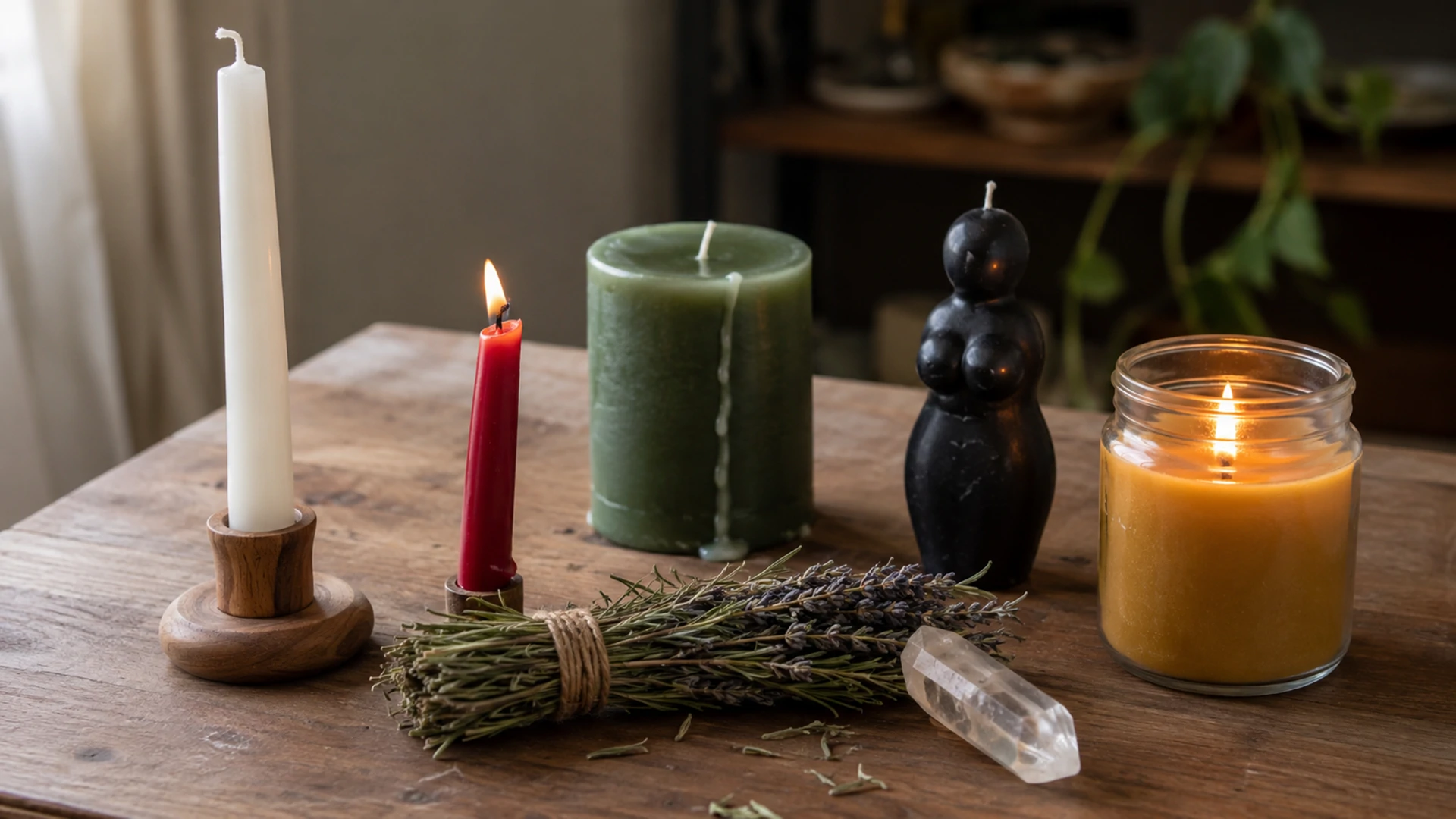
Beyond these three core techniques, modern candlework includes a rich range of related practices. Candle color magic assigns specific intentions to different colors — red for passion and vitality, green for money and growth, black for banishing and protection, white for purification and clarity, and so on. Practitioners work with different candle formats too: taper candles for long ritual burns, chime candles for quick focused workings, pillar candles for sustained multi-day spells, and figural candles — shaped like human figures, hearts, or skulls — for highly targeted sympathetic workings.
Reading the flame and the wax after a burn is also part of the practice. A tall steady flame is generally seen as strong forward momentum. A flickering or struggling flame may suggest interference or the need for more clarity in your intention. Wax drips, the way leftover wax pools or hardens, and the residue left in a candle jar all become part of how experienced practitioners assess a working and decide what, if anything, to do next. Candlework is a conversation — and paying attention to what it tells you back is part of becoming skilled at it.
The History of Candle Magic Across Cultures
Candlework is not a modern invention. The use of fire, flame, and light as a medium for magical and spiritual intention is one of the oldest and most consistent threads running through human ritual practice. Long before birthday candles or church votives, flame was understood to be a living thing — a force that carried prayers, manifested will, and bridged the gap between the material world and something beyond it.
Ancient Egypt offers some of the earliest and most sophisticated examples of flame used in magical ritual. Egyptian magical practice was highly developed and deeply integrated with spiritual life. Lamps and flames were used in ritual contexts to invoke deities, protect the living, and guide the dead. The famous magical papyri of Greco-Roman Egypt — a collection of spell texts that survived into the modern era — contain numerous lamp divination spells in which a flame was used as a focus for scrying and for summoning divine presence. In these workings, the light itself was treated as a living conduit, anointed with specific substances and addressed with spoken invocations. The principle is the same one you use when you dress and charge a candle today: the flame carries your will forward when you prepare it with intention.
Ancient Rome contributed enormously to the candlework tradition through its culture of votive offering and household spiritual practice. The Romans maintained sacred flames in temples — most famously the eternal flame of Vesta, goddess of the hearth, tended by the Vestal Virgins — and in private homes through the cult of the Lares and Penates, the household gods. Small oil lamps were lit at domestic shrines daily as offerings and petitions. When Romans wanted something — health, victory, love, protection — they made offerings with flame at shrines dedicated to the appropriate deity. This is the direct cultural ancestor of the votive candle tradition, and it reflects the same core logic that runs through modern candle magic: a lit flame is an act of focused petition backed by physical offering.
Hoodoo and African American folk magic represent one of the most direct and influential lineages behind the way candle magic is practiced in America today. Hoodoo is a practical folk magic tradition rooted in the African diaspora, drawing on Central and West African spiritual practices, European herbal and ceremonial magic traditions, and Native American plant knowledge. Candle magic became a central pillar of Hoodoo practice, particularly through the use of vigil candles — large glass-encased candles, often dressed and prayed over — to work petitions for love, money, court cases, and protection. The practice of dressing candles with condition oils specific to the working, pairing them with curios and herbs, and reading the burn for signs of success or obstruction is deeply rooted in Hoodoo tradition. Much of what you see in modern candle magic — especially in American witchcraft — carries this lineage directly, whether practitioners acknowledge it or not.
What all three of these traditions share is a recognition that flame is not passive. It is active, alive, and responsive. When you bring intention to fire, you are participating in one of the oldest magical acts in human history. Candlework is ancient — and it is also yours to practice right now, today, with whatever you have at hand.
How to Start Your Candle Magic Practice
If you are new to candle magic, the most important thing to know is this: you already have everything you need to begin. A single white candle covers almost any intention. White is the all-purpose color in candle magic — it can stand in for any other color, and it carries correspondence with clarity, purification, and truth. Start there.
Before you light anything, get clear on your intention. This sounds simple, but it is the step most beginners skip and most experienced practitioners return to first. Vague intentions produce vague results. Instead of thinking "I want more money," try "I am calling in a specific financial opportunity that allows me to cover my rent and build savings." The more precisely you can feel the outcome — not just think it, but feel it as already real — the more force your working carries.
Once you have your intention, decide on your approach. Are you working a simple focused burn where you light the candle, hold the intention, and let it burn? Are you dressing the candle with oil? Carving a sigil or word into the wax? Working with a specific color correspondence? Timing your working to a moon phase or day of the week? Each of these choices adds a layer. You do not need all of them at once. Build your practice one technique at a time so that each element you add is something you genuinely understand and connect with.
Journal your workings. Write down the date, the moon phase, the candle color, what you did to prepare it, how the flame behaved, how the wax settled, and what happened in the days and weeks that followed. This record becomes your most valuable magical tool over time. Pattern recognition built from your own documented experience is how you develop real skill and real confidence in your practice.