Candle Dressing: The Complete Guide to Oils, Herbs & Intent
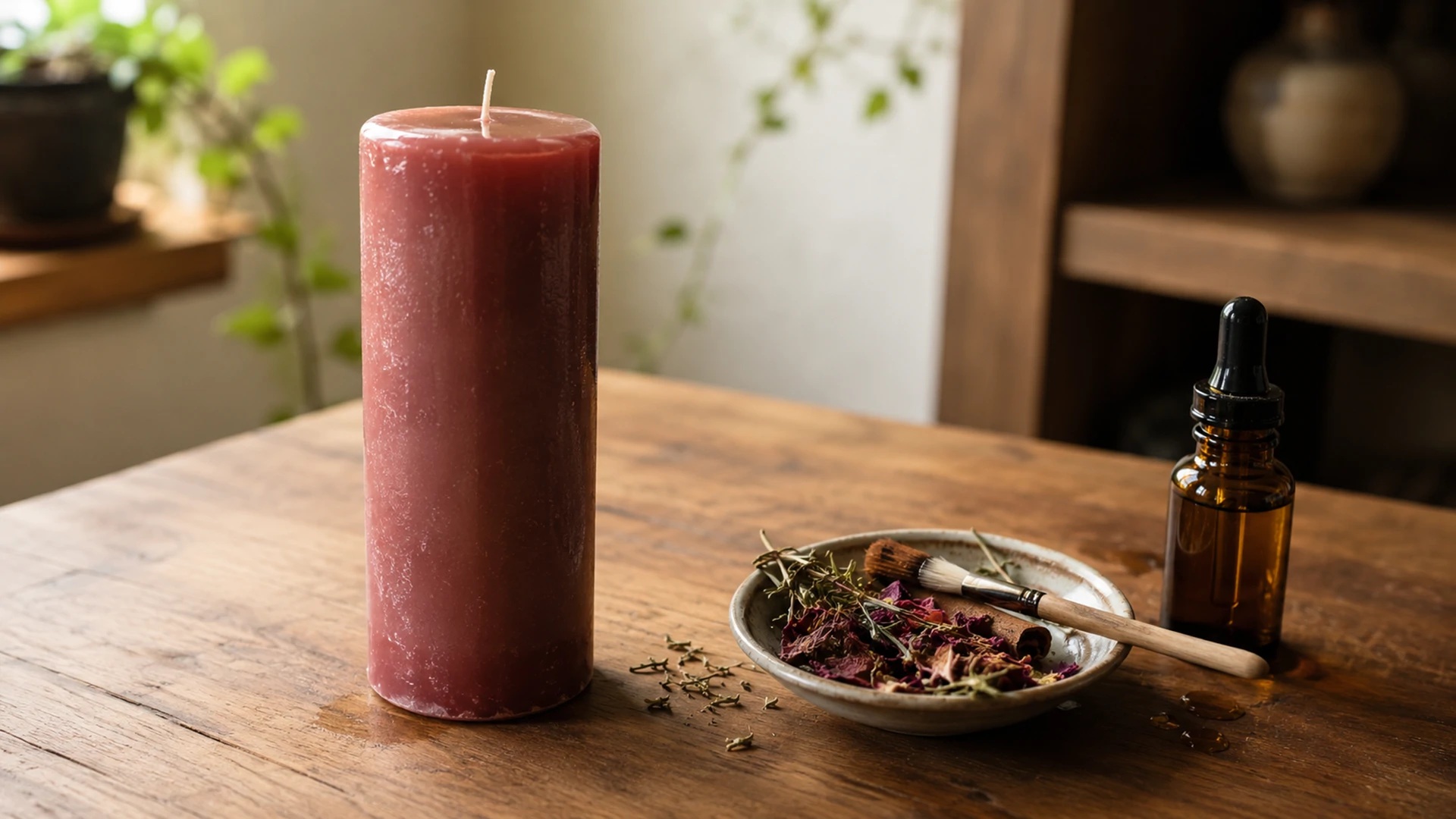
Candle dressing is one of the most effective things you can do to level up your candle magic. At its core, dressing a candle means anointing it with a carrier or ritual oil — and optionally rolling it in herbs, ground resins, or powders — before you burn it in a spell or ritual. The process physically marks the candle as yours, imprinting your intention into the wax and creating a multi-sensory anchor for your will. If you want your candle to do more than just burn, dressing it is where that transformation starts.
What Candle Dressing Does for Your Practice
A plain candle is neutral. It holds no particular energetic direction on its own. When you dress a candle, you are doing something very specific: you are using a combination of symbolic materials and focused intention to turn a generic object into a precise ritual tool. The oil, herbs, and your hands-on contact all serve as layers of correspondence that tighten the signal of your working.
From a practical magic standpoint, dressing works because of correspondences — the doctrine that certain plants, oils, colors, and substances carry inherent sympathetic qualities that resonate with specific magical goals. When you choose a rosemary-infused oil for a protection candle, or roll a candle in cinnamon for a money-drawing working, you are stacking symbolic material that all points in the same direction. The more layers of aligned correspondence you build into a working, the more focused and potent it becomes.
Beyond the symbolic layer, dressing is a tactile, intentional act. The physical contact — running oil along the wax, pressing herbs into the surface — is not just preparation. It is part of the ritual itself. Every motion is an opportunity to hold your intention clearly in mind and pour that focus into the object you are about to burn. This is why dressing cannot be rushed or done mindlessly. The candle becomes what you make it during this process.
Dressing also gives you enormous creative flexibility. You are not locked into one oil, one herb, or one method. A simple anointing with olive oil and clear intention is entirely valid. So is a more elaborate dressing using a custom-blended ritual oil matched to planetary timing, rolled in a specific herbal powder, and finished with a dusting of ground resin. You can scale the complexity to match the working and your own practice. What matters is that every choice is deliberate. And if you want to take your preparation even further, dressing pairs powerfully with inscribing your candle with symbols or words and charging it before the working begins — each layer compounds the one before it.
How to Dress a Candle: A Step-by-Step Walkthrough
Before you touch the oil, you need to be clear on what this candle is for. Not vaguely clear — specifically clear. Define the goal of your working in one direct statement. "I am drawing financial abundance" is better than "I want more money." "I am shielding my home from harmful energy" is better than "protection." That precise intention is what you will hold in your mind through every step of the dressing process. Write it down if that helps anchor it.
Start by choosing your oil. For most workings, you have two main options: a pre-made ritual oil blended specifically for a magical purpose, or a carrier oil — like fractionated coconut, jojoba, or sweet almond — that you empower yourself with intention. If you are using a carrier oil, you can enhance it by adding a few drops of an essential oil with matching correspondences. For love work, try rose or jasmine. For protection, try frankincense or cedar. For money and prosperity, try patchouli or cinnamon. The carrier handles the physical application; the essential oil sharpens the energetic direction.
Now pick up your candle and pour a small amount of oil into your palm. The direction you apply the oil is one of the most well-known variables in candle dressing, and it comes down to two schools of thought. Anointing from the center of the candle outward toward both ends is traditionally used for drawing — pulling something toward you. Anointing from both ends inward toward the center is traditionally used for banishing or releasing — pushing something away. Some practitioners always anoint top to bottom and consider that drawing, bottom to top as releasing. What matters most is that you choose a method, understand what it means in your system, and apply it consistently.
As you apply the oil, keep your intention fully in your mind. Do not let your thoughts drift. This is an active meditative state, not daydreaming while going through the motions. Speak your intention aloud if that helps ground it — a short declarative statement repeated as you work is enough. You are not reciting a script. You are just keeping the channel open and pointed in the right direction. Run the oil across the entire surface of the candle — the sides especially, and if you are working with a taper or pillar, make sure you have even coverage.
If you are adding herbs, prepare them on a flat surface — a piece of parchment or a shallow dish works well. You can use dried herbs, ground powders, crushed resins, or a combination. Choose herbs whose magical properties match your goal. Lavender and chamomile for calm and peace. Basil or cinnamon for prosperity. Rosemary or rue for protection and cleansing. Rose petals or vanilla for love. Once your oiled candle is ready, roll it gently across the herb mixture, pressing lightly so the herbs adhere to the oil-coated surface. You do not need a thick crust — a light, even coating is enough.
Once the candle is fully dressed, set it in its holder and take a moment before you light it. This is a good time to speak your intention one final time, visualize your desired outcome clearly, and consciously signal to yourself that the preparatory phase is complete and the working is beginning. Some practitioners breathe on the candle at this point, or hold it briefly between both palms, as a final act of imprinting before the flame takes over. Then light it with full presence and let the working unfold.
What to Avoid When Dressing a Candle
The most common mistake is going through the motions without mental engagement. You can follow every step perfectly and still produce a hollow result if your mind is scattered. Dressing a candle without genuine focused intention is like sending an email with no subject and no body — technically performed, but meaningless. If you sit down to dress a candle and realize you are distracted or emotionally disconnected, wait. Come back when you can be fully present.
Avoid mixing conflicting intentions in a single dressing. This happens more than you might expect when people try to combine goals — dressing one candle for both love and money, or for protection and banishing simultaneously. Each of those is a distinct working with its own energetic direction. If you have multiple goals, dress separate candles for each. Trying to stack unrelated intentions into one candle muddies the signal and weakens both outcomes.
Do not overload the candle with herbs to the point where combustion becomes a hazard. A heavy coating of dry plant material around a burning flame is a fire risk, full stop. Keep herb coatings light and use a heat-safe candle holder with a wide base to catch any material that falls off as the candle burns. Never leave a heavily dressed candle burning unattended. This is not a fear-based warning — it is just practical safety that lets your ritual actually complete without incident.
Be careful about using essential oils undiluted directly on the candle wax. Most essential oils are flammable, and applying them neat — especially in large quantities — raises the risk of a flare-up when the candle reaches that part of the wax. Always dilute essential oils in a carrier before applying them. A few drops of essential oil in a teaspoon of carrier oil is the right ratio for dressing. More is not better here. Citrus oils such as bergamot and lemon carry an extra risk on top of general irritation — they increase your skin's sensitivity to sunlight, so wash your hands after handling them undiluted, even if you plan to spend the rest of the day inside.
Finally, avoid using random materials that have no intentional correspondence to your goal. Every element you add to a dressed candle should be chosen deliberately. Throwing in whatever herbs are sitting on your altar because they look pretty is not candle dressing — it is decorating. The power in this practice comes from the precision of your choices, not the quantity of materials.
The Historical Roots of Candle Dressing
Candle dressing as a codified ritual practice has clear roots in Hoodoo, the African American folk magic tradition that developed in the American South from a synthesis of West African, Indigenous American, and European influences. In Hoodoo, dressing a candle — known as "fixing" it — is standard practice before any candle ritual. Practitioners apply condition oils (ritual oils blended for specific purposes like love, luck, or crossing) and roll candles in corresponding herbs or powders. The practice is deeply pragmatic: every component is chosen with surgical precision to match the working's goal, and the act of dressing is considered inseparable from the spell itself.
In ancient Rome, ritual use of oils in sacred contexts was common and well-documented. Priests anointed altars, offerings, and sacred objects with olive oil and infused oils as an act of consecration — setting them apart from the mundane world and dedicating them to a divine purpose. While Romans did not dress candles in the exact modern sense, the underlying logic — that anointing with oil sanctifies and directs an object's purpose — is the same principle that governs candle dressing today. The ritual grammar is continuous across millennia.
In the ceremonial magic traditions of medieval and Renaissance Europe, particularly those documented in grimoires like the Key of Solomon, the preparation of ritual tools through anointing, fumigation with herbs, and spoken consecration was considered mandatory before any working. Candles, wands, and ritual implements were anointed with oils corresponding to the planetary forces being invoked. An oil worked under Jupiter for abundance, one under Mars for conflict magic, one under Venus for love. This planetary correspondence framework — applying specific oils to align a tool with specific forces — flows directly into the way many modern practitioners approach candle dressing today.
Keep Building Your Candle Magic Practice
You now have a complete framework for candle dressing — what it is, why it works, how to do it with real precision, what to watch out for, and where the practice comes from. The core principle to carry with you is simple: every choice you make when dressing a candle is an act of will. The oil, the herbs, the direction of application, the intention you hold in your mind — all of it is you shaping the working before the flame even catches.
Dressing is one layer of candle preparation, and it works best when it sits inside a fuller ritual context. If you want to go deeper — including how to choose the right candle color for your working, how to inscribe symbols and words into the wax, and how to charge a candle before you light it — the full picture is laid out in the complete guide to preparing candles for magic. Dressing is powerful on its own. Combined with inscription and charging, it becomes something else entirely.