Candle Types for Magic: Complete Guide
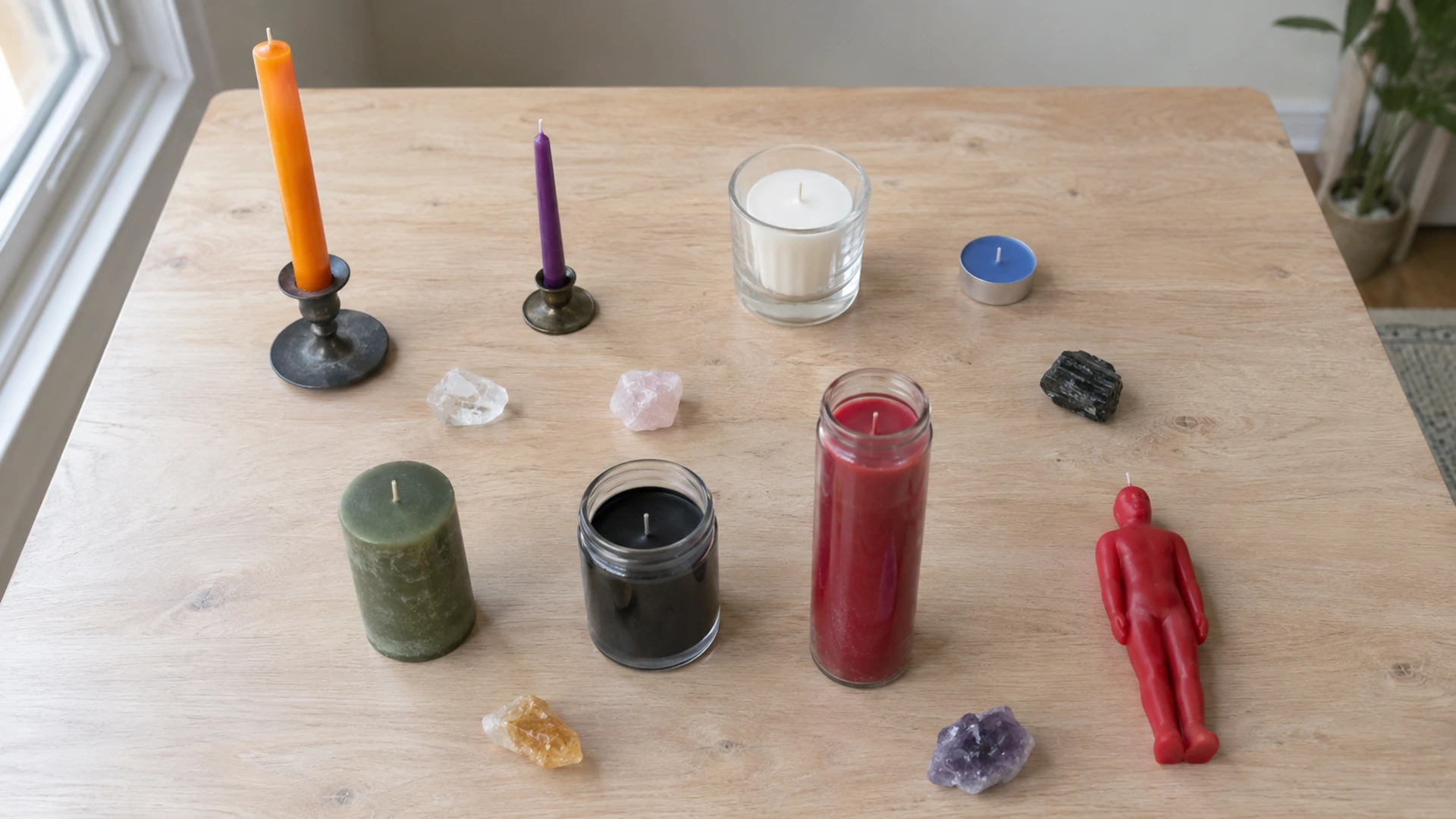
When most people start working with candle magic, they focus almost entirely on color. Color matters — a lot — but it's only half the picture. The types of candles you use for spellwork matter just as much, because the physical format of a candle determines how it burns, how long your working stays active, and what symbolic role the candle can play in your ritual. Choosing the wrong format for your intention doesn't ruin a spell, but choosing the right one sharpens it considerably. This guide covers every major candle type used in modern magical practice, why each one works the way it does, and exactly what kinds of workings each format is built for.
Why Candle Shape and Format Matter in Spellwork
The most practical reason candle format matters is burn time. A chime candle burns out in under two hours. A seven-day vigil candle burns for — you guessed it — up to a week. These are not interchangeable formats. A working that requires sustained energetic pressure over several days needs a candle that can hold the flame that long. A quick-fire intention working — banishing something fast, sending a burst of energy, amplifying a single focused moment — benefits from a short, concentrated burn. Matching burn time to working duration is the first and most concrete reason to think carefully about format before you ever light a match.
The second factor is wax volume and vessel type. An open-flame candle (a taper, a chime, a pillar) burns freely and releases its energy outward into the space around it. A contained candle — a jar, a votive in a holder, a tealight in a cup — concentrates the flame and keeps the wax and any added materials (herbs, oils, petition papers) enclosed. Contained formats are better for workings where you want the energy held and built up over time, or where you've loaded the vessel with additional materials that need to stay in place. Open-flame formats are better for workings where you want energy moving, radiating, or being sent outward.
The third factor is shape as a tool for sympathetic magic — the practice of using a physical object to represent a person, relationship, desired outcome, or situation. Sympathetic magic works on the principle that a symbol of a thing can carry the intention directed at that thing. A human-shaped figural candle can represent a specific person. Two candles placed close together can represent a union. A candle carved with someone's name becomes, in the working, an energetic stand-in for that person. Shape makes this symbolic layering possible in ways that a plain cylinder cannot.
When you're choosing a candle format, run through these three questions: How long does this working need to stay active? Do I want energy moving outward or held and built? Does the shape of this candle need to represent something specific? Your answers will tell you what format to reach for — not the one that looks prettiest on your altar.
Taper Candles: Spiritual Meaning and Best Uses
Taper candle magic is some of the most widely practiced candle work in Western magical traditions, and for good reason — tapers are versatile, easy to work with, and available in virtually every color. A standard taper runs 10 to 12 inches tall and burns for roughly 6 to 10 hours, though dinner tapers and smaller versions vary. They require a holder that catches dripping wax, and their long, narrow form makes them well-suited for inscription work — carving names, sigils, symbols, or words of intention directly into the wax before burning.
Tapers are the classic altar candle. They work well for single-session rituals, petition workings, deity or ancestor offerings, and spells that need a meaningful burn time without requiring days of continuous flame. Because they drip, wax reading — the practice of interpreting how melted wax flows and pools — is a natural part of working with tapers. Many practitioners watch the drip patterns as a form of divination during or after the working.
Tapers pair naturally with dressing with oils and herbs because the open wax surface gives you room to coat the candle thoroughly and press botanical material into it before lighting. They're a solid all-purpose format — if you're not sure which type to reach for, a dressed and inscribed taper in the right color is rarely the wrong choice.
Chime Candles: Spiritual Meaning and Best Uses
Chime candle magic is built for speed. Chime candles — also called spell candles or mini tapers — are small, thin candles about 4 inches tall that burn completely in roughly 1.5 to 2.5 hours. They fit standard chime candle holders and are sold in large multipacks, which makes them economical for practitioners who burn frequently. Because they're small, they don't offer much surface area for inscription, but they take oil dressing easily and can be rolled in finely ground herbs before use.
The short, complete burn of a chime candle is its defining magical feature. When you want a working to complete itself in a single sitting — a quick petition, a focused intention release, a candle burned during a short meditation or prayer — a chime candle is ideal. The fact that it burns all the way down without needing to be extinguished and relit means your working runs its full course in one uninterrupted session. There's a completeness to that which longer-burn formats can't quite replicate.
Chime candles are also popular in multi-candle arrangements — burning several in a pattern, one for each element of an intention, or one per day for a short working series. Their affordability and availability in every color makes them a staple format for practitioners who work regularly and want options without significant investment.
Votive Candles: Spiritual Meaning and Best Uses
Votive candle magic draws on centuries of religious practice — the word "votive" literally means "offered in fulfillment of a vow," rooted in the Latin votum. Before they became a staple of modern magical practice, votive candles were burned in churches and temples as offerings and petitions to the divine. That history still carries weight in how they're used magically today. A standard votive is roughly 2 inches tall and 1.5 inches wide, with a burn time of 10 to 15 hours. They're designed to be burned in a snug holder, which contains the wax as it liquefies.
Because they sit low and contained, votives are well-suited for sustained single-purpose petitions — intentions you want to hold steady over an extended burn without needing a full multi-day commitment. They work especially well on devotional altars, where a candle is burned regularly as an offering or to maintain an ongoing connection with a deity, ancestor, or spiritual practice. Their small size also makes them easy to work with in groups: burning several votives simultaneously, each in a different color corresponding to a different aspect of your intention, is a clean and effective technique.
Because votive wax is designed to fully liquefy when burned in a proper holder, you can add a drop of charged oil to the melted pool during burning to reinforce the working. Avoid burning a votive without a holder — it will collapse and spread as the wax melts, which is a fire hazard and a mess.
Tealight Candles: Spiritual Meaning and Best Uses
Tealight candle magic is the art of working with the smallest practical flame. Tealights are tiny — typically about 1.5 inches in diameter and less than an inch tall — housed in thin aluminum or clear plastic cups. They burn for 3 to 5 hours and are widely available in both scented and unscented versions. Unscented is generally preferred for magical work so you can control the aromatic element yourself with oils or incense rather than having it predetermined.
Tealights are the most accessible candle format in practice, and that accessibility has real magical utility. Because they're cheap, plentiful, and self-contained, they're ideal for workings where you need multiple flames at once — casting a circle of light, placing one candle at each cardinal direction, creating an illuminated grid around an object, or burning one as a simple daily offering without using up a larger candle. They're also a good choice when you want a candle present but contained — the aluminum cup keeps the wax enclosed and makes them safer on flat surfaces.
Tealights are less suited for workings that benefit from inscription or heavy dressing, simply because their surface area is minimal. But you can place a dressed tealight on top of a written petition, or float them in water with herbs and flowers for water-element workings. Their simplicity is part of their power — sometimes the intention and the flame are all you need.
Pillar Candles: Spiritual Meaning and Best Uses
Pillar candle magic offers something no other format quite matches: a long, sustained, open-flame burn with a significant wax body you can work with extensively. Pillars are freestanding candles — typically 2 to 4 inches in diameter and 3 to 9 inches tall — that don't require a traditional holder, just a heat-safe plate or tray to catch drips. Burn times range from 40 to 100 hours or more depending on size, which makes pillars the go-to format when you want an open-flame working that extends across multiple sessions.
Because the wax body is thick and substantial, pillars give you room to work. You can carve deep inscriptions, press herbs or crystals into the surface, dress the exterior thoroughly with oil, and return to the candle across multiple sessions without it burning away too quickly. This makes pillar candles well-suited for longer-arc intentions — spells for gradual change, ongoing protection, extended manifestation work — where you want to tend the working over days or weeks rather than in a single sitting.
Pillar candles are also visually striking on an altar, which matters more than it might sound. A candle you find compelling and meaningful to look at is a candle you'll engage with more intentionally every time you work with it. That sustained attention is part of what makes the working effective. When burning a pillar across sessions, always trim the wick to about a quarter inch before relighting, and never leave it burning unattended for extended periods — the open flame and wax pool on a large pillar deserve the same respect you'd give any sustained fire.
Jar and Container Candles: Spiritual Meaning and Best Uses
Jar candle magic is particularly powerful for contained, building workings — intentions you want to accumulate energy rather than release it outward. A jar candle is any candle with its wax poured directly into a glass or ceramic container, with a single wick. Burn times vary enormously by size, from a few hours for small vessels to 40 to 80 hours for a large mason jar candle, and upward of 150 hours for very large containers. The defining feature isn't the burn time — it's the containment. The flame, the wax, and everything you've loaded into the vessel (herbs, crystals, a rolled petition paper buried in the wax before pouring) all stay enclosed within the jar.
This containment makes jar candles ideal for workings where you want the energy sealed and focused: honey jar spells, where a candle is burned on top of a sweetening jar to draw someone closer; loaded candle workings, where the vessel itself holds layers of magical material; and protective workings where you want a sealed energetic barrier rather than an outward broadcast. The glass also makes it easier to observe the flame and watch for signs — a strong, steady flame versus a flickering or smoking one can tell you something about how the working is progressing.
Never leave a jar candle burning when you're not present, especially if it's been loaded with dry botanical material. Herbs near a wick are a fire risk. If you're adding plant material to a jar candle, keep it well below the wax line and make sure there's enough clean wax above it to prevent the herbs from catching directly.
Seven-Day Candles: Spiritual Meaning and Best Uses
Seven-Day candle magic is its own distinct practice, not just a longer version of jar candle work. While seven-day candles do come in glass containers, what defines them isn't the vessel — it's the commitment. A seven-day candle is a tall, cylindrical glass-encased candle designed to burn continuously for five to seven days. The practice of burning them without interruption over that span connects directly to the vigil candle and novena traditions of Catholic and folk Catholic practice, where a candle was lit and tended for nine days as a sustained petition to a saint or sacred figure. That tradition of showing up every day — maintaining the working, returning to it with renewed intention — is the spiritual core of seven-day candle use.
Seven-day candle spells are the right format for intentions that require sustained energetic pressure over time: court case work, where you need an outcome to develop across days or weeks; healing workings that support a gradual recovery; long-term protection that needs to stay active rather than fire once and fade; and large-scale manifestation work where the intention needs to be fed daily. The extended burn is itself part of the magic — your repeated attention and intention during that week reinforces and deepens the working every time you engage with it.
Tending a seven-day candle means checking on it at least once a day. Traditional candle readers — practitioners who interpret burn signs as omens and messages — pay close attention to how a seven-day candle burns. An even, clean burn with a steady flame is a strong positive sign. Soot building on the inside of the glass, especially black soot near the top, can indicate resistance or interference. An early burnout — the candle exhausting itself in three or four days — is read by many practitioners as the working either completing quickly or burning through significant opposition. A flame that barely holds on suggests the working needs reinforcement. These aren't superstitions — they're a framework for staying in relationship with your working rather than just setting and forgetting it.
If a seven-day candle extinguishes on its own before the wax is gone, relight it with clear, renewed intention. Some practitioners say a brief prayer or restate their petition at each relighting. The act of returning to it matters. And practically speaking: seven-day candles in glass will get hot. Place them on a heat-safe surface well away from anything flammable, and don't leave them burning unsupervised overnight until you're familiar with how that particular candle burns.
Figural Candles: Spiritual Meaning and Best Uses
Figural candle magic is sympathetic magic in its most direct form. A figural candle is molded into a specific shape — most commonly a human figure (male or female), but also animals, pairs of figures, hands, skulls, penises, cats, crosses, and other forms depending on the tradition and supplier. These are solid wax candles cast in a mold, typically ranging from 4 to 10 inches tall depending on the form, with burn times commonly running 2 to 4 hours for smaller figures and considerably longer for larger ones — sometimes requiring multiple sessions to burn completely. The shape is the point. By working with a candle that physically resembles a person or situation, you create a direct symbolic link between the candle and your target or intention. What you do to the candle, you're doing — energetically and symbolically — to what it represents.
Human figure candles (sometimes called "image candles" or "doll candles") are the most widely used type. A single figure can represent a specific person — yourself for self-work, or another individual in workings aimed outward. Two figures placed close together and burned simultaneously represent union, attraction, or binding depending on how they're positioned. Figures burned back to back represent separation or banishment. The positioning, the color of the candle, and what's inscribed or applied to the wax before burning all work together to direct the intention with precision.
Animal figural candles carry their own correspondences: black cats for luck and uncrossing in some traditions, skull candles for ancestor work and communication with the dead, snakes for wisdom and binding, toads for hex work in certain folk magic lineages. These associations are rooted in specific cultural traditions — primarily Hoodoo, Conjure, Santería-adjacent folk practices, and various streams of European folk magic — and are worth understanding in that context rather than using generically.
Because figural candles are often larger and more irregular in shape than standard candles, they can burn unevenly. A figure may lean, drip significantly from one side, or have areas of wax that don't fully melt. This is normal and doesn't compromise the working. What you watch for is which parts of the figure melt first — in traditional practice, a figure candle that melts from the head down is considered a sign the working is entering through the mind of the target, while one that melts from the feet up suggests the working is grounding and building from the base. These are interpretive tools, not fixed rules, and your own intuition about what you observe matters here.
Choosing the Right Candle for Your Working
Every candle type covered in this guide comes back to the same core principle: match the format to the working's duration, mechanism, and symbolic needs — not to what you already have on hand or what looks appealing. A quick banishment needs a short, complete burn. A healing working that spans a recovery period needs a flame that can stay active for days. A spell aimed at a specific person benefits from a candle that physically represents them. A working you want to seal and contain needs a vessel to hold it.
Once you've chosen your format, the next two decisions are color and preparation — and both have as much depth as the format question does. For color, the complete guide to candle colors covers every color's correspondences, associations, and best-fit intentions in full detail. Once you've matched a color to your working, How to Prepare Candles for Magic walks you through dressing, inscribing, and charging your candle so that when you light it, every element of the working is already aligned and loaded with intent.
The candle is not the source of the magic — you are. But when the format is right, the color is intentional, and the preparation is thorough, you give your will every possible advantage. That's the whole practice: stacking every layer of a working so your intention has the clearest possible path to manifestation. Start with the right candle, and everything that follows becomes sharper.