Smoky Quartz: The Stone That Transforms What It Absorbs
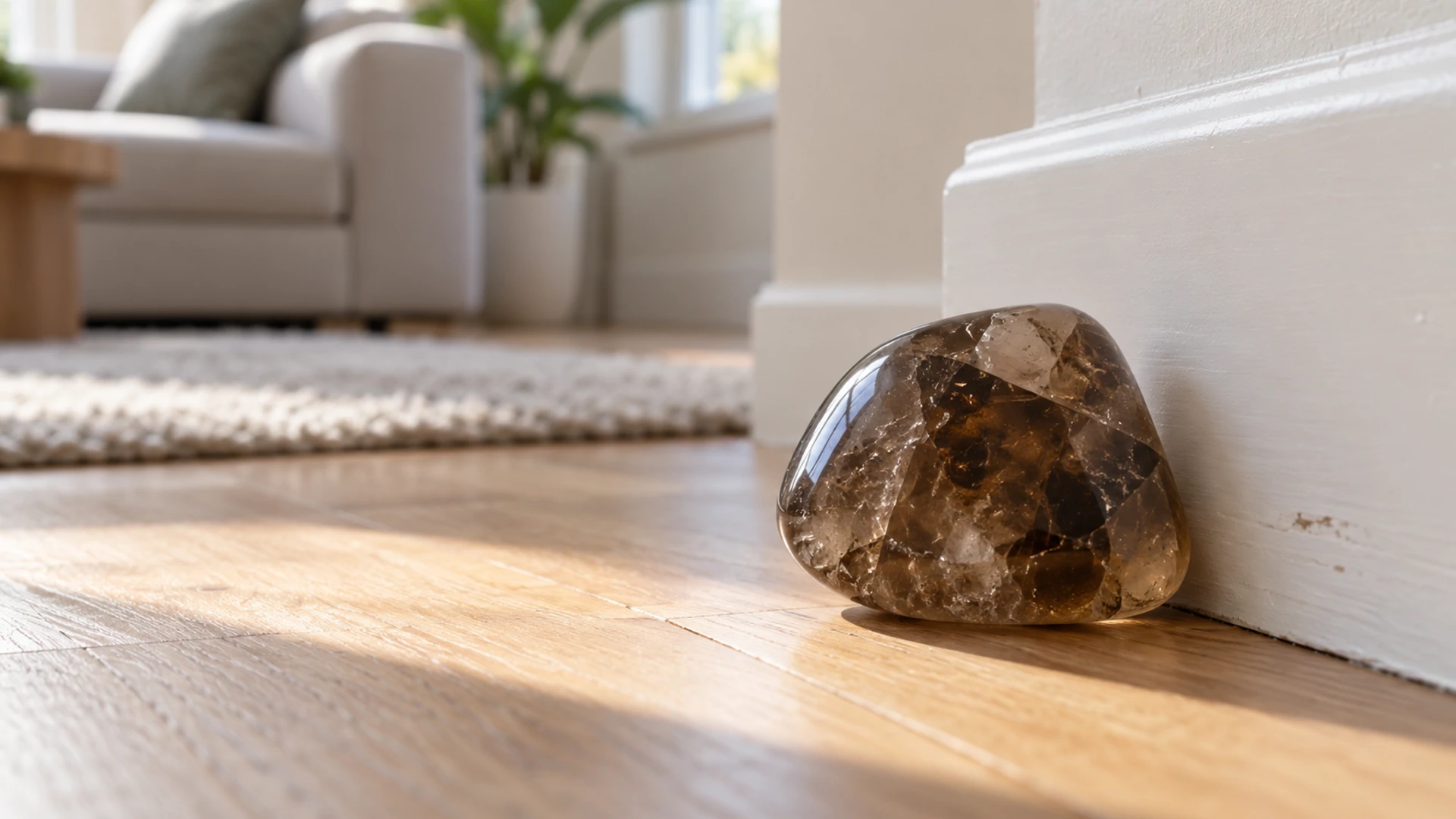
Smoky quartz is a protection stone whose defining quality is transmutation — it doesn't build a wall or bounce energy back, it converts what it takes in. That's a specific and useful distinction once you understand how it works.
The Transmuter: Why Smoky Quartz Belongs in Protection
Smoky quartz is a variety of quartz colored by natural irradiation of trace aluminum within its crystal lattice. The result is that signature brown-to-black translucent smoke that sets it apart from clear quartz and from every other stone in the protection category. But color alone doesn't explain why it belongs there — the mechanism does.
Most protection stones work by creating some form of boundary or resistance. Black tourmaline grounds first and then holds a firm boundary. Black obsidian functions as a mirror, reflecting and revealing rather than absorbing. Smoky quartz does something different: it transmutes. The stone's reputation isn't for blocking what comes toward you, but for taking in low-frequency or destabilizing energy and converting it into something workable — neutralizing it at the root rather than redirecting it somewhere else. That's a genuinely different quality of protection, and it's the reason this stone tends to feel quieter and less confrontational in use than tourmaline or obsidian, while still being deeply effective.
Its correspondences support this. Smoky quartz sits at the root chakra, the energetic center tied to physical grounding, basic safety, and your relationship to the material world. Its element is earth. Its planetary ruler is Saturn — the planet of discipline, structure, endings, and the long work of consolidation — which fits the idea of a stone that doesn't just absorb disruption but metabolizes it. Astrologically it's associated with Capricorn and Scorpio, two signs that share a particular relationship to depth and transformation over time.
The combination of those correspondences — root chakra, earth, Saturn — makes smoky quartz especially well-suited for situations where the goal is to come back down into the body and into practical reality rather than deflect outward. It's grounding in the literal sense: not warding off an external threat, but stabilizing the internal field so disruption has less to land on. Think of it less as armor and more as deep roots. The tree doesn't block the wind; it stays put while everything else moves.
Natural, Treated, or Morion: Choosing Smoky Quartz
There's an authenticity issue with smoky quartz that doesn't come up as often as it should. The majority of commercial smoky quartz — including much of the jet-black material that's sometimes sold under the name morion — is actually clear quartz that has been artificially irradiated, usually through gamma irradiation, to produce the brown-to-black color. This process is safe and stable. The treated stone is not radioactive, it won't harm you, and the color holds permanently under normal conditions. But it is a real disclosure issue, and knowing it helps you make an informed choice.
Natural smoky quartz looks different from the treated kind if you know what to look for. Natural material tends toward brownish rather than purely black, often with uneven color zoning — darker near the base or tip of the crystal, lighter in the middle, sometimes slightly smoky and slightly clear within the same piece. Artificially irradiated material is usually flatter and more uniformly near-black throughout the whole crystal, with an almost opaque look that natural material rarely achieves. If a piece looks like it could be black tourmaline but with a translucent quality, it's worth asking the seller whether it's been treated. That said, most sellers either won't know or won't disclose proactively, so buying from a source that deals in natural, unenhanced material — or from regions known for quality smoky quartz like Brazil, Switzerland, Scotland, or Arkansas — is your best practical route.
The care considerations for smoky quartz are straightforward, with one notable exception. It's a true quartz at Mohs 7, water-safe for brief rinsing, and not toxic in any form. You can cleanse it with sound, smoke, earth burial, or simply running it under cool water for a moment. What to watch is prolonged, direct sunlight. Unlike amethyst, which fades readily, smoky quartz is generally considered sunlight-stable for typical household exposure. But very long-term placement in a south-facing window — months or years of direct strong light — can gradually lighten the color, particularly in naturally smoky material. This matters both for how you display the stone and for how you charge it: if you're using sunlight as a charging method, a short window of morning or late-afternoon light is fine. Leaving it in full midday sun day after day is not ideal for preserving that characteristic color. Moonlight is a better default if you want to keep it dark and rich.
Three Rituals for a Stone That Transforms What It Holds
The Transmuting Hold
Use this when you're carrying a specific stress, fear, or low-grade dread that you've been unable to fully shake — particularly during a waning moon, when the lunar current naturally supports releasing and processing rather than building.
Sit somewhere quiet and hold a piece of smoky quartz in both hands, or in the hand that feels most natural. Close your eyes and bring one specific thing forward — not a general sense of worry, but something named. Let yourself feel the full texture of it without trying to fix or suppress it, then consciously direct it into the stone. The working isn't about pretending the feeling doesn't exist; it's about actively feeding it to the transmutation process rather than continuing to carry it yourself. Hold the stone for as long as the feeling needs — five minutes, fifteen, longer. When you feel a shift (usually a sense of lightness or quiet), set the stone down and take several slow breaths. Afterward, rinse the stone briefly under cool water to clear what it's processed, and if you want additional support, place a black candle nearby to mark the close of the working. Timing this to a Saturn hour deepens the resonance with the stone's own planetary current.
The Traveler's Anchor
Use this before any journey — travel that involves physical transit, crossing unfamiliar territory, or situations where you'll be out of your usual environment and routines for an extended period.
Choose a piece of smoky quartz small enough to carry in a pocket or wear as jewelry. The night before travel, hold the stone at your root chakra — the base of the spine, or simply your hands in your lap — and spend a few minutes breathing steadily, letting the stone settle into alignment with your physical body. Set the intention plainly: this stone travels with me and keeps me grounded in my own field wherever I go. You don't need elaborate language. Specificity and calm are more effective than ceremony. Tuck it into your carry-on or pocket the next morning and keep it on your body throughout transit. This practice traces directly to smoky quartz's historical role in Highland dress — more on that below — where it was carried and worn not as decoration but as a grounding anchor during movement through wild or uncertain terrain. Juniper, burned the night before as a protective herb, pairs well with this working if you want to add an herbal layer.
The Grounding Grid
Use this to establish a sustained, space-wide grounding field in a room that has been energetically unsettled — after an argument, during a period of collective household stress, or when moving into a new space that needs to be cleared and anchored.
You'll need four pieces of smoky quartz — raw points or tumbled stones both work, though points placed tip-inward toward the center of the room direct the current more deliberately. Place one piece at each cardinal corner of the room: north, south, east, west. Before placing each stone, hold it briefly and state its position plainly — north anchor, south anchor, and so on — to set the directional structure consciously. Once all four are placed, stand in the center of the room and take a few slow breaths, letting yourself feel the container that the four points create. Leave the stones in place for as long as the room needs settling; a full lunar cycle is a natural rhythm if you're establishing long-term stability. If you want to strengthen the grid further, place a piece of black kyanite at the center — it's one of the few stones that can clear other crystals without needing cleansing itself, which means the grid maintains itself with minimal intervention on your part.
Smoky Quartz and Scotland
Smoky quartz is Scotland's national gemstone, and its association with the country isn't symbolic or modern — it runs through several hundred years of material culture. The stone is historically called Cairngorm after the Cairngorm Mountains in the Scottish Highlands, where it was mined extensively. The Cairngorms are part of a granite belt that runs through eastern Scotland, and smoky quartz forms naturally in those granite pegmatites as the result of natural irradiation over geological time.
In Highland dress, Cairngorm stones occupied a specific and practical role. They were set into the handles of sgian-dubh, the small blade traditionally worn tucked into the top of the stocking. They appeared as pins on kilts, in brooches, and on sporrans. These weren't decorative flourishes added after the fact — the stone was chosen deliberately, valued for both its appearance and its longstanding protective reputation. A Highland traveler moving through mountainous terrain carried the stone on their body for the same reason it's described as a travel anchor in the ritual above: it was understood as something that kept a person grounded and protected during movement through uncertain conditions.
The Victorian era amplified smoky quartz's association with Scotland when Queen Victoria's enthusiasm for Highland culture made Cairngorm jewelry fashionable across Britain and Europe. This led to increased demand, and eventually to the importation and sale of Brazilian smoky quartz as "Cairngorm," since the Scottish sources couldn't keep pace. That substitution is part of why the authenticity issue around smoky quartz's color and treatment has a longer history than most people realize — it didn't begin with modern gamma irradiation, it began with a surge of demand that the original source simply couldn't meet.
Protection Without a Wall
Smoky quartz's value within protection work comes from doing something none of the other stones in that category do: it transforms rather than blocks. That makes it a complement to boundary-setting stones rather than a substitute for them, and it makes it especially useful in situations where the source of disruption is internal as much as external — accumulated stress, unprocessed fear, the weight of circumstances that haven't resolved yet. You can't build a wall against that kind of thing. You can transmute it.
If you want to see how smoky quartz fits alongside the rest of the protection stones — and how the six other crystal categories (cleansing, healing, empowerment, abundance, love, and intuition) each do distinct work — The Crystal Compendium: Seven Paths to Stone Magic is the place to start.