Red Candle Magic: The Color of Wanting Something Badly Enough to Act
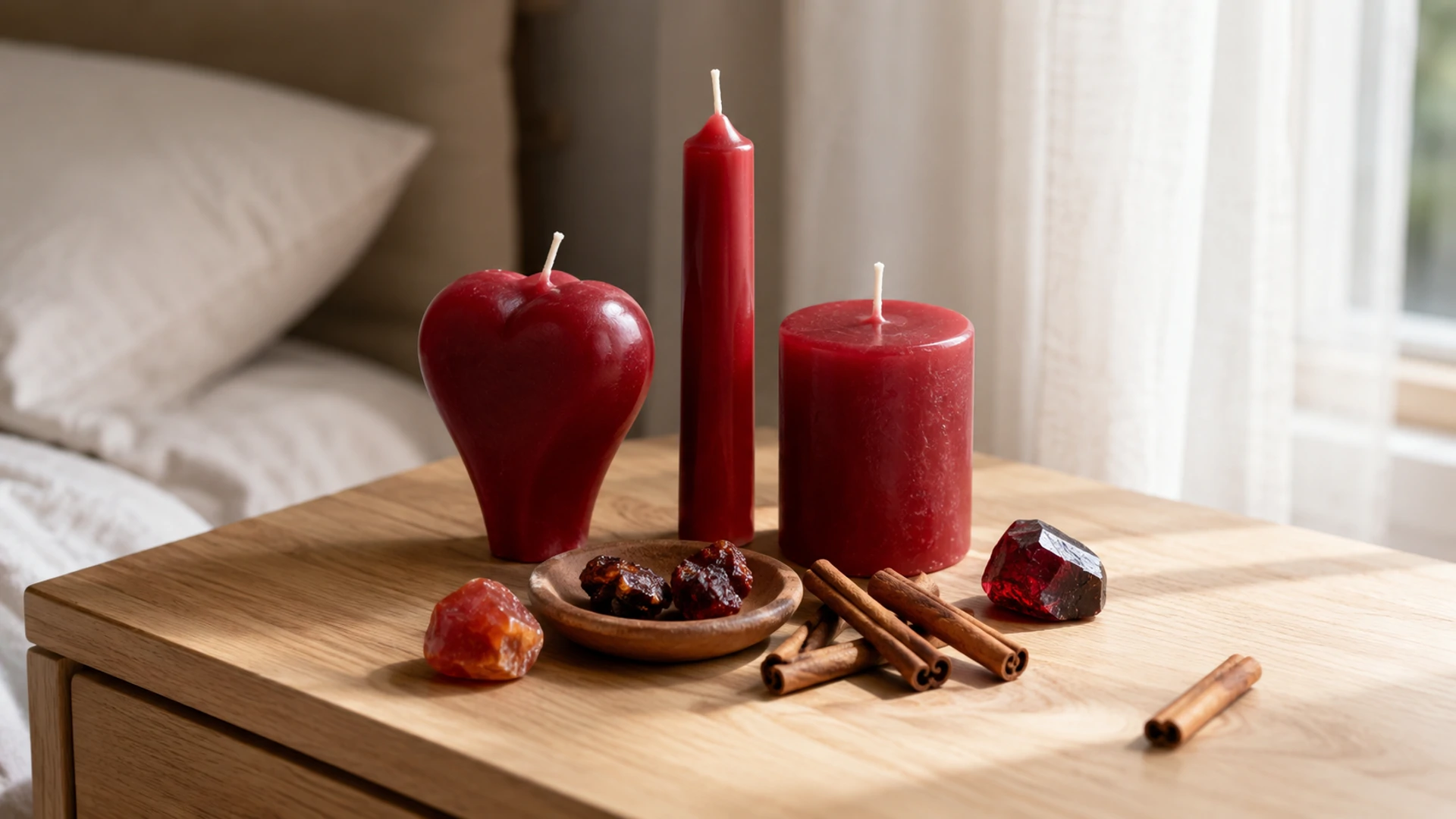
There's a particular feeling red captures that no other color does — the heat in your chest when you want something so much that waiting starts to feel like surrender. Red is desire with momentum behind it. It's the courage that arrives right before you do the hard thing, and the physical surge of will that moves you from deciding to doing. In candle magic, red carries all of that. It's the color you reach for when a working needs to break through, when attraction needs to become action, and when the force behind your intention has to be unmistakable.
The Fire That Doesn't Wait
Red as Life Force
Red is blood, fire, and the beating heart. These aren't abstract symbols — they're the body's most immediate signals that something matters. Your pulse quickens before a confrontation. Your face flushes with want. You feel heat before you feel anything else. Red doesn't operate at a distance from the body the way some other magical currents do. It lands in the physical, the immediate, the now.
That's what sets red apart from colors like purple or silver, which are oriented toward the unseen, the reflective, the elevated. Red is grounded in what's happening right now — what you desire, what you're willing to fight for, and what you're ready to act on today. In magical terms, this makes red particularly effective for workings tied to urgent, concrete intentions rather than long, slow unfurling ones.
Mars's Governance
Mars rules red, and that's everything you need to know about how this color moves. Mars doesn't deliberate. It doesn't wait for the right moment or the perfect alignment — it initiates. The Martian current is assertive, direct, and built for forward motion. In classical planetary magic, Mars governs drive, courage, conflict, and physical vitality. It's the planet called on when you need to push through resistance rather than dissolve it gently.
Lighting a red candle is, in a very literal sense, an act of invoking that same quality in yourself. You're not asking the universe to handle something on your behalf while you wait. You're declaring that you are the force moving this situation. That's a meaningful distinction in candle work, and red makes it with every flame.
The Root Chakra and Urgency
Red's correspondence to the Root chakra — Muladhara — explains why red workings feel so physical and immediate. The Root governs survival, groundedness, and your sense of being rooted in your own body. When it's activated and strong, you act from a place of security. When it's blocked or depleted, fear and stagnation creep in. Red candle work speaks directly to that territory — not as a passive healing, but as a deliberate charge of will directed there.
This is part of why red feels urgent where other colors feel spacious. It's not operating in the realm of higher wisdom or emotional nuance. It's operating at the level of the body's core drive to survive, want, and act.
Red's Intensity Is the Point
Some practitioners hesitate around red because of its association with aggression and confrontation. That hesitation makes sense if you're looking for a gentle, open-handed working. But if what you actually need is force — the kind that clears stagnation, holds a firm boundary, or pulls something toward you with real insistence — red's intensity is exactly what makes it work. A candle chosen for its soft energy won't carry a working that calls for heat. Red doesn't apologize for being strong, and you shouldn't either.
For situations where desire or attraction is the intention but red feels too sharp, pink carries the same Venusian emotional register with considerably less force. When the drive behind your working is more about ambition and forward momentum than raw desire or confrontation, orange channels that same Martian energy into opportunity and creative drive. But when red is what the working calls for, use red.
Red's Correspondence Profile
Red's magical identity is built on a tight cluster of correspondences that all point the same direction: outward, forceful, embodied, and alive.
Here's the full correspondence profile at a glance:
- Planet: Mars
- Element: Fire
- Gender: Masculine
- Deities: Mars, Ares, Brigid, the Morrigan, Sekhmet
- Magical properties: Passion, courage, physical strength, sexual desire, willpower, protection-through-force
- Associated crystals: Carnelian, Red jasper, Garnet, Ruby
- Chakra: Root (Muladhara)
Mars as Ruling Planet
In classical and Renaissance planetary magic, Mars was understood to govern war, but also the broader category of assertive will — the force that initiates, pushes through obstacles, and refuses passivity. Physically, Mars rules blood, heat, and muscular energy. In correspondence terms, this means red candle workings carry an inherently activating quality. They don't soften or wait. They push.
This makes red the natural choice for workings that require you to do something — speak up, pursue something you've been circling, make a move you've been hesitating on. The Martian current rewards action and resists stagnation. If you're asking red for help with something passive, you're working against its grain.
Fire as Elemental Correspondence
Fire is the element of will, transformation, and the raw power to act. In practice, that means any working with a red candle is also a fire working — you're calling in the element that burns away hesitation and converts intention into motion. Fire doesn't preserve what was. It transforms it. When you light a red candle over an intention, you're not just representing your desire — you're feeding it to a force that converts it into something that moves.
This is also why red corresponds so well to courage and willpower. Fire is the element that doesn't flinch. It doesn't negotiate with what's in its way. Working with red means asking for that same quality in yourself: the will to commit, move, and not withdraw.
The Root Chakra in Full
Muladhara sits at the base of the spine and governs survival, physical identity, and the fundamental sense of being safe and rooted in your body. When it's healthy, you act from security rather than fear — you pursue what you want because you trust your own capacity to have it. Red candle work doesn't passively heal this center. It directs focused will toward it, charging it with the Martian current that says: you are here, you have force, you are not a passive receiver of what happens to you.
This is why red is appropriate for workings tied to physical strength, sexual confidence, and self-assertion. All of these live in Root territory. The candle functions as a point of focus for the will you're directing there — not a substitute for inner work, but a sharp, deliberate amplifier of it.
The Four Crystals
Each of the four crystals associated with red brings something distinct to the current, and they're not interchangeable.
Carnelian is the most direct match for the Martian frequency. It carries vitality, motivation, and bold action — it resonates naturally with red's forward, initiating quality. Place it alongside a red candle when the working is about momentum: starting something, pursuing something, refusing to stall.
Red jasper works differently. Its energy is stabilizing, keeping the heat of a red working from burning itself out too fast. Where carnelian accelerates, red jasper grounds and sustains. It's useful in longer workings or any time you need the fire energy to last rather than spike and fade.
Garnet is the crystal for passion that has to endure. It combines desire with staying power, which makes it better suited to ongoing intentions — a sustained draw, a relationship you're actively tending, a long-term ambition — rather than a single-session push.
Ruby is the highest-vibration stone of the four, associated with life force itself, the nobility of will, and intense passionate love. It's not a beginner's everyday working stone — its energy is strong enough that it tends to amplify whatever it's working alongside. Pair it with a red candle when the intention is deeply significant, or when you want to intensify the entire working's charge.
The Deities
Five deities carry the red current, and they don't all carry it the same way. What runs through all of them is intensity in service of will and protection — not violence as an end in itself, but force directed toward something that matters.
Mars and Ares (the Roman and Greek expressions of the same archetype) represent assertive force, martial valor, and the will to fight for what you're protecting or pursuing. They're the deities to call on when the working is about confrontation, boundary enforcement, or the courage to initiate something you've been avoiding.
Brigid arrives from a completely different direction. She's the goddess of the forge, the creative fire, and fierce protection — not combat, but the heat of making and the ferocity of a guardian. She's a strong ally for workings that combine passion with creation, or protection that comes from loving something enough to defend it.
The Morrigan brings battle energy, sovereignty, and transformation through raw will. She's tied to blood symbolism in the deepest sense — not wound, but life force, inheritance, and the power that comes from claiming who you are without apology.
Sekhmet, the Egyptian lioness goddess, governs solar fire and the destructive force that is also healing. Her energy is intense in the way that cauterizing a wound is intense — it hurts in the service of restoration. She's appropriate when the working requires burning something away before anything new can take hold.
Working With Red
The Simple Working
A plain red candle with one clear, stated intention is a complete working. That's not a starting point for something more elaborate — it's a full act of will in itself. The flame is the declaration. Lighting it is the moment you commit, outwardly and symbolically, to what you've already decided internally.
State the intention aloud. Not in the abstract, and not as a question or a hope — as a statement of what you're calling in or moving toward. Speaking the intention carries your will directly into the working in a way that staying silent doesn't. Red doesn't respond well to hedging. Be specific. Be direct. Let the flame hold it.
Dressing, Inscribing, and Charging
When you want to layer more intention into the candle before burning it, preparation adds significant weight to the working.
For dressing, the oils that carry red's current most effectively are rose (for romantic and sensual desire), cinnamon (heat, urgency, the feeling of something pressing forward), and dragon's blood (courage, strength, and a resinous power that amplifies the working). The directional logic matters: when you're drawing something toward you, stroke center outward toward both ends. When you're releasing, banishing, or pushing energy away, stroke ends inward toward the center. That physical gesture encodes your direction into the oil.
For inscribing, red candles respond well to a name (your own or the person the working is directed toward), a single word that captures the core intention — COURAGE, DESIRE, STRENGTH — the Mars glyph (♂), or a personal sigil you've created for this specific purpose. Keep the inscription tight. One clear symbol carries more force than a paragraph of carved text.
For charging, visualize the outcome as if it has already happened. Don't picture the wanting — picture the having. Feel the specific emotion that belongs to it: the heat of desire satisfied, the steadiness of courage proven, the solidity of something secured. Then speak a present-tense charging statement aloud directly to the candle — "This candle carries my will toward [intention]. It is done." That's the moment the tool becomes live.
Ritual and Ceremonial Use
In circle work, red belongs at the southern quarter as the Fire elemental anchor. When you're casting a full elemental circle, a red candle in the south grounds the fire current into the working space and holds the energy of will and transformation throughout the ritual.
For love and passion workings, two red candles burned together — set side by side and lit simultaneously — represent two people or two energies being drawn into contact. The pairing works especially well for love magic that carries genuine heat: desire, attraction, reunion, or intensifying a connection that already exists.
Red's protection current is specifically active and force-based — it deters rather than shields. This is the distinction that matters: black candle protection works by absorbing and neutralizing, drawing harm in and containing it. Red protection works by projecting force outward, making the protected space or person feel dangerous to approach. Both are legitimate — they just do different things. For protection workings with that explicitly aggressive, boundary-enforcing quality, see the full guide on preparing candles for protection magic.
Herbs that support red's Mars current in altar and ritual work include nettle, black pepper, and ginger — all of which carry heat, assertive force, and the capacity to push through resistance. Scatter them around the base of the candle or incorporate them into the dressing oil if you're working with a carrier blend.
Timing
Tuesday is Mars's day, and it's the natural choice for red candle workings. If you want to work with more precision, the Mars planetary hour adds another layer of alignment — you're not just working on Mars's day, you're working in Mars's hour, stacking the timing to match the current you're calling on.
The moon phase shapes how the working unfolds. A waxing moon supports workings that call something in: desire, passion, courage, strength, an attraction you want to build. The full moon amplifies whatever is already in motion — if a working is underway, burn a red candle at the full moon to intensify it. Neither phase cancels the other out, and neither is mandatory — red's force is strong enough to work across the lunar cycle. But timing your working to match the moon adds real momentum when you can manage it.
Red doesn't require a perfectly aligned Tuesday at the Mars hour under a waxing moon to be effective. Urgency is its own timing. If the situation calls for it now, light the candle now.
Red is the color for the moment when wanting something has to stop being internal and become an act. It doesn't traffic in patience or subtlety — those are real virtues, but they belong to different currents. Red is for the decision point, the forward push, the working that says: this is what I want, this is what I'm claiming, and I am the force moving this. For a broader look at how every color fits into the full picture of candle work, the complete guide to candle color magic covers the whole spectrum.