Black Candle Magic: The Color of Boundaries, Not Bad Intentions
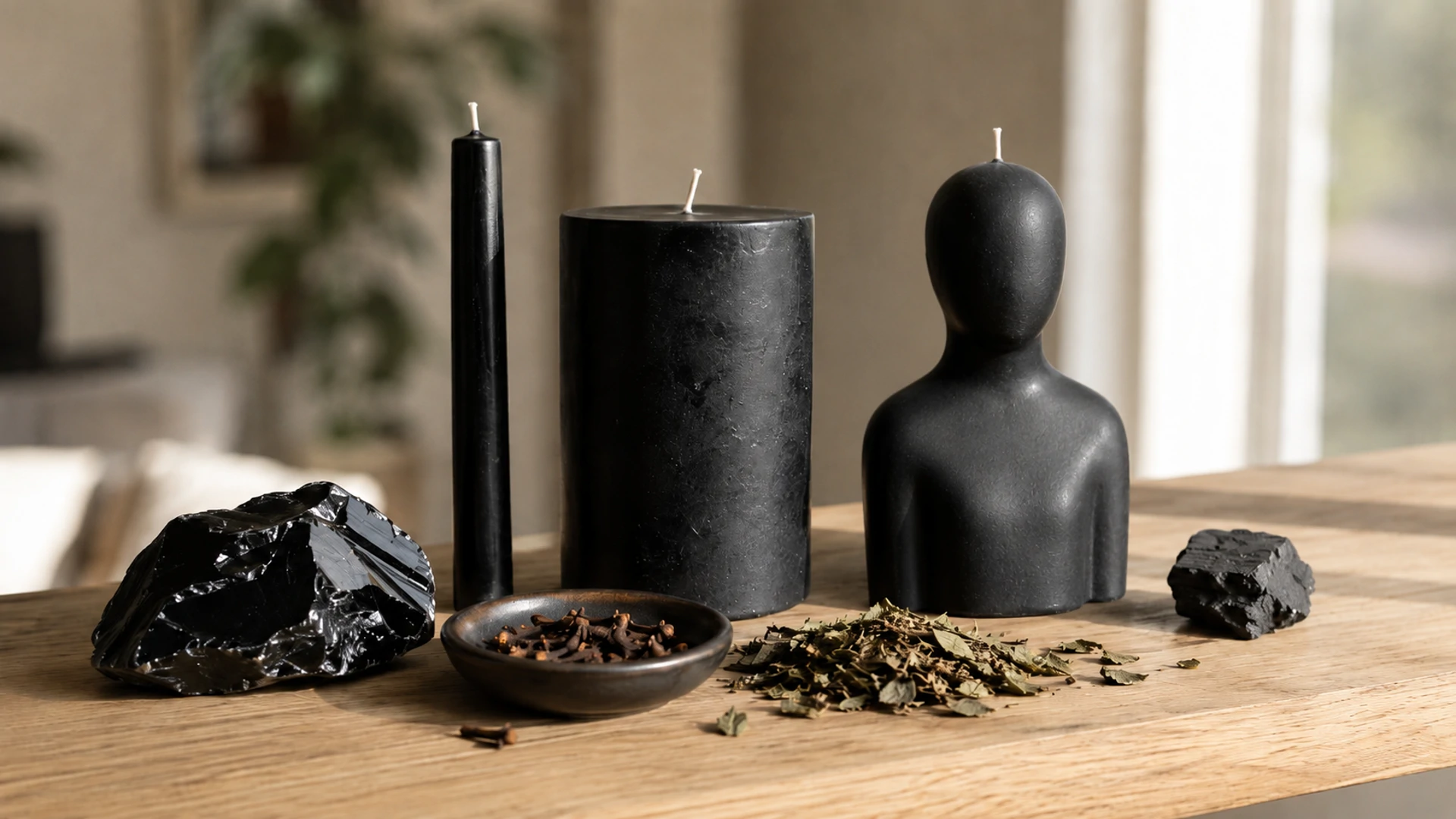
Black candles have a reputation problem. People unfamiliar with candle magic often assume black means curses, malice, or dangerous territory — something to avoid unless you're willing to cross a line. None of that is accurate. Black is the color of containment, absorption, and clean endings. It doesn't project outward or call things in. It closes, seals, and releases. In candle magic, that makes it one of the most precise tools you have — not the most sinister one.
What Black Actually Absorbs
The Mechanic Behind the Color
Black absorbs all wavelengths of visible light. Nothing passes through, and nothing reflects back. That total containment isn't just a physics fact — it maps directly onto what black does in magical practice. When you burn a black candle, you're working with a color that takes things in rather than sending them out. That's exactly what makes it useful for clearing, protecting, and severing what no longer belongs to you.
Three Historical Anchors
Black's association with endings, protection, and transition runs across cultures and centuries, and it's worth grounding that in specifics rather than vague gestures toward antiquity.
In Egyptian cosmology, Anubis — the jackal-headed guardian of the dead — was depicted with black coloring not to signal destruction but transition. His role was to escort souls safely through what came after death. Black here was the color of transformation, the fertile black silt of the Nile that preceded new growth, not the color of harm.
In Greek tradition, Hecate presides over the dark of the moon, the moment between lunar cycles when light is completely absent. That liminal space — between states, between worlds — is her domain. Black belongs to her because it represents the threshold: what has ended and what hasn't yet begun. Offerings of black candles at crossroads have been part of her worship for millennia.
European folk magic traditions treated black as having a literal absorptive virtue. Black objects — cloth, candles, stones — were used to draw negativity out of a person or place and trap it. A black candle burning in a sick room wasn't a bad omen; it was doing the work of pulling harm into itself so it couldn't circulate. That's the logic that underlies most modern banishing work as well.
Shadow Work
Shadow work is the practice of confronting the parts of yourself you've hidden, suppressed, or refused to look at directly — fears, patterns, grief, impulses you've been ashamed of. The goal isn't to wallow but to integrate. You can't change what you won't acknowledge.
Black creates the right atmosphere for that kind of honest self-examination. It absorbs distraction, holds space without judgment, and signals to your own mind that you're entering a different kind of attention. A black candle burning during a journal session, a mirror meditation, or a shadow-work tarot spread functions as an anchor — it marks the work as intentional and contained.
Banishing Is Not Cursing
Banishing is setting a boundary with force. You're removing something — a pattern, a person's influence, an energy — from your space or your life. You are not wishing harm on anyone. That distinction matters both ethically and practically, because the two workings have different mechanics and different targets.
The contrast with white candle magic makes this clear. White radiates outward — it opens, purifies, and illuminates. It pushes energy into a space. Black does the opposite: it draws inward, seals, and removes. Neither is superior; they work in different directions for different purposes. When you need to clear something out rather than build something up, black is the correct tool.
Black's Correspondence Profile
Black carries a specific set of planetary, elemental, and symbolic correspondences that have been consistent across traditions for centuries. Here's the full correspondence profile at a glance:
- Planet: Saturn
- Element: Earth (also Spirit/Void in some traditions)
- Gender: Feminine
- Deities: Hecate, Anubis, Kali, Morrigan, Hades
- Magical properties: Protection, banishing, absorption of negativity, shadow work, endings and release, binding, cord-cutting
- Associated crystals: Black tourmaline, obsidian, onyx, jet
- Chakra: Root (Muladhara)
Saturn as Ruling Planet
Saturn governs boundaries, discipline, karma, and endings. It's the planet of what is owed, what must be faced, and what has run its natural course. Saturn's influence is not soft — it demands honesty and completion. That quality is exactly what makes it the right planetary force for banishing work and cord-cutting: Saturn doesn't negotiate or extend what's finished.
Saturday is the strongest timing for black candle work. The waning moon reinforces any working aimed at reduction, removal, or release. The dark moon — the night or two before the new moon when no light is visible at all — is particularly potent for banishing and shadow work, because the sky itself mirrors what you're doing: going into darkness before the turn. If you want to add planetary hour precision, the Saturn hour on a Saturday during a waning or dark moon stacks every available current in the same direction.
Earth and Spirit/Void: The Dual Elemental Nature
In most traditions, black's primary element is Earth. Earth grounds protective and banishing work in something solid and real. When you light a black candle and state a clear intention to release a destructive pattern or clear your space of an unwanted influence, Earth keeps that working practical and anchored. It prevents banishing work from becoming purely abstract — it roots it in the physical reality of your life.
Some traditions also assign black to Spirit or the Void, and this is a different kind of working entirely. The Void isn't empty — it's the undifferentiated state before form, the space between states. Working black through the Spirit/Void correspondence opens it toward ancestral communication, working with liminal forces, and engaging with what exists at the edge of form. These two elemental readings aren't contradictory; they address different layers of what black can do depending on where your intention is pointed.
The Root Chakra Connection
The root chakra — Muladhara — sits at the base of the spine and governs your sense of safety, survival, and belonging in your physical body and material life. When that foundation feels unstable or threatened, fear sets in at a deep, pre-rational level. Protection and boundary-setting, at their most fundamental, are root chakra work. They address the layer where the question "am I safe?" actually lives.
That's why black candle workings for protection and banishing carry a grounding quality even when the subject matter feels intense. You're working at the level of the root — reinforcing the foundation rather than suppressing a feeling. The black candle, paired with Saturn's discipline and Earth's stability, operates at precisely that layer.
The Four Crystals
Black tourmaline is a shield. It deflects and neutralizes negative energy before it can settle — it's projective in its protection, creating a barrier around the aura or a space rather than absorbing harm passively. Place it near a black candle when your primary intention is warding or active protection.
Obsidian absorbs rather than deflects. It's the stone for psychic protection and truth-seeing — it pulls up what's hidden and reflects reality without flattery. Obsidian pairs well with shadow work and banishing because it doesn't let you look away.
Onyx is about self-discipline and severance. Historically used to cut ties with grief, habit, and attachment, it supports any working where you're ending something by choice rather than being forced out. It reinforces your will to complete the release.
Jet is fossilized organic material — ancient wood transformed over millions of years — and it has one of the longest histories as a protective amulet in the Western tradition. Jet absorbs and transmutes heavy energy rather than simply trapping it. Viking and Roman funerary amulets, mourning jewelry in Victorian Britain, and protective talismans in folk magic traditions across Europe all reach for jet specifically because of that transmutation quality. It's particularly suited to grief work and ancestral protection alongside a black candle.
Working With Black Candles
The Simplest Working
You don't need an elaborate setup to make a black candle effective. What you do need is a precise intention. "I want things to get better" gives your will nothing to grip. "I release this pattern of choosing relationships where I disappear" gives it a clear target. Specificity is what makes the difference.
Light the candle, state your intention aloud or in writing, and let it burn. When you need to stop a session before the candle is finished, snuff it rather than blowing it out. Blowing disperses the energy you've built; snuffing keeps it contained and held in place. You can relight the same candle across multiple sessions until the working completes — the intention carries through.
Dressing, Inscribing, and Charging for Black Work
The oils that belong on a black candle reflect the nature of the working. Frankincense brings purification and spiritual authority — it's consecrating as much as it's cleansing. Patchouli grounds the working in earth energy and reinforces banishing. Myrrh suits protection and shadow work specifically, with its long association with funeral rites and the threshold between states. Black pepper or clove is for aggressive banishing and clearing — when you need force behind the removal.
Direction matters when you dress the candle: for banishing and release, work from the center outward, pushing what you're removing away from you. For drawing protection in around yourself, work from the ends toward the center.
When you inscribe the candle, carve what you're releasing — the word "release," "banish," "sever," the name of the pattern or the person's influence you're removing. Sigils work here too, especially personal ones you've crafted specifically for the working. Carving turns your intention into a physical mark on the candle, which it then burns through.
To charge the candle, hold it and visualize dark, absorptive energy filling it completely — like light being drawn into a void. Charge it under a new or dark moon if you can, or rest it briefly on a piece of black tourmaline. Both reinforce the absorptive quality you're activating.
Structured Ritual Anchors
A black candle placed at the entrance to your home, lit with the clear intention of a protective boundary forming around the perimeter, is one of the oldest and most direct protective workings there is. As it burns, visualize a sealed field of energy extending outward from it — not a cage, but a filter. What belongs inside stays; what doesn't cannot enter.
For releasing a specific situation, write what you're releasing on a piece of paper and place it under the candle before lighting. The candle burns over it as the session continues. You don't have to burn the paper itself — the act of the flame working above it is sufficient for most practitioners, though you can burn it separately in a fire-safe dish as a final step.
Shadow work pairs well with a journal session or a tarot reading done by candlelight. The black candle marks the session as intentional and creates a contained space for honest self-examination. If a full banishing feels like more than a situation calls for — if what you need is to stall something, neutralize a conflict, or hold a boundary without escalating — consider grey candle magic instead. Grey sits between black and white, carrying neutralization and concealment where black carries active removal. It's the subtler option when you want to stop something without a full severance.
Cord-Cutting Rituals
The cord-cutting working is one of the most well-known uses for black candles, and for good reason — it gives your will something physical to work through, which makes it significantly more effective than intention alone.
Set up two candles: one represents you, one represents what you're releasing — a person's hold on you, a relationship dynamic, a pattern, a fear. Run a cord or thread between them, connecting the two. Natural fiber works well here; cotton, hemp, or wool are common choices.
Light both candles. Sit with the visualization of the connection between you and whatever you're releasing — not dwelling, but seeing it clearly. State your intention aloud: what you are severing, why, and that the severance is complete and final. Then cut or burn through the cord between the candles. Some practitioners let both candles burn out completely; others extinguish the candle representing the other party and let the black candle burn down on its own to finalize the ending.
The black candle burning out completely is the closing of the working. Once it's done, it's done. Once that space is clear, you can decide what you're building into it. Magenta candle magic is the natural next step — where black releases and severs, magenta commands a new direction with force. The two work in sequence: black clears the space, magenta fills it with intention.
Black candles paired with specific preparation techniques for banishment work bring every element of the working into alignment before you even light the wick.
Black is the clean ending that makes a genuine new beginning possible. Its reputation as something ominous or dangerous says more about cultural discomfort with endings than it does about the color's actual nature. Endings are necessary. Boundaries are necessary. The willingness to close a door rather than let it blow open indefinitely is a form of strength, not aggression. If you want to explore how black fits into the full spectrum of color magic — where it sits alongside white, grey, and every other hue — the complete candle color guide maps the whole picture.