Carnelian: The Spark That Gets You Moving
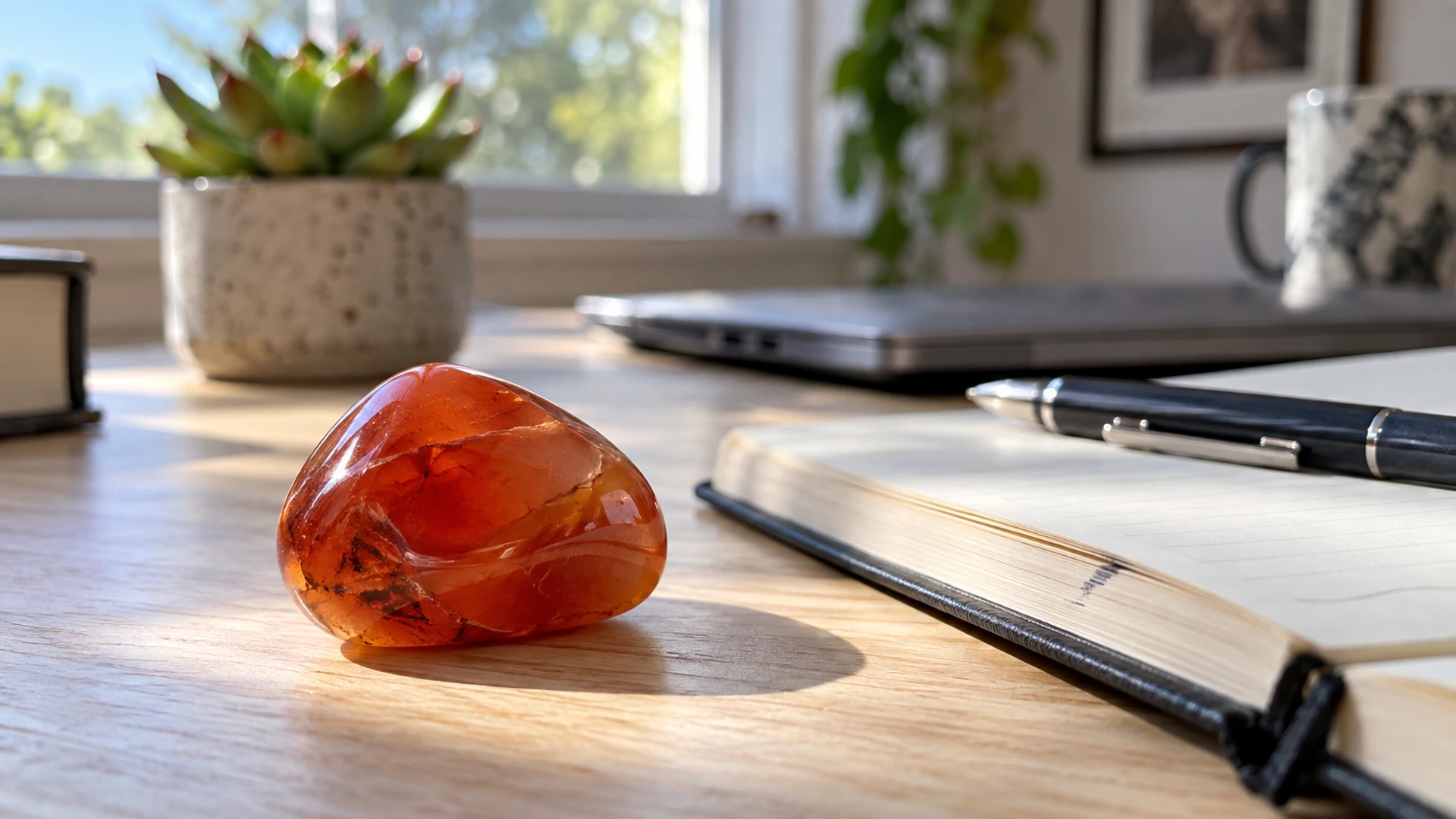
Carnelian is the stone you reach for when hesitation is the only thing standing between you and the action you already know you need to take. It doesn't rebuild motivation after a long setback — it cuts through the pause right now.
The Spark That Gets You Moving: Why Carnelian Belongs in Empowerment
Carnelian's place in the Empowerment category comes down to one thing: timing. Its function is immediate activation. Where other empowerment stones work over days or weeks — garnet rebuilds motivation after a real defeat, slowly restoring drive that's been worn down — carnelian works in the moment. The procrastination is happening right now. The hesitation is here. Carnelian's job is to break it. That's a specific and distinct function, not a synonym for general boldness, and it's why this stone earns its category placement on its own terms.
The mineral itself supports this. Carnelian is a chalcedony — a microcrystalline quartz — colored a vivid orange-red by iron oxide inclusions. It forms in gas cavities in volcanic rock and has been used across cultures for thousands of years, not as a contemplative or meditative stone, but as a warrior's stone, an orator's stone, a stone you wore when you needed to act. Ancient Egyptian scribes kept it close. Roman officials wore it on their hands. Its reputation isn't mystical vagueness — it's a long, documented record of people reaching for it before they had to do something that required nerve.
Its correspondences reinforce the same picture. Carnelian works with the sacral chakra — the energetic center associated with desire, creative drive, and the will to move toward what you want. It's a fire element stone, which in practice means its energy is initiating and outward rather than inward and reflective. Its planetary rulers are both the Sun and Mars, the two planets most consistently associated with personal will and decisive action. Its zodiac associations span Leo, Virgo, Taurus, and Cancer — a wider range than many stones carry, which reflects how broadly its activation energy applies rather than how specific its audience is. You don't have to be a particular sign to work with carnelian effectively. You just have to be stuck.
Color Depth Matters: Choosing Carnelian
The most important thing to know before buying carnelian is that much of the commercial supply is heat-treated agate. A paler orange-brown agate, when heat-treated, deepens into a richer, more uniform red-orange — and this has been a standard trade practice for centuries. It isn't concealed fraud. But it's worth knowing what natural, untreated carnelian actually looks like: softer in color, more translucent, tending toward a warm orange rather than a saturated red, and often showing variation in tone across the stone rather than a consistent color throughout. If you're holding a piece that's a deep, uniform red with no translucency and no tonal variation, it's likely heat-treated. That doesn't make it less usable — but if you specifically want natural material, you're looking for something that appears almost amber-like in the light, not something that reads as a dark terracotta.
Form matters too. Tumbled stones are the most accessible and the easiest to carry on the body, which suits carnelian's primary use case — you want it with you in the moments when activation matters. Carved carnelian intaglios and rings are historically accurate and deeply appropriate for the stone (more on why in a later section), though they're harder to source in genuine material. Raw pieces are less common than with other chalcedony varieties given that carnelian's color shows best when polished, but they do exist and are fine for altar use. If you're buying in person, look through the stone toward a light source — natural material will show that soft internal glow; heavily treated material often looks flat and opaque by comparison even when nominally translucent.
Care is simple. Carnelian sits at Mohs 6.5 to 7, which makes it durable for everyday carry and wear. Brief water contact is fine — rinsing under cool water to cleanse it is not a concern. No toxicity issues. The main thing to avoid is prolonged soaking, since chalcedony can have internal fractures that absorb water over time, but a quick rinse or even a brief soak won't harm a solid piece. Sunlight is generally tolerated better by carnelian than by other quartz-family stones — its iron oxide coloring is more stable than amethyst's, for instance. If you're cleansing by sunlight, a few hours is fine without worry about fading.
Three Practices for Immediate Action
The Push Past
This practice is for the specific moment when you know what needs to be done and you're not doing it.
Hold the carnelian in your dominant hand and name — out loud if you can, silently if not — the single smallest action you can take in the next five minutes toward the thing you've been avoiding. Not the whole task. One action. Squeeze the stone once while you say it, then put it down and take that action before you pick it up again. The stone isn't performing the work — your commitment to a concrete, immediate move is. The carnelian's job is to be the physical anchor for that commitment, something you physically hold while making the decision rather than thinking around it. This works best in a Mars hour, when the planetary current is already oriented toward cutting through delay.
The Bold Word
This practice is for before a conversation, a presentation, or any moment that requires visible courage rather than quiet, internal resolve.
Light an orange candle and hold the carnelian at the level of your sacral chakra — just below your navel — for two to three minutes before you need to speak. Let your breath drop low and slow. You're not building up to something or trying to feel a certain way; you're grounding the nerve that's already there. The sacral chakra governs desire and drive, and this practice calls your attention to it before your mind tries to talk you out of what you actually want to say. Carry the stone with you afterward if you can — in a pocket, not a bag — so it stays in your physical field during the conversation itself. Cinnamon, burned as incense or worn as an oil, pairs well here as a solar herb that amplifies presence and forward momentum.
The Warrior's Seal
This practice draws on carnelian's oldest documented use — as a signet-ring stone — to mark a decision as formally made and no longer open to second-guessing.
Write the decision on a piece of paper in full, plain language. Not a wish or a hope — a statement of what you are doing. Then press the carnelian against the paper as if you were pressing a seal into wax, hold it there for a moment, and say the decision aloud one final time. Fold the paper and keep it somewhere deliberate — under the stone on your altar, or in your wallet. The act of sealing is the practice. Historically, pressing a carved carnelian into hot sealing wax was how agreements became binding; the stone's refusal to stick to the wax meant the seal released cleanly and the impression held. You're using the same gesture to make an agreement with yourself. A red candle lit during this practice acknowledges the Mars current in carnelian's correspondence and marks the moment as distinct from ordinary decision-making.
The Seal That Wax Won't Stick To
The reason carnelian dominated ancient signet-ring use isn't symbolic — it's physical. Hot sealing wax does not adhere to polished carnelian. When you pressed a carved carnelian intaglio into molten wax and pulled it away, the seal released cleanly every time, leaving a sharp impression without the ring sticking or the wax tearing. For Egyptian scribes and Roman officials who were sealing documents, correspondence, and legal agreements dozens of times a day, this was a genuine practical advantage. No other commonly available stone at the time offered the same combination of hardness, fine carvability, and clean wax release.
Carnelian intaglios — images carved in reverse into the stone's surface so that they print correctly when pressed into wax — were produced in enormous quantities across the ancient Mediterranean world. The carved subjects ranged from personal emblems and gods to portrait profiles and symbolic animals. What they shared was the material: carnelian, or occasionally its close relative sardonyx, chosen specifically for this functional property rather than purely for its color. The stone's beauty was a bonus. Its practical superiority for the task was the actual reason.
This history matters for how you work with carnelian today. The Warrior's Seal practice above isn't importing symbolism from thin air — it's using the same material logic that made carnelian the choice of officials and warriors for millennia. The stone's connection to action, commitment, and the making of binding decisions is baked into its actual history of use, not retrofitted as metaphor. When you hold it while committing to something, you're doing something that people have always done with this specific stone.
Empowerment That Starts Right Now
The thing that makes carnelian distinctive within the seven paths of stone magic is that it doesn't ask you to wait. It isn't a stone for recovery or rebuilding or long-term cultivation. It's a stone for right now, for the moment the hesitation shows up, for the conversation you're about to walk into, for the decision that's been sitting unmade for too long. That's a specific thing, and it's a genuinely useful one.
If you want to see how carnelian fits alongside the other Empowerment stones — and how the Empowerment category itself sits within the full crystal framework — the Crystal Compendium maps out all seven paths and gives you the context to choose what actually fits your situation, not just what sounds appealing.