Magenta Candle Magic: The Color With No Single Frequency
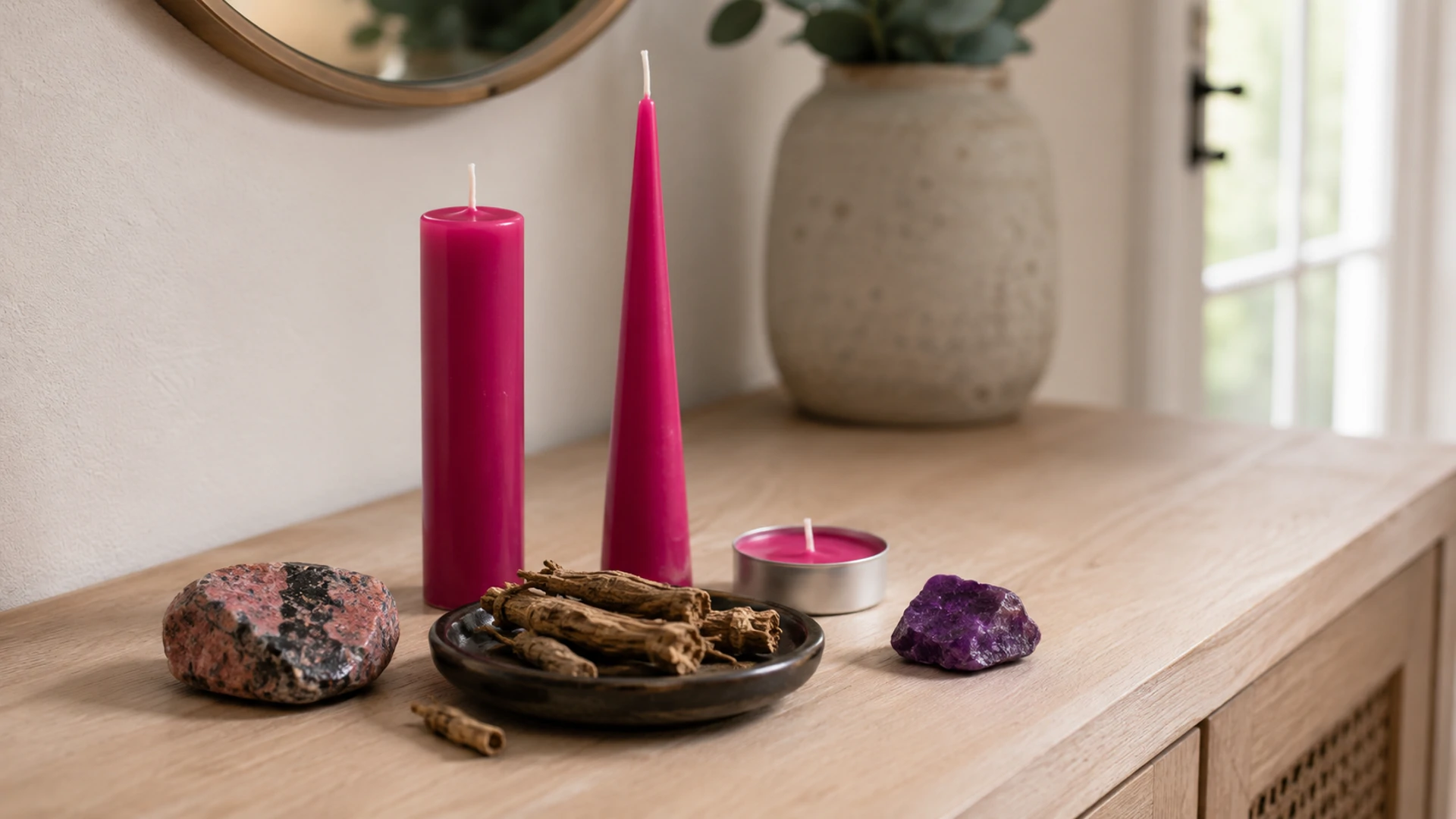
Magenta is the only color in the visible spectrum that your brain has to invent. When your eyes register red wavelengths at one end of the spectrum and violet at the other, with nothing bridging them, your visual cortex synthesizes something entirely its own: a color that has no single frequency and no fixed place on any wavelength chart. Magenta only exists because two opposite signals are held together at once. That's the whole point of what it does in candle magic. It doesn't settle into one current or the other. It fuses them, holds the tension, and then moves — fast.
A Color Your Brain Invents
The Synthesis at Magenta's Core
Most colors belong cleanly to one part of the spectrum. Magenta doesn't. It exists only because the brain refuses to leave a gap between red and violet and instead builds a bridge. The result is a color that carries two energies in dynamic tension rather than averaging them into something neutral. Red and violet don't cancel each other out inside magenta — they coexist, each contributing something distinct, each pulling in a different direction while somehow staying coherent.
That same quality carries directly into its magical character. Magenta isn't a milder version of red or a warmer version of purple. It's something that requires both to be true at the same time.
Red and Purple as Source Currents
Red governs physical energy, desire, and force in the material world. It's the color of appetite, action, and willpower expressed through the body. Purple governs spiritual vision, expanded consciousness, and access to planes beyond the immediate physical. It sees further and reaches higher, but it can drift away from grounded action without something anchoring it.
Magenta brings those two currents together. The practitioner who works with it isn't choosing between earthly force and spiritual clarity — they're drawing on both at once. Think of it as the energy of someone who has done real inner work, arrived at genuine clarity about what they want, and is now ready to act on it with speed and precision. That's the specific quality magenta holds that neither red nor purple carries alone.
Rapid, High-Vibration Change
Magenta's defining quality is speed. This is what separates it most clearly from black, which works through slow, deep dissolution — clearing what no longer belongs, releasing attachments over time, making space by degrees. Black is deliberate and patient. Magenta is neither of those things. Once the space is open, magenta moves into it and commands the new direction. It doesn't ask. It doesn't ease in gradually.
This is why magenta suits moments of decisive shift rather than prolonged processes. You're not asking reality to consider changing. You're asserting that it already has.
The Heat Red Brings to Magenta
Without red's component, magenta would be purely a spiritual color — elevated, visionary, and somewhat remote from lived experience. Red's heat keeps magenta connected to the body, to self-worth, and to emotional vitality. The result isn't aggression or recklessness. It's the specific feeling of loving your own power without apology. Of knowing what you're worth and acting from that knowledge rather than from doubt or depletion.
This is why magenta is so well-suited to confidence work and self-empowerment. The color itself carries that quality — the sense that you are the source of what you're claiming, not waiting for permission from outside yourself.
Fierce, Sovereign, Generative Power
Across the traditions and deities associated with magenta, a consistent thread emerges: power that is active, not passive. Commanding, not receptive. Generative rather than simply protective. Some practitioners call this the sacred feminine in its most forceful expression — not the nurturing or yielding aspect, but the aspect that creates, destroys what needs destroying, and refuses submission. Magenta carries that current strongly. It's not about softness or restoration. It's about authority over your own life, claimed and exercised.
Magenta's Correspondence Profile
Every element of magenta's profile reflects its core nature: projective, catalytic, and oriented toward rapid transformation rather than slow build. Here's the full correspondence profile at a glance:
- Planet: No fixed classical assignment. Commonly linked to Mars through its red component (drive, urgency, projective force), and in some modern traditions to Pluto (transformation, death and rebirth) or Jupiter/Neptune through its violet component (expanded perception, spiritual elevation). Which planetary current you work with depends on the tradition and the specific intent of the working.
- Element: Fire
- Gender: Projective
- Deities: Hecate, Kali, Lilith, Sekhmet
- Magical properties: Rapid change, spiritual power, self-mastery, high-vibration manifestation, commanding energy
- Associated crystals: Rhodonite, Sugilite, Garnet, Ruby
- Chakra: Crown, with root-chakra activation via the red influence
The Planetary Picture
The honest answer on magenta's planetary rulership is that traditions genuinely disagree, and flattening that into a single confident claim would misrepresent how the correspondence actually functions. Mars is the most common association, arriving through magenta's red component: Mars brings drive, urgency, projective force, and the will to act rather than wait. If you're working a magenta candle for commanding energy or rapid personal assertion, Mars is the planetary current most practitioners are drawing on, consciously or not.
The violet component opens other possibilities. Pluto, where it appears in modern magical systems, contributes the quality of transformation through destruction — death and rebirth as a fast, rupturing event rather than a gradual process. Jupiter and Neptune, in other traditions, contribute expanded perception and the ability to see and operate on higher planes. Which of these you work with is less about which one is correct and more about which aspect of magenta you're activating. Timing your working to a Mars hour sharpens the urgency and force; leaning into a Jovian frame amplifies the spiritual elevation.
Fire as the Elemental Correspondence
Fire doesn't negotiate. It burns through what it contacts, converts it, and moves on. As an element, it is purely projective — it radiates outward, consumes what it touches, and transforms rather than absorbs. That's a precise description of how magenta functions as a magical current. It isn't a color for quiet, receptive, inward work. It acts. It initiates. It changes things on contact.
Fire also carries the quality of catalyst — a substance that accelerates transformation without being consumed by it. Magenta holds that quality specifically. It doesn't gradually erode what needs to change. It accelerates the process dramatically, which is why working with it during a moment of genuine readiness produces much stronger results than working with it to manufacture readiness you don't yet have.
The Deities
Each of magenta's four deities embodies a specific aspect of its energy, and none of them overlap cleanly with how these figures appear in other color profiles.
Hecate here is not the guardian of the crossroads in the sense of guidance or illumination. She is Hecate at the moment of transformation itself — the force present when one form of existence ends and another begins, presiding over the hinge point, not the path leading up to it. She governs the instant of rupture and the instant of reconstitution.
Kali is perhaps the clearest deity match for magenta's energy. She embodies time, death, and liberation through destruction. She doesn't coax or suggest. She cuts. Her presence in a magenta working invokes the part of transformation that requires something to be fully ended before something new can take its place — not metaphorically, but as a genuine act of force and will.
Lilith governs sovereignty and the refusal to submit to a role or definition imposed from outside. Her energy in a magenta context is specifically about reclaiming personal power after it has been diminished or surrendered — standing in full authority over your own life and refusing to continue operating from a position of self-erasure.
Sekhmet's aspect here is distinct from her role in red's profile, where she appears through protection-through-intensity. In magenta's frame, she embodies transformation and rebirth through fire. She is the forge, not just the warrior — the heat that reshapes rather than simply defends.
The Crystals
Magenta's four crystals each support a different angle of its energy, and each earns its place through a specific quality rather than a general amplification of the color's themes.
Rhodonite works here through emotional strength and the courage required for self-empowerment. Its contribution to magenta isn't the forgiveness-and-healing angle it carries in other contexts — it's the quality of standing in your own worth even when that requires something difficult. It steadies the emotional body so the commanding energy of magenta has somewhere grounded to land.
Sugilite supports magenta's violet current specifically, providing spiritual protection and elevation. When you're working at the level of rapid, high-vibration change, you're operating in territory that benefits from spiritual anchoring. Sugilite holds that space, keeping the working elevated rather than scattered.
Garnet's role in a magenta working is to ground the transformation in real-world action. Fast energetic shifts can remain unanchored if there's no corresponding movement in the physical. Garnet bridges that gap — it pulls the force of the working down into the material, making sure the change that happens in the subtle body actually propagates outward into life circumstances.
Ruby is the highest-vibration stone in this group. Its role is tied specifically to magenta's intensity rather than to passionate love or desire. Ruby matches magenta's frequency — it can handle that level of force without distorting it, amplifying the commanding quality of the working without diluting it into something softer.
Working With Magenta
Burning a Plain Magenta Candle
For rapid-change workings, a plain magenta candle lit with clear intention is already a complete working. You don't need to dress, inscribe, or elaborate the candle for it to be effective — especially when speed and directness are the point. Set your space, state your intention clearly (aloud or in your mind with full conviction), light the candle, and hold the outcome in your awareness for as long as the working feels active. The simplicity is the point. Magenta commands. You don't need to build up to that slowly.
If you're using a chime candle, the complete burn in a single session suits magenta's fast-moving energy well. A taper works equally well for single-session petitions.
Dressing and Inscribing
When you want to layer intention more deliberately, dressing the candle with magenta's specific oils adds real directional force to the working. High John the Conqueror oil is the strongest choice for commanding power — it asserts dominance of will and opens doors that stubbornness or fear have kept shut. Frankincense elevates the working onto a spiritual frequency and connects it to a higher plane of intent. Cinnamon accelerates and amplifies, while dragon's blood contributes both urgency and a protective charge that keeps the working clean and focused.
The directional logic: anoint from wick to base to draw something toward you, base to wick to send something outward or away. Choose the direction based on the nature of the working — drawing in confidence or personal power, or pushing out what's been blocking you.
For inscribing, a present-tense phrase that states the outcome as already true works well with magenta's commanding energy. A relevant symbol, a personal sigil, or simply a name — your own name for self-empowerment work, or the name of what you're claiming — can replace or accompany the phrase. Keep it direct. Magenta doesn't suit tentative, conditional language.
Charging
Charging a magenta candle works best when you visualize the goal as already complete — not as something you're hoping will happen, but as a reality you're pushing into the wax. Feel the emotional truth of that outcome fully before and during the transfer. That's the actual charge: not the image, but the feeling that comes with the image. The conviction that this is real. Hold that state, push it into the candle through your hands, and then release it when the transfer feels complete. The charging process for magenta specifically benefits from being vigorous rather than contemplative — match the energy of the color itself.
Ritual and Ceremonial Use
Magenta functions particularly well as the centerpiece of a multi-component working, where each element is doing distinct work. A self-empowerment ritual built around a dressed magenta candle, garnet and rhodonite arranged as a crystal grid around the base, and a spoken declaration of intent said with full conviction is one of the cleaner setups for this color. Garnet anchors the transformation in the physical; rhodonite holds the emotional strength needed to actually receive the shift; the magenta candle carries the commanding frequency through all of it.
If you're working a transformation ritual that follows a clearing phase, pair black and magenta in sequence. Burn the black candle first to complete the release — clearing what needs to go, dissolving attachments, making room. Once the black candle has burned down, light the magenta. The sequencing matters: black releases and clears, magenta commands what comes next. The two together form a complete transformation arc. Incense (frankincense or dragon's blood work well) and a clearly stated spoken word component strengthen the working at every stage.
Petition Work
A written petition is one of the most direct methods for magenta. Write your goal as a specific, present-tense statement — not what you want to happen, but what is happening or what is now true. Keep it in first person and make it concrete. Fold the paper toward yourself to draw something in (confidence, power, a new chapter), or away from yourself to send something out (the old version of yourself, a pattern you're done carrying, a circumstance you're releasing into change).
Place the folded petition under the candle holder while the candle burns. As the candle works, the petition is held in the heat and intent of the flame. For magenta specifically, shorter candles like chimes or tealights suit this format well — the petition accompanies a complete, contained burn rather than sitting under a multi-day working. Magenta's energy is fast, and the petition format should match that.
For workings that require sustained momentum over several days, a pillar candle gives you room for deep carving and daily renewal of intention while the working builds.
Magenta is the color for the exact moment when inner work is finished and outer force begins. When you've done the clearing, arrived at genuine clarity about who you are and what you're claiming, and are ready for that to become real in your actual life — fast. That's the working magenta is built for. When you're there, you'll know. And when you are, the complete candle color guide has everything you need to support that working with the right tools alongside it.