Nettle: The Sting That Breaks a Curse
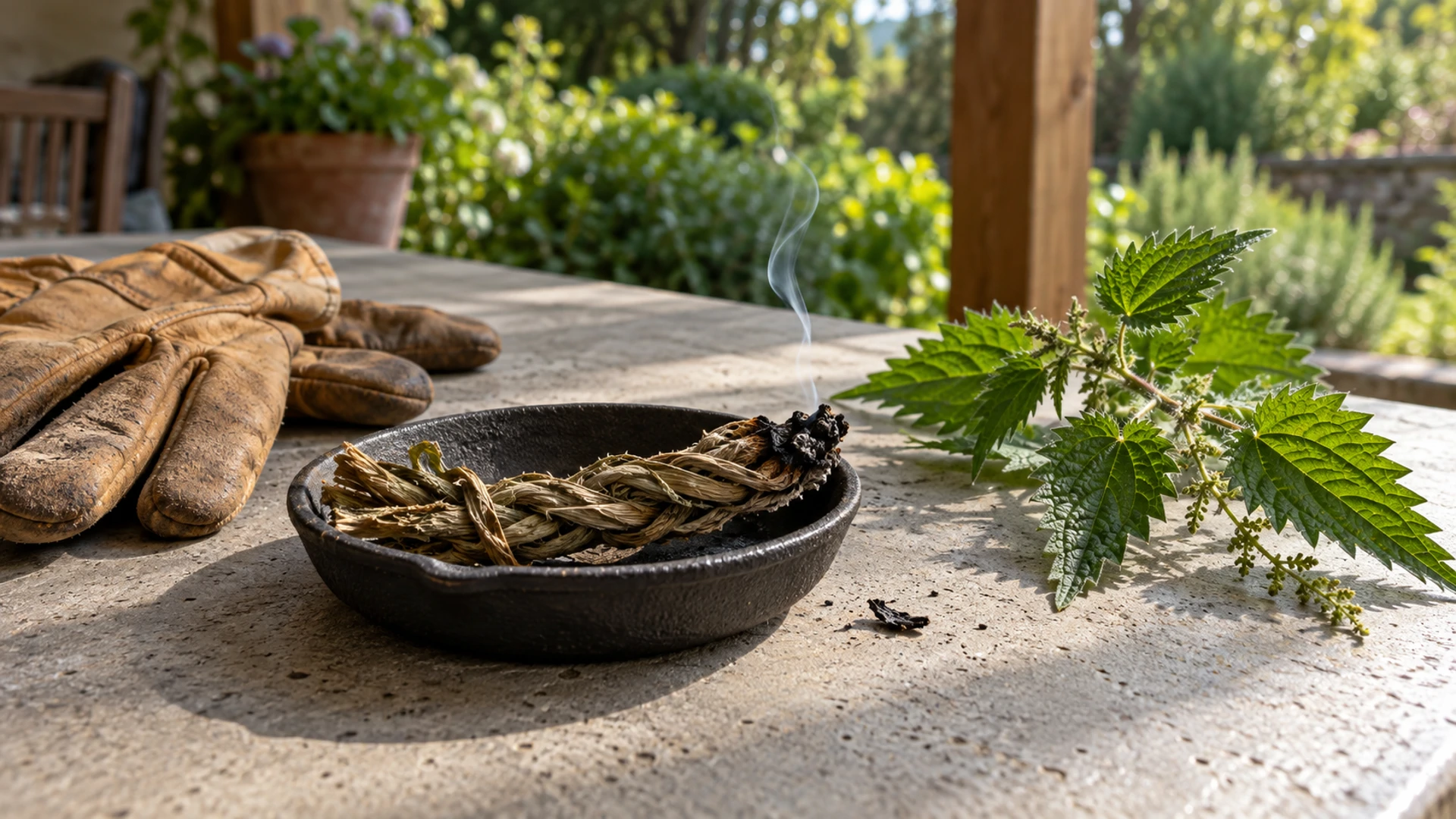
Stinging nettle is a banishing herb with one clear job: it breaks what should not hold. Its place in folklore is literal — in Hans Christian Andersen's "The Wild Swans," a sister weaves shirts from nettles to shatter the curse that turned her brothers into swans, and she does it with her own hands, through pain.
Breaking What Should Not Hold: Nettle's Place in Banishing
Nettle's angle in banishing work is curse-breaking. Not every banishing herb works the same way, and the distinction matters when you're choosing what to reach for. Agrimony reverses — it returns a harmful working to where it came from. Blackthorn severs — it cuts ties and cords that need to end. Nettle does neither of those things. It breaks what should not hold: a curse, a crossed condition, an influence that has wrapped itself around you and won't let go. The sting is the point. This herb does not negotiate.
Nettle is ruled by Mars and associated with fire and Tuesday — the planetary current of action, force, and combat. Culpeper and Cunningham both place it firmly in Mars's domain, and the correspondence fits. Mars herbs cut, heat, and drive. They don't dissolve gently; they break things open. Nettle's secondary category is Protection and Warding, which makes sense once you understand that its curse-breaking action also enforces a boundary. When something harmful is expelled, what takes its place is a cleared perimeter. Botany: Urtica dioica, stinging nettle, belongs to the nettle family (Urticaceae), and the leaves, stems, and roots are all used in practice.
What makes nettle distinctive among Mars herbs is that it carries its action in its body. The sting is not a side effect — it is the herb's character made physical. Handling fresh nettle with bare hands means you feel exactly what the plant does. That direct encounter between practitioner and material is part of why nettle cord, twisted by hand (with gloves), is such a fitting medium for breaking-work. You are doing something with your hands that requires sustained effort, and the object you create carries the plant's own breaking quality.
Nettle Shirts and the Nine Herbs
The story in Andersen's "The Wild Swans" (1838) is one of the clearest images in Western folklore of nettle as a curse-breaker. A princess must weave eleven shirts from nettles — gathered from graves, worked by moonlight — to restore her brothers, who have been transformed into swans by their stepmother's curse. She cannot speak while she works. She cannot stop. The final shirt is unfinished when she runs out of time, and the youngest brother is left with one swan's wing where his arm should be. The magic is not painless, and it is not complete. That tension — effort, cost, incompleteness — is closer to real magical work than most fairy-tale endings manage to be.
The story is not purely symbolic. Nettle fiber has been spun into cloth since the Bronze Age, so Andersen was drawing on a real craft tradition when he gave the sister her impossible task. Nettle is also named in the prose instructions of the Anglo-Saxon Nine Herbs Charm, a 10th or 11th-century text preserved in the manuscript called Lacnunga. The charm names it alongside mugwort, chamomile, and fennel, among others. Scholars disagree about which verses of the charm specifically address nettle, so the detail is worth holding lightly — but its presence in the prose instructions is documented. That puts nettle in the company of the oldest named protective herbs in the English tradition.
Gloves to Gather, Heat to Tame
Nettle is one of the easier banishing herbs to source because it grows wild across most of the temperate world. Roadsides, field edges, and damp disturbed ground are its preferred habitat. When gathering, gloves are non-negotiable — the fine hollow hairs on leaves and stems inject formic acid, histamine, and other compounds on contact, producing the characteristic sting that can last for hours on sensitive skin. Drying and cooking both neutralize the sting entirely, which is why nettle has been eaten as a green throughout European history. Dried nettle from a reputable herb supplier is an equally good option and removes the gathering step. Stems can also be retted — soaked and broken down — and then twisted into a cord, which is a preparation with direct relevance to the working below.
Safety with nettle in ritual is mostly about the fresh plant and about medicinal dose. The fresh sting is handled by gloves and by allowing material to dry fully before handling it bare-handed. The more significant caution applies if you intend to drink nettle: medicinal doses interact with blood-pressure medication, diabetes medication, and lithium, so anyone on those drugs needs to take care before adding nettle to a regular tea practice. A one-time ritual cup is a different matter from daily medicinal use, but the interaction is real enough to mention clearly. If you want to work with nettle as a ritual drink specifically for protection, the nettle tea ceremony for protection lays out the full practice — keep that medication note in mind before you brew.
Three Nettle Workings for Breaking a Hold
A Twisted Nettle Cord, Burned
This working is for when you feel something has settled over you that has no right to be there — a residue, a crossed condition, a pattern that seems to keep renewing itself no matter what you do.
Take a length of dried nettle stem — or twist several stems together into a rough cord — while naming aloud or in your mind exactly what you are breaking. Be specific. Don't say "bad energy"; say what it is, what it has done, how long it has been there. The twisting is the work: you are binding the condition into the cord so it has a physical form, the same way the sister in "The Wild Swans" bound her brothers' freedom into the shirts she made. When the cord is as long as feels right — a hand's length is enough — hold it over a fireproof dish and light one end. Let it burn completely. Don't rush it. What has been named burns with it.
Dried Nettle in a Banishing Jar
Use this when the influence you want to break is diffuse or ongoing — something you can't point to a single moment of, but that you know needs to end.
Write on a small piece of paper exactly what must break: a habit, a dynamic, a pattern, a crossed condition. Fold the paper away from you — each fold moving it away, not toward — and place it in a small jar. Pack dried nettle around and over it, enough to bury the paper completely. Seal the jar. Place it somewhere out of sight: a high shelf, the back of a cabinet, under the bed if that's a space you use for working. You can make this jar on a Tuesday or during a Mars hour to reinforce the planetary current already running through the herb. Leave it in place until you feel the breaking is done, then dispose of the contents away from your home — bury them in the ground or throw them in running water.
A Nettle Wash at the Boundary
This one leans into nettle's secondary category, Protection and Warding, and is for a threshold that has been tested — a door, gate, or entry point that feels compromised.
Steep a generous handful of dried nettle in near-boiling water for ten minutes, then strain it thoroughly so no plant material remains. Let it cool until it's comfortable to work with. Take the infusion to your threshold — front door, back door, gate, wherever the boundary needs reinforcing — and wash it across the surface from the outside in, or pour it across the width of the step. As you do it, speak the boundary plainly: what may not pass, what is no longer welcome here. The nettle's curse-breaking quality works on whatever has already slipped through; its warding quality holds the line going forward.
Sting, Break, Free
Nettle's role in the Banishing and Hex-Breaking category is the one that cannot be replicated by anything else in that group. The other herbs sever, drive out, repel, reverse, or bar return — and each of those is its own distinct action. Nettle breaks the thing itself. If what you're working against is a hold that has already taken shape, that has structure and duration, nettle is the herb that answers that specific problem.
To see nettle in full context alongside the other banishing herbs — and alongside the six other paths through plant magic, from protection to love to spirit work — the seven paths through plant magic is where to go next.