Black Andradite Garnet: The Stone That Concentrates What Scatters
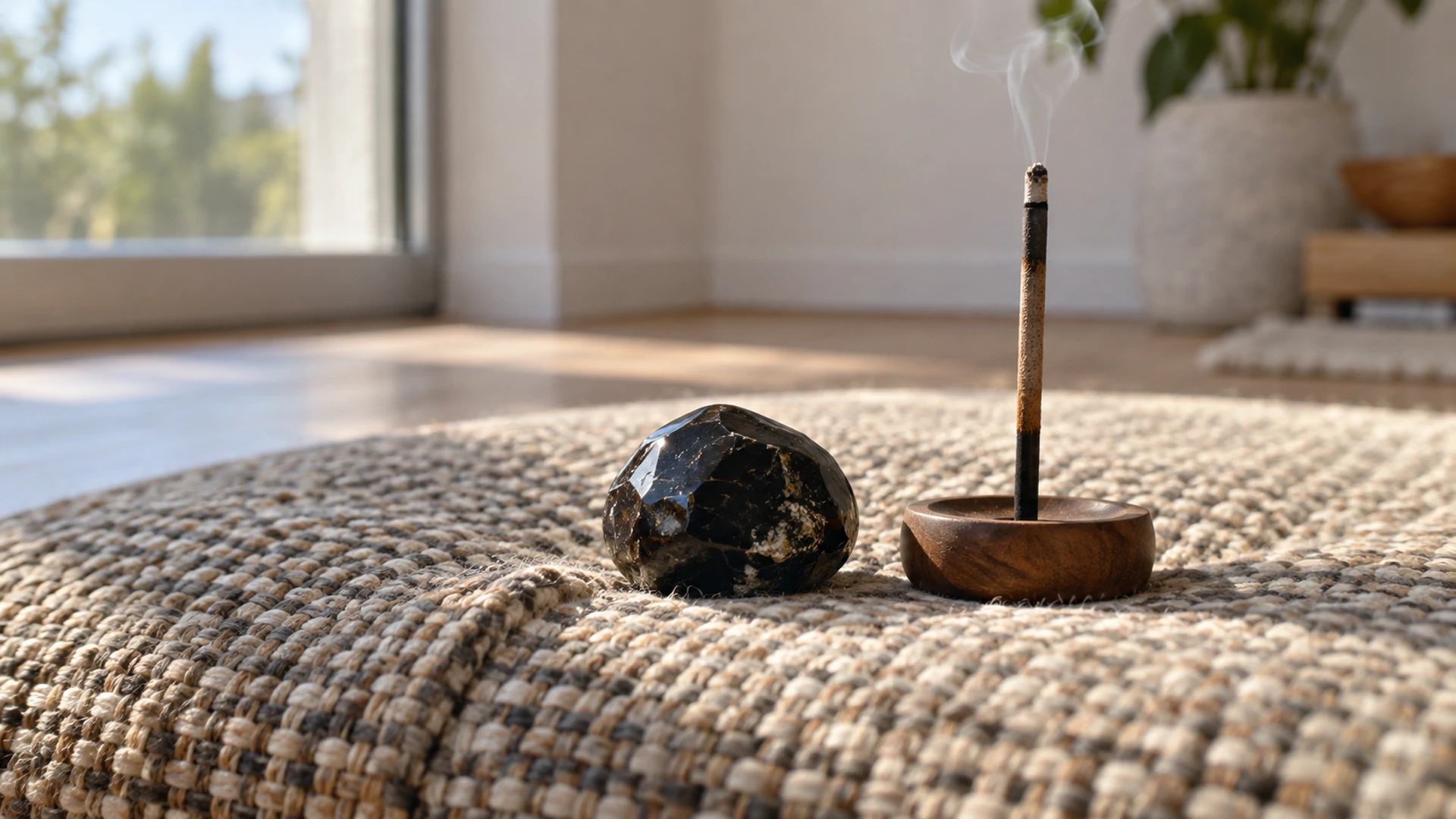
Black andradite garnet — also called melanite — protects not by building a wall, but by pulling everything you are into one unbreakable point.
Named for Titans: Why Black Andradite Garnet Belongs in Protection
Most people's first question about melanite is why a garnet is black. Garnets are supposed to be red. And technically, black andradite garnet is still a garnet in every structural sense — it belongs to the andradite species of the garnet group, forming in the same silicate framework. The difference is what fills the crystal. In melanite, titanium replaces a significant portion of the iron and silicon in the lattice. That titanium content is what produces the opaque, glossy black color. It's also what makes this stone genuinely unusual in the garnet family, because andradite already has the highest refractive index and dispersion of any garnet species — meaning it bends and splits light more dramatically than most gems — and black andradite carries that same internal optical intensity even though its surface reads as solidly dark.
Titanium, the element that gives melanite its color, was named after the Titans of Greek mythology — the primordial beings of overwhelming, unconquerable strength who preceded the Olympian gods. That naming wasn't poetic license; the element was called titanium because of its extraordinary resistance to being broken down or alloyed. When you're working with a black garnet whose color comes specifically from titanium, you're working with a stone that carries two layers of naming: melanite (from the Greek for black) and andradite (a garnet species with exceptional optical density), both saturated with the substance named for pure, concentrated force. That isn't a fabricated correspondence. It's a verifiable fact about the stone's chemistry and etymology — and it's the clearest argument for what this stone actually does in protection work.
Black andradite garnet's protective mechanism is consolidation. It doesn't ground you the way black tourmaline does, building a boundary out from a stable root. It doesn't reflect or reveal the way black obsidian works, acting as a mirror for what's approaching. What melanite does is gather. When your energy is diffuse — leaking into worry, scattered across too many competing demands, eroded by people or situations that chip away at your sense of self — this stone draws it back in. The protection comes from density. A consolidated center is harder to disturb than a spread-thin one. That's the mechanism, and it's specific to this stone.
This consolidating quality also feeds what is honestly a secondary but real thread in melanite's character: Empowerment. Strength, courage, and personal will are consistently cited alongside its protective use, and that makes sense when you understand the mechanism. Concentration of energy isn't just defensive. A gathered, dense personal power is also the foundation of decisive action. This secondary thread is worth knowing, but it doesn't override the primary one — this stone's center of gravity is protection through consolidation, not activation for a specific goal.
Its correspondences sit in exactly the places you'd expect from that mechanism. The root chakra anchors it — this is about the most fundamental layer of personal stability, not the higher centers. The Earth element governs its energy, consistent with the dense, compressed quality it works with. Saturn rules it, fitting for a stone concerned with boundaries, endurance, and the kind of slow-building structural strength Saturn specializes in. Its zodiac affinities are Scorpio and Capricorn — two signs defined, in very different ways, by the capacity to concentrate rather than disperse. Scorpio holds power inward until the moment it becomes necessary; Capricorn applies sustained, disciplined force over time. Both are fitting.
Garnet or Schorlomite? Choosing Genuine Melanite
Before you look for fakes, there's a more interesting labeling problem to understand. Melanite (black andradite garnet) is closely related to a mineral called schorlomite, which is a titanium-rich andradite with an even higher titanium content. The two minerals exist on a compositional continuum rather than having a sharp boundary, and the trade labeling between them is genuinely inconsistent. Material sold as schorlomite is frequently andradite (melanite), and vice versa, because distinguishing them reliably requires chemical analysis rather than visual inspection. For practical purposes in crystal work, this matters less than people might think — you're working with the same fundamental mineral species — but it's worth knowing that the name on the label may not be the more precisely accurate one.
What matters more for actually identifying genuine melanite is understanding andradite's optical character. Even in black andradite garnet, the high dispersion that defines andradite as a species is still present. A well-polished or well-cut piece, when turned slowly in light, will show a faint but real inner sparkle — a subtle flash that comes from the stone's internal structure interacting with light even through its dark surface. Material that is completely flat and lifeless, showing no inner movement at all when you rotate it under a lamp, is more likely to be black glass, black tourmaline (which has a different crystal habit entirely), or a dyed stone. Genuine melanite has a visual depth to it that inert black material doesn't.
The crystals themselves tend to form in the dodecahedral habit characteristic of garnets — twelve-faced, rounded, roughly spherical shapes — or in a combination of dodecahedral and trapezohedral forms. Finding melanite in a well-formed crystal rather than a tumbled piece gives you more visual information to work with. Raw specimens from reputable mineral dealers, labeled by locality (Zermatt in Switzerland and various Italian localities have historically produced fine material, as have sites in Russia and Canada), are a safer choice than generic tumbled black stones with no provenance.
Care for this stone is straightforward. At Mohs 6.5 to 7, melanite is durable enough for most handling and jewelry use, though it shouldn't be stored loose with harder stones like sapphire or diamond that could scratch it. Brief water contact is safe — rinsing it clean is fine — but prolonged soaking isn't necessary or advisable since garnet-group minerals can have internal fractures that water may work into over time. There are no toxicity concerns with normal handling. Energetically, melanite is often cleansed with sound or by brief burial in dry earth, both of which are consistent with its Saturn and Earth correspondences.
Three Practices for Consolidating Power
The Density Draw
Use this before any situation that requires you to be fully present and undivided — a difficult conversation, a high-stakes performance, or any moment where scattered attention will cost you.
Hold the melanite in both hands and close your eyes. Spend a full minute or two simply noticing where your attention and energy actually are — not where you want them to be, but where they've drifted. Notice the thoughts running ahead to outcomes, the awareness split across unfinished things, the low hum of background worry. Then, slowly and deliberately, visualize all of that diffuse energy as threads or streams pulling inward toward the stone in your hands, condensing into a single dense point at your center. The stone is the model: compact, consolidated, nothing wasted. When you feel the shift — a settling, a slight heaviness, a sense that you've arrived in your own body — the draw is complete. Set the stone somewhere visible for the duration of the task.
The Titan's Grip
Use this when you need raw willpower specifically — not the quiet endurance of a long undertaking, but the kind of force required to act decisively in a moment you'd rather avoid.
Pair the melanite with a red candle dressed with a small amount of black pepper, which carries Mars's activating, push-through quality. If timing matters to you, work during a Saturn hour for its association with concentrated force and necessary confrontation. Hold the stone in your dominant hand and speak your intention aloud — not a wish, a statement of what you are about to do. The etymology here is worth using directly: the titanium in this stone bears the name of beings who existed before the gods, whose power was not granted but inherent. That's the quality you're calling on. State what you intend. Then go do it.
The Deep Earth Meditation
Use this when the issue isn't urgency or courage but foundation — when you need access to the kind of stability that doesn't depend on circumstances being favorable.
Sit with the melanite placed on the floor between your feet, or held loosely in the lap. This practice works well with frankincense burning nearby — its Saturn and solar-purification qualities complement the stone's Earth and Saturn correspondences without competing with them. Breathe slowly and let your awareness move downward rather than up: not into the sky or the crown, but into the floor beneath you, the soil beneath the floor, the bedrock beneath the soil, the slow geological time beneath all of it. Melanite is a stone that forms in conditions far older than most of what's on the surface. Let yourself rest inside that timeframe for ten or fifteen minutes. The stability you're touching here isn't emotional reassurance — it's something more structural. It's the recognition that the ground itself has been here longer than the problem has.
Titanium, Titans, and a Name from the Greek for Black
The name melanite traces to the Greek word melanos, meaning black. The attribution for formalizing it as a mineral name is commonly given to Abraham Gottlob Werner, the influential German mineralogist whose work on mineral classification in the late 18th and early 19th centuries shaped how many stones were named and categorized. The exact year of Werner's classification is inconsistently cited across sources, so it's more accurate to say the name was established in the period around the turn of the 19th century rather than pinning it to a specific date.
The more interesting naming story is the element inside it. Titanium was named by the English chemist Martin Heinrich Klaproth, also in the late 18th century, drawing on the Titans of Greek mythology — not for any specific Titan, but for the category itself: the pre-Olympian beings of immense, primordial force. Klaproth's choice was deliberate. He wanted a name that conveyed unconquerable strength. The element he named it for is genuinely resistant to corrosion, heat, and chemical breakdown in ways that most metals are not — the name fit the substance.
What this means for melanite specifically is that this stone carries an unusually direct, verifiable chain from its geology to its mythology. The black color comes from titanium. Titanium was named for the Titans. The Titans were mythological figures of concentrated, inexorable power that couldn't be divided or dispersed. That chain isn't a practitioner's creative interpretation layered on top of the science — it's built into the stone's actual chemistry and the decisions of the scientists who named what they found inside it. In a practice where correspondences are often symbolic by convention, it's worth noting when one is structural by fact.
Protection as Concentration
Every stone in the protection category works through a different mechanism, and the distinction matters when you're choosing what to reach for. Black andradite garnet's contribution is one that the other stones in this category don't duplicate: it consolidates. When the threat is not something coming toward you from outside but rather the internal fragmentation that leaves you with nothing coherent to defend, melanite is the tool built for that specific problem. Dense personal power isn't the same as a shield. It's what makes a shield possible.
If you want to see how melanite sits alongside the full range of protection stones — and how the Protection category itself relates to Cleansing, Healing, Empowerment, Abundance, Love, and Intuition — The Crystal Compendium: Seven Paths to Stone Magic maps all of it in one place. It's the right starting point for building a practice that uses stones intentionally rather than by instinct alone.