Moon Hour: Intuition, Dreamwork, and Emotional Healing
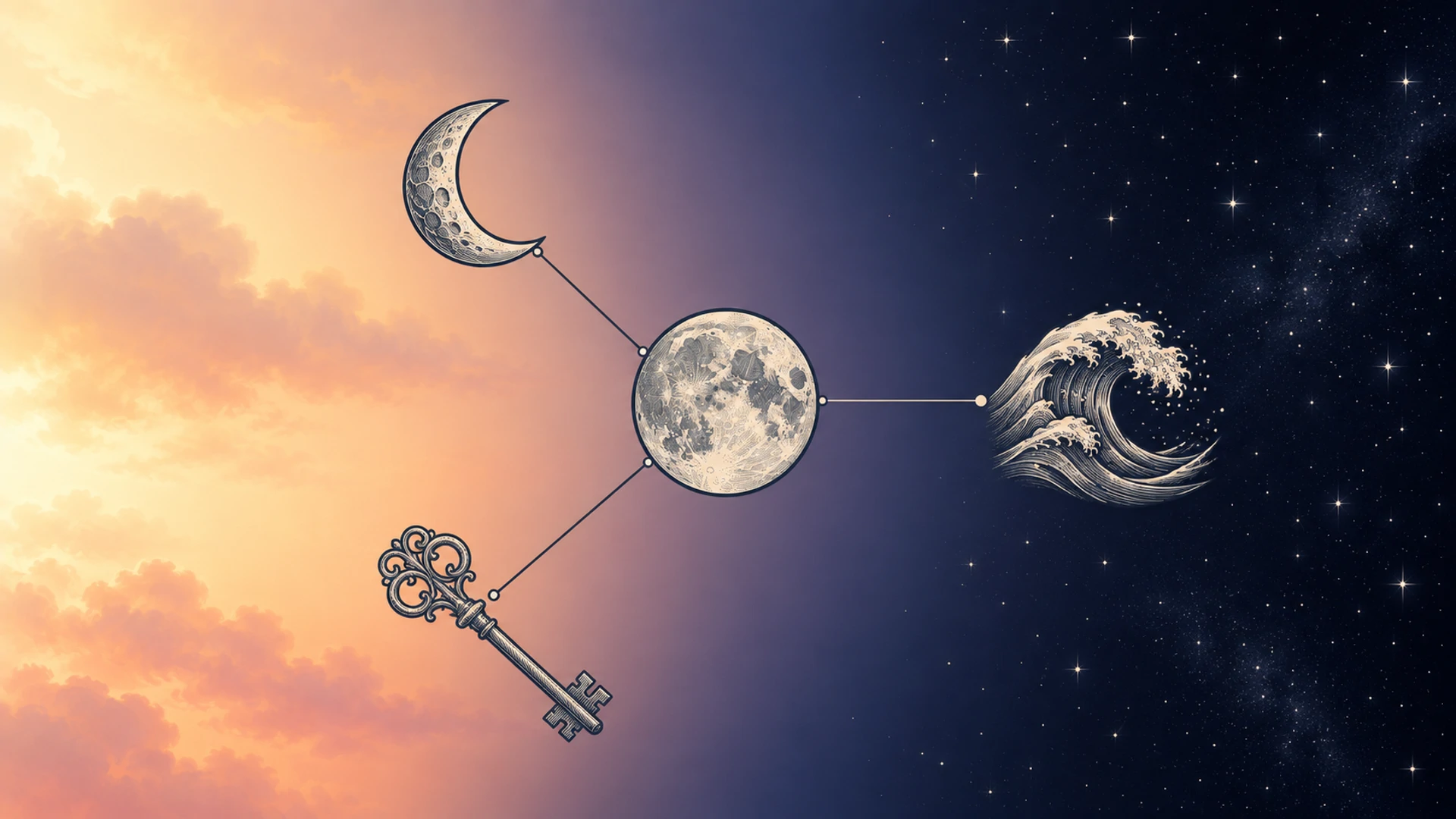
The Moon Hour is not a time for asserting or pushing — it is a time for receiving, perceiving, and processing. Where other planetary hours sharpen your will into a blade, Moon's hour opens a door inward. It governs intuition, the subconscious, dreams, emotional truth, and the quiet currents that run beneath everyday awareness. If you have a working that requires listening more than speaking, or one where the outcome depends on what surfaces from below rather than what you declare from above, the Moon Hour is the window you want.
Understanding what makes this hour distinct — its position in the Chaldean order, what the grimoire tradition actually says about it, and the full picture of when it appears across the week — gives you a real tool. Not a vague suggestion to "work with lunar energy," but a timed, historically grounded window with a specific character and a clear range of uses.
Moon's Place in the Chaldean Sequence
The Moon sits last in the Chaldean order: Saturn, Jupiter, Mars, Sun, Venus, Mercury, Moon. This sequence ranks the classical planets by their apparent speed of movement across the sky, from slowest to fastest, as observed from Earth. Saturn moves most slowly through the zodiac and was considered the most distant. The Moon completes its full cycle in roughly 29.5 days and crosses the sky visibly night after night — the fastest-moving body in the sequence, and the one considered closest to Earth.
That last position is not a demotion. Speed and closeness are what make the Moon the most immediately felt of all seven rulers. While Saturn's influence accumulates across decades and Jupiter's across years, the Moon shifts its position visibly within hours. Its domain is everything that changes at that pace: mood, tide, dream, and the emotional undercurrents that surface without warning. Being last in the sequence placed it at the threshold between the celestial order and the world of living, changing matter — the ruler whose character you feel in your body before you can name it.
The Chaldean sequence repeats continuously through all 24 unequal hours of every day, which is what determines which planet rules any given hour. You can read the full mechanics of how the sequence produces the seven-day week and governs each day's hour assignments in the planetary hours guide. For now, what matters is that the Moon's last position in the order is what places it at hours 1, 8, 15, and 22 of every Monday — a point worth returning to in a later section.
Moon in the Grimoire and Astrological Tradition
The Moon's hour carries one of the most clearly defined characters in all of planetary hour literature. Across the grimoire tradition, its hours are consistently associated with receptivity, hidden knowledge, water, domestic concerns, and travel by sea — not the dramatic or aggressive workings assigned to Mars and Saturn, but the quieter ones that require openness rather than force.
Gabriel and the Governing Angel
The Heptameron assigns Gabriel to the Moon, and Cornelius Agrippa carried that pairing into his Three Books of Occult Philosophy, cementing it as the default attribution in ceremonial magic. The fit is not arbitrary. Gabriel is the angel of annunciation — of what is disclosed rather than commanded, of divine communication that arrives as revelation rather than decree. In every Abrahamic context that fed into Renaissance grimoire culture, Gabriel is the one who brings the message you did not know was coming. That character maps directly onto the Moon's domain: the unconscious surfacing, a truth rising through sleep, something hidden becoming known. The pairing held because it was coherent, not just conventional.
What the Key of Solomon Says
The Key of Solomon — whose Hebrew name for the Moon is Levanah, listed last in its descending Chaldean roster of planetary names — is specific about what Moon's days and hours are suited to. Book I, Chapter II lists embassies, voyages, messages, envoys, navigation, reconciliation, love, and the acquisition of merchandise by water as the proper concerns of the Moon's hour. Separately, the same text states that the Hours of the Moon are proper for making trial of experiments relating to recovery of stolen property, for obtaining nocturnal visions, for summoning spirits in sleep, and for preparing anything relating to water.
A few things are worth pulling out of that list. The Moon's hours in the Key of Solomon are not passive or trivial — voyages and embassies were serious undertakings, and "nocturnal visions" and "summoning spirits in sleep" are direct references to intentional dreamwork and scrying. The emphasis on water, travel, and messages also maps cleanly onto the Moon's astrological character: it rules tides, the unconscious as a body of water beneath waking awareness, and the movement of things across boundaries. Goods crossing water, dreams crossing the threshold of sleep, information moving through an intermediary — all of these fall under Levanah's office.
The mention of recovering stolen property is one of the more specific and interesting assignments in this section of the text. It implies that Moon's hours are useful when something has passed out of your direct possession or perception and you need it brought back — a logic that extends naturally into workings for lost objects, estranged relationships, and anything else that has drifted out of reach.
The Traditional Metal: Silver
The Moon's traditional metal is silver. This correspondence is among the most stable in all of planetary magic — traced consistently through alchemical tradition, Agrippa's synthesis, and the grimoires without meaningful variation. Silver was associated with the Moon long before the Renaissance systematized these correspondences: its color, its reflective quality, and the way it catches and returns light rather than generating its own made the pairing feel self-evident. In practice, silver is used as a material correspondence in Moon workings — as a candle color, as a choice of vessel or ring, and as a symbolic anchor for any working operating under Moon's hour.
Color is a different matter. The silver and white often attributed to Moon hours in modern practice largely reflect 19th- and 20th-century Golden Dawn systematization rather than a single unbroken classical source. Earlier grimoire literature is considerably less uniform about color attributions across the seven planets. Silver as a metal has an unbroken classical pedigree; silver as a candle color is a later convention, though a widely used and practically coherent one.
The Pentacles of the Moon in the Key of Solomon extend the text's treatment of Moon's domain into specific talismanic workings — for gates and locked ways, against perils of water, for travel protection, and for dreamwork and nocturnal vision. If you are working with the 44 pentacles of Solomon, the six lunar pentacles map almost perfectly onto the categories of work the Key of Solomon assigns to Moon's hours: protection over water, defense against sorcery, nocturnal vision, and knowledge of herbs and stones.
Moon's Day: Monday
The reason Monday belongs to the Moon is straightforward: in the planetary hour system, the first hour of any day — the hour beginning at sunrise — is always ruled by that day's own planet. Monday's first hour is a Moon hour, and from there the Chaldean sequence continues. The day takes its identity from that opening hour, just as each of the other six days takes its from whichever planet rules its sunrise.
Monday's name has carried the Moon's identity without interruption across two entirely separate language families. In English, it descends from the Old English Monandæg, a direct translation of the Latin dies Lunae. The Romance languages preserved the Latin form directly: French lundi, Spanish lunes, Italian lunedì. None of them displaced the Moon's name with a later religious substitute, unlike Sunday, which became dimanche, domingo, domenica in the Romance family. And unlike Tuesday through Friday in English, where Tiw, Woden, Thor, and Frigg replaced their Roman counterparts, the Moon never received a Norse substitute in Old English. Monday is the one weekday where both language families arrived at the same result through entirely different routes — one translating, one inheriting — and neither one let go of the Moon's name along the way.
For practice, what this means is simple: on a Monday, the Moon's character runs through the entire day from the first light of sunrise. A Moon hour on Monday isn't just a timed window — it's a window inside a day that's already saturated with lunar current. That distinction matters most for workings that need to build gradually, where the hour alone might not be enough time, but the full span of a Monday gives you the room to let something unfold across multiple hours and still stay within the planet's domain.
Finding Moon's Hours: Day and Night Windows
Because the Chaldean sequence repeats across all 24 hours of every day without resetting, Moon's hour falls at predictable positions throughout the week — not just on Mondays. On Monday itself, Moon rules hours 1, 8, 15, and 22. Hour 1 begins at sunrise. Hour 8 falls roughly in the mid-morning. Hour 15 arrives in the mid-afternoon. Hour 22 comes after dark, a few hours into the night portion of the day.
On the other six days of the week, Moon's hour lands at different points in the cycle. Some of those windows fall in daylight; others fall well after sunset. Which days carry Moon's hour in what part of the day shifts across the week, and both types are usable — but they feel different, and that difference is worth paying attention to.
A Moon hour that falls during daylight is slightly more outward-facing. The Moon's domain is naturally nocturnal, but a daytime window works well for practical matters with a lunar character — correspondence, travel preparation, purchases related to the home, or workings for reconciliation where the intent is to bring something back into visibility. The Moon's hour after dark is where its full character opens. Dreamwork, scrying, shadow work, and anything requiring deep contact with the subconscious are better suited to a Moon hour that falls in darkness, especially one landing in the hours shortly before sleep. The grimoire tradition's emphasis on "nocturnal visions" is not accidental — it is a direct instruction about timing.
One thing to know: planetary hours are not clock hours. Each day hour is one-twelfth of the time between sunrise and sunset, and each night hour is one-twelfth of the time between sunset and the following sunrise. The length of each hour changes with the seasons and with your latitude. In summer, daytime Moon hours run longer than 60 minutes and nighttime ones run shorter. In winter, it reverses. This means you cannot simply count off 60-minute blocks from sunrise to find the Moon Hour — you need the actual calculation for your location and date.
For the exact start and end times of every Moon hour this week, use a live Moon hour almanac built for your location. The calculation shifts daily, so checking in real time rather than relying on a fixed schedule is the only way to work with precision.
What Moon Hours Are For
The Moon's hour supports a wide range of work, but it has a consistent through-line: it favors workings where you need to receive rather than project, where the goal is perception, flow, or restoration, and where the subject matter connects to water, cycles, the home, or what lies beneath ordinary waking awareness.
Divination and Dreamwork
This is the Moon hour's strongest suit. Scrying, card reading, mirror work, and any form of divination that relies on intuitive interpretation rather than calculation are well-served by this window. The Key of Solomon is explicit that Moon's hours are good for obtaining nocturnal visions and for summoning spirits in sleep — which in practical terms means working before sleep, during a Moon hour that falls in the night portion of the day, to prime the mind for intentional dreaming. Mugwort and jasmine are both traditional Moon herbs, and either can be incorporated into pre-sleep ritual work timed to a Moon hour to deepen dream recall and lucidity.
Emotional Healing and Domestic Work
Workings aimed at emotional processing, grief, old wounds, or the slow restoration of something that was broken belong here. The Moon governs cycles — what comes and goes, what ebbs before it returns — which makes its hour a good fit for workings that need to unfold gradually rather than resolve in a single session. Domestic matters fall under the Moon's traditional rulership as well: anything connected to the home, the family, or the private life can be worked during a Moon hour with full alignment. A silver candle dressed with jasmine oil is a clean and historically grounded choice for Moon hour work of this kind.
Recovery and Restoration
The Key of Solomon's note that Moon's hours are suited to recovering stolen property extends further than it first appears. Recovery — of an object, a relationship, an emotional state, or a sense of self — is lunar work. The Moon rules what returns: tides go out and come back, the Moon itself waxes after waning. Workings for estranged relationships, for retrieving something that has been lost or taken, and for healing after a rupture all sit comfortably in this window.
Travel Over Water and Safe Passage
Historically, Moon hours were specifically called out for voyages and navigation. In modern practice this extends to any kind of travel working, but it carries a particular resonance for journeys involving water or for any situation where the path is uncertain and you need safe passage through unfamiliar territory. This is also where the Moon's correspondence with envoys and messages comes in — workings to smooth a communication that needs to cross a difficult gap, reach an estranged person, or arrive at the right moment belong in a Moon hour.
Reconciliation
The Key of Solomon lists reconciliation explicitly among the Moon's hour concerns — not just as a secondary note, but as a named category of work. Reconciliation workings that aim to restore warmth between estranged parties, to soften a conflict that has hardened, or to re-establish contact after a breakdown benefit from Moon's hour. This pairs well with harmony candle work timed to a Monday Moon hour, particularly the first or eighth hour of the day.
Silver as a Material Correspondence
Moon's traditional metal, silver, has the most consistent pedigree of any of this planet's correspondences. Using silver in a Moon hour working — as a ring worn during the ritual, as the color of the candle, or as a silver coin placed on the altar — is one of the most grounded ways to anchor the hour's character in physical form. The color white works as a substitute when silver candles are unavailable and carries a similar energy in modern practice.
Working With Moon's Hour
The Moon Hour appears every single day of the week, at four distinct windows on Monday and at least once on every other day at varying positions in the cycle. You are not waiting for a rare alignment — you are choosing which of the available windows fits your intent and your schedule. Checking your location's hour schedule for the current week takes thirty seconds and tells you exactly when each window opens.
The most straightforward way to amplify a Moon hour working is to layer it with lunar phase. The Moon's own phase adds a second layer of timing that sharpens the intent. A Moon hour during a waxing moon strengthens workings aimed at growth, drawing something toward you, or building emotional resilience. A Moon hour during a waning moon sharpens workings for release, for letting something go, or for the slow dissolution of a pattern that no longer serves. A Moon hour on the full moon, especially one that falls during the night, is as concentrated a lunar window as the week offers — and it happens once a month without any effort to manufacture the alignment.
Monday adds a third layer when it's available. A Moon hour on a Monday during a waxing moon is a strong window for emotional healing, dreamwork preparation, or any working that needs the full weight of lunar influence behind it. But you do not need all three to work effectively. A Moon hour on a Tuesday night, timed to fall an hour before sleep, is enough to open meaningful dreamwork.
The Moon's character is receptivity — not passivity. There is a real difference between sitting still and waiting for something to happen, and deliberately opening yourself so that what is ready to surface actually can. The hour creates the conditions. What moves through it depends on how clearly you have cleared the way: quieted the noise, named what you are asking for, and made yourself actually available to receive it. The Moon does not push. It pulls, the way tides pull — and what comes back up is what you put in front of it.