The Planetary Hour System: How the Calculation Actually Works
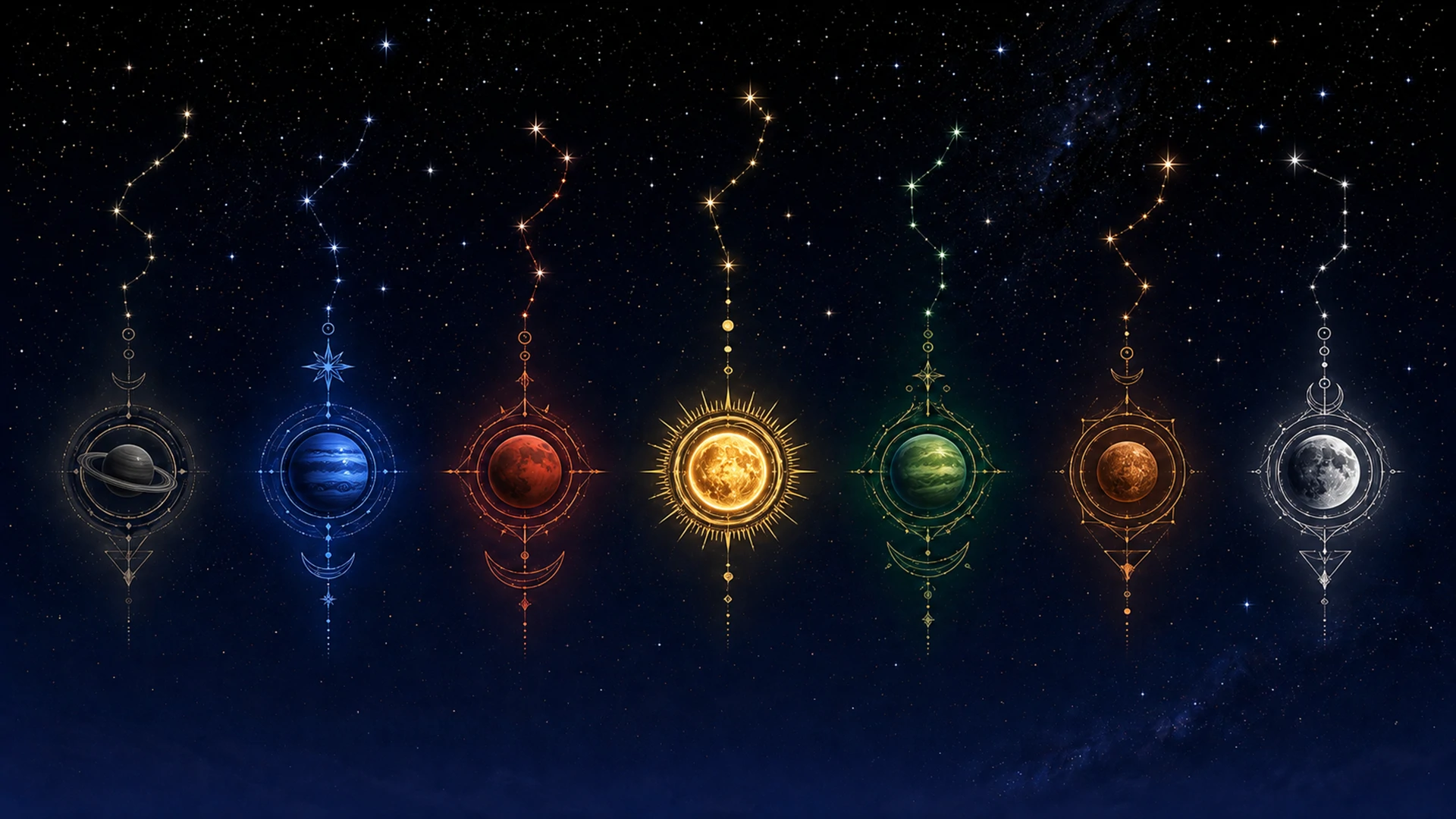
If you've already spent time with our guide to planetary hours, you know what each planet governs and why timing your workings matters. This article is the next step: the actual arithmetic underneath the system, the historical chain that carried it from ancient Alexandria into your practice today, and the real-world complications that most introductions skip. Understanding the mechanics won't make the magic more complicated — it will make you more confident every time you sit down to plan a working, because you'll know exactly why the numbers land where they do.
Unequal Hours: Why Planetary Hours Are Not Clock Hours
The single most important thing to understand about planetary hours is that the word "hour" does not mean sixty minutes. It never did, at least not originally. The system divides each day into twenty-four segments, but those segments are defined by the sun's position in the sky, not by any fixed mechanical unit.
The concept comes from what ancient and medieval timekeepers called temporal hours or seasonal hours — terms used interchangeably across different eras and languages to describe the same thing. Daylight, from sunrise to sunset, is cut into twelve equal portions. The night, from sunset to the following sunrise, is cut into another twelve. Because the length of daylight and darkness changes constantly with the seasons, those portions change too. Your planetary hours in June are a completely different length than your planetary hours in December.
At the equinoxes in spring and autumn, day and night run close to equal length, so both sets of hours approach sixty minutes. In summer, daytime hours stretch past sixty minutes and nighttime hours compress below it. In winter, that relationship flips. The further you live from the equator, the more dramatic this variation becomes. This is not a flaw in the system — it's the point. These hours breathe with the actual rhythms of the sky above you, not with an abstract mechanical grid.
One practical consequence worth knowing: the twelve daytime hours and the twelve nighttime hours of the same calendar date are almost never the same length as each other, except at the equinoxes. When you calculate your hours for a given day, you'll end up with two distinct figures — one for the day hours and one for the night hours — and you use each within its correct window.
The Calculation Method, Step by Step
The math itself is straightforward once you see it laid out. You need two pieces of information: the exact time of sunrise and the exact time of sunset for your location and date. Both of these are easy to find — any reliable weather service or astronomy site will give you accurate local times.
Here's how the calculation runs:
- Subtract your sunrise time from your sunset time. Convert the result entirely into minutes. That total is your day length.
- Divide your day length by 12. The result is the length in minutes of each daytime planetary hour.
- Subtract your sunset time from the following day's sunrise time, again in total minutes. That is your night length.
- Divide your night length by 12. The result is the length in minutes of each nighttime planetary hour.
- The first daytime hour begins exactly at sunrise. Add your daytime hour length once to get the start of hour 2, again to get hour 3, and so on through all twelve daytime hours, ending at sunset.
- Hour 13 begins at sunset. From here you use your nighttime hour length. Add it twelve times to carry you through to the following sunrise.
Here's a concrete example. Say it's a Wednesday in late October in New York City. Sunrise is at 7:14 AM, sunset at 5:58 PM. Day length is 644 minutes. Divide by 12: each daytime hour runs approximately 53.7 minutes, so just under 54 minutes. Night length from 5:58 PM to Thursday's sunrise at 7:15 AM is 797 minutes. Divide by 12: each nighttime hour runs approximately 66.4 minutes, about an hour and six minutes.
Wednesday is ruled by Mercury, so the first hour after sunrise is Mercury's. From there you step through the Chaldean sequence — Saturn, Jupiter, Mars, Sun, Venus, Mercury, Moon, repeating — to assign a ruler to each of the remaining 23 hours. The sequence runs unbroken across the sunset boundary. You do not reset it at nightfall; night hour 1 (hour 13 of the day) picks up exactly where day hour 12 left off.
One useful internal pattern: because 24 divided by 7 leaves a remainder of 3, the day's ruling planet always falls again at hours 8, 15, and 22 of that same day. So if you want a Mercury hour on Wednesday but missed the sunrise hour, you have reliable windows to work with throughout the day and into the night.
The Mathematics Behind the Chaldean Cycle
The sequence the hours follow — Saturn, Jupiter, Mars, Sun, Venus, Mercury, Moon — is called the Chaldean order, and it reflects the geocentric model's ranking of the planets from slowest-moving to fastest. Saturn, appearing to move most sluggishly against the fixed stars, was placed farthest from Earth. The Moon, completing its cycle fastest, was placed nearest. This ordering traces back to Babylonian planetary astronomy, which is why the name stuck, though the planetary-hour system itself was a Hellenistic development.
The seven-day week is a direct product of this same cycle. Because 7 and 24 share no common factor, the full sequence of planet-to-hour assignments takes exactly 168 hours — seven days — to return to its starting point. That mathematical property is precisely what fixes the order of the days of the week. The planet that rules hour 1 on a given day also governs that entire day, and working out which planet lands on hour 1 of the next day requires counting through 24 hours of the Chaldean sequence from the previous day's ruler. The result, every time, is the day order you already know: Sun, Moon, Mars, Mercury, Jupiter, Venus, Saturn. In most European languages, the day names still carry the planetary names directly — Sunday, Monday, Saturday — or their Norse mythological equivalents standing in for the Roman planets.
This also means the system is entirely self-consistent. Once you know today's ruling planet, you can derive the complete hour sequence for any day without looking anything up. The arithmetic is fixed. What changes is only the duration of each hour slot, which depends on your location and the time of year.
Historical Origins and the Grimoire Tradition
The planetary hour system as practitioners use it today did not emerge from a single source — it accumulated across roughly fifteen centuries of transmission, picking up layers of additional correspondence at each stop.
The earliest surviving technical treatments appear in Hellenistic astrological literature. Vettius Valens, writing in Alexandria in the second century CE, is among the first authors to systematically apply planetary hours to the timing of events and actions — what later writers would call electional astrology, the practice of choosing an auspicious moment to begin something. His Anthology treats the hour's ruling planet as a co-significator influencing whatever is initiated during that window. Dorotheus of Sidon, working slightly earlier in the first century CE, similarly integrates planetary timing into his astrological framework, though with less explicit hour-by-hour instruction. Both authors were drawing on a synthesis already underway: Babylonian astronomical data, Egyptian traditions of assigning divine guardians to time periods, and Greek theoretical astrology combining into something new in the Hellenistic world.
The system moved into Arabic scholarship with the great translation projects of the eighth and ninth centuries. Abu Ma'shar's Introduction to Astrology, composed in Baghdad in the ninth century, carried the Hellenistic framework forward with additional refinements and became one of the primary bridges through which Arabic astronomical and astrological knowledge reached medieval Europe. The Picatrix — originally written in Arabic as Ghayat al-Hakim, the Aim of the Sage, probably in tenth- or eleventh-century Islamic Spain, translated into Latin in 1256 — took this a step further, embedding planetary hours explicitly into a practical magic context. The Picatrix treats the hours not just as astrological timing but as active channels: the right hour is the condition under which a working can actually take effect, not merely a favorable backdrop.
The Key of Solomon, the most widely copied grimoire in the Western tradition, devotes significant attention to days and hours of the planets, presenting correspondence tables that specify which workings belong to which planetary windows. Its treatment of Saturn's hours is notably stern — the Key describes them as suited to matters of destruction, discord, and binding alongside more general business affairs, marking the Saturnine hours as the harshest of the seven. The Heptameron, attributed to Pietro d'Abano, went further still by pairing each planetary hour with a specific governing angel, a seal, and a conjuration formula. This is where the angelic layer of the system — Michael for the Sun, Gabriel for the Moon, Samael for Mars, Raphael for Mercury, Sachiel for Jupiter, Anael for Venus, Cassiel for Saturn — became fixed in the grimoire canon. Cornelius Agrippa's Three Books of Occult Philosophy, published in 1531, synthesized all of this into the most comprehensive theoretical treatment in the Renaissance tradition, drawing heavily on both the Picatrix and the Heptameron while noting that angelic attributions were not entirely consistent across sources.
William Lilly's Christian Astrology, published in 1647, stands as the most complete English-language classical text that preserves the planetary hours within a working astrological framework. Lilly was a practicing judicial astrologer — someone who applied astrology to answer specific questions and plan specific actions — and his treatment of hours is thoroughly practical rather than theoretical. Where many grimoire authors describe the system from the inside of a ceremonial magic worldview, Lilly's treatment shows how planetary hours sat equally comfortably within professional astrological practice. That dual inheritance, magical and astrological, is part of why the system is so durable.
What's worth noticing across this whole lineage is where the sources agree and where they diverge. The hour calculation itself — the mathematics, the Chaldean sequence, the sunrise-anchored day — is stable across all of them. The layer of additional correspondences, particularly colors and angelic names, shows more variation. Color attributions in particular largely reflect the systematization work of the nineteenth- and twentieth-century Golden Dawn rather than a single unbroken classical source. That doesn't make them less useful, but it's worth knowing they sit on a different level of historical grounding than the arithmetic does. The Pentacles of Solomon follow a similar pattern — core structure ancient, later elaborations layered on over centuries.
Edge Cases: Where the System Gets Complicated
Most practitioners working at temperate latitudes will never hit a situation where the standard calculation fails. But the system does have edges, and knowing where they are prevents confusion.
The variation in hour length across the year is not trivial even at mid-latitudes. In New York, a midsummer daytime planetary hour runs close to 75 minutes while a midwinter one runs closer to 45. If you're timing a working to fall within a specific hour, those differences matter for how you plan your day. This is not an edge case exactly — it's built into every calculation — but practitioners accustomed to thinking of hours as fixed units sometimes underestimate how much it shifts between seasons.
At high latitudes, the variation becomes genuinely dramatic. In Reykjavik near the summer solstice, the sun barely sets, and the night hours compress to under twenty minutes each. Near the winter solstice the reverse holds: daytime hours shrink toward fifteen or twenty minutes while night hours balloon. The system still functions mathematically at these latitudes — you can still calculate it — but the practical texture of working within a twenty-minute planetary hour is quite different from working within a seventy-five-minute one.
True polar regions, where the sun does not set at all for extended periods in summer or does not rise for extended periods in winter, represent a genuine breakdown of the method. There is no sunrise and no sunset to anchor the calculation. Various historical authors were simply not writing for practitioners at 70 degrees north latitude, and no classical source offers a satisfying resolution. The most honest answer is that the system has a known geographic limit. If you're in a region of continuous daylight or continuous darkness, working from the nearest location with regular sunrise and sunset times is a practical workaround, though it's a workaround rather than a proper solution.
A different kind of edge case involves the question of when the planetary day begins. The standard method — and the historically dominant one across both the astrological and grimoire traditions — anchors the day to sunrise. A minority of sources, particularly some later Renaissance and early modern texts, treat the day as beginning at a fixed clock time, often midnight or noon. This convention produces different hour assignments for any given moment. If you're using a source or a tool and the hour assignments don't match what you've calculated by hand, the start-point convention is usually the explanation. Sunrise-anchored calculation is the classical default, and it's the one most practitioners follow today.
Once you understand these variations, you can work with them deliberately. Knowing that your Saturn hour on a winter evening in a northern city might run nearly ninety minutes gives you a genuinely spacious window for a sustained binding or banishing. Knowing that your Mercury hour on a summer morning runs short keeps you from planning anything that needs unhurried attention. The constraints of the calculation are also information.
Putting It Into Practice
The calculation described in this article is something you can do by hand with nothing more than a sunrise and sunset time and a few minutes of arithmetic. Doing it manually at least once is worth it — not as a test of dedication, but because walking through the numbers yourself makes the system legible in a way that looking at a chart doesn't. You understand why the hours fall where they do, and that understanding belongs to you.
That said, for daily practice, calculating by hand every morning is not necessary. The math is fixed and well-understood, and tools exist specifically to handle it. If you want the current planetary hours for your location without doing the arithmetic yourself, the planetary hour calculator will give you accurate local hour times updated for your date and location.
The system has been in continuous use, across cultures and magical traditions, for roughly two thousand years. It survived the fall of the classical world, the translation movements of the Islamic Golden Age, the grimoire compilations of the Renaissance, and the nineteenth-century magical revival. It persisted not because it was preserved in amber but because practitioners across those centuries kept finding it genuinely useful for organizing their work. That's the best argument for learning it properly — not the history alone, but the fact that the history kept happening because the practice kept working.