Planetary Hours: A Witch's Guide to Magical Timing
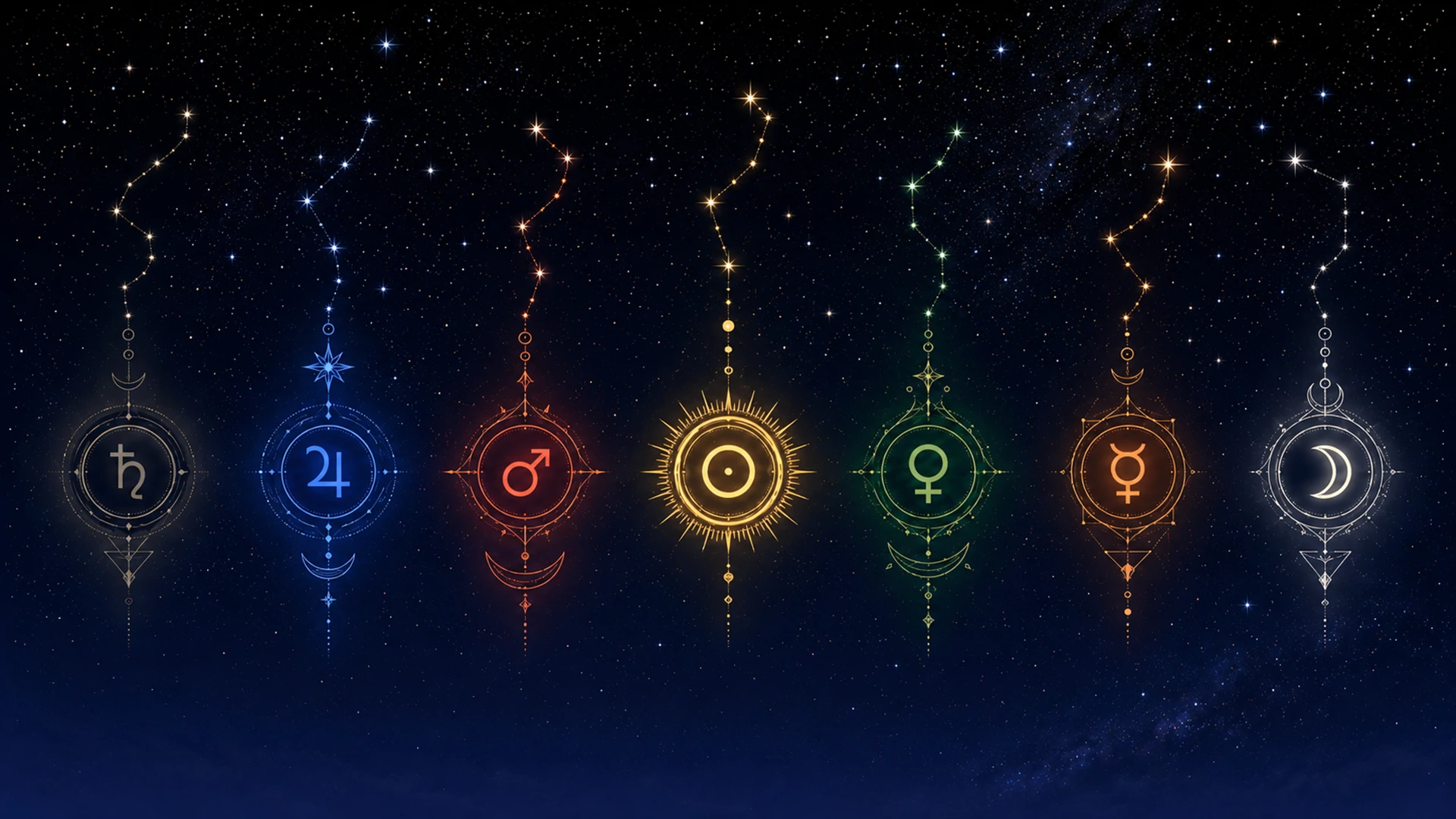
Every hour of every day is ruled by a planet. Not as metaphor, not as loose inspiration — as a deliberate, mathematically precise timing practice that practitioners have used to align their workings with celestial forces for over two thousand years. This is planetary hours: a system rooted in Hellenistic astrological magic, carried through medieval Arabic scholarship, and preserved in Renaissance grimoires like the Key of Solomon, the Picatrix, and Cornelius Agrippa's Three Books of Occult Philosophy. The idea is elegant. Each of the seven classical planets governs certain kinds of intention and force. By timing your workings to the hour ruled by the planet that matches your goal, you're not just casting a spell — you're casting it with the current already moving in your direction.
What makes planetary hours so useful in practice is their specificity. Rather than broadly saying "this is a good day for love magic," the system lets you identify the exact hour on any day of the week when Venusian, Jovian, Martian, or Saturnine force is at its peak — and build your working around that window. Once you understand the underlying logic, you can apply it to anything from a quick candle lighting to a full ceremonial ritual.
How Planetary Hours Actually Work
The first thing to know: a planetary hour is not sixty minutes. The system divides daylight — sunrise to sunset — into twelve equal parts, and darkness — sunset to the following sunrise — into another twelve. Those twenty-four segments are the hours. Because the length of daylight shifts with the seasons and your geographic latitude, each planetary hour expands and contracts throughout the year. Near the equinoxes they're close to sixty minutes. In deep summer the daytime hours stretch longer; winter compresses them. The hours are always proportional to the actual day you're living in, wherever you are. If you want to see the exact arithmetic behind that stretching and compressing — sunrise and sunset times translated into precise hour lengths — the planetary hour system breakdown walks through the full calculation.
The twenty-four hours of each day are assigned to the seven classical planets in a fixed repeating sequence called the Chaldean order: Saturn, Jupiter, Mars, Sun, Venus, Mercury, Moon — then back to Saturn. This ordering comes from the geocentric model of the cosmos, ranking the planets from slowest-moving (Saturn, considered most distant) to fastest-moving (the Moon, closest to Earth). The same sequence that generates planetary hours also produces the seven-day week and the names of its days. Sunday belongs to the Sun, Monday to the Moon, Tuesday to Mars, Wednesday to Mercury, Thursday to Jupiter, Friday to Venus, Saturday to Saturn. In most European languages those names are still embedded directly in the weekday words.
The rule for any given day: the first hour after sunrise is always ruled by that day's own planet. From there, the Chaldean sequence continues unbroken through all twenty-four hours, rolling straight through sunset without resetting. Because seven and twenty-four share no common factor, the full alignment cycle only repeats after one hundred sixty-eight hours — exactly seven days. This is the same arithmetic that locks the weekday order in place. Within a single day, the day's ruling planet recurs at hours one, eight, fifteen, and twenty-two. That gives you four natural power windows per day even without tracking every single hour.
A new day begins at sunrise in this system, not midnight. The night hours after Sunday's sunset belong to Sunday's sequence — they don't restart fresh as Monday until the next sunrise. Keep this in mind when you're planning late-night workings: the planetary hour you're in is determined by the arc started at that morning's sunrise, not by the date on the calendar.
Historically this practice is called electional astrology when applied this way — choosing the most favorable moment to begin something. The grimoire tradition formalized it extensively. The Heptameron, attributed to Pietro d'Abano, pairs each planetary hour with a specific angel and set of conjurations. The Picatrix, composed in Arabic in the tenth or eleventh century and translated into Latin in 1256, treats hour-selection as fundamental to any effective working. William Lilly's Christian Astrology (1647) is the most comprehensive English-language classical source preserving the full tradition. What these sources agree on is simple: the planet ruling the hour lends its character to whatever you begin during that hour.
The Seven Planetary Hours in Chaldean Order
Here are the seven planetary rulers presented in Chaldean order — the sequence that governs the repeating hour cycle. Each planet carries a distinct sphere of influence, a body of traditional correspondences, and a set of workings it particularly supports.
Saturn
Saturn opens the Chaldean sequence as the slowest-moving planet in the classical model, and its hours carry that weight. This is the planet of limits, endings, deep-rooted patterns, and time itself. Its traditional metal is lead; its governing angel in the grimoire tradition is Cassiel. The Key of Solomon describes Saturn's hours as suited to workings of binding, destruction, discord, and serious business — covering both constructive discipline and baneful intent with equal frankness.
Saturn hours are the right choice when your working requires finality. Black candle workings for banishing, cord-cutting, bindings meant to hold, and any spell directed at ending something that has refused to end on its own — all of these belong to Saturn's hour. The planet also governs long-term commitment and the kind of structural discipline that makes sustained practice possible, so Saturn hours work equally well for workings that are about building rigorous protection over time rather than quick deflection. If a problem is deeply entrenched, Saturn is the force with the patience and severity to match it.
Jupiter
Jupiter is the second planet in the Chaldean sequence, and its hours are some of the most actively sought in practical magic. This is the planet of expansion, good fortune, abundance, and the kind of authority that opens doors rather than closes them. Its traditional metal is tin; its governing angel is Sachiel (also written Zadkiel). Traditional color associations lean toward blue and purple, though these vary by source.
Jupiter hours support workings for prosperity, career advancement, legal outcomes, and any situation where you need things to grow or to flow more freely in your favor. Luck workings, petitions for increase, candles prepared for abundance or luck — all of these benefit from Jupiter's timing. This is also the hour to begin workings where you're asking for generosity from the world: a promotion, a grant, a windfall, an opportunity that expands your reach. Jupiter doesn't contract; it opens. Work with that.
Mars
Mars is the third planet in the sequence — aggressive, direct, and fast-acting. Its hours carry the force of iron (its traditional metal), and its governing angel is Samael, also written Zamael. This is the planet of courage, conflict, physical strength, and the decisive cut. It is not subtle, and its hours shouldn't be wasted on workings that require patience or softness.
Mars hours are best when you need something to move quickly and with force: protective workings against a specific, identified threat, banishing that requires a confrontational edge, workings meant to build courage before a difficult situation, or any magic aimed at cutting away what is actively harming you. Red candle workings for strength and protection sit naturally here. Mars hours also support workings for physical endurance, competition, and any situation where you need to hold your ground rather than negotiate.
Sun
The Sun is fourth in the Chaldean sequence and rules Sunday. Its governing angel is Michael; its traditional metal is gold. Sun hours carry the quality of clarity, visibility, and power that operates openly rather than in concealment. This is the planet of vitality, leadership, personal authority, and success in the public eye.
Workings timed to the Sun are best for anything that requires recognition: career success tied to merit, health and vitality, confidence, and situations where you want to be seen and acknowledged favorably. Gold candle workings for personal power and success align directly with solar timing. The Sun also governs workings meant to illuminate — revealing hidden truths, strengthening clarity of purpose, or calling in the kind of prosperity that comes through your own accomplishments rather than luck. If Jupiter expands what you have, the Sun makes you worthy of it in the eyes of others.
Venus
Venus is the fifth planet in the sequence and rules Friday. Its governing angel is Anael (also written Camael); its traditional metal is copper; its most common color correspondence is green. The Key of Solomon describes Venus's days and hours as favorable for forming friendships, for kindness and love, for joyous and pleasant undertakings, and for travel — a notably warm characterization compared to the severity it grants Saturn.
Venus hours are the natural home for love and relationship workings, beauty and self-love practices, reconciliation between people who've grown estranged, and any working aimed at drawing in harmony, pleasure, or attraction. Candle workings for love land most powerfully when timed to a Venus hour, and the same goes for harmony work. Venus also governs artistry and creativity — if your work involves beauty-making of any kind, Venus hours support that too. This is the hour that makes things feel welcoming, warm, and worth wanting.
Mercury
Mercury is the sixth planet in the Chaldean sequence and governs Wednesday. Its governing angel is Raphael; its traditional metal is quicksilver. Mercury is the planet of movement, exchange, and the transmission of information in all its forms: spoken, written, symbolic, and commercial. Its hours carry quickness and adaptability.
Mercury hours suit workings around communication — drafting important messages, signing contracts, negotiating agreements, preparing for a difficult conversation. They're also strong for study and any kind of divination that relies on interpretation or symbol-reading. Travel workings, particularly those asking for safe and smooth movement, belong here. If you're working with sigils, magical seals, or written petitions, activating them during a Mercury hour adds the planet's swiftness to your intention. Mercury is neutral and fast — it doesn't push in any one emotional direction, but it carries your message where it needs to go.
Moon
The Moon closes the Chaldean sequence as the fastest-moving body in the classical cosmos — the most immediate, the most changeable, and the most intimately connected to inner life. Its governing angel is Gabriel; its traditional metal is silver. Moon hours are quieter than most, oriented toward receiving rather than asserting.
Divination, dreamwork, scrying, and any working that asks you to listen to your own intuition rather than direct it outward — these all belong to the Moon's hours. Workings around the home, family, emotional healing, and fertility also fall under lunar governance. Silver candle workings aligned with intuitive or psychic practice fit naturally into Moon hours. This is also the best hour to begin workings that follow the lunar cycle — setting intentions that will unfold over the course of a moon phase rather than resolving in a single sitting. The Moon governs cycles, and working within one is working with its nature.
Putting Planetary Hours Into Practice
Understanding the seven planetary rulers is the foundation. The next step is actually using them — and that requires knowing exactly when each hour falls on any given day at your location. Because planetary hours are calculated from your local sunrise and sunset times, no fixed printed table will give you the right answer for long. The hours shift daily as the year turns.
In practice, a few things make this immediately usable. First, you don't need a perfect hour for every working. Timing a spell to its ideal planetary hour is a way to add precision and alignment — it sharpens the intention behind the working and places you inside a current that's already moving in the right direction. But your will is the primary driver. A focused, clear working done at a slightly imperfect hour will outperform a distracted working done at the ideal one every time. Think of planetary hours as a powerful ally, not a prerequisite.
Second, you have more options than you might think. Each day's ruling planet returns at hours one, eight, fifteen, and twenty-two — four windows across a full twenty-four-hour period. If you need a Jupiter hour and it's Thursday, you have four natural entry points without counting every single segment from sunrise. On days where the ruling planet doesn't match your working, the Chaldean sequence still cycles through all seven rulers regardless, so your target hour arrives multiple times throughout that day too.
Planetary hours layer well with other timing practices. Working during a waxing moon in a Jupiter hour concentrates two expansive currents at once — one cyclical, one hourly. A Saturn hour during a waning moon amplifies banishing and closure. A Venus hour on a Friday near a full moon is as strong a moment for love work as the tradition offers. None of these combinations require you to find a rare astronomical alignment. They use tools you can access any week.
Combining planetary hours with the right candle color, herbal correspondence, or crystal reinforces the working on every level. Career candle work timed to a Jupiter or Sun hour, or a protection working opened during a Mars or Saturn hour — these aren't rigid rules but genuinely productive combinations, each layer sharpening the clarity of your intention.
To find your exact planetary hours for today, use the planetary hour almanac — it calculates the precise hour windows based on your local sunrise and sunset, so you always know exactly where you are in the day's cycle. Bookmark it. Once you start working with planetary hours regularly, checking it becomes as natural as checking the moon phase.
The practice builds over time. The more you track which hours you work in and how your workings land, the more you develop a felt sense for each planet's quality — not just as an intellectual correspondence but as a real, recognizable texture in the moment. That's the real depth of this tradition. It's not about finding the perfect astrological window and hoping for the best. It's about learning to feel the current, and knowing when to work with it.