Mars Hour: Protection, Courage, and Decisive Action
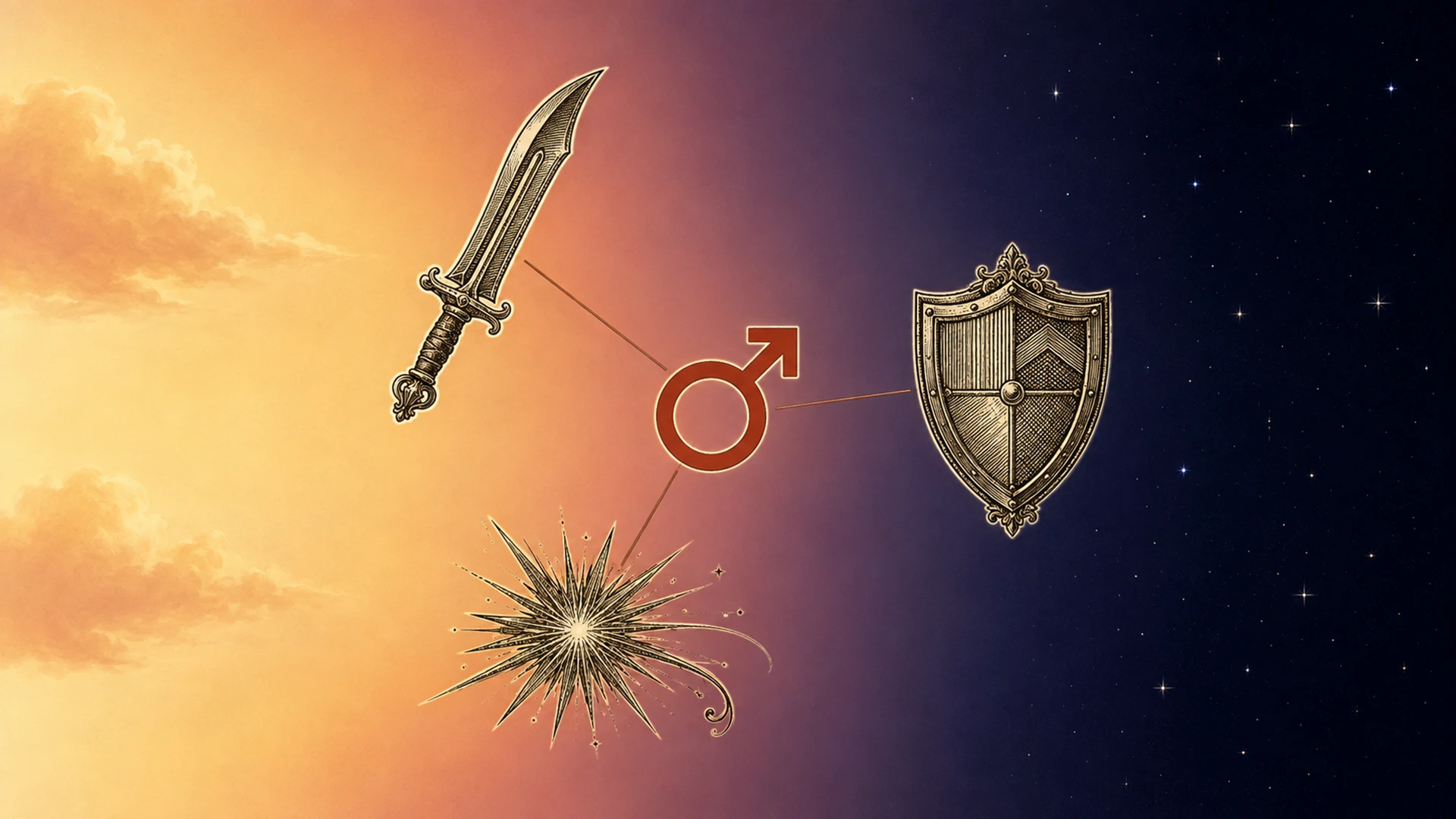
The Mars Hour is not a moment for patience or soft requests. It is a window cut from the week specifically for force — clean, directed, and unapologetic. Mars governs protection, confrontation, the swift removal of threats, and the kind of courage that does not wait for conditions to be perfect before it acts. When you need magic that moves with real momentum behind it — a banishing that holds, a ward that actually bites, a decision you've been avoiding — this is the hour the grimoire tradition was built to use. No other planetary hour carries quite the same blunt authority, and once you know when it lands across your week, it's available to you far more often than most practitioners realize.
Mars's Place in the Chaldean Sequence
The seven classical planets are arranged in a fixed repeating sequence — Saturn, Jupiter, Mars, Sun, Venus, Mercury, Moon — called the Chaldean order, and it governs which planet rules each successive hour of every day. Mars sits third. That placement is not incidental.
Saturn opens the sequence as the slowest, most remote, and most restrictive of the seven. Jupiter follows: expansive, generous, unhurried. Then comes Mars. It is the first planet in the line with real heat, real momentum, and a willingness to cut rather than contain or enlarge. Everything before it in the sequence is either cold patience or broad abundance. Mars is neither. It is force with a specific target. That is exactly what makes its hour the one the grimoire tradition reached for when something needed to be removed, confronted, or defended against without hesitation.
Because the Chaldean sequence cycles continuously through all 24 hours of the day and night without resetting at midnight, Mars's hour falls at predictable intervals across every single day of the week — not just Tuesday. But the hour-to-hour timing is variable, because planetary hours are not equal to clock hours. Each one is calculated from the actual length of daylight and darkness at your location on that date. If you want to understand how that calculation works and what the sequence looks like across the full week, the complete guide to planetary hours covers the whole system in depth. Understanding the sequence tells you the pattern; a live planetary hour calculation tells you exactly when that pattern lands today.
Mars in the Grimoire and Astrological Tradition
The grimoire tradition's treatment of Mars is notably direct. Where Jupiter's hours are praised in expansive terms and Venus's hours are listed alongside joyous undertakings, Mars gets plain language about war, enemies, and courage. The Key of Solomon, in Book I, Chapter II, describes the days and hours of Mars as suited to "experiments regarding War; to arrive at military honour; to acquire courage; to overthrow enemies; and further to cause ruin, slaughter, cruelty, discord; to wound and to give death." The text does not soften this. Mars's hours are not framed as useful with certain caveats — they are simply characterized as the hours for confrontation and decisive removal of opposition.
That plainness is itself information. Grimoire authors who chose careful, diplomatic phrasing for most planets let Mars stand in its own register. This is a planet whose hour was understood as a specific kind of tool: one you reach for when diplomacy has already failed, when a threat needs to be addressed directly, or when a working demands the will to act without hesitation.
The governing angel assigned to Mars in the later ceremonial tradition is Samael, sometimes written Zamael. The attribution was set down in the Heptameron — the late medieval grimoire that paired each planetary hour with its angel, seal, and conjuration — and Cornelius Agrippa repeated it in his Three Books of Occult Philosophy, which is how it traveled into the broader ceremonial current. Samael is not a gentle intercessor. The name itself carries associations with severity and judgment in the same tradition that built these working texts. When the Heptameron pairs Mars's hours with Samael's governance, it is making a consistent point: this planetary current is not about comfort or abundance. It is about force applied with precision.
Mars's traditional metal is iron (or steel). This is one of the most stable correspondences in the entire system, tracing back through Agrippa to older alchemical tradition without meaningful dispute across sources. Iron's magical character maps cleanly onto Mars: it is the metal of weapons, of tools built for hard use, of nails that hold things shut and blades that cut things open. When you work a Mars hour with an iron implement — a nail, a pin, a blade used in ritual — you are drawing on an attribution that has been consistent across centuries of practice.
The Hebrew name the Key of Solomon uses for Mars is Madim. It appears in Book I, Chapter II, in the descending Chaldean order — Shabbathai (Saturn), Tzedeq (Jupiter), Madim (Mars) — positioning Mars as the third of the classical seven. Knowing this name is useful if you work with the Solomonic tradition directly, either through its pentacles or its invocations, since the grimoire's own planetary vocabulary differs from the common Greek or Latin names most modern practitioners use.
The Solomonic pentacles specifically tied to Mars carry this same energy forward into sigil work. The 44 Pentacles of Solomon include seven dedicated to Mars, covering purposes from invoking martial spirits to protection, victory, and binding. Working with those pentacles during a Mars hour aligns your timing, your symbol, and your intent into a single current — and the grimoire tradition explicitly treats that kind of alignment as meaningful amplification.
One further note worth making: the Key of Solomon groups Saturn and Mars together when it comes to the most severe workings — experiments of hatred, enmity, and discord. Mars does not stand alone as the planet of aggressive magic; Saturn shares that territory from a different angle (restriction and long-term binding versus Mars's swift confrontation). But within the seven planets, Mars is consistently the hour for anything requiring speed, strength, and the willingness to engage directly with opposition rather than working around it.
Mars's Day: Tuesday
Every weekday is ruled by a planet, and the first planetary hour of that day — the hour that begins at sunrise — always belongs to the day's ruling planet. For Tuesday, that planet is Mars. This is not arbitrary. It is the same mathematical relationship that produces the seven-day week itself: because there are seven planets and 24 hours in a day, and because 7 and 24 share no common factor, the planet that governs the first hour of each day shifts in a fixed pattern that cycles back to its starting point after exactly seven days.
The word Tuesday carries Mars's name, just not obviously. The Latin original — dies Martis, Mars's day — passed straight into the Romance languages: French mardi, Spanish martes, Italian martedì all still spell it out. English arrived at the same place through a different door. Old English Tiwesdæg named the day after Tiw, the Germanic war god identified with the Norse Týr. This was part of a deliberate interpretive practice — the interpretatio germanica — where Roman planetary deities were swapped for their native equivalents. Thor took Jupiter's Thursday, Woden took Mercury's Wednesday. Tiw took Mars's Tuesday. The name changed; the planetary identity did not. Every European tradition that preserved the original planetary week structure kept Tuesday as Mars's day.
Practically speaking, a Mars hour falling on a Tuesday carries double weight. The day's general current is already Martian, and then the specific hour adds another layer of that same influence. This is what electional astrology — choosing the most favorable moment to begin a working — looks like in practice. Tuesday's first hour at sunrise is Mars on Mars. But any Mars hour on a Tuesday, day or night, draws from that compounded quality. For practitioners who plan their work around planetary timing, Tuesday is the natural home base for Mars workings even in hours that belong to other planets — and the Mars hours within it are where the week's strongest martial current runs.
Finding Mars's Hours: Day and Night Windows
Because the Chaldean sequence runs unbroken through all 24 hours of every day, Mars's hour does not stay confined to Tuesday. Across the full week, it lands on every day of the seven, at different points in the day-and-night cycle. On Tuesday itself, Mars rules hours 1, 8, 15, and 22 — the first hour after sunrise, then at predictable intervals through the day and into the night. On other days, Mars hours fall at different positions: sometimes in the heart of the afternoon, sometimes deep in the night, sometimes just before dawn.
This matters for how you approach the work. A daytime Mars hour and a nighttime Mars hour are not identical in quality, even though both carry the planet's signature. During daylight, Mars hours tend to support outward action: confronting a situation directly, doing a banishing that removes something from your waking life, standing a protective ward around your home or person. After sunset, the same energy turns inward or becomes more covert — better for workings you do not want witnessed, for magic aimed at severing something you've been carrying internally, or for protection work that covers the hours you're most vulnerable.
The Chaldean sequence also means that Mars hours are genuinely accessible across the week, not clustered only around Tuesday. If you cannot work on Tuesday, a Mars hour on Thursday or Sunday carries the same planetary rulership — the day's background current is simply different. Most practitioners find that working within any Mars hour is fully effective; the Tuesday alignment is an enhancement, not a requirement.
What you cannot determine from the sequence alone is when, precisely, each hour begins and ends on a given day at your location. Planetary hours shift with sunrise and sunset, which means they expand and contract with the seasons and vary by latitude. A summer day hour in New York runs considerably longer than a winter day hour; night hours contract to match. The only way to know exactly when your next Mars Hour opens this week is through a live calculation keyed to your date and location. Use a dedicated Mars hour almanac to pull the exact windows for any day you're planning to work — it removes all the guesswork and lets you plan your ritual down to the minute.
What Mars Hours Are For
The Key of Solomon's framing — war, military honor, overthrowing enemies — maps onto a specific range of magical work that is just as relevant today as it was when those texts were compiled. You do not need to be fighting a literal battle to work within Mars's domain. Conflict, threat, and the need for decisive self-protection are perennial human problems, and Mars's hour is the tradition's answer to all of them.
Protection Workings
Mars hours are one of the strongest windows for protective candle work — particularly wards, shields, and any working meant to turn harm away from yourself or your home. The planetary current supports magic that actively repels rather than passively deflects. Mars protection has edges to it; it does not merely block, it discourages further approach.
Banishing
If you need something gone — a person's influence, a habit that has its hooks in you, a spiritual presence that has overstayed — a Mars hour is the right timing. This is removal work done with force rather than patience. For candle work supporting banishment, a black candle is a classic choice; the tradition of using red for Mars-specific banishing also has deep roots, and a red candle dressed with protective or banishing herbs in a Mars hour is a combination that has been in consistent use across folk and ceremonial traditions alike.
Courage and Confrontation
Mars hours support workings that build or channel personal courage — magic before a difficult conversation, a confrontation you cannot avoid, a situation where you need to hold your ground. This is some of the most underused territory in Mars's domain. The grimoire tradition was explicit that Mars governs military honor and courage, not only destruction. A confidence-building working done during a Mars hour carries a different character than the same working in a Sun or Jupiter hour: it is less about being recognized and more about being unshakeable.
Iron as a Ritual Material
Mars's traditional metal is iron. In practice, this means incorporating iron into Mars hour workings — an iron nail driven into a protective charm, iron filings in a working bag, a steel pin used to inscribe a candle. The metal correspondence is one of the oldest and most consistent in the whole system, grounded in the alchemical tradition that Agrippa drew from and earlier writers preserved. If you work with physical materials in your practice, iron is the natural choice for anything done in Mars's hour.
Color: Red, With a Caveat
Red is the color most commonly associated with Mars in modern practice, and it holds up as a working choice. What's worth knowing is where that assignment actually comes from: the color-to-planet pairings most practitioners use today were largely fixed by the Golden Dawn in the 19th and early 20th centuries, and the older grimoire literature is considerably less uniform on this point. Red for Mars is intuitively coherent — the planet governs blood, fire, and physical heat — but it is not a clean line back to a single classical source the way the iron correspondence is. If you encounter a different color attribution in an older text, it is not an error. The metal is the more historically grounded anchor; the color is a modern convenience that happens to read as consistent.
Workings Requiring Swift Resolution
Unlike Saturn's hours, which support long-term binding and patient restriction, Mars's hours are not built for slow work. If a working requires sustained energy over many days, Saturn or Jupiter hours may serve you better. Mars is for things that need to be resolved decisively and quickly. A ward, a banishing, a working to cut a cord — these all suit the hour's tempo. The energy of the hour rewards clarity of purpose and swift execution.
Working With Mars's Hour
The most straightforward way to deepen a Mars hour working is to stack it with Tuesday itself. Any protective or banishing ritual you run during a Mars hour on a Tuesday is running on both the day's broader current and the specific hour's concentrated one. Mars hours recur every week without exception — no rare transit required, no waiting for an unusual configuration. The regularity is the point. A working you can run every Tuesday is more useful than one you can run twice a year.
If you want to layer further, consider the moon phase. A Mars hour during a waning moon is well-suited to removal work: the waning phase traditionally supports diminishment and release, and Mars's hour provides the force to cut cleanly. A Mars hour under a waxing moon shifts the emphasis toward building a protection or strengthening your own resolve. Neither is wrong; they simply point the working in different directions.
You can also pair Mars's hour with its pentacles. The Pentacles of Solomon dedicated to Mars cover a range of applications — from invoking martial spirits to binding specific threats — and using one as a focal point during a Mars hour creates a tight alignment between your timing and your symbol. This is one of the cleaner combinations available in the ceremonial tradition, and it does not require elaborate preparation to be effective.
What the hour does not do is supply the will you haven't brought with you. Mars's particular demand is decisiveness — not just intention sitting quietly in your chest, but the actual willingness to act on it. The grimoire tradition assigned this hour to war and courage precisely because both require you to move forward when everything in you might prefer to wait. The hour amplifies force that is already in motion. Show up with clarity about what you want gone, what you want protected, or what you need the courage to face — and then actually commit to it. That commitment is what the Mars hour runs on.