Sun Planetary Hour: Leadership, Vitality, and Success
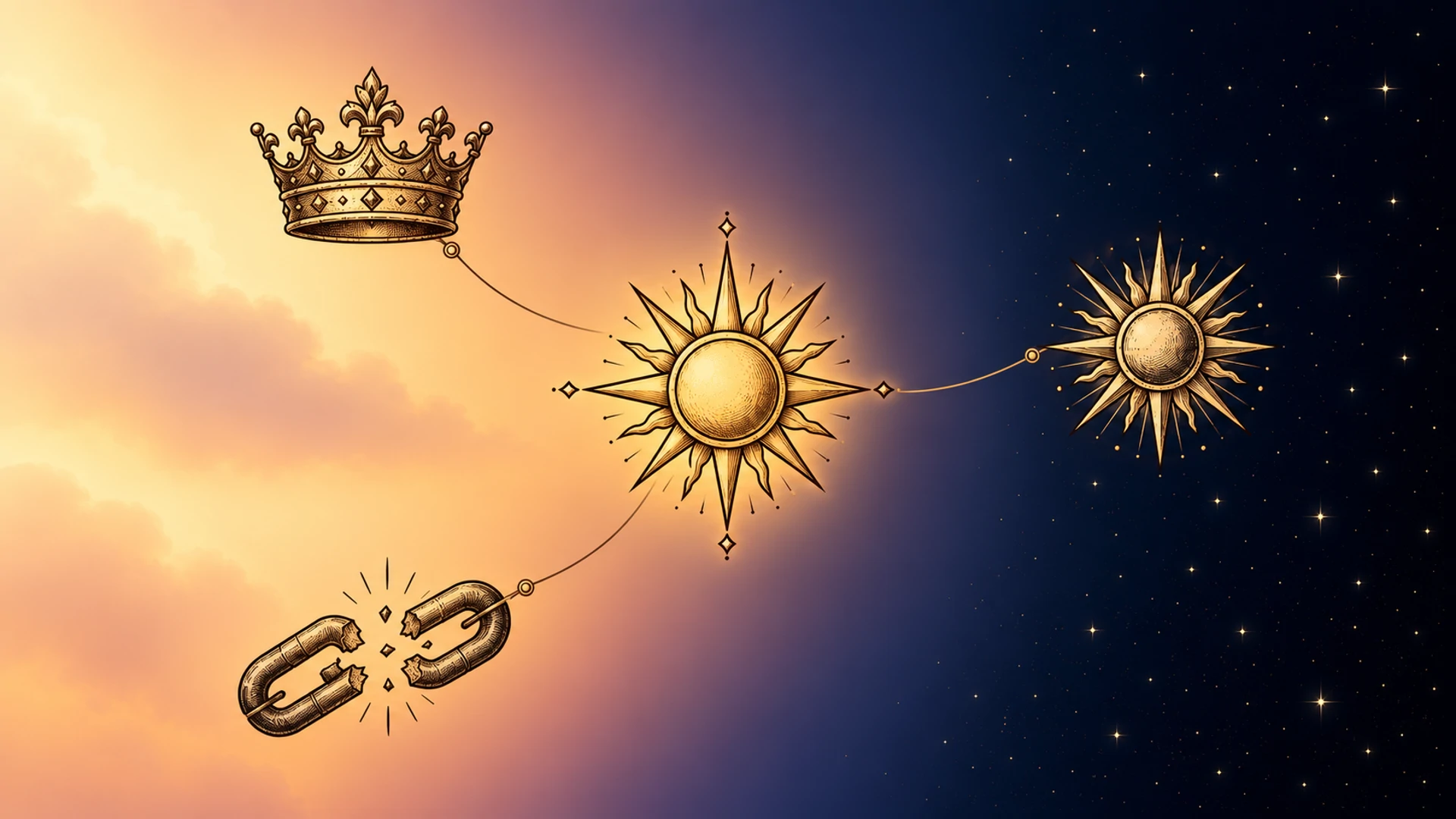
The Sun planetary hour is the hour that asks you to stand in the open and claim what is yours. Where other planetary hours favor secrecy, patience, or careful negotiation, this one is built for visibility — for workings that require you to be seen, recognized, and taken seriously. Its domain covers leadership, vitality, personal authority, and the kind of success that comes from being known for what you do well. If you have ever waited for the right moment to put yourself forward, light a candle, make the ask, or launch something important, the hour of the Sun is the window built for exactly that.
The Sun's Place in the Chaldean Sequence
The seven classical planets are arranged in a fixed order called the Chaldean sequence, running from slowest-moving to fastest as they appear from Earth: Saturn, Jupiter, Mars, Sun, Venus, Mercury, Moon. The Sun sits fourth — the exact midpoint. That is not a coincidence in how the tradition reads it.
Saturn opens the sequence as the most remote and slowest-moving body, carrying the weight of restriction and deep time. The Moon closes it as the fastest and most changeable, governing the tidal pull of emotion and the subconscious. The Sun holds the center between those two poles. In the geocentric model underpinning planetary hour work, this placement made the Sun the dividing point between the outer planets — the slow, structural, impersonal forces — and the inner ones, which operate close and fast and personally. The tradition read that position as fitting for a body associated with kings and individual life force: the Sun doesn't govern from a distance, and it doesn't flicker. It illuminates everything within reach.
You can read a full breakdown of how the Chaldean sequence governs every planetary hour, including how the 24-hour cycle distributes across all seven rulers, in our guide to planetary hours for magical timing.
The Sun in the Grimoire and Astrological Tradition
The Key of Solomon is the grimoire that most fully defines how the Sun's hours were understood in the ceremonial tradition. Its treatment of the Sun is notably warm — almost lavish compared to the terse, conditional language it uses for some other planets. Book I, Chapter II describes the days and hours of the Sun as good for workings involving temporal wealth, hope, gain, fortune, divination, and the favor of princes. That last detail is worth pausing on. The phrase "favor of princes" is the period's way of saying: workings intended to make powerful people look at you kindly. Influence, recognition, and access to those who hold authority over outcomes in your life.
The same text goes a step further. It groups the Sun with Jupiter and Venus as the three planets whose hours are adapted for any operations of love, kindness, and invisibility. The word "invisibility" there is a Solomonic technical term for glamour work — the magical art of going unnoticed when you choose to. That the Sun's hour, of all hours, would appear in this grouping is interesting. It suggests that the tradition saw the Sun's hour as capable of both directions: full visibility when you want to be seen, and controlled concealment when you need to pass without drawing attention. The Sun governs light, and light can illuminate or it can blind.
The governing angel of the Sun's hour is Michael. The Heptameron established the pairing, Agrippa carried it forward in his Three Books of Occult Philosophy, and it has stayed stable across the major sources ever since — no significant dispute, no competing candidate. Michael's character in the tradition is protective and victorious, associated with divine fire and the defeat of adversarial forces. That the hour of the Sun is under Michael's office rather than a softer angelic figure reinforces its character: this is not a gentle, receptive hour. It is an hour of assertion and authority.
The Key of Solomon gives the Sun its Hebrew name Shemesh, placing it fourth in the descending sequence from Saturn (Shabbathai) down to the Moon (Levanah). The traditional metal assigned to the Sun is gold — one of the most stable correspondences in the whole system, traceable through alchemical tradition and consistent across Agrippa, the Key of Solomon, and the Picatrix. Gold is not just a color or a symbol here; it is the material expression of the Sun's virtue. Working with gold objects, gold-colored candles, or gold leaf during a Sun hour is a direct application of this correspondence, not a modern decorative choice.
The Key of Solomon's pentacles for the Sun extend this picture further. Across the full set of Solomonic seals, the Sun's pentacles cover a striking range: compelling all spirits to obey, renown and empire, revealing invisible spirits, breaking bonds, and liberation. The Third Pentacle of the Sun, which inscribes the Tetragrammaton twelve times across its face, is explicitly linked to kingdom, empire, and renown. The Seventh Pentacle is a liberation seal, used to break constraints placed on the practitioner. Taken together, the Sun's pentacles describe a planet whose magical office covers both the gaining of power and the freedom to use it — two things that are ultimately the same working approached from different angles.
One thing worth knowing before you reach for a gold or yellow candle: that specific color-to-planet pairing is largely the Golden Dawn's work. Nineteenth-century ceremonial magicians systematized the color correspondences that most modern practitioners now take as given. The metal gold is ancient and consistent across the grimoire record. The color as a formal ritual designation is a more recent layer. It still works — the Sun's associations have pulled toward gold and yellow long enough that the correspondence has real traction — but it is a different kind of authority than the metal, and knowing that distinction helps you use it consciously.
Sun's Day: Sunday
The Sun governs Sunday because the planet ruling the first hour of any day is the same planet that gives that day its name. The first hour after Sunday's sunrise is a Sun hour, which makes Sunday the natural home base for all Sun-aligned work in the weekly cycle.
The English word Sunday comes straight from the Old English Sunnandæg, which was itself a direct translation of the Latin dies Solis — "day of the Sun." On the days ruled by Mars, Mercury, Jupiter, and Venus, English swapped in Norse equivalents: Tiw for Mars, Woden for Mercury, Thor for Jupiter, Frigg for Venus. The Sun got no such substitution. The solar name carried forward unchanged, which means every time someone says "Sunday" in English they are using a word that has meant "the Sun's day" for well over a thousand years.
The Romance languages took a different path. French, Spanish, and Italian all started from the same Latin dies Solis, but Christian usage displaced it with dies Dominica — "the Lord's Day" — giving dimanche, domingo, and domenica. None of those words retain any trace of the Sun. So English, somewhat unexpectedly, is the language that preserved the original planetary name in its Sunday, while the Romance languages let it go entirely.
Practically, what this means for working with the Sun is that Sunday brings the planet's character in at two registers at once. The day itself belongs to the Sun, and the first hour of the day — along with the eighth, fifteenth, and twenty-second — are Sun hours within that day. A working on a Sunday Sun hour is not just timed well; it is anchored in the Sun's full daily influence rather than borrowing a window from a day that belongs to another planet. That layering matters most when the working is high-stakes: a major career move, a public launch, something where you genuinely need the room to see you at your best. For smaller, more routine work, any Sun hour across the week does the job.
Finding Sun's Hours: Day and Night Windows
Because the first hour of Sunday belongs to the Sun, and because the Chaldean sequence runs in fixed order without resetting, the Sun's hour on Sunday falls at hours 1, 8, 15, and 22. That means four windows on Sunday alone: one right at sunrise, one roughly midmorning depending on the season, one in the early afternoon, and one in the late evening. The Sun planetary hour touches every part of Sunday's day and night.
On every other day of the week, the Sun's hour still appears — just at different points in the 24-hour cycle, because the sequence continues unbroken from one day into the next. Some of those windows fall in daylight, some after dark. Which days and what times depend entirely on the current season and your location, since day hours and night hours expand and contract throughout the year as the length of daylight shifts.
Working with the Sun in a daylight hour feels different from working with it after dark, and this is worth thinking about intentionally. The Sun's associations — visibility, authority, vitality — are at their most literal during the day. A Sun hour in the daytime is the Sun operating in its own element, fully expressed. A Sun hour after sunset is still valid, and the grimoire tradition does not restrict the Sun's hours to daytime only. But there is a quality difference. Night hours of the Sun feel more like holding a flame in the dark than standing in open light — more interior, more about inner authority than public-facing recognition.
Because planetary hour lengths shift with every sunrise and sunset, the exact start and end time of each Sun hour changes daily. The only reliable way to find your current windows is through a live calculation. Our planetary hour almanac gives you the precise times for every Sun hour this week, adjusted for your location and the current season.
What Sun Hours Are For
The Key of Solomon's framing — temporal wealth, hope, gain, fortune, divination, the favor of those in power, dissolving hostility, making friends — is a good starting list, but it benefits from translation into what practitioners actually bring to this hour.
Authority and Recognition
This is the Sun's most concentrated domain. If you are asking for a promotion, presenting work to decision-makers, launching something you have built, or simply trying to make an impression on someone whose opinion matters, a Sun hour gives that working traction. The traditional phrase "favor of princes" maps directly onto any situation where you need powerful people to notice you favorably. This includes job interviews, salary negotiations, public launches, creative releases, and any moment where being seen clearly and positively is the whole point.
Health and Vitality Workings
The Sun's keywords of vitality and life force make its hour a natural fit for workings aimed at physical recovery, energy, and general wellbeing. A healing candle worked during a Sun hour carries the planet's life-affirming current directly into the intention. This is especially fitting when the healing in question involves recovering personal strength or stamina rather than emotional processing, which tends to belong more naturally to Moon or Venus hours.
Prosperity and Career
The Sun's association with temporal wealth is not about luck or chance — that belongs more to Jupiter. Sun's hour prosperity work is specifically about merit-based success, the kind that comes from being recognized for what you are actually capable of. Career candle work done in a Sun hour is directly in line with this tradition. The metal here is gold, so working with a gold candle, a piece of gold jewelry, citrine, or sunstone during this hour gives the working a material grounding in the Sun's correspondence. If you use color-coded candles, gold or yellow are the standard choices for the Sun, though as noted above, that color correspondence is a Golden Dawn-era systematization rather than a fixed classical rule.
Confidence and Self-Expression
The Sun rules identity and the expression of who you actually are — not the projected, cautious version, but the real one. Workings for self-confidence, for overcoming the impulse to make yourself smaller, or for stepping into a role that genuinely fits you belong in a Sun hour. A confidence candle is one practical form this can take. Herbs associated with the Sun — chamomile, bay laurel, St. John's Wort, and frankincense as incense — can support this kind of working with correspondences that reinforce the planet's character.
Dissolving Hostility and Making Peace
This one surprises people. The Key of Solomon explicitly includes dissolving hostility and making friends among the Sun's hour applications. The logic tracks: the Sun's domain includes harmony between people when that harmony is based on mutual respect and open goodwill, not emotional manipulation or hidden pressure. If a relationship has gone cold or adversarial and you want to restore a working connection, a Sun hour supports that — particularly when the aim is to be seen fairly rather than to emotionally move the other person.
Divination
The Key of Solomon names divination as one of the Sun's hour applications. This is not primarily dream-based or intuitive divination — that belongs to the Moon. Sun-hour divination tends toward clarity about visible circumstances, questions about how you are perceived, or readings about situations that involve authority, timing, and public outcomes. Tarot spreads focused on career, reputation, or life direction land well in this hour.
Working With Sun's Hour
The most straightforward way to use a Sun hour is to begin a working at its start and keep your focus sharp through its length. Sun hours come around multiple times every week — four windows on Sunday alone, and at least one or two more on the days that follow. You are not waiting on a rare configuration. The Sun's hour is a regular feature of the weekly cycle, and it rewards practitioners who use it consistently far more than it rewards those who hold out for perfect conditions.
That said, layering timing does deepen a working. A Sun hour landing on a Sunday naturally concentrates the planet's influence, as the day and hour reinforce each other. Pairing that with a waxing moon phase — when the lunar current supports building and growth — makes the combination particularly strong for workings around recognition, career advancement, or launching something new. If you also want to add a material anchor, a gold candle dressed with frankincense oil or bay laurel is a direct, historically grounded choice that touches the Sun's correspondences at every level.
The Sun's hour opens a window for visibility — but a window is only useful if you show up to it. Wanting to be seen is not the same thing as being ready to be seen, and the hour cannot close that gap for you. What it can do is sharpen a clear intention and carry a committed will forward with more force than the same working done at an indifferent moment. The Sun rewards the practitioner who steps into the light already standing straight — not the one who hopes the light will do the standing for them.