Pentacles of Solomon: History, Meaning & Modern Practice
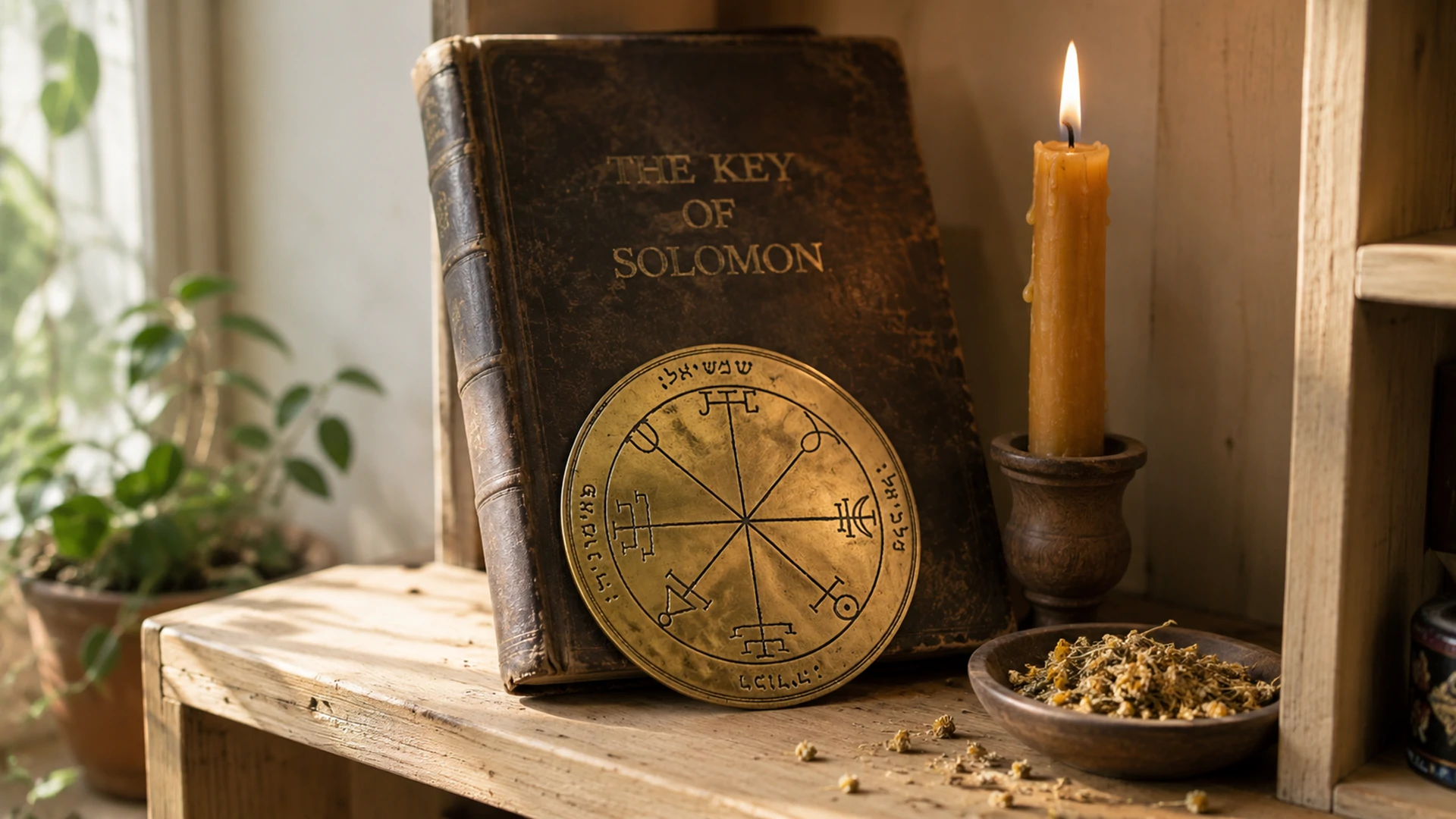
The Pentacles of Solomon are not pentagrams. That distinction matters and it's the first thing worth getting clear. A pentagram is a five-pointed star — a geometric symbol with its own long magical history. The Pentacles of Solomon are something far more specific: consecrated talismanic figures drawn from the Key of Solomon, a grimoire that circulated across medieval and Renaissance Europe in Hebrew, Latin, and French manuscripts. Each pentacle is a composed figure, not just a shape. It contains divine names written in Hebrew, specific lines from the Psalms, geometric structures aligned to planetary forces, and a clearly defined office — a precise spiritual purpose it was constructed to accomplish.
There are 44 of them in total. They are organized under the seven classical planets, with each planet governing a set of figures aimed at the kinds of outcomes that planet was believed to rule: restriction and binding under Saturn, expansion and material wealth under Jupiter, conflict and courage under Mars, authority and revelation under the Sun, love and beauty under Venus, communication and knowledge under Mercury, and the deep currents of the subconscious under the Moon. The number 44 is not arbitrary, and the system is not decorative. These figures were built according to a specific theological logic that makes them coherent as a whole.
This article covers that logic — where the Key of Solomon came from, why these figures are structured the way they are, and how practitioners actually work with them today. If you're looking to identify and work with a specific pentacle, the complete guide to all 44 Pentacles of Solomon covers each figure's documented purpose, planetary attribution, and symbolic construction. What follows here is the foundation that makes that reference useful.
Historical Origins of the Key of Solomon
The Key of Solomon — Clavicula Salomonis in Latin — is one of the most influential grimoires in the Western ceremonial magic tradition. Its attribution to King Solomon himself is a convention, not a claim with historical evidence behind it. Solomon's name carried enormous symbolic authority: in the Hebrew Bible he was renowned for wisdom, and in apocryphal texts, folk tradition, and Islamic sources, that reputation extended into command over spirits, demons, and invisible forces. Attaching a magical text to his authorship was a way of lending it the highest possible legitimacy in the eyes of a medieval or Renaissance reader.
The reality of the manuscript tradition is considerably messier. The Clavicula Salomonis was not written by one person at one time. It accumulated across centuries, with variant manuscripts disagreeing on details, sections, and the specific figures they include. Some manuscripts date to the 14th and 15th centuries, though the tradition they draw from is older. The text exists in Hebrew, Latin, Italian, French, and Greek versions, each with its own variations. Grimoire history is genuinely tangled — there is no clean original text from which all others descend cleanly.
What the pentacles reflect is a layered synthesis of traditions that were circulating together in medieval and Renaissance learned culture. Jewish Kabbalistic thought contributed the theological weight of Hebrew divine names — specific combinations of letters understood to carry divine authority, not merely symbolic meaning. Christian ceremonial magic contributed the framework of angelic hierarchies and the use of Psalm verses as invocatory text. Renaissance Hermeticism contributed the planetary correspondence structure that organizes the entire pentacle system. These three registers don't sit separately in the pentacles — they operate simultaneously in each figure.
The version most modern practitioners have encountered comes through S.L. MacGregor Mathers, a founding member of the Hermetic Order of the Golden Dawn, who translated and published an edition of the Key of Solomon in 1889. That edition drew primarily from manuscripts held in the British Museum. Mathers' translation was instrumental in bringing Solomonic practice into the modern esoteric mainstream — his editorial choices shaped how the text has been read and practiced for over a century. It's worth knowing that Mathers worked from a selection of available manuscripts and made choices that later scholars have debated, but his edition remains the most widely referenced starting point for practitioners in English.
The Spiritual Logic Behind the Pentacles
Understanding how a pentacle was believed to work requires setting aside the modern instinct to read these as symbols of personal power. In the theological framework the Key of Solomon operates within, a pentacle is not an expression of the operator's own magical strength. It is a vessel — a constructed object whose authority derives from the divine names and scriptural passages it contains, not from the person holding it. The operator is the one who invokes that authority, but the compulsion the pentacle exerts over spirits comes from above the operator, not from them directly.
This is a meaningful distinction because it explains the precision the grimoire demands. If you're invoking divine authority, you can't approximate it. The names have to be correct, the script has to be legible, the Psalm verses have to correspond to the pentacle's specific office. A sloppy copy was understood to be not merely less effective — it was a different object. This is why the manuscript tradition includes detailed instructions on how the figures must be drawn, what prayers accompany the work, and what materials are appropriate for which planetary figures.
Planetary correspondence is the organizing structure of the entire system. Each of the seven classical planets — Saturn, Jupiter, Mars, the Sun, Venus, Mercury, and the Moon — was understood to govern specific domains of existence. This isn't metaphor in the medieval and Renaissance context; it's cosmology. Saturn rules time, limitation, binding, and the crossing of boundaries. Jupiter governs expansion, wealth, legal matters, and divine favor. Mars rules conflict, courage, and the breaking of obstacles. The Sun governs authority, visibility, and truth. Venus governs love, desire, and beauty. Mercury governs communication, skill, and knowledge. The Moon governs the inner life, dreams, and the movement of water and tide.
The pentacles under each planet were built to accomplish ends within that planet's domain. When the Key of Solomon specifies that a figure should be engraved in lead at the hour of Saturn on the day of Saturn, that instruction isn't ceremonial decoration — it's tuning. Lead was the metal associated with Saturn since antiquity. Performing the work in Saturn's hour was understood to align the construction with that planet's active current, strengthening the object's connection to the forces it would invoke. Timing and material were understood as modes of correspondence, the same logic that governs colored candle correspondence or gem association, but applied at a higher level of structural precision.
As for why there are exactly 44, it follows from the number of distinct offices recorded for each planetary court. Some planets have more pentacles than others because their domain, as the tradition mapped it, encompassed more distinct types of work. Saturn, Jupiter, Mars, and the Sun each carry seven; Venus and Mercury each carry five; the Moon carries six. The total isn't a round number because it was never meant to be one. It's a record of what the tradition held each planetary intelligence to govern, and 44 is simply what that accounting produced.
Modern Interpretation and Adaptation
Contemporary practitioners engage with the Pentacles of Solomon across a wide range of approaches, and being clear about that range is more useful than pretending there's one right way. Some work within the historical ceremonial framework as closely as possible: sourcing the correct metal, observing the planetary hour and day for construction, performing the accompanying prayers and invocations from the grimoire itself. This approach treats the system as it was designed — as a complete working where each element reinforces the others.
Many more practitioners today use the pentacles in adapted form. Printed or hand-drawn figures, paper rather than metal, used as altar pieces, worn as jewelry, placed in spaces for ongoing protection or intention work, or used as meditation focuses for work connected to a particular planet's domain. This is a real adaptation from the historical practice, and calling it something else would be dishonest. But adaptation is not the same as invalidation. What's preserved in eclectic use is the specific documented office of each figure and its planetary attribution — the two things that make a given pentacle distinct from a generic sigil. What's typically set aside is the full ceremonial apparatus: the timing, the material, the specific prayers and ritual preparation the grimoire prescribes.
Whether that matters depends on what framework you're working within. If your practice holds that the authority of a pentacle derives from its divine names and scriptural content alone, then a carefully hand-drawn copy carries that content whether or not it was made in the correct planetary hour. If your practice holds that the full construction ritual is what activates the object, then the adapted version is a different kind of tool — still useful as a focus for intention, but not operating as the grimoire's original logic intended. Neither position is the only defensible one. But knowing which position you're actually working from keeps your practice honest.
What the pentacles offer modern practitioners that most contemporary sigil systems don't is precisely the specificity that comes from centuries of recorded use. Modern sigil magic often invites the practitioner to generate their own figures from personal intention, which is powerful in its own right. The Solomonic figures come pre-loaded with a documented purpose, a planetary current, a body of symbolic correspondences developed over centuries, and — for those who work within a spirit-conjuring framework — a recognized authority that the figures were built to invoke. That's a fundamentally different kind of tool, and it's worth understanding it as such rather than flattening it into the category of generic magical symbols.
The pentacles have also become touchstones within the broader witchcraft and occult revival of the last few decades. You'll find them as altar art, in jewelry collections, on candles, incorporated into protection workings alongside rue or angelica root, and referenced in traditions well outside the Golden Dawn lineage that Mathers helped establish. This spread is partly a reflection of how visually striking the figures are, but it's also a recognition that a system this specific and this old carries something worth working with — even when the full ceremonial context isn't present.
Why a System This Old Still Works
The Pentacles of Solomon have persisted for centuries not because they're mysterious or dramatic, but because they're precise. Every figure has a defined purpose. Every purpose is organized under a planetary domain with centuries of correspondence built around it. Every figure draws on divine names and scriptural authority that the tradition understood as carrying real spiritual weight. That precision is what separates this system from a collection of interesting symbols — it's a coherent body of applied theology, developed through accumulated practice and manuscript transmission across multiple cultural contexts, and it's still recognizable as the same system whether you encounter it in a 15th-century Latin manuscript or a modern practitioner's altar setup.
The fact that the system synthesizes Jewish Kabbalistic thought, Christian ceremonial practice, and Renaissance Hermetic astrology is not a weakness. It's actually part of why it survived. Those three streams shared enough common theological ground — the reality of divine names, the existence of angelic and demonic intelligences, the governing influence of planetary forces — that their combination produced something more robust than any one of them alone would have. The pentacles sit at that intersection, and that position gave them staying power across traditions that changed significantly around them.
If you're new to this system and ready to work with specific figures, the next step is identifying which planetary domain your working falls under and finding the pentacle whose documented office matches your intention. That's exactly what the complete guide to the 44 Pentacles of Solomon is built for — every figure, its planet, its purpose, and its construction. Start there once you know what you're looking for. The foundation you've built here will make that reference considerably more useful.