Venus Hour: Love, Beauty, and Harmony
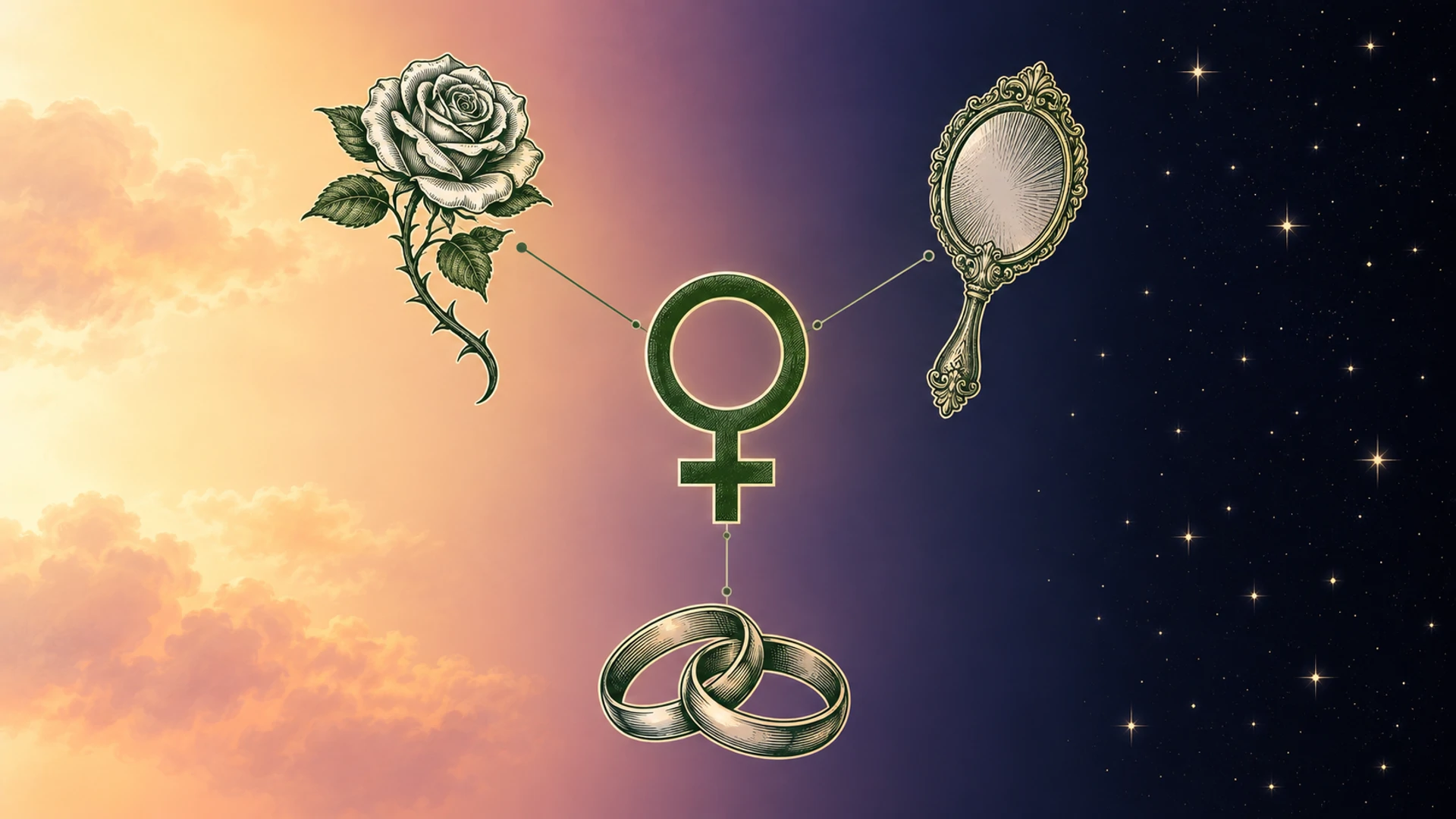
The Venus hour is the window in the day when the planet of love, beauty, and desire holds its office over time. It is not a vague invitation to feel good — it is a specific kind of opening, one that the grimoire tradition consistently designated for love workings, the building of friendships, reconciliation between estranged people, and any ritual meant to draw pleasure and harmony toward you. When you time a working to a Venus hour, you are not adding decoration to your intention. You are aligning the moment itself with the same current your working is trying to call up.
Unlike planets whose hours carry a sharp edge or a weight you have to reckon with, Venus's hour is genuinely generous. It rewards desire, openness, and the kind of will that knows what it wants and isn't ashamed of that. Whether you are working on romantic love, self-worth, or the repair of a fractured relationship, Venus hours show up for you several times a week, on every day of the calendar, and most densely on Fridays.
Venus's Place in the Chaldean Sequence
The classical planetary hour system orders the seven planets in what is called the Chaldean sequence, ranked by their apparent speed across the sky as seen from Earth: Saturn, Jupiter, Mars, Sun, Venus, Mercury, Moon. Saturn moves most slowly, the Moon most quickly. Venus sits fifth. That position is specific: it places her past the heavy outer planets and past the Sun, closer to the quick, personal end of the sequence. In the geocentric model, this put Venus within reach in a way that Saturn and Jupiter simply were not. And Venus was already the brightest object in the sky after the Sun and Moon, rising as the morning star and setting as the evening star. Her fifth-sequence position and her sky presence together made her feel like a planet that actually showed up for you, that you could work with directly rather than petitioning from a distance.
This sequence cycles continuously through all 24 hours of every day without interruption. Each hour's ruling planet is simply the next one in the chain, picking up wherever the previous hour left off — across sunset, across midnight, across the boundary of one weekday into the next. You can read more about how that cycle works and why it produces the planetary week we still use in the full guide to planetary hours. What matters here is that Venus's position — fifth in the Chaldean order — means it arrives reliably and often across the week, and always governs the first hour of Friday.
Venus in the Grimoire and Astrological Tradition
The most direct record we have of what the tradition specifically assigned to Venus's hours comes from the Key of Solomon, one of the most influential grimoires in the Western magical canon. The text is not subtle about Venus's domain. It describes the days and hours of Venus as suited to forming friendships, for kindness and love, for joyous and pleasant undertakings, and for travelling. What is notable in the Key of Solomon's framing is the tone. Venus is described with warmth and breadth. Where Mars's hours are described in bluntly martial terms and Saturn's in severe ones, Venus gets what might be the most appealing set of associations in the entire planetary chapter: joy, kindness, and the full spectrum of loving connection.
Anael: Venus's Governing Angel
The Heptameron assigned a governing angel to each of the seven planets, a pairing that Cornelius Agrippa drew into his own synthesis and that later ceremonial magic largely inherited. Venus's angel is Anael, also written Camael in some sources. Spellings shift between texts and Agrippa himself records competing attributions in different passages, but Anael is the name most consistently repeated across later ceremonial magic and is the one most practitioners work with today. When Venus's hour is used for an invocation, Anael is the intelligence you are addressing — the governing officer of that hour's current.
Venus's Traditional Metal: Copper
The metal correspondence for Venus is copper, one of the most stable attributions in the entire classical system. Color is a different story. The green that most modern practitioners associate with Venus largely reflects 19th and 20th century Golden Dawn systematization rather than any single unbroken ancient source — earlier traditions were considerably less consistent about color. Copper, by contrast, traces back through Agrippa's synthesis into older alchemical tradition and holds across a wide range of source texts.
The association runs deeper than alchemy. Copper takes its very name from Cyprus, the island historically linked to Aphrodite — in Latin, cuprum, from Kypros. Working with copper during a Venus hour — as a ring, a dish, a talisman base, or simply a piece of copper wire laid on the altar — is a correspondence grounded in a long and consistent lineage, not a modern invention.
The Pentacles of Venus
The Key of Solomon includes a dedicated set of Venus pentacles — talismanic seals designed to be constructed and consecrated under Venus's influence. The 44 pentacles of Solomon span all seven classical planets, and the Venus set runs the full range of that planet's domain: from seals for grace, honor, to one specifically described as exciting love on sight, to a pentacle for compelling any person to come to the operator. The consistent instruction across this set is that these seals should be made during Venus's hour, ideally on a Friday — which places the construction under a double Venus influence, both by day and by hour.
What the Venus pentacles reveal, taken as a group, is that the grimoire tradition had a considered view of love magic. It covered everything from gentle reconciliation and the cultivation of friendship to more assertive workings aimed at drawing a specific person. Venus's hour supports all of it. The tradition did not moralize about which of these was legitimate — it provided the tools and trusted the practitioner to know what they needed.
Venus in the Broader Astrological Record
Beyond the Key of Solomon, Venus appears across Hellenistic and Renaissance astrological writing as the benefic planet most closely associated with pleasure in its earthly, embodied form. Jupiter was the greater benefic, concerned with expansion, wisdom, and abundance on a large scale. Venus was the lesser benefic, but her domain was more personal and immediate: the way a relationship feels, the pull of attraction, the quality of beauty in a space or a body, the ease of connection between people. In electional astrology — the practice of choosing an auspicious time to begin something — Venus hours were consistently recommended for any beginning that involved a person's heart, their appearance, or the quality of their social bonds.
Venus's Day: Friday
Every weekday is ruled by a planet because the first hour of that day, the hour beginning at sunrise, belongs to the day's own planetary ruler. Venus rules Friday. That means every Friday begins with a Venus hour and then recurs at hours 8, 15, and 22 of the day. Friday is Venus's home ground across the entire week.
Friday's Name Across Languages
English gets its Friday from Old English Frigedæg — Frigg's day. Frigg was the Germanic goddess of love, marriage, and the domestic sphere, and when Roman culture brought the planetary week into Germanic territory, the translators matched each Roman god to its nearest native equivalent rather than borrowing the Latin name directly. Dies Veneris, Venus's day, became the day of Frigg. That substitution is called interpretatio germanica, and it's why the English weekday carries a Norse goddess's name instead of the Roman one.
The Romance languages didn't make that trade. French vendredi, Spanish viernes, and Italian venerdì all come straight from dies Veneris — Venus is still sitting there in plain sight every time someone in Paris or Madrid names the end of the working week. Friday is also the only day of the English week named for a female deity, which is its own kind of distinction, separate from anything the hours are doing.
Why Friday Concentrates Venus's Power
When a Venus hour falls on a Friday, you have the planet working at both levels simultaneously — the day as a whole carries Venus's signature, and the specific hour you are working in does too. It happens four times every Friday, at predictable points across the day and night. Friday is the most efficient day for Venus workings in terms of timing: you don't have to hunt for a Venus hour in the middle of a Wednesday. You can plan your working for the morning, the afternoon, or the evening and almost certainly find a Venus hour close by.
That said, Venus's hour on any other day of the week is still Venus's hour. The day's overall ruler adds a layer, but it doesn't override the hour's character. A Venus hour on a Tuesday still draws Venus's current. Friday is simply where that current flows most cleanly.
Finding Venus's Hours: Day and Night Windows
Because the Venus hour falls fifth in the Chaldean sequence and the sequence runs unbroken across all 24 hours of every day, Venus's hour appears on every day of the week — not just Fridays. On Friday it holds hours 1, 8, 15, and 22. On other days it falls at different positions in the cycle, some in daylight and some after dark, depending on where the sequence lands for that day's ruling planet.
Day Hours vs. Night Hours
The planetary hour system divides each day into 12 daytime hours (sunrise to sunset) and 12 nighttime hours (sunset to the next sunrise). These are not 60-minute blocks. Their length shifts with the seasons and with your latitude. In midsummer, daylight hours stretch longer and night hours compress. In midwinter, the reverse. At the equinoxes they come close to equal.
For Venus, this distinction matters in a practical way. A Venus hour that falls during daylight tends to have a more social, outward-facing quality — it suits workings around attraction, visibility, and drawing connection toward you. Venus is the morning and evening star, famously visible at dawn and dusk, and there's something fitting about working with her in the golden hours when light is present but not at its harshest. A Venus hour that falls after dark carries a quieter intimacy — it lends itself to self-love rituals, dreamwork with a romantic or relational theme, or the kind of slow, inward magic you do when you want to shift your own energy rather than the energy between you and another person.
Neither window is more powerful than the other. They are different moods of the same planet, and choosing between them is a matter of what your working actually needs.
Tracking the Exact Times
Since hour lengths shift daily based on your location and the time of year, the only way to know exactly when today's Venus hours fall is through a live calculation tied to your local sunrise and sunset. A Venus hour almanac or planetary hour-finder handles this for you — enter your location and the date and it returns the exact start and end time for every planetary hour that day. Check it the morning of any working you want to time precisely, and you'll always know which window to use.
What Venus Hours Are For
The range of work that fits a Venus hour is wide, but it is not unlimited. The common thread is desire, connection, and the quality of experience — not force, not analysis, not the slow work of discipline. If your working is about what you want and who you want it with, a Venus hour will carry it.
Love and Relationship Magic
This is Venus's most obvious domain, and the tradition is unequivocal about it. Love candle workings are particularly well-suited to Venus hours — if you are preparing a love candle, lighting it during a Venus hour aligns your physical act of ritual with the governing planetary current. The same applies to attraction workings, workings meant to deepen an existing bond, or any spell aimed at opening the conditions for a relationship to form. Rose quartz and malachite are both traditional Venus stones and work well on the altar during these hours.
Reconciliation and the Repair of Bonds
The Key of Solomon describes Venus's hours as suited to forming friendships — and the repair of a friendship that has fractured is a natural extension of that. You are not forming something that never existed; you are returning to what was there before something went wrong. This is distinct from a purely romantic working. It covers estrangement between friends, the cooling of family tension, or the smoothing-over of a professional relationship that has gone awkward. Harmony candle work fits naturally here, and pink or green candles are both appropriate, though the color correspondence should be understood as a later systematization rather than a classically mandated rule.
Beauty and Self-Worth Workings
Venus governs not just how others see you but how you see yourself. A Venus hour is good timing for any working aimed at building self-worth, releasing shame around your body or your desires, or cultivating the kind of magnetic ease that comes from feeling at home in yourself. Pink candle magic is a natural fit for this kind of self-directed Venus work. So is working with rose quartz, Venus's most commonly worked crystal, or with rose and yarrow — both traditional Venus herbs with long histories in love and beauty workings.
Pleasure, Joy, and Art
The Key of Solomon explicitly names joyous and pleasant undertakings as part of Venus's hour. This is an underused category in modern practice. A Venus hour is a good time to begin a creative project you want to succeed, to dedicate time to music or visual art you are making as an act of devotion, or to consecrate an object you want to carry the feeling of beauty and pleasure. Venus is also traditionally associated with travel undertaken for pleasure rather than necessity — a distinction the grimoire tradition preserved but that maps clearly onto the difference between a trip you have to make and one you are choosing.
Copper and Traditional Metals in Venus Work
Copper is Venus's traditional metal in the classical attribution, and incorporating it into a Venus hour working is one of the most historically grounded choices you can make. A copper dish to hold your offerings, a copper ring worn while performing the working, or a small piece of copper as a focal point on the altar all serve as physical anchors for the Venusian current. If you are working with one of the pentacles of Solomon in Venus's set, engraving or tracing the seal onto copper during a Venus hour on a Friday is the most complete alignment the tradition describes.
Working With Venus's Hour
The simplest way to layer Venus's hour effectively is to combine it with Friday, a waxing moon, and at least one material correspondence from Venus's set. A waxing moon supports attraction and growth — which matches what most Venus workings are trying to do, whether that's drawing love toward you or building your own sense of worth. On a Friday, during a daytime Venus hour, with a waxing moon overhead, you have three distinct currents pointing in the same direction. That's a solid working window, and it comes around every few weeks.
Working Outside the Ideal
You don't need all three. A Venus hour on a Thursday is still a Venus hour. A Venus working on a Friday outside of a Venus hour is still a Friday working with the day's planetary signature behind it. The layering improves the timing, but the will behind the working is the actual driver.
If you are new to working with planetary hours, Venus is one of the easiest planets to start with precisely because her hours are frequent, her domain is accessible, and the results of a well-timed Venus working tend to be legible: relationships shift, connection opens up, something in how you carry yourself changes. Track a few Venus hours over several weeks, use them intentionally, and you'll develop a direct sense of what this current actually feels like in practice. Venus's hours don't manufacture desire — they meet it. What you bring to the hour is the working. The hour just makes sure the door is open when you arrive.