Blue Lotus Tea Ceremony for Spiritual Growth: The Gentle Opening Ancient Egypt Knew
Blue Lotus tea has carried a reputation for expanding consciousness since the time of the ancient Egyptians, and that reputation is grounded in something real. When you drink it as part of a focused ritual, you are not just sipping a pleasant floral brew. You are participating in one of the oldest forms of sacred plant ceremony on record, and directing that centuries-old current toward a single, clear intent: spiritual growth. This guide walks you through the full ceremony, from preparing your space to closing the working, with every step built specifically around what Blue Lotus does and why it works for this intent.
Why Blue Lotus Is Suited to a Spiritual Growth Tea Ceremony
Blue Lotus, Nymphaea caerulea, is governed by the Moon in most Western magical traditions, and this planetary attribution is the key to understanding why it works so well for spiritual growth. The Moon rules inner sight, the subconscious, dreams, intuition, and the parts of the self that sit below the surface of ordinary waking awareness. Working with a Moon-ruled plant deliberately draws on that current. It is not a coincidence that ancient Egyptians depicted Blue Lotus at the nostrils of the dead in funerary rites, or that priests and initiates used the flower in temple rituals intended to facilitate communion with the divine. The plant was specifically chosen because it was understood to thin the boundary between ordinary consciousness and the realm of spirit. You can read more about the plant's full range of magical properties in the Blue Lotus correspondences, uses, and safety guide.
The elemental association of Blue Lotus is Water, and this maps cleanly onto spiritual growth as an intent. Water magic concerns itself with depth, receptivity, and the dissolution of fixed mental patterns. Spiritual growth is not a forceful act. It happens when you become permeable enough to receive new understanding, when you let go of what you think you already know. Blue Lotus as a Water plant creates that quality of inner openness. Its mild psychoactive compounds, particularly aporphine and nuciferine, have been shown to produce a calm, slightly hypnagogic state that quiets the analytical mind without causing dissociation. Magically speaking, that is exactly the condition you want for working with spiritual expansion: alert but soft, present but not rigid.
There is also a strong sensory case for using Blue Lotus specifically for this intent. The dried flowers produce a tea that is faintly sweet, slightly earthy, and carries a delicate floral note that does not overwhelm. That subtlety is part of its virtue in this working. Unlike intensely bitter or pungent herbs that demand attention through their sharpness, Blue Lotus tea settles you. The scent alone, when the cup is warm and you hold it close, has a quality that many practitioners describe as gently expansive. That is the plant working on you before you even take the first sip, and it tells you something about why drinking it is such a complete vehicle for this kind of working.
Drinking Blue Lotus rather than burning it or carrying it as a talisman is a fundamentally different relationship with the plant. When you ingest it, you are not projecting its energy outward into a space or object. You are receiving it internally. The plant becomes part of your body's chemistry for the duration of the ceremony, and that internalized quality reflects the intent of spiritual growth perfectly. Growth is not something you perform for an audience or attach to an external object. It happens inside you, in your perception, your understanding, your relationship with your own spirit. Drinking Blue Lotus enacts this literally. The working takes place within.
Preparing for Your Blue Lotus Tea Ceremony
Timing
The most effective time to hold this ceremony is in the evening, after full dark. Blue Lotus is a Moon plant, and timing your ceremony when the Moon is above the horizon aligns the working with the planetary current the herb naturally carries. If you want to be more precise about this, Monday is the Moon's own day — you can find the Moon's hour for your exact location and date using our Moon's hour finder. For the intent of spiritual growth specifically, a waxing or full Moon is ideal: the waxing phase supports expansion and development, and the full Moon brings heightened receptivity and amplified inner sight.
Space
Your space should be quiet enough that you can sit undisturbed for at least forty-five minutes. Dim the lights or work entirely by candlelight. Clear the area of clutter, since visual noise pulls the mind outward, and you want everything in this ceremony drawing your attention inward. If you have an altar space, use it. If not, a small cleared table or even a mat on the floor works fine. The physical clearing of the space is part of the working: you are creating a container for the intention before the tea ever touches your lips.
Auxiliary Tools
Two auxiliary tools serve this ceremony well and should be treated as part of the ritual setup, not decoration.
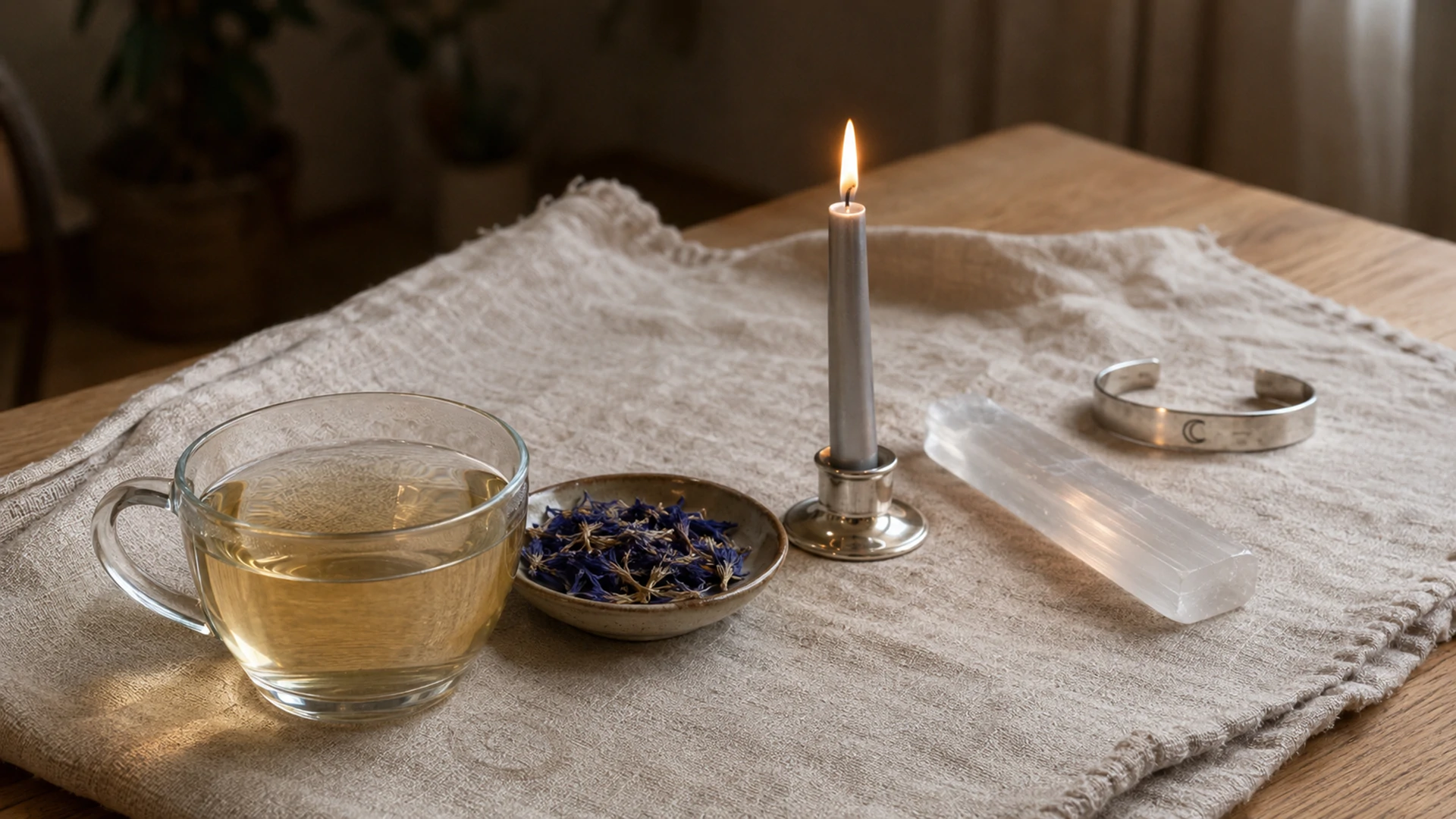
- A silver or white candle: Silver candle magic is directly tied to the Moon current — it reflects and amplifies lunar energy rather than adding a separate frequency to the working. Because Blue Lotus is already carrying that same current into your body through the tea, lighting a silver candle creates a coherence between the plant, the flame, and the space around you. Everything in the room is tuned to the same frequency. Light it before you begin brewing and let it burn for the full duration of the ceremony.
- Selenite: Selenite is one of the few stones named directly for the Moon — its name comes from Selene, the Greek lunar goddess — and its magical reputation centers on clearing mental fog, lifting the awareness toward higher states of perception, and strengthening the connection between the conscious mind and spiritual insight. That makes it a precise match for what this ceremony is asking of you. Where the tea softens your inner resistance from the inside, selenite holds a steady, clarifying presence in the space around you, keeping the channel open rather than letting the mind drift back into ordinary chatter. Place a piece beside your cup or hold it in your non-dominant hand while you drink, so both are pulling in the same direction at once.
Safety Note
A brief but important note before you proceed: Blue Lotus is generally considered safe for most healthy adults when consumed as a standard herbal tea. That said, if you are pregnant or breastfeeding, taking prescription medications (particularly sedatives, antidepressants, or blood thinners), or have a history of adverse reactions to plant compounds, please consult a doctor or qualified herbalist before using it. Checking in with a doctor first is simply the responsible move before working with any herb internally, not a signal that something is wrong.
Brewing Blue Lotus With Intention
Gathering the Petals
Gather your dried Blue Lotus flowers. You will need approximately one to two teaspoons of dried petals per cup of water. If this is your first time working with the plant ceremonially, start with one teaspoon — not because it is dangerous to use more, but because your first ceremony should be about learning how Blue Lotus communicates with you, not about maximizing intensity.
Heating the Water
Fill your kettle and set it to heat. While the water comes up to temperature, hold the dried petals in your hands for a moment before placing them in your cup or strainer. Blue Lotus petals are light and papery in your palm, almost impossibly delicate for a plant with such a long spiritual history. Feel them. The act of holding the herb and setting your intention before it ever meets the water is one of the most important steps in this ceremony. Speak your intent aloud or in your mind: something direct and personal, not a formal incantation unless that resonates with you. Something like, "I open myself to growth. I am ready to see what I have not yet seen." Keep it true to how you actually think.
Pouring and Steeping
Blue Lotus should be steeped in water that is hot but not aggressively boiling. A temperature between 85°C and 90°C (185°F to 195°F) is ideal. Fully boiling water can cook off some of the delicate aromatic compounds that carry the plant's more subtle qualities. If you are using an electric kettle without temperature settings, just let boiling water rest off the heat for two to three minutes before pouring. Pour the water over the petals slowly and deliberately, not as a mindless kitchen task but as an intentional act. Watch the petals begin to unfurl and release their color into the water. The brew will take on a soft gold to pale amber hue, sometimes with a very slight blueish undertone depending on your flowers. This is the plant yielding.
Steep the flowers for ten to fifteen minutes. This is longer than you would steep a standard herbal tea, and intentionally so. During this time, do not pull out your phone. Sit with the cup in front of you. You can hold your selenite, let your gaze soften on the candle flame, or simply sit with closed eyes and follow your breath. What you are doing in this window is not waiting for the tea to be ready. You are entering the ritual space. Your mind is beginning to slow, and the ceremony is already underway. The Blue Lotus is still steeping, but so are you.
Before You Drink
After fifteen minutes, remove the petals or strain them out. Take a moment before drinking. Hold the cup with both hands, feel its warmth, and breathe in the scent. Blue Lotus has a faintly sweet, almost honey-adjacent fragrance with something green underneath it, like water and living things. Let that scent settle you further before you take the first sip.
Drinking and Closing the Ceremony
Drink the tea slowly. This is not something to gulp down. The pace of consumption is part of the ritual. Take a sip, set the cup down, and spend a few moments in the sensation before reaching for it again. What you are looking for is not an overwhelming effect. Blue Lotus tea produces a gentle softening: a warmth behind the eyes, a slight loosening of mental grip, a quality of spaciousness that begins to open up around your thoughts. For spiritual growth work, this is exactly the state you want to be in. You are not trying to force insight. You are creating the conditions for it to arrive.
While you drink, keep your focus on your intent. You might visualize your awareness expanding outward like light moving through still water. You might simply sit with the question of where you want to grow spiritually, not demanding an answer but holding the question with genuine openness. If thoughts arise, let them come and go without grabbing at them. Some practitioners find that journaling during this phase works well; others prefer complete stillness. Do what allows you to remain present with the plant and your intention rather than drifting into ordinary thinking.
Once the cup is finished, remain seated for at least ten to fifteen more minutes before moving on. This is the closing movement of the ceremony, and it matters as much as everything that came before. If you have received any insights — images, feelings, words, realizations — write them down now while they are still clear. Do not try to analyze them in the moment. Just record them faithfully. The understanding often comes later, sometimes days later, as the working continues to integrate.
To close the ritual formally, express gratitude for what you received, whether or not it felt like much in the moment. Trust that the working landed. Extinguish the candle with a snuffer or your fingers rather than blowing it out, which is a common practice when you want the intention to remain contained rather than dispersed into the air. Set the selenite somewhere you will see it over the coming days as a physical anchor for the intention you set.
Dispose of the spent petals by returning them to the earth. Burying them in soil or scattering them outdoors completes the cycle of the plant's energy. You are not throwing away waste. You are returning what has served its purpose. If you are in a city with no immediate access to open ground, a houseplant works just as well.
Blue Lotus and the Long Work of Expanding Your Inner World
What makes this ceremony worth returning to is not a single dramatic experience. It is the cumulative effect of repeatedly creating the conditions for your inner sight to sharpen. Blue Lotus works for spiritual growth not because it does the growing for you, but because it reliably softens the mental rigidity that gets in the way. Every time you sit with this plant, hold the intent clearly, and give yourself permission to receive rather than achieve, you are practicing the actual skill that spiritual growth requires.
The Moon attribution that grounds this plant's magical use is worth remembering here. The Moon does not force the tide. It pulls, and the water responds because the water is receptive. Blue Lotus tea ceremony works the same way. You bring the intention, you create the container, and you make yourself available to what wants to move through you. The plant's mildly psychoactive compounds, its Water correspondence, and its long history of sacred use in initiation contexts all point toward the same quality: it makes you more open to what is already trying to reach you from within.
This is a ceremony you can perform as often as feels right. Monthly on the full Moon is a natural rhythm for a Moon-ruled plant working. You might also return to it when you feel spiritually stagnant, when a major life transition is asking you to grow in a direction you cannot yet see clearly, or simply whenever you want to deepen your connection to your own practice. Each ceremony builds on the ones before it. The more you work with Blue Lotus in this way, the more attuned you become to its particular quality of opening, and the more efficiently the working runs.
If you want to explore other herbs suited specifically to spiritual growth work, two ceremonies worth looking at are the Mugwort Tea Ceremony for Spiritual Growth and the Eyebright Tea Ceremony for Spiritual Growth. Mugwort works through dream-layer access and is particularly strong when the veil between ordinary and non-ordinary awareness feels thick; eyebright targets clarity of inner vision more directly. Each brings something distinct to this intent, and working with all three over time gives you a real feel for how differently plants can approach the same territory.
For a broader view of what intentional tea ceremony can do across other intents, the Spiritual Tea Ceremonies: A Complete Guide by Intent is a good place to go next. The practice is a craft worth developing across many plants and many purposes.