Spiritual Tea Ceremonies: A Complete Guide by Intent
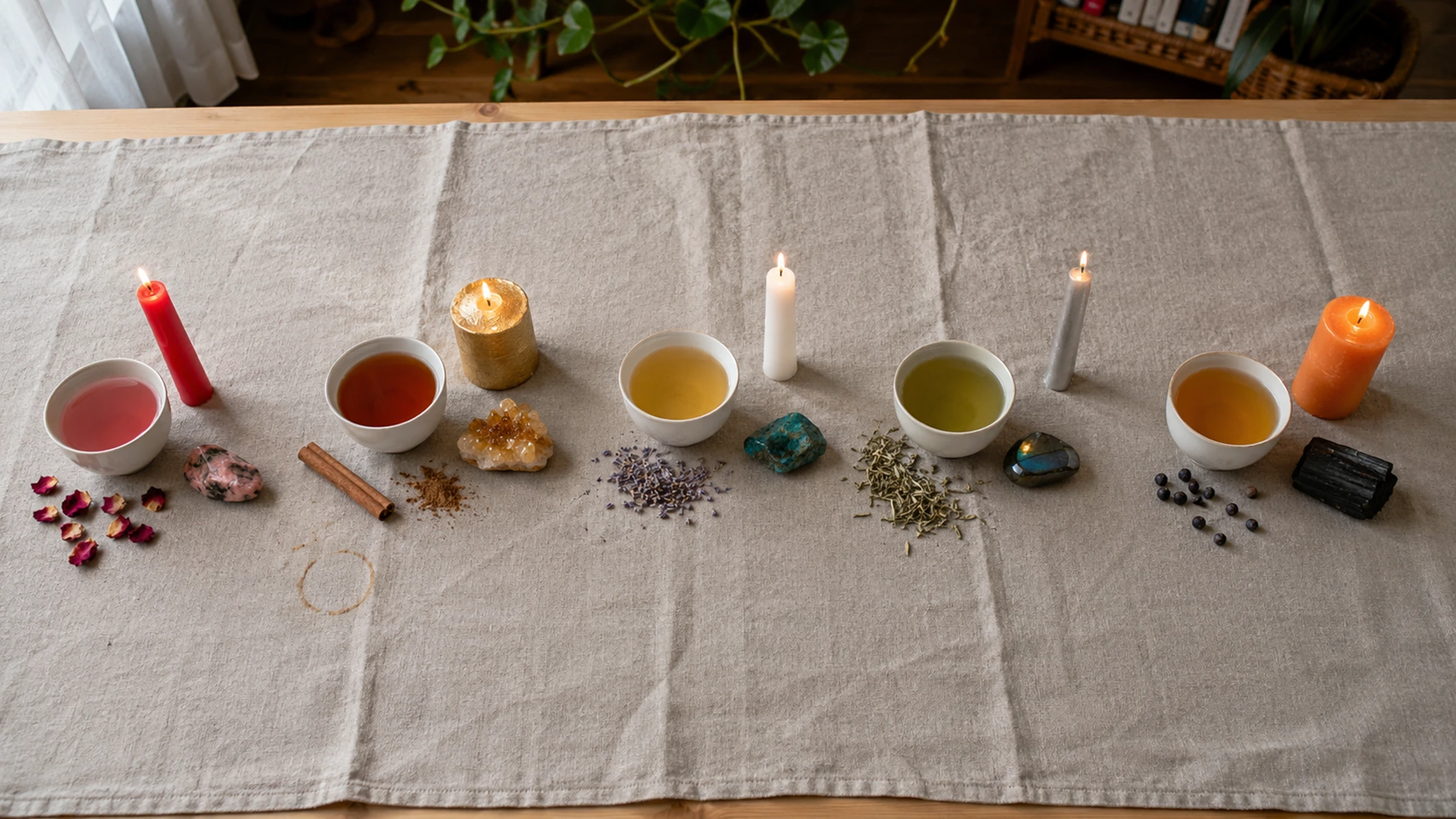
A spiritual tea ceremony is one of the most accessible and genuinely powerful magical practices you can build into your daily life. The act of brewing, holding, and drinking tea is already intimate — it slows you down, warms your hands, and asks you to be present. When you layer intention onto that, you have a ritual that works on every level at once: physical, symbolic, and energetic. This guide covers what makes a tea ceremony magical and breaks down the best herbs for a range of different intents, so you have somewhere real to start — and plenty of room to go deeper.
What Is a Spiritual Tea Ceremony?
A Spiritual Tea Ceremony is a ritual in which the preparation and consumption of tea becomes an act of intentional magic. The word "ritual" here just means a structured, repeated action performed with conscious purpose — not necessarily anything elaborate. Even a five-minute morning brew can qualify if you bring real intention to it.
The magic in a tea ceremony doesn't come from the herbs alone. It comes from you — from the focused attention you bring to the process of choosing your plant, boiling your water, steeping your blend, and drinking with awareness. The herbs act as symbolic and energetic anchors. Their historical correspondences, their scent, their taste, and the physical act of consuming them all work together to impress your intention onto your subconscious mind and direct your will toward a goal. This is the core principle behind all magical herbalism: the plant supports and amplifies the work, but you are the source.
In many traditions around the world — from the Japanese chado to Chinese gongfu cha to the medicine teas of indigenous North American cultures — tea has been treated as a sacred substance. The act of preparing it slowly and mindfully was itself considered a spiritual discipline. Modern magical tea ceremonies draw on this same instinct: slow down, be deliberate, treat the cup as a vessel for something larger than thirst.
Your ceremony can be as simple or as layered as you want. At its most basic, it involves choosing an herb with the right correspondence for your intent, brewing it while holding your goal clearly in mind, speaking your intention over the cup, and drinking with full awareness. You can build on this with candles, crystals, sigils, journaling, moon timing, or anything else that deepens your focus. The foundation is always the same: clear intention, chosen plant, conscious action.
Spiritual Tea Ceremonies by Magical Intent
Below you'll find a range of magical intent categories, each with three herbs suited for tea preparation. These aren't exhaustive lists — they're strong, well-established starting points. Within each category, the herbs share a core energy but differ in nuance, so read through them and choose the one that resonates most with where you are right now.
Love
Love teas work best when you're specific about what kind of love you're calling in — self-love, romantic attraction, deepening an existing bond, or opening your heart after loss. Each has its own energetic flavor, and so do these herbs.
- Rose (Rosa spp.) — Rose is the quintessential love herb, and for good reason. Across European, Middle Eastern, and South Asian traditions, the rose has symbolized the heart in its fullest expression — desire, devotion, grief, and beauty all at once. In a love tea ceremony, rose petals open the emotional body and create a receptive, warm internal state. Brew dried rose petals and hold your intention on the feeling of love already present in your life, then let it expand outward.
- Jasmine (Jasminum officinale) — Jasmine carries a sweet, heady energy associated with attraction, sensuality, and lunar femininity. It's particularly well suited for ceremonies aimed at drawing a romantic partner or increasing magnetic appeal. The scent alone does real psychological work — jasmine activates the senses and shifts you into a more open, receptive state, which is exactly where you want to be when working love magic.
- Damiana (Turnera diffusa) — Damiana has a long history as an herb of passion and desire. Its energy is warmer and more physical than rose or jasmine — it's less about romantic sentiment and more about rekindling fire, increasing confidence in intimate contexts, and dissolving emotional blocks that prevent you from fully expressing desire. Brew it when you want to move love from the head into the body.
Money
Money magic is really about shifting your relationship to abundance — clearing scarcity thinking, opening channels for opportunity, and aligning your energy with growth. These herbs have deep roots in prosperity workings across multiple traditions.
- Cinnamon (Cinnamomum verum) — Cinnamon is one of the most consistently used prosperity herbs across folk magic traditions worldwide. Its solar, fiery energy accelerates manifestation and draws wealth with momentum. In a money tea ceremony, cinnamon sharpens your focus on financial goals and gives your intention a sense of urgency and forward motion. It pairs beautifully with a clear, specific financial target held in mind during the brew.
- Basil (Ocimum basilicum) — Basil is closely associated with money, luck, and business success in Mediterranean, Caribbean, and Latin American folk magic. As a tea, it supports abundance work with an active, assertive energy — less about patient waiting and more about the confidence and forward motion it takes to go after opportunity directly.
- Lemongrass (Cymbopogon citratus) — Lemongrass is a powerful clearer of stagnant energy and a traditional herb for opening roads and removing financial blockages. If money seems stuck or opportunities keep falling through, lemongrass tea is the one to reach for. It clears the energetic pathway between you and prosperity and sharpens mental clarity so you can actually see and act on the opportunities already around you.
Protection
Protection teas work on multiple levels — warding off negative energy, strengthening your personal energetic boundaries, and reinforcing your sense of inner safety. They're particularly useful as part of a daily practice or before situations you find draining.
- Rosemary (Salvia rosmarinus) — Rosemary is one of the oldest and most widely used protective herbs in Western magical tradition. Its sharp, clarifying scent and strong energetic presence make it a natural ward against negative influences. As a tea, rosemary reinforces mental clarity and personal sovereignty — the sense that you know your own mind and your space is your own. Drink it before entering environments where you feel vulnerable to psychic or emotional drain.
- Nettle (Urtica dioica) — Nettle is a fierce and boundary-asserting herb. In magical tradition it's associated with warding, reversing hexes, and sending negativity back to its source. As a tea, nettle strengthens your auric field and puts a sharp edge on your personal boundaries — energetically and psychologically. Brew it when you feel under psychic attack, when someone is consistently crossing your limits, or when you need to assert yourself clearly in a difficult situation.
- Juniper (Juniperus communis) — Juniper has been used across European and Indigenous North American traditions as a powerful purifying and protective herb. As a tea, it creates a strong energetic shield around your personal space and clears away any negative energy that has already attached itself to your field. Brew it when you need a deep cleanse as well as ongoing protection, or when you've spent time in environments that felt heavy or hostile.
Healing
Healing teas support the body, mind, and spirit in returning to wholeness. They work best when you pair them with a genuine commitment to rest and self-care, letting the ceremony reinforce the physical and emotional work you're already doing.
- Chamomile (Matricaria chamomilla) — Chamomile is one of the most beloved healing herbs in both folk medicine and magical tradition. Its gentle, solar energy soothes inflammation, calms the nervous system, and creates a sense of warm, enveloping comfort. In a healing tea ceremony, chamomile is ideal for recovery from emotional wounds, illness-related exhaustion, or anxiety. It invites the body to release tension and the mind to trust the healing process.
- Lemon Balm (Melissa officinalis) — Lemon balm has been used medicinally and magically since antiquity, associated with longevity, joy, and healing the emotional heart. As a tea, it's particularly powerful for healing ceremonies that address grief, heartbreak, depression, or the kind of bone-deep weariness that comes from long periods of stress. It lifts the spirit without overstimulating — a rare and precious quality.
- Calendula (Calendula officinalis) — Calendula is a solar herb with a warm, regenerative energy that has been used across European folk traditions for physical and spiritual healing alike. In magical work, it's associated with vitality, renewal, and the sun's restorative power. As a tea, calendula supports healing ceremonies focused on rebuilding strength after illness or trauma — it works with your will to restore rather than merely recover.
Career
Career teas are about clearing mental fog, sharpening ambition, and aligning your energy with success, recognition, and forward momentum in your professional life.
- Bay Laurel (Laurus nobilis) — Bay laurel has symbolized achievement, victory, and recognition since ancient Greece and Rome, where laurel crowns were given to poets, athletes, and victors. As a tea, it carries this same energy of earned success and public acknowledgment. Use it in ceremonies focused on promotions, job applications, public speaking, or any professional milestone where you want your abilities to be seen and rewarded.
- Cardamom (Elettaria cardamomum) — Cardamom is a warming, clarifying spice associated with mental acuity, charm, and the ability to influence others favorably. In career magic, it supports ceremonies around negotiation, networking, and persuasion — situations where you need not just competence but charisma. Brew it when you want people to listen, trust, and say yes.
- Peppermint (Mentha piperita) — Peppermint is a sharp, energizing herb with strong associations with mental clarity, communication, and forward motion. In career magic, it cuts through mental fog and sharpens your thinking so you can perform at your best under pressure. Brew it before presentations, high-stakes meetings, or any situation where you need to articulate your ideas with precision and confidence.
Confidence
Confidence teas work on the solar plexus — the energetic center of personal power, self-worth, and courage. These herbs help you access the version of yourself that already knows what you're capable of.
- Thyme (Thymus vulgaris) — Thyme's association with courage runs deep in European folk tradition — it was carried by soldiers and woven into garlands for heroes. As a confidence tea, thyme works specifically on the fear that holds you back: the voice that says you're not ready, not good enough, not qualified. Brew it when you need to act in spite of fear, and let the ceremony remind you that courage was never about the absence of doubt.
- Star Anise (Illicium verum) — Star anise is a traditional herb for self-belief and personal authority, drawing on its solar correspondence. In confidence work, it sharpens your sense of personal authority and helps you project presence. It's particularly useful when confidence work intersects with visibility — public speaking, creative sharing, or any context where you're putting yourself in front of others and need to own the space you're in.
- Clove (Syzygium aromaticum) — Clove is a bold, fiery herb with deep associations with personal power, protection of the self, and commanding presence. As a confidence tea, it stokes your inner authority and helps you hold your ground in situations where you'd normally shrink or defer. Brew it when you need to feel solid in yourself — immovable, capable, and ready to take up the space that is already yours.
Luck
Luck teas are about opening yourself to opportunity, synchronicity, and favorable outcomes. They shift your energetic state to one of receptivity and positive expectation — which turns out to be more than half the battle.
- Vervain (Verbena officinalis) — Vervain is one of the most magically loaded herbs in Western tradition — sacred to druids, Romans, and folk practitioners alike. Its energetic quality is one of opening gates and turning tides, which makes it exceptional for luck work. Brew it when luck has been persistently bad and you need to genuinely shift the pattern, not just get a one-off win.
- Lemon (Citrus limon) — Lemon is a bright, solar herb with a long folk magic history of attracting good fortune, clearing away negative energy, and opening the way for positive outcomes. As a tea, it refreshes your energetic field and puts you in a light, expectant state that draws luck in naturally. Brew it in the morning before a day where you need things to fall your way.
- Vanilla (Vanilla planifolia) — Vanilla has a warm, magnetic energy with a long folk magic history of drawing good fortune, favor, and positive outcomes. As a luck tea, it creates an aura of sweetness and receptivity around you — the kind of energy that makes things fall into place rather than fall apart. Brew it when you want luck to arrive gently and consistently, building momentum over time rather than arriving in a single sudden burst.
Banishment
Banishment teas are about removal — clearing what no longer serves, severing energetic ties, and sending unwanted energies, habits, or influences out of your life. They require clear, directed intention more than almost any other magical intent.
- Agrimony (Agrimonia eupatoria) — Agrimony is one of the classic banishing herbs in European folk magic, historically used to break hexes and draw out harm that has already taken hold. As a tea, it supports banishment ceremonies aimed at removing psychic interference, cutting ties with people or patterns that drain you, or clearing persistent bad luck.
- Yarrow (Achillea millefolium) — Yarrow is named for Achilles and carries the energy of the warrior-healer — it both shields and cuts. In banishment work, yarrow severs unwanted connections cleanly and with precision, without the scorched-earth energy of more aggressive banishing herbs. Use it when you need to remove something or someone from your energetic space but want the cut to be clean rather than destructive.
- Hyssop (Hyssopus officinalis) — Hyssop is one of the oldest purification herbs in recorded magical and spiritual history, appearing in biblical texts and folk traditions across Europe and the Middle East. As a banishment tea, it purifies your energetic field after removal — clearing the residue of what has been cut away and restoring a clean internal state. Brew it in the closing stage of a banishment ceremony to seal the work and reclaim your space fully.
Harmony
Harmony teas are about creating peace — in relationships, in environments, in the self. They're excellent for diffusing conflict, smoothing communication, and restoring a sense of equilibrium when things feel fractured or tense.
- Lavender (Lavandula angustifolia) — Lavender is the herb of calm, balance, and gentle resolution. In harmony work, it soothes inflamed emotions and creates the kind of internal quiet that makes clear communication possible. Brew it before difficult conversations, during periods of household tension, or whenever you feel pulled in too many directions at once. Lavender doesn't suppress emotion — it gives emotion enough space to settle naturally.
- Violet (Viola odorata) — Violet carries a gentle, Venus-ruled energy long associated with peace, kindness, and the mending of fractured bonds. In harmony work, it softens pride and opens the heart to reconciliation without forcing resolution. Brew it when a relationship has grown cold or brittle and you want to reintroduce warmth — not by pushing past the tension, but by quietly dissolving it from the inside out.
- Passionflower (Passiflora incarnata) — Passionflower is a deeply calming herb with a strong traditional association with peace, stillness, and the release of conflict energy. As a harmony tea, it works on the nervous system and the emotional body at once — quieting the internal noise that keeps disagreements alive long after they should have ended. Brew it when the tension you're carrying has become habitual, when you need to genuinely let something go rather than simply manage it.
Spiritual Growth
Spiritual growth teas support the deepening of your practice — enhancing intuition, expanding awareness, strengthening your connection to your inner guidance, and opening the mind to insight and revelation.
- Mugwort (Artemisia vulgaris) — Mugwort is the preeminent herb for psychic development, dreamwork, and intuitive opening across multiple magical traditions. As a tea, it heightens perception and creates a softly altered, receptive inner state ideal for meditation, scrying, or any practice that requires you to tune into subtle information. Brew it before divination sessions, ritual work, or deep journaling to sharpen your inner sight.
- Blue Lotus (Nymphaea caerulea) — Blue lotus was sacred in ancient Egypt, tied to solar creation myths even though its magical correspondence here is lunar — associated with dreams, intuition, and spiritual illumination. As a tea, it produces a mild, calming euphoria and a deeply meditative state that makes it one of the most powerful herbs available for spiritual growth ceremonies. Use it for practices focused on ego dissolution, receiving spiritual guidance, or accessing deeper states of consciousness through meditation.
- Eyebright (Euphrasia officinalis) — Eyebright is a traditional herb for clairvoyance — the ability to see clearly, both literally and psychically. As a spiritual growth tea, it cuts through confusion and illusion, helping you perceive situations, patterns, and spiritual information with greater accuracy. Brew it when you've been feeling spiritually foggy or when you're seeking clarity about your path, your practice, or your purpose.
Building Your Herbal Tea Practice: Where to Go From Here
The herbs in this guide are your entry points, not your limits. Each one has a rich magical history, a set of correspondences that extend far beyond what any single article can cover, and a relationship with your practice that will deepen the more you work with it. The best way to develop your intuition for herbal magic is to start simple — choose one intent, choose one herb, perform the ceremony consistently, and observe what shifts.
If you're new to working with plants magically and want a solid foundation before you dive into specific ceremonies, the beginner's guide to magical herbalism is exactly where you should start. It covers how correspondences work, how to approach herbs as magical allies, and how to build a practice that's grounded, intentional, and genuinely your own. Your tea ceremony practice will be stronger for it.
Tea ceremonies fit seamlessly alongside other magical practices too. You can time them to the moon cycle, pair them with candle magic in a corresponding color, or incorporate crystals that share the same energetic intent as your chosen herb. The more deliberately you layer your tools, the more tightly your intention is focused — and focused intention is what makes magic work. Start with the cup. Build from there.