Mugwort Tea Ceremony for Spiritual Growth: A Bitterness That Tells the Truth
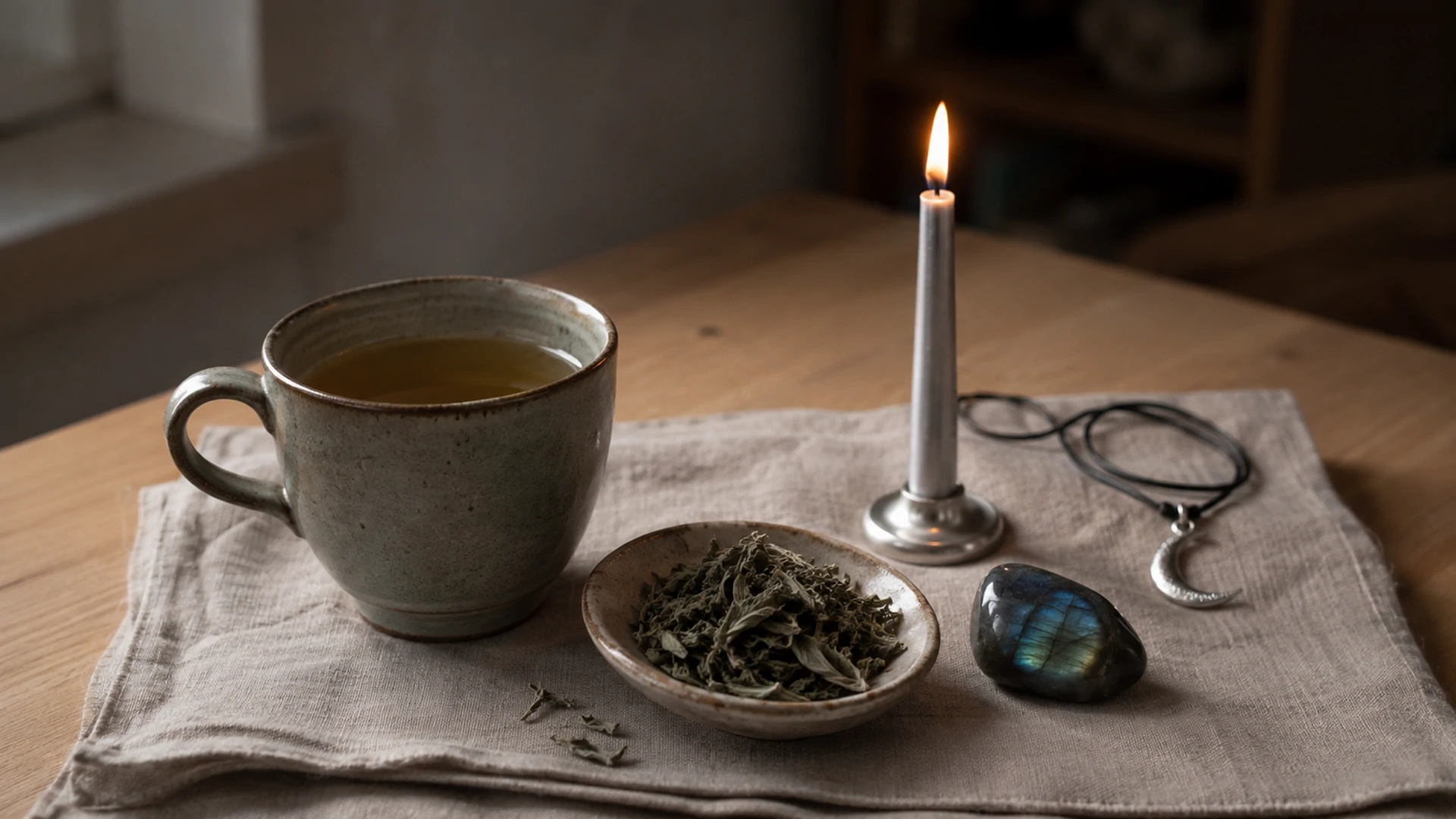
Mugwort tea for spiritual growth isn't a new idea. Artemisia vulgaris has been used in ritual and healing contexts across Europe, Asia, and the Americas for well over a thousand years, and its association with expanded perception, visionary experience, and inner knowing runs through almost every tradition that worked with it. This ceremony takes that long history and gives it a clear, usable form. You'll learn exactly why mugwort is the right herb for this intent, how to set up the space, how to brew with intention, and how to close the working so that what you've opened doesn't just dissolve back into the noise of the day.
Why Mugwort Is Suited to a Spiritual Growth Tea Ceremony
Mugwort is governed by the Moon and ruled by the element of Earth, which is an unusual pairing that tells you something important about how it works. The Moon rules the inner world — dreams, subconscious perception, psychic sensitivity, and the fluid boundary between waking awareness and deeper knowing. Earth grounds those perceptions so they're usable, not just overwhelming. For spiritual growth, that combination is exactly what you want: expanded access to inner truth, anchored enough to actually integrate.
Historically, mugwort's role in visionary and spiritual work is well-documented. In European folk practice, it was placed under pillows to provoke prophetic dreams and burned before divination sessions to sharpen the practitioner's second sight. In Traditional Chinese Medicine, dried mugwort (known as moxa) has been used for centuries in ways that emphasize its ability to move stagnant energy and open blocked channels. Across these traditions, the common thread isn't relaxation or protection — it's opening. Mugwort was the herb you reached for when you needed to see more clearly, receive more, or break through a plateau in your inner work.
Mugwort also has a sensory quality that reinforces this intention. Its bitter, slightly camphorous taste is not gentle or sweet. That bitterness has a traditional symbolic valence — it signals transformation over comfort, the kind of growth that requires you to actually look at something rather than glide past it. When you taste mugwort, you're tasting something that has historically asked something of the people who drank it. That's not incidental to the working; it's part of it.
Drinking mugwort as tea is meaningfully different from burning it or carrying it in a sachet. When you burn mugwort or carry it, the herb works in your environment and on the edges of your awareness. When you drink it, you bring it inside your body. The intent isn't external anymore — you've literally taken it in. There's an embodied commitment to the working that burning or carrying doesn't replicate. For spiritual growth specifically, that internal dimension matters: you're not just creating conditions for growth around you, you're inviting the herb to work within you. That's a stronger statement of will, and it tends to produce a more focused result. For a deeper look at everything mugwort carries into your practice, the full mugwort correspondences and uses guide is worth having open alongside this one.
Preparing for Your Mugwort Tea Ceremony
Space
Before you brew anything, spend a few minutes with your space. Mugwort's lunar nature makes it most responsive to quietude — a room where you can sit without interruption for at least thirty minutes. If you can dim the lights or work by candlelight, do it. Mugwort's work happens in the liminal space between what you already know and what you're reaching toward, and that space opens more easily when external stimulation is low. Silence your phone. Close the door. Let the ordinary world hold still for a bit.
Timing
Timing matters with a lunar herb. The waxing or full moon is the most supportive phase for a spiritual growth ceremony — waxing energy favors expansion and building, while the full moon amplifies receptivity, which is exactly the quality mugwort is trying to cultivate in you. Evening or night is the natural window, aligning with the Moon's hour and reinforcing her dominion. If you want to be precise about planetary hours, work during the Moon's hour on a Monday, which is her day. You can find the Moon's hour for your exact location and date using our Moon's hour finder.
Auxiliary Tools
Two supporting tools will anchor the ceremony and keep your intention clear throughout.
- A silver candle: Silver candle magic is directly tied to the Moon — her color, her reflective quality, her governance over the dream state and subconscious perception. Lighting a silver candle here does something specific: it tells your mind and your will that this is lunar work, working in the same current mugwort already moves through, rather than layering in a second intent. Let it burn throughout the ceremony and snuff it at the close.
- Labradorite: Labradorite has a long-standing reputation in magical practice as the stone of inner vision and the strengthening of intuitive sight — it works specifically at the threshold between what you consciously know and what your deeper awareness is already tracking. That's exactly the territory mugwort moves through, and holding labradorite during the ceremony keeps that threshold actively open rather than letting it drift shut between sips. Rest it beside your cup or hold it in your non-dominant hand while you drink.
Safety Note
One safety note before you brew: mugwort is contraindicated during pregnancy, as it has historically been used to stimulate uterine contractions and should be avoided entirely in that context. It may also interact with blood-thinning medications and some anticoagulant drugs. If you have any existing health conditions, take regular medications, or have a known sensitivity to plants in the Asteraceae family (which includes ragweed and chamomile), check with a doctor or qualified herbalist before drinking mugwort tea. Millions of people have drunk mugwort safely for centuries, so this is simply worth a quick check rather than a cause for concern if any of those situations apply to you.
Brewing Mugwort With Intention
Setting Your Intention
Use one teaspoon of dried mugwort leaf per cup of water. That quantity is enough to carry the herb's bitter, aromatic character without being overwhelming, and it's the traditional working dose for tea. You don't need to pack the infuser — mugwort is light and the oils release readily. If you have a dedicated ritual cup or teapot, now is the time to use it. Fill your kettle and set it to heat, but don't walk away.
Heating the Water
As the water heats, stay with it. This is not dead time between steps — it's the first moment of the ceremony proper. Watch the water if you can, and let your mind settle into what you're actually here for. Spiritual growth is a vague phrase until you make it specific: what wall have you been pressing against? What understanding keeps almost arriving but not quite landing? What layer of yourself is asking to be seen? Let one clear intention take shape while the water moves toward a boil. You don't need to force it into words. An image, a feeling, a question that's been sitting in your chest — any of those will work. The point is to arrive at something specific rather than a general wish for improvement.
Pouring and Speaking Your Intention
Heat the water to just below a full boil — 90°C to 95°C (194°F to 203°F). A rolling boil can drive off some of the delicate aromatic compounds in mugwort, and those compounds are part of what makes the tea feel the way it does. When the water is ready, pour it slowly over the dried herb. As you pour, speak your intention aloud or form it clearly in your mind — not as a request to an outside force, but as a statement of what you are now open to. Something as direct as "I open to what I cannot yet see" or "I release the ceiling I've been pressing against" is enough. Your will is the instrument here, and naming what you want done gives it direction.
Steeping
Steep for ten to fifteen minutes. Mugwort is not a delicate floral tea that turns bitter from a long steep — it's already bitter, and the bitterness deepens into something more complex with time. Ten minutes gives you a lighter infusion; fifteen gives you the full presence of the herb. While the tea steeps, stay close. Light your silver candle if you haven't already. Hold the labradorite or rest it against the side of the cup. Watch the steam rise. The steam from mugwort is itself aromatic — breathe it in slowly and deliberately, because you're already beginning to receive what the plant carries before you take the first sip.
When the steep is done, strain the leaves. Take a moment before you lift the cup — look at what you've made, notice the color (it will be a pale gold to olive green, depending on your leaf), smell it once more. You've been building toward this cup for the last ten or fifteen minutes. That buildup is intentional. The more presence you bring to the approach, the more the ceremony gives back.
Drinking and Closing the Ceremony
Drink slowly, maintaining the quality of attention you built during the brew rather than savoring flavor for its own sake. Take a sip, let it sit for a moment, then take another. Mugwort tea has a distinct bitterness with an almost green, slightly piney undertone. Don't fight the taste or wish it were sweeter. The bitterness is part of the working. Let it ask something of you. Each sip is a small act of choosing what you came here for.
While you drink, keep your intention in the foreground without straining toward it. You're not trying to force visions or manufacture insights — you're holding yourself open and letting the herb do its work in the body while your focused will does its work in the mind. If thoughts come, let them pass. If an image or feeling surfaces that feels connected to your intention, note it without clutching at it. The most useful material from a mugwort working often surfaces in the hours after the ceremony, or even in your dreams that night. Keep a journal nearby.
When the cup is empty, sit with it for a minute before you move. Feel your body. Notice whether anything has shifted — sometimes it's subtle, a slight softening of mental tension, a sense of something loosened. Mugwort is not a dramatic plant; it doesn't knock you sideways. It opens a door and waits to see if you'll walk through. The walking is your work.
To close the ceremony, ground yourself before you stand. Press your feet flat on the floor, breathe slowly three or four times, and let your awareness come back to the room. Thank the herb — not as a performance, but as a genuine acknowledgment that you asked something of a plant that has been doing this work for centuries before you arrived. Then extinguish your candle. Don't blow it out in a rush; snuff it or let it burn down if it's a small chime candle, so the closing feels as deliberate as the opening.
Dispose of the spent mugwort leaves outside if you can — bury them in soil, scatter them in a garden, or return them to the earth in whatever way is available to you. For a working aimed at spiritual growth, returning the leaves to the earth closes the lunar-earth circuit you opened when you brewed. It's a small act with clear symbolic weight: you've taken what you needed, and you're returning the rest. Write in your journal before you go to sleep that night. Even a few lines about what surfaced during the ceremony, what your intention was, and how you feel now gives the experience a place to land and lets you track what this practice builds over time.
What Mugwort Opens, and Why It's Worth Coming Back To
What you did in this ceremony wasn't just drink an herb. You used mugwort's Moon-ruled, vision-associated character as a focus for your own will — the intention you held while the water heated, the words you said when you poured, the quality of attention you brought to each sip. Those things don't happen automatically just because you brewed the right plant. They happen because you directed your will through a medium that has been recognized as useful for exactly this purpose across multiple continents and centuries of practice.
Mugwort's bitterness is its honesty. It doesn't promise ease. What it offers is clarity — the kind that comes from being willing to look at what's actually there rather than what you wish were there. That's the specific gift this herb offers for spiritual growth: it doesn't inflate your sense of yourself, it opens your perception of what's actually unfolding within you. That's harder and more useful than comfort.
This ceremony is designed to be returned to. It works as a one-time working if that's what you need, but it builds if you practice it consistently — monthly with the full moon, or whenever you feel your growth has stalled and you need to open something up again. Each time you sit with mugwort tea in this way, you're reinforcing the same neural and magical habit: the habit of turning toward your inner life with intention and staying present long enough to hear what it says back. That habit, over time, is what spiritual growth actually looks like.
Mugwort isn't the only herb that works this kind of opening. If you want to explore other plants suited to the same intent, the Blue Lotus Tea Ceremony for Spiritual Growth works with a profoundly different energy — softer, more meditative, with deep roots in ancient Egyptian visionary practice — and the Eyebright Tea Ceremony for Spiritual Growth focuses specifically on sharpening inner clarity and perception. Each herb opens something distinct. For the full range of herbal allies across every intent, Spiritual Tea Ceremonies: A Complete Guide by Intent maps out what each one does and when to reach for it.