Selenite: Half a Million Years in the Making
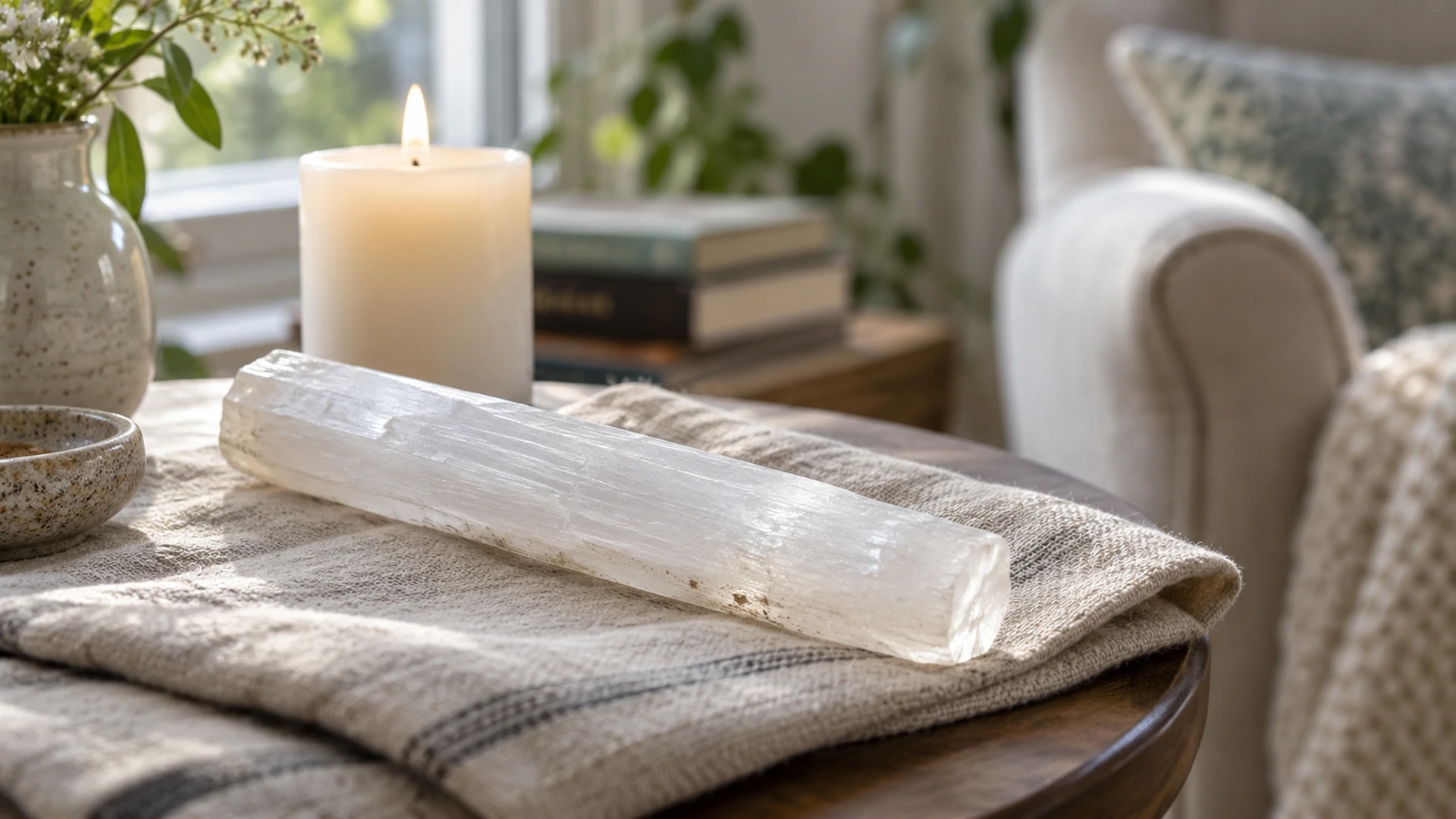
Selenite is a variety of gypsum aligned with the Moon, the crown chakra, and the cleansing category — and it earns that placement through a mechanism no other stone in this category shares: it clears continuously and can clear other stones around it, without ever needing to be cleansed itself.
Named for the Moon: Why Selenite Belongs in Cleansing
The name selenite comes from Selene, the Greek goddess of the Moon, and the stone wears that name accurately. It carries a cool, quiet luminosity — the kind of light that doesn't call attention to itself but is always present. That lunar quality runs through its correspondences: the Moon as its planetary ruler, the crown chakra as its primary energy center, and the water element as its dominant elemental association (though some traditions also place it under air, drawn by its lightness and clarity). Its zodiac affinity is Taurus, which grounds it a little — selenite isn't all ethereal drift, it's also the steady maintenance of a clear field.
What makes selenite genuinely distinct within the cleansing category is its mechanism. Most cleansing stones work by absorbing energy, or by vibrating at a frequency that disrupts stagnant patterns, or by amplifying what's present and resetting it. Selenite does something different: it cleanses continuously, as an ongoing condition of its existence rather than as a directed act. You don't charge it with an intention to cleanse and wait for it to work — it is always working. And crucially, because it doesn't hold onto what it encounters, it never accumulates density. It doesn't need cleansing. That's a rare claim, and it's worth taking seriously: very few stones in any category can make it honestly.
The chemistry is part of the argument here. Selenite is a form of gypsum — calcium sulfate dihydrate — with an unusually open crystalline lattice. That same structural openness that makes it dissolve in water is why it doesn't retain energetic imprints either. It isn't built to hold things. Water moves straight through the structure and degrades it; dense or stagnant energy moves through it in the same way, without lodging. The stone's physical properties and its energetic ones aren't separate facts that happen to coexist — they're expressions of the same underlying character.
The second function — cleansing other stones simply by proximity — is rarer still. Place a stone that's picked up a lot of energetic residue on or near a selenite slab, and that stone will clear passively over time. No ritual required, no moonlight, no sound bath, no intention-setting. The selenite's continuous high vibration does the work. This makes it less of a single-use tool and more of an ongoing infrastructure for your practice, something that's always maintaining the space and the stones within it rather than needing to be consciously deployed.
The One Rule: Keep Selenite Dry
Selenite isn't often faked. It's inexpensive, widely available, and abundant enough that there's essentially no financial incentive to substitute something else for it — so when you're buying, authenticity isn't the concern it is with rarer stones. The real thing to know before you buy, and the one thing that governs every care decision afterward, is this: selenite will dissolve in water.
This isn't a gentle caution about prolonged soaking, the way it is for many softer stones. Selenite is genuinely water-soluble. Regular contact with water will pit the surface, cloud the natural clarity, and eventually begin to physically degrade the structure. This means no water cleansing, no leaving it near a sink, no rinsing after handling, no placing it in a dish that might collect condensation. If it gets wet, dry it immediately and gently with a soft cloth. The practical upshot is that selenite is one of the few stones in any practice where "don't get it wet" is the primary rule — not an afterthought tucked at the end of a care list, but the single most important thing you can know about it.
Beyond keeping it dry, selenite is straightforward to care for. It doesn't need energetic maintenance — that's the whole point. Wipe dust from the surface with a dry or very slightly damp cloth (immediately dried), handle it gently because it's relatively soft at 2 on the Mohs scale and can scratch or chip, and store it away from stones that might physically damage it through contact. It doesn't need sunlight, moonlight, or sound to stay clear. It takes care of itself energetically, and you take care of it physically.
One thing worth knowing when you're shopping: satin spar and desert rose are not different stones from selenite — they're the same mineral in different growth habits. Satin spar is the fibrous, silky variety that comes in wands and towers with a distinctive sheen along the grain; it's often what people mean when they say "selenite wand." Desert rose is a rosette formation, named for its resemblance to a flower, found in arid environments. Both are gypsum, both share selenite's water solubility and care requirements, and both belong in the same energetic category. However, gypsum alabaster — a massive, fine-grained form of gypsum sometimes sold alongside selenite products — is a related but distinct material. It's softer even than selenite, often used for carving, and while it's chemically close, it doesn't carry the same clarity or the same energetic properties. If you see something marketed as "alabaster selenite," look closer: the terms aren't interchangeable.
Three Practices for a Stone That Cleans Itself
The Charging Shelf
Use this when you work with multiple crystals regularly and want them consistently clear without individual cleansing sessions between uses.
Designate a shelf, tray, or flat surface where a selenite slab or plate sits permanently. After you use any stone — whether it's been in a ritual, carried in a pocket, placed on the body during a session, or simply handled a lot — set it on or near the selenite to rest. The selenite's continuous cleansing field will clear the stone passively overnight, or over a few days for stones that have been doing heavy work. Stones like clear quartz — which cleanses by amplifying and resetting to a neutral state — can sit here too, though they serve a different function. The shelf doesn't replace your intentional practice; it maintains the baseline so that when you reach for a stone, it's already ready.
The Entryway Ward
Use this when you want continuous energetic clearing for a space, particularly a high-traffic threshold where outside energy enters most frequently.
Place a selenite piece — a raw chunk, a wand, or a flat slab — at the main entry point of your home: on a shelf beside the door, above the frame if you have the space, or just inside the threshold on the floor. This isn't a one-time setup that needs recharging; selenite's continuous action means it keeps working without activation. Because it's aligned with the water element and the Moon, it's particularly effective at clearing the kind of diffuse, accumulated social energy that builds up in spaces where many people come and go. It won't replace a deliberate protection working if you need one, but as background maintenance, it's one of the quietest and most consistent tools available.
The Crown Rest
Use this when mental clutter, decision fatigue, or a sense of psychic congestion is making it hard to think clearly or access intuition.
Lie down in a comfortable position and place a selenite wand or piece at or just above the crown of your head. Close your eyes and breathe slowly. The crown chakra is selenite's primary point of resonance — this placement isn't symbolic, it's direct. Spend ten to twenty minutes here, letting the stone do the work without directing it toward any specific outcome. You can incorporate this into a Moon hour session to deepen the lunar correspondence, or burn a white candle nearby for clarity and purification. What distinguishes this practice from a general relaxation exercise is the stone's correspondence to the crown chakra specifically — you're working with a point of entry for higher perception, using a stone that's aligned to it by both tradition and elemental logic.
Half a Million Years in Naica's Cave of Crystals
In April 2000, miners drilling deeper into the Naica mine in Chihuahua, Mexico, broke through into a hidden chamber that had been sealed from the world for an unimaginable stretch of time. What they found inside is still one of the most extraordinary geological discoveries of the modern era: a cavern filled with selenite beams measuring up to roughly 12 meters long and weighing tens of tons each. These are among the largest natural crystals ever documented on Earth, and they grew in total silence, without any human witness, for an estimated 500,000 years.
The conditions that made them possible were extreme by any measure. The cave sits above a magma chamber that held the temperature inside at a near-constant 58 degrees Celsius — hot enough that the mineral-rich water filling the chamber stayed in a precise chemical equilibrium for half a millennium, depositing gypsum molecule by molecule onto the growing crystals. When researchers finally entered to study them, they could only survive inside for 30 to 45 minutes at a time, even in specialized cooling suits. The cave is now flooded again to preserve the crystals from the damage that air exposure was beginning to cause.
The Naica cave doesn't change what selenite does in practice. But it's worth sitting with for a moment. The piece of selenite on your shelf grew through the same mineral process as those cathedral-scale beams — the same gypsum lattice, the same water-mediated growth, the same structural openness. The scale is different. The mechanism isn't. When the context of a stone is this specific and this documented, it doesn't need mystical framing. The fact itself carries enough weight.
Cleansing That Never Stops Working
What makes selenite worth understanding carefully is what makes it genuinely unusual: it clears continuously, without input, and brings other stones along with it. That combination — ongoing action, no maintenance required, passive effect on whatever's nearby — is rare enough that it earns a distinct place within the cleansing category across all seven paths of stone magic, not just as one option among equals but as a stone that functions differently from the rest.
If you want to see how selenite sits alongside halite — which cleanses by drawing out and dissolving dense, stagnant energy the way salt draws out moisture — and the other stones across all seven categories, that's the place to go next.