The First Pentacle of Saturn: The Seal That Commands Spirits to Kneel
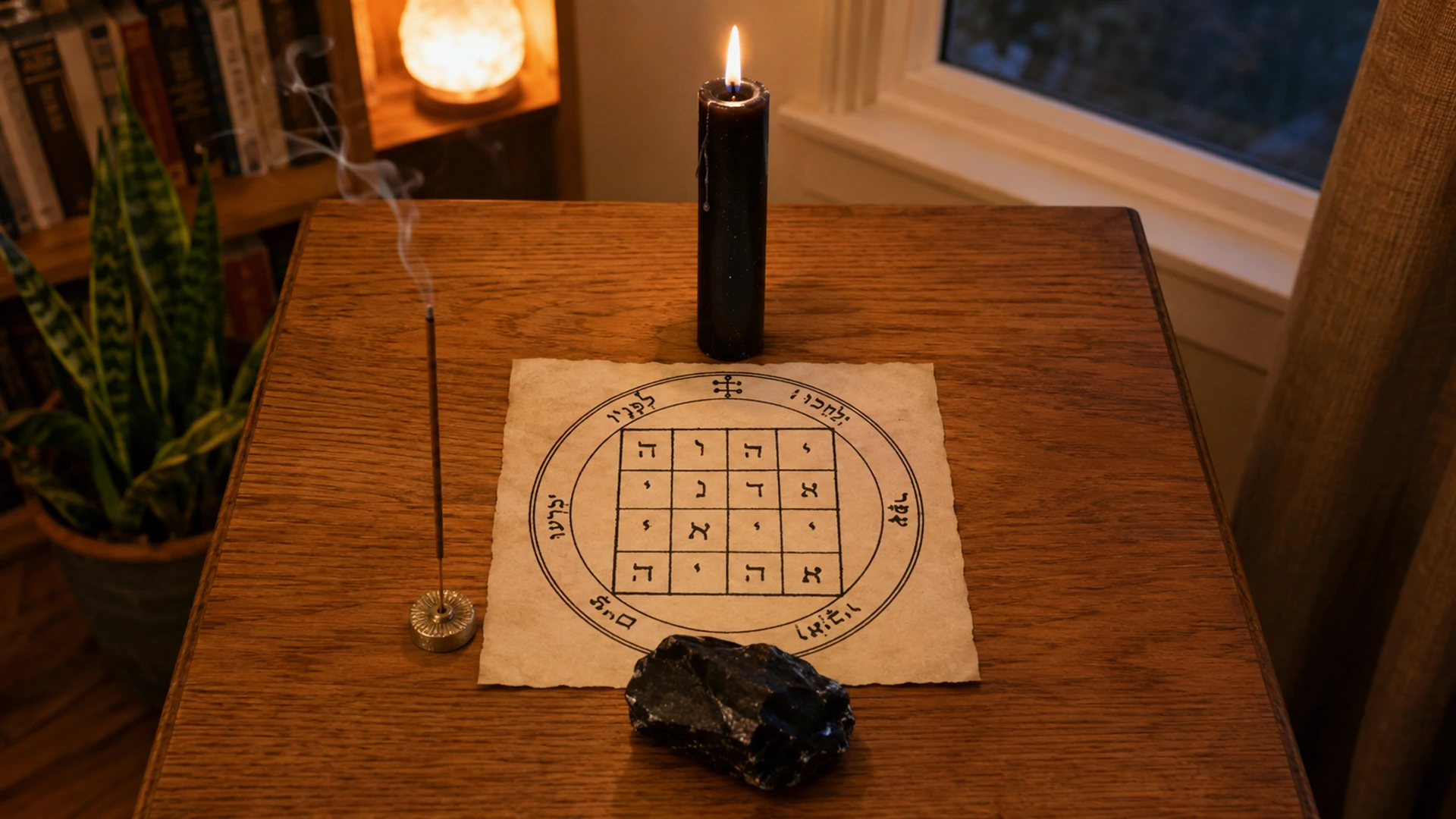
The First Pentacle of Saturn carries one documented office: it strikes terror into spirits, and upon being shown it, they submit, kneel, and obey. That is not a vague promise of spiritual authority — it is a precise, functional claim, and this Pentacle of Solomon has been used with exactly that intention for centuries. Saturn governs discipline, restriction, karmic law, and the hard edges of reality; it is the planet of boundaries enforced and forces brought to heel, which makes this first pentacle a fitting entry point into its current. If you want context on how Saturn fits within the broader Solomonic tradition, that foundation is worth reading first.
This pentacle is not a charm for general Saturnine energy. It is specific — a tool whose single purpose is compelling spiritual forces into submission and obedience. Understanding what that means in practice, how the figure is built, and how to work with it responsibly is exactly what this guide covers.
For a full map of all seven planetary groups and their 44 pentacles, the complete guide to the 44 Pentacles of Solomon has everything you need.
Construction and Symbolism of the First Pentacle of Saturn
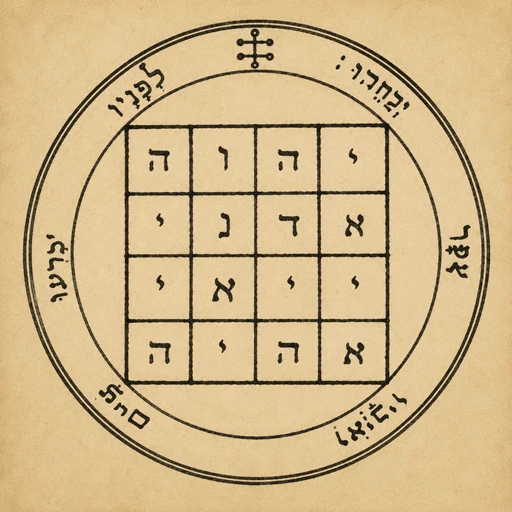
The figure of the First Pentacle of Saturn is built around a square — not a hexagram, not a pentagram, but a four-sided geometric form. That choice is meaningful. In classical Solomonic geometry, the square is associated with the material world, with fixed boundaries, and with the imposition of order onto chaotic forces. A spirit bound within or confronted by a square is being told, through the language of form alone, that it has entered a structured space with defined limits.
Within that square are inscribed four divine names: IHVH (the Tetragrammaton, the four-letter name of God in Hebrew, typically rendered as Yahweh or Jehovah), Adonai (meaning "Lord," used in Jewish practice as a spoken substitute for the Tetragrammaton), Yiai, and Eheieh (translating roughly as "I Am" or "I Am That I Am," the name God gives to Moses at the burning bush in Exodus 3:14). Each of these names carries a distinct register of divine power. IHVH is the totality of divine being. Adonai is divine lordship and sovereignty. Eheieh is divine existence itself — the unmovable ground of all that is. Yiai shares the same Hebrew numerical value — gematria — as the divine name El, grounding it in the same current of elemental divine power. Together, these four names are not decoration. They are the theological architecture of the pentacle's authority.
The pentacle carries a single verse: Psalm 72:9 — "They that dwell in the wilderness shall bow before him; and his enemies shall lick the dust." The choice of this verse is not incidental. Psalm 72 is a royal psalm, addressed to a king and describing the ideal of a monarch before whom all peoples and forces of the earth bow. The specific verse chosen focuses on submission: those in the wilderness (a traditional metaphor in Hebrew literature for liminal, uncontrolled spiritual terrain) bow down; enemies are brought to the lowest possible posture. The verse is not about protection, healing, or prosperity. It is entirely about the compelled reverence of opposing forces. That single focus mirrors the pentacle's office exactly.
There are no named angels on this pentacle — unlike, for example, the Third Pentacle of Saturn, which lists Omeliel, Anachiel, Arauchiah, and Anazachia by name. The First Pentacle works through divine names alone, which in Solomonic logic gives it a different kind of weight. It does not invoke a specific angelic intermediary to carry out its office; it presents the names of God directly, and the submission of spirits follows from that confrontation. The square as container, the four names as authority, and the verse as declaration of outcome: these three layers of the figure work together toward one specific end.
The Spiritual Office of the First Pentacle of Saturn
The office of this pentacle is coercive in the most direct sense: it is designed to compel spirits into submission. Not to banish them (that would be the work of a different tool), not to bind them from acting (that is the Sixth Pentacle of Saturn's territory), but specifically to make them kneel. The distinction matters. You are not sending a force away with this pentacle. You are establishing dominance in its presence.
In the traditional framework, this pentacle functions as a kind of credential — something displayed to spirits during evocation to establish the operator's authority before any other work begins. Think of it less as a weapon and more as a seal of rank. When the text says spirits "submit, kneel, and obey" upon being shown it, the implication is that the pentacle does the heavy lifting of asserting divine authority, so the operator does not have to fight for it. That is a genuinely useful function in complex workings where you need a clear power dynamic established before anything else proceeds.
In modern practice, the same logic applies even if you are not running a full ceremonial evocation. Working with this pentacle in situations where you feel spiritually outmatched — where something in your environment, in a space, or in an ongoing spiritual conflict feels resistant, defiant, or simply unwilling to cooperate — fits its documented office. You are not asking the pentacle to do something it was not built for. You are using the right tool for exactly the problem it was designed to solve.
Saturn's energies are disciplined, karmic, and boundary-enforcing — not impulsive or warmly receptive. Working with this pentacle requires the same quality from you. You need to be clear in your will, steady in your intention, and willing to hold the authority you are claiming. If you approach it hesitantly or experimentally, the working will reflect that. This pentacle rewards conviction.
Saturn Correspondences for This Working
Saturn's planetary day is Saturday — that word literally descends from "Saturn's day" in Old English (Sæternesdæg), making Saturday the straightforward choice for any working under this planet's influence. The element is Earth, which in magical terms means density, permanence, and the kind of power that does not move easily. Saturn is not a fast planet in the sky or in practice; its effects tend to settle deeply and hold.
The colors associated with Saturn are black and dark grey, sometimes shading into deep indigo. Black is the color of the void before form — and also of authority that does not need to announce itself. For this pentacle's office, black is the clear call. Its correspondences in stone carry the same quality: obsidian is the strongest match for this working specifically, because it shares the First Pentacle's character of confrontation and domination rather than simple protection or grounding. Obsidian does not soften what it meets. It reflects, reveals, and overwhelms. Onyx, jet, and hematite are also Saturnine, and worthy additions to any Saturn altar, but obsidian's confrontational edge makes it the right choice at this pentacle's side.
For herbs, mullein is Saturn's most characteristic plant — tall, slow-growing, architecturally severe, and historically used in workings involving spirits and the boundary between the living and the dead. Cypress is another classic Saturn herb, tied in Mediterranean tradition to mourning, permanence, and the gateway into the underworld. Comfrey rounds out the Saturn herb palette, its deep roots and long history of use in binding and consolidating workings making it a natural fit for this planet's energy. Any of these supports the atmosphere of this working well. For incense, myrrh is the traditional Saturnine choice: heavy, resinous, ancient, and used across cultures in contexts of death, prayer, and the invocation of serious powers. Patchouli is the earthier alternative, grounding the working without the funereal weight of myrrh. For the First Pentacle of Saturn, myrrh is worth the preference — it matches the gravity of the office.
Who Should Work With the First Pentacle of Saturn
This pentacle is for practitioners dealing with a specific kind of problem: spiritual forces that are not cooperating. That might be a presence in a space that feels resistant to cleansing, a spirit attachment that does not respond to banishment work, or an entity in a working that is not complying with the operator's direction. The First Pentacle of Saturn was built for exactly these situations — not as a general ward or an ambient protective charm, but as an assertion of authority in the moment it is needed.
If you are looking for protection from spiritual attack, this is not the most direct fit. The Fifth Pentacle of Saturn, which explicitly defends nighttime invokers and chases away spirits guarding treasures, is closer to a protective function. If you are dealing with adversity that is more circumstantial than spiritual — opposition from people, difficult life conditions, a situation that feels stacked against you — the Second Pentacle of Saturn is a better match, since its office is specifically about repressing adversarial forces and managing adversity broadly. The First Pentacle's office is narrower: it addresses defiant spiritual forces directly.
It is also worth being honest about what kind of readiness this working requires. Because the pentacle's office is coercive, working with it without clarity of will tends to produce little. The energy it calls on is Saturnine — slow, heavy, and karmic in nature. It is not responsive to vague intentions or half-formed goals. You need to know exactly what you are asserting authority over and why, and you need to hold that clarity through the entire working. A practitioner who is still questioning whether they "should" be doing this working will not get the same result as one who has made a clear-eyed decision and is ready to back it with focused will.
Beginners who are drawn to this pentacle out of general curiosity about Solomonic magic would do better to start with its construction and study rather than immediate ritual use. Sit with the figure. Write out the divine names. Read Psalm 72:9 slowly and let the imagery land. Understanding what authority feels like in the body is a prerequisite for projecting it effectively in a working.
A Modern Ritual for the First Pentacle of Saturn
This ritual is built specifically around the First Pentacle of Saturn's office of compelling spiritual submission and asserting authority over resistant forces. Every element traces back to that purpose.
Timing
Saturday, during a Saturn planetary hour. Use the planetary hour almanac to find the first Saturn hour after sunset on a Saturday — nightfall on Saturn's own day is the heaviest concentration of this planet's current, and it suits the gravity of this pentacle's work.
Materials
- Black candle — black is Saturn's color and the color of this pentacle's office; it signals authority, finality, and the kind of power that does not negotiate.
- Obsidian — placed directly beside the pentacle to amplify its confrontational current; obsidian shares the pentacle's quality of forcing what it meets to yield.
- Myrrh incense — burned throughout to establish the heavy, ancient atmosphere this working requires; myrrh has been used across traditions to signal that serious spiritual business is being conducted.
- The First Pentacle of Saturn — drawn by hand on paper or parchment in black ink, or printed clearly; the figure must be legible and complete, with all four divine names (IHVH, Adonai, Yiai, Eheieh) correctly inscribed within the square.
Setup
Clear your working space completely. This ritual benefits from a stripped-down altar — nothing on the surface except what is listed above. Light the myrrh incense first and let the smoke move through the space for several minutes before you do anything else. You are not decorating an altar; you are establishing the conditions under which authority operates.
Place the pentacle flat at the center of your space. Set the black candle behind it, the obsidian in front of it. The arrangement should feel deliberate, not decorative. Light the candle.
The Working
Sit or stand before the pentacle. Take three slow, full breaths — not to relax, but to arrive fully in your body and in your intention. When you feel settled, read Psalm 72:9 aloud once, clearly and without rushing: "They that dwell in the wilderness shall bow before him; and his enemies shall lick the dust."
Then name the four divine names on the figure, one at a time: IHVH. Adonai. Yiai. Eheieh. Say each one as a statement of fact, not a request.
Now speak your intention aloud. This should be specific to your situation — but the structure should name what you are asserting authority over and what you are requiring of it. For example:
"By the authority of the First Pentacle of Saturn, and by these names — IHVH, Adonai, Yiai, Eheieh — I command all resistant spiritual forces in this [space / working / situation] to submit and cease their opposition. They bow. They yield. They obey."
Hold the pentacle in both hands after speaking this. Let your will settle into it. Stay with it for as long as feels complete — this is not a moment to rush. You are not waiting for a sign; you are holding the authority you have claimed.
Closing
When you feel the working is complete, set the pentacle back down. Thank the divine names aloud — one by one, in the same order you called them. Snuff the candle rather than blowing it out. Let the incense finish burning on its own. The obsidian can be left on your altar as long as the working's effects need to hold, then cleansed under running water.
How to Work With the First Pentacle of Saturn Today
The Key of Solomon calls for this pentacle to be engraved on lead — Saturn's own metal — during the correct planetary day and hour, with the full preparatory rites observed. Those requirements reflect a tradition in which the physical object was understood to be the activated talisman — the engraved lead itself was the seat of the pentacle's power.
Modern practice has largely moved away from that framing without abandoning the pentacles themselves. The prevailing approach treats the figure as a focus for intention — a geometric and symbolic form that sharpens your will toward a specific purpose. In this view, what you draw by hand on paper, with full attention and clear intention, can carry the same functional weight as an engraved metal piece, because the operative force is your focused will, not the substrate. This is the approach most eclectic and contemporary practitioners take, and it is the approach the ritual above is built on.
What is genuinely worth preserving, regardless of material choice, is the planetary timing. Saturn's hours on Saturday carry a quality of density and authority that genuinely supports this pentacle's work — not because the planet causes anything to happen mechanically, but because aligning your working with that timing focuses your awareness on Saturnine qualities at the moment you need them most. If you want to understand how planetary hours function in practice, that guide covers the full system.
Because this pentacle's office is coercive — it compels rather than invites — it sits in a category of magic that some practitioners approach with extra care. That care is reasonable. The First Pentacle of Saturn is not a soft tool. Working with it without clear purpose, stable grounding, or genuine need for its specific office tends to produce either nothing or results that feel heavier than expected. This is not a pentacle to reach for out of curiosity or ambient spiritual restlessness. It rewards practitioners who know exactly what they need, have run out of gentler options, and are ready to hold the authority they are claiming from start to finish.
Used with that kind of clarity, the First Pentacle of Saturn is one of the most direct tools in the Solomonic arsenal. Not the most dramatic — it does not cause earthquakes like the Seventh Pentacle of Saturn, or obsess enemies like the Fourth. But for the specific problem of a spiritual force that is not cooperating, nothing in Saturn's seven pentacles answers more precisely.