Borage: The Blue Starflower of Courage
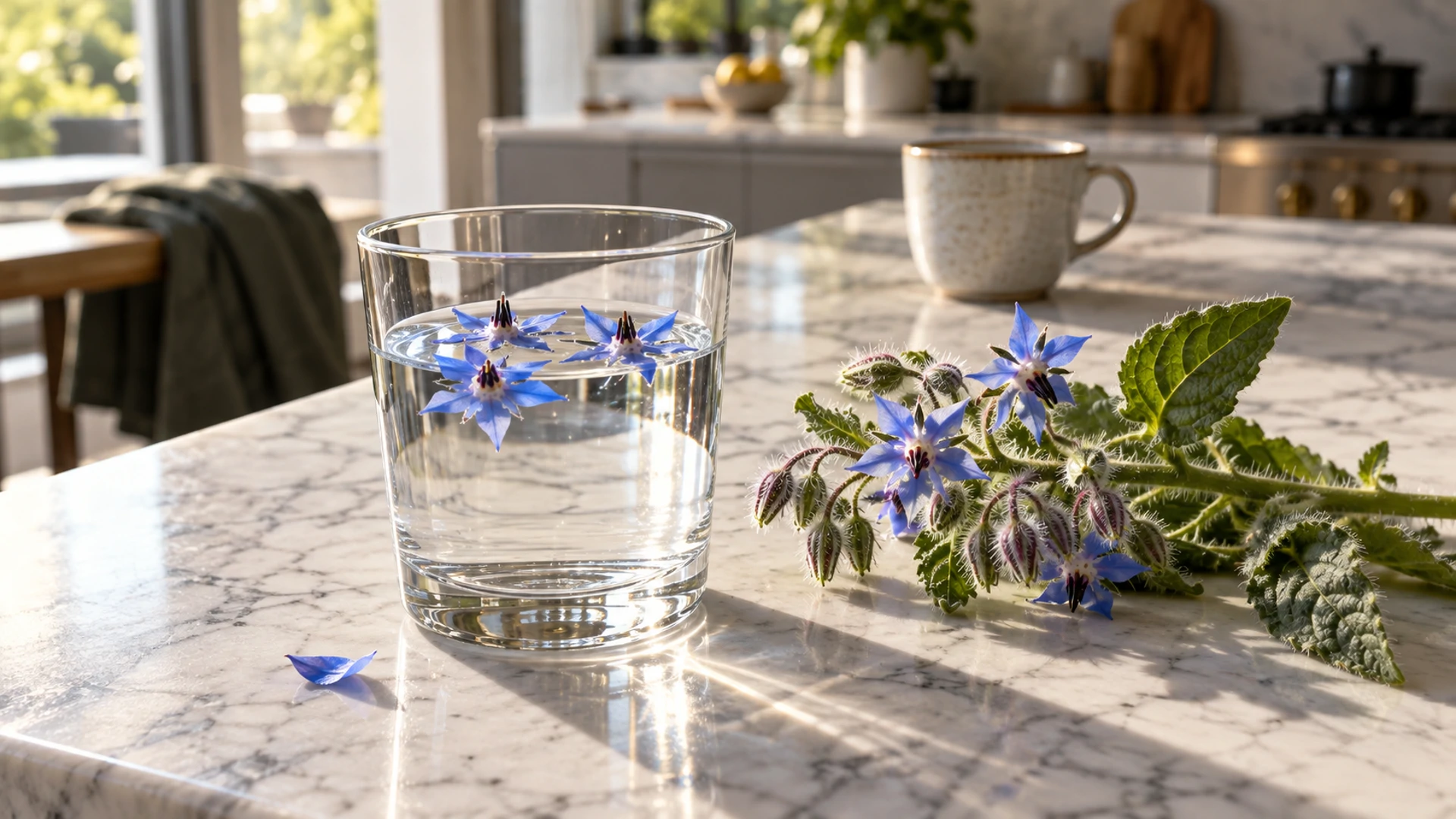
Borage (Borago officinalis) is a bristly herb with vivid blue, star-shaped flowers used in magic to lift heaviness and restore courage — floated in drinks, laid on the altar, and carried in sachets before situations that require nerve.
Courage: Borage's Place in Healing
Within the Healing & Peace category of herbal magic, different plants address different facets of wellbeing. Some herbs quiet. Some mend. Some gladden. Borage does one thing with particular clarity: it gives back courage. Its angle is not comfort or rest — it is nerve. The heaviness it addresses is the specific kind that comes before a hard conversation, a daunting beginning, or a moment that asks more of you than you feel you currently have. If you are looking for an herb to accompany exactly that kind of day, borage is the one.
Comparing it to its Healing & Peace neighbors sharpens the picture. Lemon balm gladdens — it lifts low spirits and brings back lightness. Borage and lemon balm are the gladdening pair of the category, but there is a real distinction between them: lemon balm brings back lightness, while borage gives back nerve. Comfrey, borage's relative in the borage family, mends — it knits together what has broken, with safe travel as its second face. Borage has no secondary category, and its entire lore — from ancient Latin tags to Gerard's Herball to the flowers floated in drinks — points at the same single thing: courage restored.
Correspondences place borage under Jupiter, specifically Jupiter in Leo according to Culpeper. Cunningham assigns it the element of air and the day Thursday. Jupiter governs expansion, confidence, and the kind of warmth that radiates outward into a room — which fits a plant whose magic is about restoring the nerve to act rather than pulling inward to recover. Air is the element of thought, communication, and forward motion. Thursday is Jupiter's day and the natural anchor for any working with this herb.
I, Borage, Bring Always Courage
An old Latin tag has followed this plant through centuries of herbal writing: Ego borago gaudia semper ago, meaning "I, borage, always bring joy." The line passed into English in a slightly altered form — "I, borage, bring always courage" — and Gerard's Herball of 1597 repeats borage's reputation for driving away sorrow, giving the tag a formal home in the printed herbal tradition. Whether the English rendering is a deliberate shift in emphasis or a loose translation that settled into something more martial is not entirely clear, but the result is a herb whose English-language identity is built around a single, memorable claim about what it does for the person who uses it.
The story that borage flowers were floated in stirrup cups for knights departing on Crusade is one of borage's most repeated pieces of lore — and one of the most thinly sourced. It has the feeling of genuine antiquity and makes symbolic sense given the plant's courage associations, but the documented evidence for it as an actual historical practice is thin. What is well documented is much simpler: the flowers garnish summer drinks. They are still floated in cups and pitchers today, which means the stirrup-cup story, whatever its historical truth, has a living descendant in something anyone can do on an ordinary afternoon. The herb's folk names reflect its appearance and its relationship to bees. Starflower describes the five-pointed blue bloom. Bee bread captures how reliably the flowers attract pollinators — borage is easy to grow in a kitchen garden and a favorite of bees
Flowers for the Cup, Leaves Left on the Plant
The flowers are the main working part of borage in magic — they are the element floated in drinks, placed on altars, and dried for sachets — but the plant also offers leaves and a seed oil sold as starflower oil. The leaves contain pyrrolizidine alkaloids that damage the liver, so they are not taken regularly or in pregnancy; the flowers as an occasional garnish are traditional and carry a long history of that use.
Three Borage Workings for Courage
A Starflower Cup Before a Hard Day
This is the working to reach for on the morning before a day that is going to ask something significant of you — a difficult meeting, a performance, a confrontation, a beginning.
Float two or three fresh borage flowers in a glass of water or a summer drink. Hold the glass in both hands and say the old English tag aloud: I, borage, bring always courage. Sit with the drink for a moment before you begin the day. The act of speaking the line is not decorative — it names what you are doing and what you are calling forward. Drink slowly and with intention rather than while doing something else. The borage flowers can be eaten or set aside. What carries the working is the combination of the named intention, the plant's long association with courage, and the deliberate pause before a day that requires nerve.
Fresh Flowers on the Altar
This working is for a stretch of time rather than a single morning — a period that is asking sustained courage from you, day after day.
Cut a small cluster of fresh borage flowers and lay them on your altar or in a dedicated space where you will see them regularly. Set them in a small dish of water to extend their life, but replace them as they fade — wilted flowers are not a failing; they are a signal to refresh the working and reconnect with the intention. Each time you replace them, take a moment to state, silently or aloud, what you are calling on courage for. The ongoing tending of the flowers keeps the intention active rather than setting it once and forgetting it. Borage's vivid blue is part of what makes this working effective as an altar piece: the color is hard to ignore, which means it functions as a daily reminder that you chose this, that you are doing this, and that the nerve is already in you.
A Courage Sachet
Carry this into any situation where the need is specific and immediate — the kind of moment where you want something small and solid in a pocket or bag.
On a Thursday or during a Jupiter hour, place a small amount of dried borage flowers in a blue cloth sachet. Hold it in your hands and name what you need courage for, plainly and specifically. Close the sachet and carry it with you. Blue is the natural color choice here — it aligns with Jupiter and matches the flower's own hue, so the sachet stays coherent with the herb's correspondences without requiring anything elaborate.
Nerve Given Back
Borage occupies a specific corner of the Healing & Peace category — not the quieting corner, not the mending corner, but the corner that deals with what it takes to keep going when going forward feels hard. That specificity is what makes it a reliable herb to reach for. You know exactly what you are asking when you work with it, and the lore behind it, from Culpeper's Jupiter placement to the old Latin tag, has been pointing at the same thing for a very long time.
If you want to see where borage sits alongside the other herbs of its category — and alongside the other six paths through plant magic — the Witch's Herbarium is the place to go. It maps the full picture and gives you the context to build a practice that draws on more than one plant's particular strength.