Peppermint Tea Ceremony for Career: Mercury's Clarity, Aimed at Your Own Mind
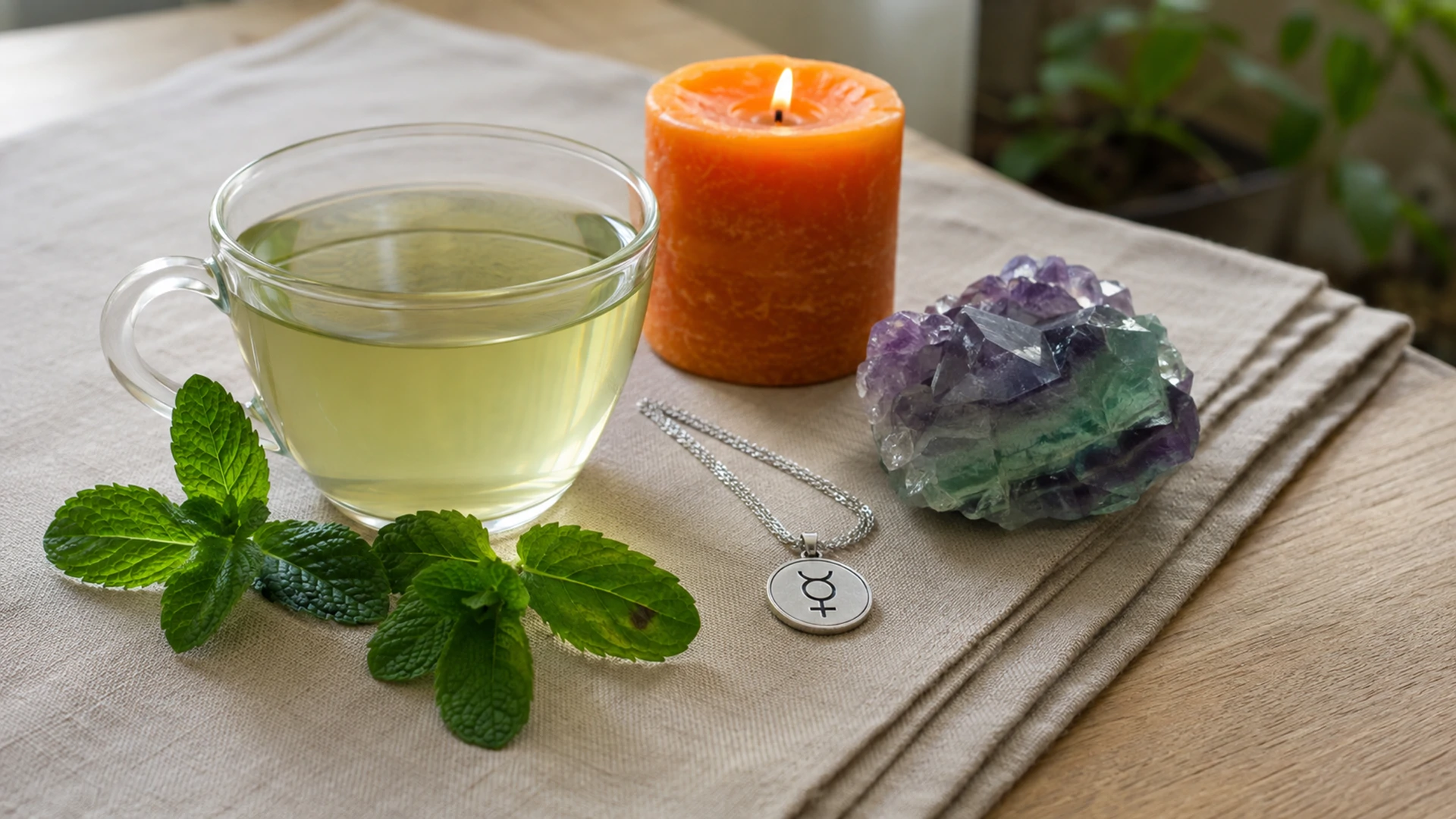
If you've been looking for a magical tea ceremony for career growth, peppermint is one of the most precisely suited herbs you could work with. This isn't a case of "mint feels fresh and fresh feels like success" — peppermint carries specific planetary and elemental correspondences that map directly onto the mental and communicative demands of professional ambition. This guide walks you through the full ceremony: why this herb, what to prepare, how to brew with intention, and how to close the ritual in a way that actually seals your working. Whether you're navigating a job search, pushing for a promotion, or trying to cut through a professional fog, this practice gives you something real to come back to.
Why Peppermint Is Suited to a Career Tea Ceremony
Peppermint (Mentha × piperita) is ruled by Mercury — the planet of communication, intellect, commerce, and swift movement. In traditional Western magical herbalism, mint's Mercury correspondence has long made it a go-to plant for workings that require sharpness of mind, persuasive speech, and the kind of quick thinking that professional environments demand. Mercury governs contracts, negotiations, networking, and career advancement in its most direct practical forms. Working with a Mercury-ruled herb in a career context isn't symbolic decoration — it's targeting the exact planetary energy that governs the domain you want to influence.
Elementally, peppermint carries Air energy. Air corresponds to the mind — ideas, strategy, communication, and mental agility. These are precisely the qualities that separate people who get ahead in their careers from those who stall. When you work with peppermint intentionally, you're calling on a plant that embodies the mental clarity and expressive power needed to navigate professional life: to speak confidently in meetings, to think quickly under pressure, to articulate your value in a way others actually hear.
There's also a strong sensory argument for peppermint's career correspondence that goes beyond planetary theory. The menthol in peppermint actively stimulates alertness — it's been used for centuries to sharpen focus and cut through fatigue. Historically, mint was strewn on the floors of places of business and trade, burned or crushed to revive tired minds, and used in folk traditions to attract prosperity and clear mental obstacles. The plant doesn't just represent clarity; it physically produces it. That's a meaningful alignment when you're using an herb as the anchor of an intentional practice.
Drinking peppermint as a tea is a fundamentally different act than burning it, carrying it in a sachet, or using it as an anointing oil. When you consume an herb, you internalize the working. You're not placing the energy outside yourself and asking it to act on your environment — you're taking it in, making it part of your body and breath for the duration of the ceremony. For career magic, this matters. Your career lives inside your choices, your communication, your confidence, your mental sharpness. Ingesting a Mercury-ruled, Air-element herb means you're directing that energy to the exact seat of where career magic needs to operate: your own mind.
Preparing for Your Peppermint Tea Ceremony
Space
Before you brew a single cup, set your space deliberately. This doesn't mean an elaborate altar setup — it means clearing the physical and mental clutter from wherever you'll be sitting. Wash your hands, clear the surface in front of you, and remove anything unrelated to the working. The space should feel uncluttered and purposeful. A tidy, focused environment is itself a form of signal to your mind: this time is different from the distracted hour you just spent scrolling or working. Treat it as a dedicated container.
Timing
Timing strengthens the working. For career magic, the most favorable timing aligns with Mercury's day — Wednesday — and ideally during a waxing moon, when magical workings oriented toward growth, increase, and building are most supported. You can find Mercury's hour for your location and date using our Mercury's hour finder to time your ceremony with even more precision. If you want to work with the moon's phase more precisely, the first quarter through the full moon is your window. Morning is the ideal time of day: your mind is fresh, Mercury's associative energies align with the start of action, and drinking a cup of peppermint tea in the morning before a workday or an important professional moment creates a clean ritual frame with a clear real-world context ahead of it.
Auxiliary Tools
Two auxiliary tools are worth including, and both should be physically present at your ceremony space:
- An orange candle: Orange candle magic sits at the intersection of Mercury's intellectual sharpness and the Sun's outward confidence — it's the candle color that best supports the specific ambition peppermint is building toward: being seen, being heard, and moving visibly forward in your career. Where yellow reflects Mercury's pure mental energy, orange adds drive and momentum to it, which is exactly what you want when the goal isn't just clarity but action on that clarity. Light it before you begin and let it burn through the ceremony.
- Fluorite: Fluorite is one of the most directly Mercury-aligned stones in practical crystal work. It organizes scattered thinking into coherent, directed thought — which is exactly what this ceremony is asking of you. Where other stones might amplify energy broadly, fluorite narrows it. It clears the mental static that makes professional communication feel muddled or hesitant, and it supports the kind of precise, structured thinking that gets ideas across convincingly. Place it next to your cup during the ceremony. Its work here is sharpening, not softening.
Safety Note
One practical note: peppermint tea is generally safe for most adults, but it can interact with certain medications, particularly those affecting stomach acid or liver enzymes. If you're pregnant, nursing, or taking regular medications, check with your doctor or herbalist before consuming peppermint regularly. This isn't meant to alarm — peppermint tea is widely consumed without issue — but a quick check is worth it if any of those apply to you.
Brewing Peppermint With Intention
The brewing itself is not a prelude to the ceremony. It is the ceremony. From the moment you begin heating your water, you are in the working. Treat every step as intentional, not automatic. Put your phone down. You're not multitasking here.
Heating the Water
Begin by boiling fresh water and then allowing it to cool very slightly — you want it just off the boil, around 90–95°C (195–200°F). Peppermint doesn't need a lower temperature the way delicate green teas do, but a brief moment of rest after boiling lets the steam settle and gives you a natural pause point for the first part of the ritual. While the water heats, hold your hands near the kettle or pot without touching it and take a slow breath in through your nose. Let the steam touch your face when it begins to rise. This is not incidental — you are starting the process of engaging your senses, and the warmth of rising water is a liminal moment between ordinary life and intentional practice.
Measuring and Setting Intention
Use one heaped teaspoon of dried peppermint leaf (or one and a half if you're working with a larger mug, around 350ml or more) per cup. If you're using a tea strainer or infuser, place the herb inside and set it in your cup. If you're using loose leaf and straining after, place the herb directly in the cup or teapot. As you measure the herb, hold the specific career intention you're working with clearly in your mind. Not a vague wish for things to go better — a specific image or statement. Maybe it's: I communicate my ideas clearly and my work is recognized. Or: I find and secure a role that aligns with my strengths. Name it precisely, even silently. The specificity is the power.
Pouring and Steeping
Pour the hot water over the herb slowly and deliberately. Watch it cover the leaves. As the peppermint steeps, the water changes — it takes on color, aroma, and the plant's properties. This is the magical moment that mirrors your intention: something is entering the water, and that same thing is about to enter you. The steep time for peppermint is 5 to 7 minutes. Five minutes gives you a bright, light brew; seven minutes gives you something stronger and more menthol-forward. For a career working, a full 7-minute steep is appropriate — you want a full, assertive cup, not a timid one.
During those minutes, sit with your candle lit and your crystal within view. Keep your attention on the cup. You can speak your intention aloud or hold it silently — both work, and the choice depends on your practice style. If you speak, keep it simple and present-tense: My mind is sharp. My path is clear. My work opens doors. If you stay silent, visualize — a specific scene in your professional life where you are performing at your best, being recognized, moving forward. Let that image develop in detail: what you're wearing, where you are, the expression on your face. You are programming the intention into this cup of tea, and that programming comes entirely from the clarity of your own directed will.
Drinking and Closing the Ceremony
When the steep is complete, remove the herb or lift the infuser. Don't rush to drink. Hold the cup with both hands for a moment and feel the warmth. Breathe in the menthol scent before the first sip — that sharp, bright aroma is a sensory anchor, and it's doing real work. Your nervous system registers the scent before you take a single sip, and in that registration, the boundary between preparation and reception blurs in a way that serves the working.
Drink slowly, with the same focus you brought to the steep. Every sip carries the menthol sharpness you've been building toward — let it register fully before the next one. This isn't the cup you drink on autopilot. Each sip is a deliberate act of receiving, taking the Mercury-charged, intention-loaded brew into yourself. You don't need to maintain an intense meditative trance, but stay present. Notice the taste, the warmth traveling down, the cooling effect of the menthol. Between sips, return to your intention. Let the image of professional success or clarity remain in your peripheral awareness. You're allowing yourself to become the vessel for it, rather than forcing the magic to happen.
When the cup is empty, sit for a moment before you move. Take three slow breaths. On each exhale, imagine the intention settling into your body — not floating in the cup anymore, not hovering in the air, but rooted in you. This brief grounding moment is important: it closes the loop between the working and your embodied self. The intention is no longer external. It lives in you now.
To close the ritual, extinguish your candle intentionally — not by blowing it out carelessly, but by snuffing it or simply acknowledging its work as complete. If you plan to repeat this ceremony (and you should), you can re-light the same candle each time you return to it, building a cumulative energetic charge over multiple sessions. Take your spent herb — the wet peppermint leaves remaining in the strainer or cup — and compost them or return them to the earth outdoors if possible. Releasing the physical remains of the working back to the earth is a way of honoring the plant's role and completing the energetic circuit. Don't flush them or throw them in the trash if you can avoid it.
Journaling immediately after the ceremony is strongly encouraged, especially in the first few sessions. Write down what you visualized, what you said, and what you felt. Note the date, moon phase, and any particular career focus you were holding. Over time, this record becomes a map of your practice — and it lets you track what's shifting in your professional life after each working. Patterns emerge. You'll start to see the ceremony's effects in your own handwriting.
Peppermint's Mercury Energy and the Career Path You're Building
Here's what you've actually done in this ceremony: you've worked with a Mercury-ruled, Air-element herb — one historically used to sharpen the mind and support commerce — in its most embodied form. You didn't just carry peppermint. You took it inside you. You aimed it specifically at the seat of your professional power: your thinking, your communication, your clarity, your confidence. That's not a vague energy alignment. That's targeted, specific, well-reasoned magical practice.
The reasoning matters because it's what makes this repeatable with genuine intention rather than rote habit. Every time you come back to this ceremony — on a Wednesday morning before an important meeting, during a job search, or when you feel professionally stuck — you're not just going through motions. You're re-engaging the same planetary energy, the same elemental channel, the same embodied practice that has a clear and logical reason for working. Mercury sharpens the mind. Air moves through obstacles. Peppermint carries both. You direct the will. That's the whole architecture.
This ceremony is yours to return to whenever your career needs a focused, intentional push. You can adapt the specific intention each time — clarity for a difficult conversation, confidence before a presentation, momentum when you feel stalled — while the structure stays the same. Keep your notes. Build the practice over time. A single ceremony is powerful; a consistent practice is transformative.
If you want to explore how other herbs work within a career-focused tea ceremony, it's worth knowing that peppermint isn't the only plant suited to this goal — it's just one of the most direct. Bay laurel's career tea ceremony works through a different energetic channel — solar energy, victory, and the kind of authority that earns recognition — while the cardamom career tea ceremony brings Venus and Mercury into the equation, making it especially powerful when your professional goals involve persuasion, magnetism, or eloquent communication. Each herb targets a different dimension of career magic; knowing which one to reach for depends on what your situation actually calls for.
If you want to explore how peppermint fits into a broader world of magical tea work, or discover which herbs suit other intentions in your life, the Spiritual Tea Ceremonies: A Complete Guide by Intent is your next stop. It maps the full landscape of intentional tea practice across every major magical goal — a resource worth bookmarking for ongoing use.