Calendula Tea Ceremony for Healing: Burning Through What Blocks Wholeness
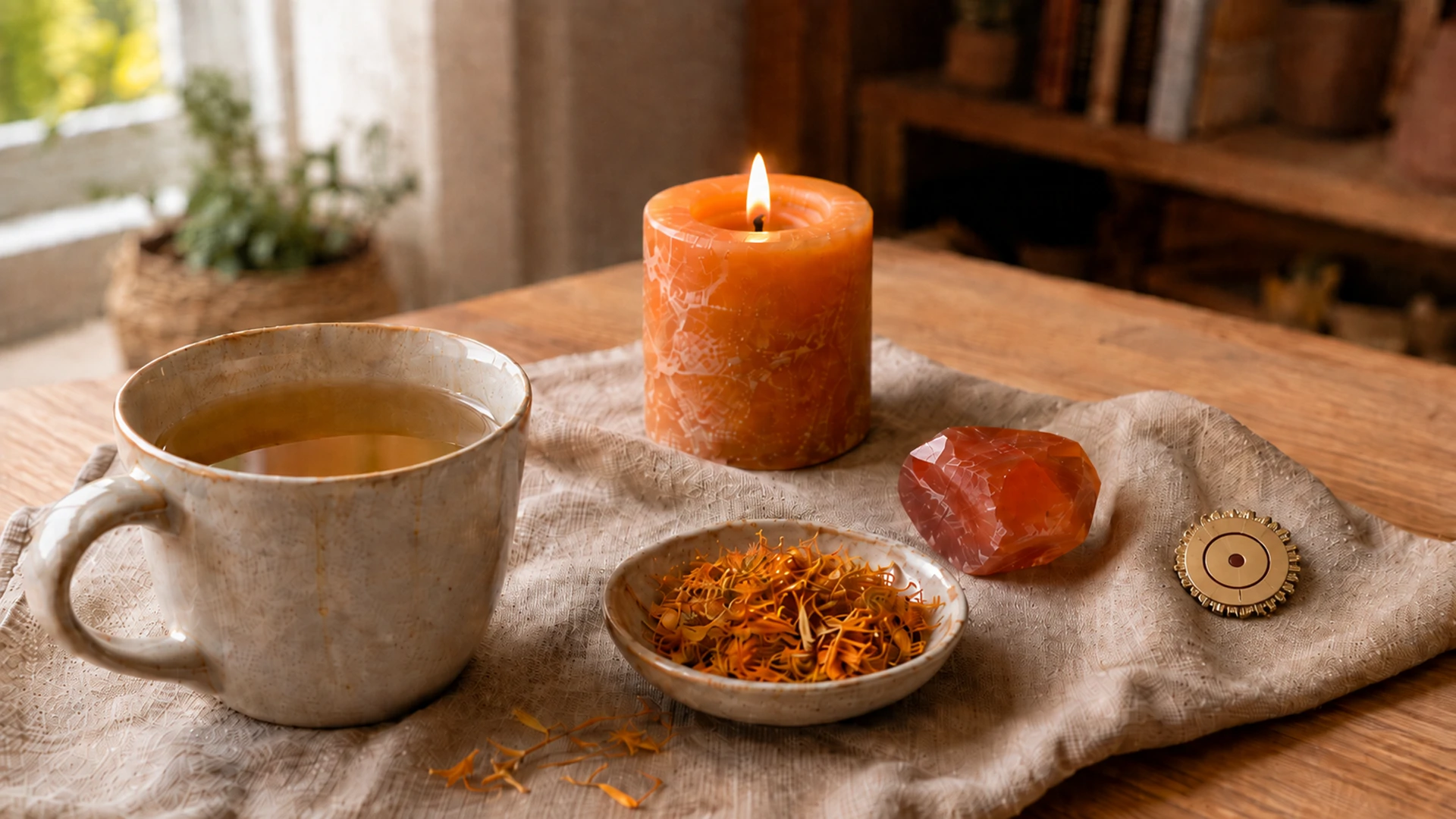
There are a lot of herbs associated with healing, but Calendula earns that correspondence through more than tradition — it earns it through planetary logic, sensory resonance, and a documented history of physical and spiritual restoration that spans cultures and centuries. A spiritual tea ceremony for healing with Calendula isn't just a comforting cup. It's a deliberate ritual act that brings your will, your body, and the herb's own nature into alignment around a single intent. This guide walks you through the whole process: why Calendula specifically, how to prepare your space and tools, how to brew with full ceremonial awareness, and how to close in a way that seals the work and grounds you back into your body.
Why Calendula Is Suited to a Healing Tea Ceremony
Calendula's healing correspondence is rooted first and foremost in its planetary rulership: the Sun. In traditional Western herbalism and planetary magic, solar herbs carry qualities of vitality, warmth, life force, and restoration. The Sun governs the heart, the vital spirit, and the body's capacity to renew itself. When you work with a solar herb like Calendula for healing, you're drawing on that regenerative, radiant quality — the same energy that drives growth after dormancy and light after darkness. This isn't metaphor for its own sake. It's a direct logic that connects the herb's correspondence to the intent.
The historical and folk record backs this up. Calendula — Calendula officinalis — has been used medicinally across European, Mediterranean, and Ayurvedic traditions for centuries. It was applied to wounds, skin inflammations, and fevers. Medieval herbalists considered it a plant of the sun partly because of its vivid orange and gold petals, which visually and symbolically mirror solar energy, and partly because of its genuine anti-inflammatory and vulnerary (wound-healing) properties. For a deeper look at Calendula's full magical correspondences, the complete herb profile covers its elemental, planetary, and ritual associations in detail. What matters for this ceremony is that the healing intent isn't imposed onto the herb — it's already intrinsic to it.
The element associated with Calendula is Fire — which might seem counterintuitive for healing until you consider what fire actually does in a magical context. Fire purifies. It burns away what is stagnant, diseased, or obstructing. Fire-attributed herbs bring that same active, transformative quality to the body and spirit. Healing in this framework isn't passive recovery — it's an active reclamation of vitality. Calendula's fire element means your working isn't asking the body to simply rest. It's asking it to burn through what is blocking wholeness.
Drinking Calendula as a tea is a meaningfully different kind of working than burning it as incense, carrying it in a sachet, or adding it to a ritual bath. When you ingest the herb, you are physically incorporating its nature into your body. There is no symbolic distance between you and the correspondence. The solar, fire-element qualities of Calendula enter you as a physical substance. In magical terms, this is an act of internal alignment — you are literally bringing the healing intent inside yourself, making it part of your body's chemistry and your will's direction simultaneously. This is why the tea ceremony format, for a healing intent, is so particularly well-suited to Calendula.
Preparing for Your Calendula Tea Ceremony
Space
Before you brew a single drop, preparation is doing real ritual work. The space you create before the ceremony is the container that holds the intention. Choose somewhere quiet where you won't be interrupted for at least twenty to thirty minutes. Clear the surface you'll be working on — physical clutter interrupts energetic clarity. If you want to cleanse the space, a simple breath of air from an open window, or a few moments of deliberate stillness, is enough. You don't need elaborate purification rites unless that's part of your existing practice.
Timing
Timing matters. For healing work, the waxing moon is ideal — specifically the period between the new moon and the full moon, when lunar energy supports growth, restoration, and increase. If you're working on something that needs to be released or diminished (a chronic condition, emotional pain, a pattern of illness), the waning moon is the better fit, since its energy supports decrease and removal. For time of day, Sunday mornings honor Calendula's solar rulership — Sunday is the Sun's day, and morning aligns with the Sun's rising, which carries associations of new beginnings and vitality. You can find the Sun's hour for your location and date using our Sun's hour finder to time your ceremony with even more precision.
Auxiliary Tools
Two supporting tools that genuinely reinforce this working:
- An orange candle: Orange candle magic sits at the meeting point of solar fire and physical vitality — it carries the warmth and forward momentum of the Sun without drifting into the broader ambitions of gold or the mental clarity of yellow. For a Calendula ceremony specifically, an orange candle mirrors the color of the petals themselves, creating a visual resonance between flame and herb that keeps your attention anchored in the body and the physical work of restoration. Place it lit near your brewing space so the flame is in your peripheral vision as you steep and drink.
- Carnelian: Carnelian is a fire-element stone with a long history in vitality workings — its deep orange-red color has made it a stone of physical life force across Egyptian, Roman, and folk traditions alike. Where a general-purpose healing crystal might work diffusely, carnelian focuses specifically on restoring physical energy and rebuilding after depletion, which maps directly onto what Calendula is doing in the body at the same time. Hold it while you set your intention before brewing, then place it beside your cup so its warmth stays present throughout the ceremony.
Safety Note
A brief note on safety: Calendula is generally considered gentle and well-tolerated, but it belongs to the Asteraceae family, which means people with ragweed or daisy allergies should be cautious. It may also interact with sedative medications. If you are pregnant, nursing, managing a chronic health condition, or on regular medication, check with your doctor or a qualified herbalist before consuming Calendula tea. This ceremony supports spiritual practice — it isn't a substitute for medical care.
Brewing Calendula With Intention
Handling the Petals
The brewing itself is the heart of this ritual, and it doesn't begin when the water boils — it begins the moment you handle the herb. Start with about one tablespoon of dried Calendula petals per cup of water. If you have a ritual space set up already, bring the petals to the space before you do anything else. Hold them in your palms for a moment. Feel their texture. Notice the dry, papery quality of the petals and the faint, slightly resinous scent. This is your first point of contact with the correspondence. Let yourself be present to it.
Heating the Water
Begin heating your water. Calendula is a gentle herb and doesn't need boiling water — you're aiming for about 90°C to 95°C (194°F to 203°F), or just before a full rolling boil. As the water heats, this is a natural pause to set your intention clearly. Don't rush it. Stand or sit near the heat source. Place a hand over your heart, or hold your crystal if you're using one. In your own words — spoken aloud, whispered, or held firmly in your mind — name what healing means for you right now. Be specific. Not just "I want to be healed" but what the healing looks like: clarity returning, pain releasing, strength rebuilding, a wound closing over.
Pouring and Steeping
When the water is ready, pour it over the petals. Use a cup or vessel that feels intentional — something you like the weight and look of. Teapots work well if you want to cover the brew; a simple mug with a small plate over the top will do the same job. Steep for ten to fifteen minutes. This is longer than most herbal teas, and the longer steep isn't just practical — it's ceremonial time. Use it. Sit near the steeping cup. Watch the water shift color, turning golden as the petals release their pigment and properties. That golden color is solar. It is the visual expression of the correspondence you are working with.
While the tea steeps, you might speak quietly to it — your intent, your need, your willingness to receive the healing you're calling in. Some practitioners repeat a simple phrase, almost like a chant, that anchors the working: something as direct as "As this herb opens, I open to healing," or whatever language feels honest and clear to you. The words themselves are not magic. Your focused will behind them is. The repetition creates a mental groove that keeps your attention from drifting, and sustained, directed attention is what's actually doing the work.
Before You Drink
Once the steep is complete, strain the petals out. If you're drawn to work with the candle flame, now is a good moment to pause over the lit candle for a breath before you begin drinking — not as a formal gesture, but as a moment of alignment between the fire element of Calendula, the solar light of the candle, and your own inner vitality that you're asking to be restored.
Drinking and Closing the Ceremony
How you drink the tea is as important as how you brewed it. This is not a cup you scroll through your phone over. Hold the cup in both hands and feel its warmth before you take the first sip. That warmth is physical and symbolic at once — it's the Sun in your hands. Take the first sip slowly, and let your awareness follow it down. Notice the flavor: Calendula tea is mild, slightly floral, faintly earthy, and sometimes a touch bitter depending on how long it steeped. That mild bitterness is worth noting — in folk herbal traditions, gentle bitterness often marks a medicine. Let the tea's flavor be part of the ritual experience, not something to mask or rush past.
Drink at a pace that keeps you present. There's no set number of sips or a specific duration — the measure is your attention. If your mind drifts, bring it back gently. Visualize the golden warmth of the tea spreading through your body as you drink it. If you're working on physical healing, direct that warmth toward the specific area that needs attention. If the healing is emotional or energetic, let the warmth fill your chest and radiate outward. You are directing where the intention lands. Your focused will determines what this moment becomes.
When the cup is finished, pause. Don't stand up immediately. This is the closing movement of the ceremony, and it deserves a few quiet moments. Place the empty cup down. Take three slow, deliberate breaths. On each exhale, consciously release the effort of focusing — not the intention itself, but the active mental work of holding it. The intention has been set. The herb is in your body. The candle, if you lit one, can be extinguished now with a snuff rather than blown out, to symbolically preserve the energy rather than disperse it. If you're using a crystal, hold it once more and silently affirm that the work is done.
Grounding is important after any intentional working, and especially after one this embodied. Eat something small — a piece of fruit, a few crackers, anything solid. Press your feet into the floor and feel the weight of your body in the chair or on the ground. You've been in a state of heightened intentional focus; grounding brings you back into ordinary awareness without losing what you've built. A few sentences of journaling immediately after — even just: what you intended, what you felt, what stood out — creates a record that will be genuinely useful if you return to this practice again.
For the spent petals, treat them with the same respect the working deserves. The most aligned disposal for a healing working is to return them to the earth — compost them, bury them in soil, or place them at the base of a living plant. Calendula is a solar herb, and returning its remnants to growing earth honors both the fire and earth elements in a way that closes the circle cleanly. Pouring the petals into a drain or throwing them in the trash isn't a ritual catastrophe, but returning them to soil is simply the more intentional choice.
Calendula Carries This Work Forward
What you've built in this ceremony is more than a one-time ritual. You've established a relationship — between your will, your body, and a specific herb whose solar, fire-element nature genuinely corresponds to the restoration of vitality. That relationship deepens with repetition. The first time you hold the petals and set your intent, you are building the association consciously. The fifth time, the ritual will begin doing part of the work the moment you reach for the herb, because your mind and body will already know what this means.
What makes this work is the same thing named in the beginning: Calendula is a solar herb whose folk and magical history links it directly to healing through warmth, regeneration, and fire-element purification. When you drink it as part of a focused ceremonial practice, you're not just consuming a plant — you're using every sensory and symbolic dimension of the herb to concentrate your will on a healing outcome. The golden color, the warmth, the mild bitterness, the Sunday morning timing, the candle flame — each of these acts as a focus that sharpens intention. Your will does the work. Calendula gives your will something real to hold.
Come back to this ceremony whenever you need it. When you're recovering from illness, processing grief, rebuilding after a hard season, or simply feeling depleted and in need of restoration — this ritual is here for you. It's yours to repeat, adapt, and deepen over time. If healing is a theme you're working with consistently, it's worth knowing that other herbs bring their own distinct energies to this same intent: the Chamomile Tea Ceremony for Healing shares this same solar rulership but works through a gentler quality suited to rest, nervous system recovery, and emotional softening, while the Lemon Balm Tea Ceremony for Healing brings a lunar softness especially well-suited to healing that involves the mind, emotional cycles, or scattered energy. Each herb opens a different door into the same intention. For a broader view of how to match herb to purpose, the complete guide to Spiritual Tea Ceremonies: A Complete Guide by Intent is a strong next step for building this kind of practice across multiple herbs and intentions.