Fluorite: The Stone That Taught Science to Glow
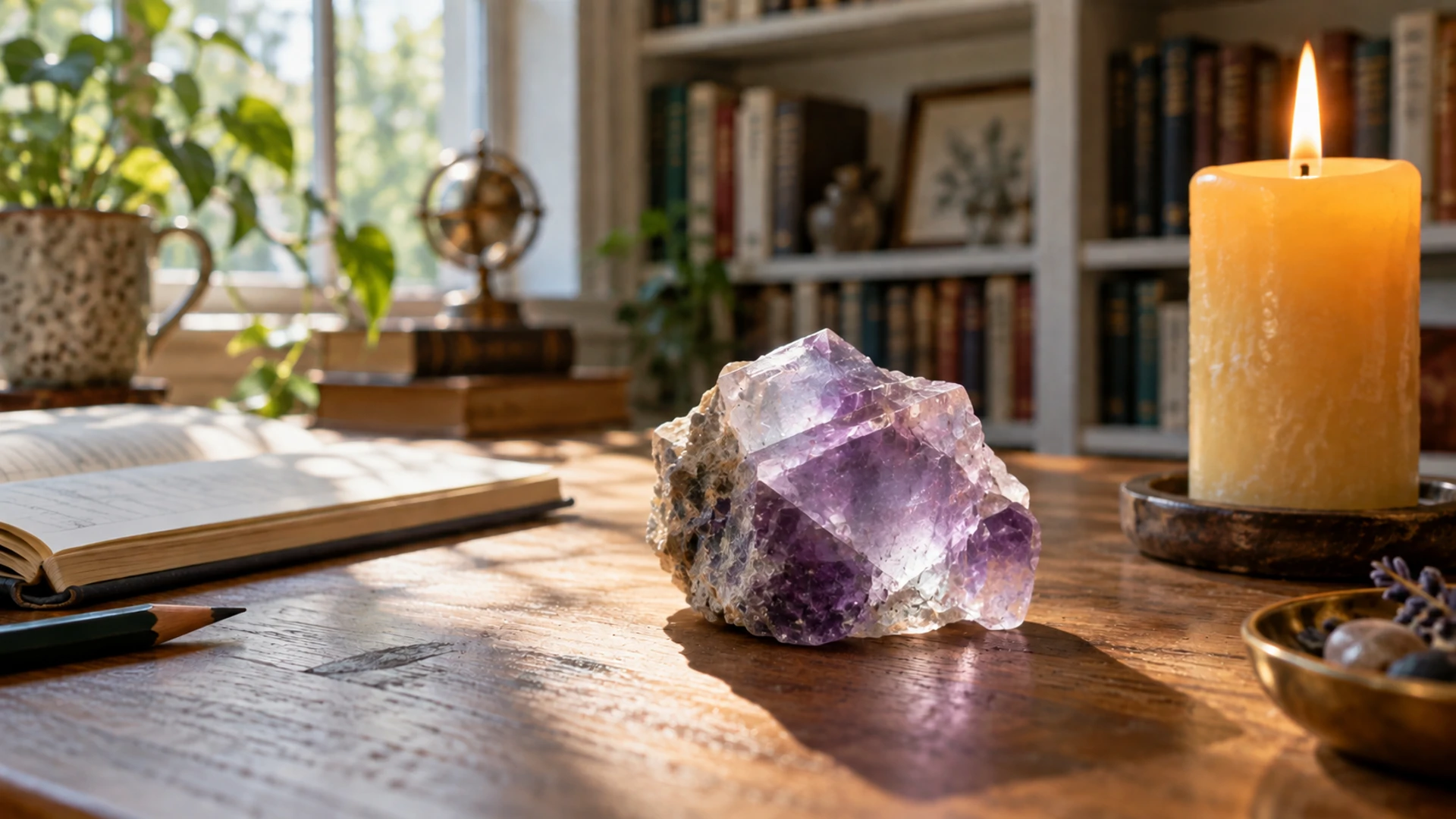
Fluorite is the cleansing stone for the mind specifically — not the whole energy field, but the mental layer where confusion, overthinking, and psychic clutter take hold.
The Stone That Named a Kind of Light: Why Fluorite Belongs in Cleansing
Most stones called cleansing stones are doing something broad: resetting the field, drawing out stagnant energy, or lifting the overall vibration of a space. Fluorite does something narrower and, for the right situation, more useful. Its cleansing action operates specifically at the mental and cognitive level. When the noise in your head is what's blocking you — not a heavy emotional residue, not a spatial energy problem, but genuine overthinking, decision fog, or the kind of psychic clutter that comes from absorbing too much at once — fluorite is the stone that actually fits the problem.
This is worth distinguishing clearly from the other stones commonly grouped in cleansing work. Clear quartz cleanses by amplifying and resetting to a neutral state, which is a universal tool that clarifies and charges whatever it's paired with, not limited to one type of energy. Halite cleanses by drawing out and dissolving dense, stagnant energy the way salt draws out moisture, with a genuine secondary function in protection. Selenite cleanses continuously through its own high vibration and can cleanse other stones by proximity. Fluorite's role is different from all of these: it isn't resetting the whole field, it isn't drawing out density, and it isn't holding a space energetically clear. It is specifically addressing the mental layer — the overthinking, the scattered attention, the confusion that accumulates when you've taken in too much and haven't had space to process it.
Its correspondences reflect that specificity. The element most commonly attributed to fluorite is air, which maps cleanly onto mental activity, thought, communication, and the kind of cognitive work that lives in the head rather than the gut or the heart. Its planetary rulers are given as Mercury and Neptune, though there's no strong single consensus here across traditions, and it's worth saying so honestly rather than picking one. Mercury governs the analytical mind, communication, and rapid information processing — a natural fit for a stone used at the desk or during study. Neptune governs intuition, the dissolving of illusion, and the deeper currents beneath conscious thought — which explains why fluorite also has a reputation for clearing psychic clutter and sharpening perception beyond ordinary logic. Both rulerships are real, and they point to different facets of the same stone. Its zodiac signs are Capricorn and Pisces, another pairing that might look contradictory — earth-sign discipline alongside water-sign intuition — but that actually reflects the same dual quality: ordered thinking alongside subtle perception.
Fluorite's chakra correspondence isn't fixed to one center, and flattening it to a single association would misrepresent how this stone actually works. Color matters here, and it matters specifically. Purple fluorite leans toward the third eye — the seat of psychic perception, inner vision, and pattern recognition. Blue fluorite works with the throat, supporting clear communication and the articulation of complex ideas. Green fluorite corresponds to the heart, useful for clearing emotional confusion or the mental noise that comes from unresolved relationship dynamics. Clear fluorite reaches toward the crown, supporting the kind of expansive, boundary-dissolving clarity that sits above ordinary thinking. Rainbow-banded fluorite, which carries multiple colors layered through a single piece, touches several of these centers at once. The stone isn't one fixed thing; it's a category of related minerals that happen to occur together, and choosing your color is closer to choosing your specific intention than to picking a favorite look.
Color and Clarity: Choosing and Keeping Fluorite
Choosing fluorite is mostly a question of which correspondence you want to lean into, because the color variation is functionally meaningful rather than just aesthetic. If you're drawn to fluorite for mental clarity during complex thinking or study, purple or clear specimens are the most direct fit — purple for intuitive and perceptive clarity, clear for broad cognitive openness. If you're working through communication difficulties or trying to express something that's been stuck, blue fluorite is the more specific choice. Green fluorite suits emotional processing work, particularly when emotional confusion is showing up as mental noise — when you can't think straight because something is unresolved in the heart rather than actually complicated in the mind. Rainbow fluorite is useful when you aren't sure which layer needs addressing, or when a working calls for integration across several centers at once.
Fluorite is also genuinely beautiful to shop for, because it forms in some of the most visually striking natural geometries of any mineral — perfect cubic crystals, octahedrons, and banded slabs with color zones that shift gradually from purple to green to clear within a single piece. That visual variety is part of why it's widely available and relatively affordable compared to stones with comparable magical reputations. Raw clusters, polished points, tumbled pieces, and flat palm stones all work well in practice; the form is less important than the color you choose for the working.
On care, fluorite requires a little more attention than some of the hardier stones in regular magical use. It sits at Mohs 4 on the hardness scale, making it genuinely soft by mineral standards. Quartz, for comparison, is a 7; even labradorite sits around 6 to 6.5. What that means practically is that fluorite will scratch, chip, and wear if you're not thoughtful about how you store it. Keep it away from harder stones — obsidian, quartz, jasper — in your collection, particularly if pieces are loose together in a bag or a drawer. A cloth pouch or a dedicated spot on a shelf is a better home for it than a tumbled-stone mix where harder minerals can knock against it.
Sunlight is the other thing to watch. Fluorite fades with prolonged direct sun exposure, and some pieces lose color noticeably faster than others depending on the mineral inclusions that create the color in the first place. A sunny windowsill is genuinely not the right spot for a piece you want to keep vibrant. Moonlight cleansing, sound cleansing, or brief time in the sun during non-peak hours are all fine. You can also set fluorite briefly near selenite, which cleanses continuously through its own high vibration and can cleanse other stones by proximity. Water is a more nuanced question: fluorite is not water-soluble the way halite is, so a brief rinse is unlikely to cause damage, but prolonged soaking or salt water should be avoided — fluorite can develop small cracks over time with repeated water exposure, and salt water accelerates surface wear on softer stones.
Three Practices for Clearing the Mind
The Fog Clear
Use this practice when you're in the middle of acute mental overwhelm — decision fatigue, information overload, or that specific kind of stuck feeling where you've been turning a problem over so many times it's stopped making sense.
Sit somewhere quiet and hold a piece of fluorite in your dominant hand, choosing the color that matches the kind of clarity you need most: purple if the block feels perceptual or intuitive, clear if it's more like generalized mental noise, green if what's actually muddying your thinking is an unresolved emotional undercurrent. Close your eyes and focus on the physical weight and temperature of the stone, letting your attention settle onto the sensation rather than the problem. The point isn't to force clarity; it's to give your mind something simple and real to anchor to while the static settles. Most people find that five to ten minutes is enough. Working during a Mercury hour adds a layer of timing that supports mental clarity, but the practice is complete without it.
The Study Stone
Use this practice for sustained periods of analytical work — extended study sessions, writing projects, research, or any kind of deep focus that requires the mind to stay clear over hours rather than moments.
Place a piece of fluorite on your desk or workspace where it stays in your peripheral vision rather than directly in your hands. You aren't using it as a meditative focus here; you're letting it work as a passive presence that supports the quality of mental atmosphere around your work. Purple fluorite is particularly suited to this use, given its third eye correspondence and association with pattern recognition and sustained perception. Some practitioners keep a yellow candle lit during study work for Mercury's clarity-supporting quality; if you do, position it within the same visual field as the fluorite rather than on the other side of the room. The combination of the stone's presence and the candle's light creates a working environment that keeps the mind engaged without pushing it toward the scattered energy that comes from trying too hard.
The Grid Hub
Use this practice when you're building a crystal grid with multiple stones and want to ensure they're working in coordination rather than pulling in separate directions.
Place fluorite at the center of the grid as the coordinating stone rather than at one of the outer points. Its mental-clarity quality functions here as a kind of organizing intelligence — not amplifying the grid the way clear quartz does, but clarifying the intention at the center so the surrounding stones have something coherent to orient around. Choose the fluorite color to match the grid's primary purpose: green for a heart-centered or abundance grid, purple for a grid built around intuition or psychic development, clear for any working where the intention is broad clarity or openness. Set your intention for the grid while holding the fluorite before placing it, then position it first and build outward. This sequence — center stone set with intention, outer stones arranged in response — helps the grid cohere rather than simply looking symmetrical.
How Fluorite Gave Science the Word "Fluorescence"
In 1852, the English physicist George Gabriel Stokes coined the term "fluorescence" directly from "fluorspar" — fluorite's older industrial name — because fluorite was the specific mineral in which he first documented the effect of glowing under ultraviolet light. The word moved quickly from scientific literature into common use, and today "fluorescence" describes everything from the glow of highlighter ink to the operation of office lighting to medical imaging techniques. One of the most ordinary words in modern English traces its etymology to a single observation of one mineral glowing in a darkened room.
This is not a footnote. It's the reason the stone's name belongs everywhere. Every fluorescent light fixture is, in its naming, a reference to fluorite. Stokes wasn't the first person to notice that fluorite glows; the mineral's distinctive violet glow under certain conditions had been noted by earlier observers. But he was the one who documented it systematically, named the phenomenon, and attached the mineral's name to it permanently. Fluorite's common nickname — the Genius Stone — sits in this same territory: a stone associated with the mind, with clarity, with the kind of organized perception that allows complex things to be understood, and with a scientific legacy that ended up naming an entire optical phenomenon used in laboratories and hospitals worldwide.
Cleansing for the Mind, Not Just the Field
Fluorite's place in cleansing work is specific, and that specificity is exactly what makes it useful. A lot of cleansing stones do something large and general; fluorite does something targeted. If the problem is mental fog, accumulated cognitive clutter, or the kind of psychic noise that comes from absorbing too much from the world around you, fluorite addresses the actual source rather than sweeping broadly. It won't replace a stone that resets the whole field — but when the field isn't the problem, reaching for a field-reset tool is the wrong move anyway.
If you want to see how fluorite sits alongside the other cleansing stones — and how the cleansing category fits within the six other paths of stone magic — The Crystal Compendium: Seven Paths to Stone Magic is the place to go. It lays out the full picture, category by category, with the rationale behind each stone's placement.