Vervain Tea Ceremony for Luck: A Current Two Thousand Years Old
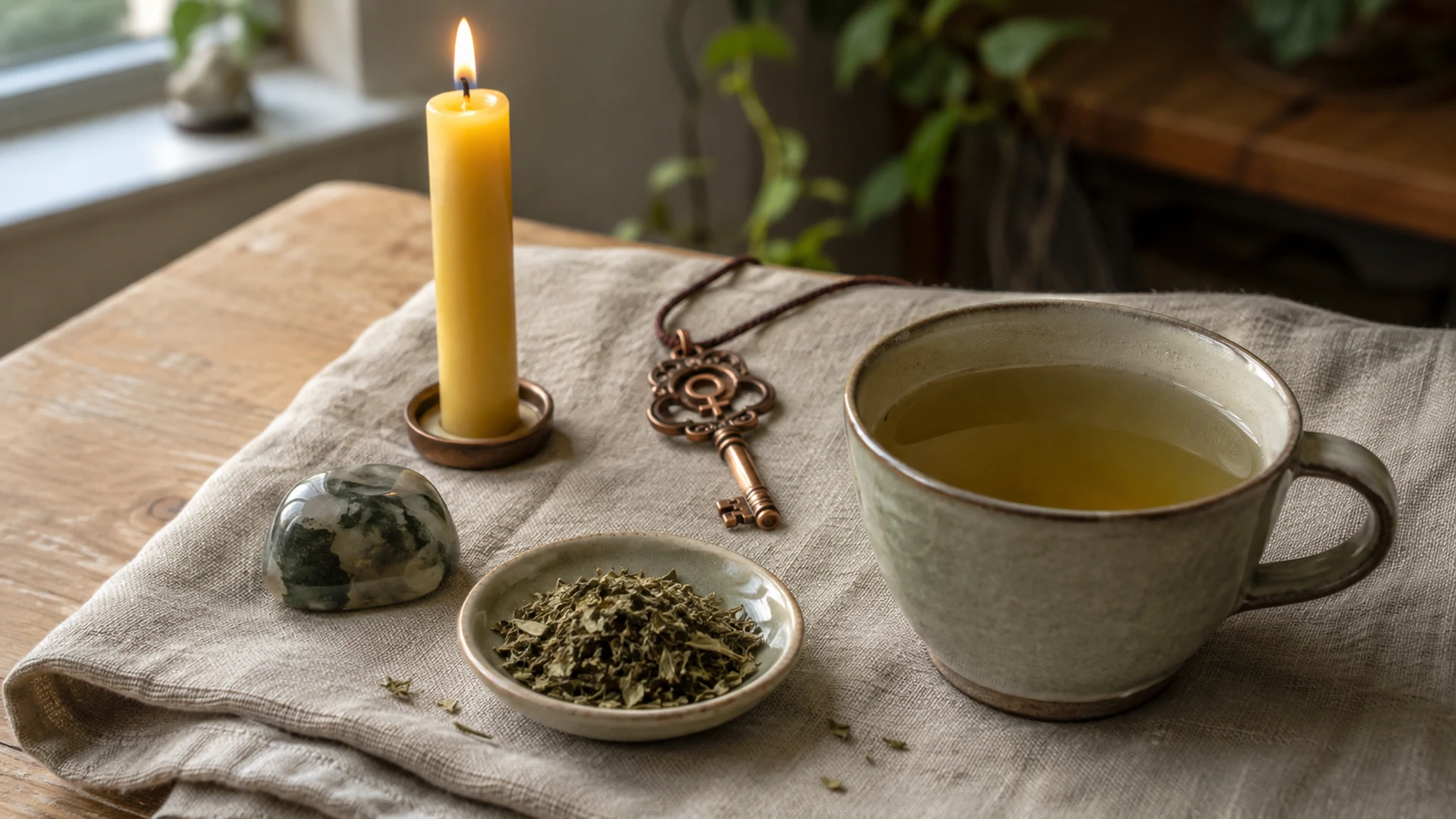
Vervain has been called the herb of enchantment, the herb of grace, and the wizard's herb — and for good reason. It has one of the longest and most consistent records in Western magical tradition of any plant still in common use today. If you want to hold a magical tea ceremony for luck, vervain is one of the most historically grounded, energetically aligned choices you can make. This guide walks you through the full ceremony: why this herb specifically carries a luck correspondence, how to prepare your space and tools, how to brew with intention, and how to close the ritual so that what you've seeded has room to grow.
Why Vervain Is Suited to a Luck Tea Ceremony
Vervain (Verbena officinalis) is governed by Venus and aligned with the element of Earth — a combination that speaks directly to the nature of luck as most practitioners understand it. Venus brings attraction, magnetism, and the quality of drawing good things toward you. Earth grounds that magnetism in the material world, in real outcomes, real opportunities, real circumstances shifting in your favor. Together, they describe exactly what luck feels like when it's working: not randomness, but a current of alignment pulling the right things into your path.
The historical record for vervain in luck and prosperity magic is unusually strong. Celtic and Gaulish priests — the Druids — considered it one of the most sacred plants in existence, used in divination, ritual blessing, and workings meant to attract fortune. Roman soldiers carried it into battle to ensure favorable outcomes. In Renaissance-era grimoires and herbals, vervain appears repeatedly as an herb that "procures the love and favour of great persons" — which is essentially luck in its social and material dimensions. The folk tradition across Britain, France, and Germany consistently associates it with drawing good fortune, warding off bad luck, and opening doors that have been closed. This isn't a vague symbolic association; it's a documented thread running across cultures and centuries. For a deeper look at vervain's full magical profile, see the complete guide to vervain in magic.
Drinking vervain as a tea rather than burning it, carrying it, or using it in a sachet is a meaningfully different kind of working. When you ingest an herb, you're not just surrounding yourself with its energy — you're taking it inside your body. The intention becomes internal. The luck you're calling isn't just something you hope will arrive from the outside; you're literally incorporating the herb's correspondence into yourself, making yourself the carrier of the working. There's a reason so many of the oldest magical traditions involve consuming sacred plants rather than simply holding or burning them. The body becomes part of the ritual. The boundary between the practitioner and the working dissolves in a way that external use doesn't achieve.
Vervain also has a mild, slightly bitter, almost green flavor as a tea — earthy, with a subtle herbaceous quality that grounds you as you drink it. That bitterness is worth noting: in folk magic, bitter herbs have long been associated with clearing, with cutting through stagnation, with removing the obstacles that block fortune from reaching you. Drinking vervain for luck isn't just about attraction — it's about clearing the channel so luck can flow.
Preparing for Your Vervain Tea Ceremony
Space
Before you brew a single cup, your space deserves attention. Luck magic works best in an environment that feels open and expansive — not cluttered, not tense, not rushed. Clear your area of anything that feels heavy or chaotic. A clean surface, a cloth if you use one, your cup, and whatever tools you're working with. The physical act of preparing your space is itself the first ritual gesture. You're signaling to your own mind — and to whatever forces you work with — that something intentional is about to happen.
Timing
Timing matters. For a luck-focused ceremony, the waxing moon is your best window — the phase between new and full when energy is building, growing, and expanding. Thursday is the traditional day for luck and abundance magic, governed by Jupiter, the planet of expansion and good fortune. If you can align both — a Thursday during a waxing moon — you're working with significant natural support. Vervain's own day is Friday, Venus's day — you can find Venus's hour for your location and date using our Venus's hour finder if you want to work with the herb's own planetary current directly, alongside or instead of the general Thursday luck-timing above. Early morning or midday works well for luck ceremonies; these are solar hours that carry qualities of clarity, forward movement, and opportunity. That said, the right time is often simply when you can be fully present and undistracted.
Auxiliary Tools
Two auxiliary tools will strengthen this working considerably:
- A yellow candle: Yellow candle magic carries a solar, Mercurial current — it opens pathways, sharpens mental receptivity to opportunity, and puts you in the right frame to notice when luck is actually moving in your direction. Vervain's Venusian pull draws fortune toward you; a yellow candle helps you stay alert and ready when it arrives. Light it as you begin the ceremony and let it burn while you brew and drink.
- Moss agate: Moss agate is an Earth-aligned stone with a long association with slow-building, lasting fortune — the kind that comes through gradual accumulation rather than a single lucky break. That makes it an unusually good match for vervain specifically, since they share the same elemental grounding. Place it beside your cup while you brew and keep it in your hands or nearby as you drink.
If you want to take the candle prep further, the guide on preparing candles for luck magic will walk you through dressing and charging it for this specific intent.
Safety Note
A safety note: Vervain is generally well-tolerated as an herbal tea for most healthy adults, but it should be avoided during pregnancy, as it has traditionally been used as a uterine stimulant. It may also interact with certain medications, including those affecting hormone levels or blood pressure. If you have any health conditions or are taking medication, check with a doctor or qualified herbalist before consuming vervain. This guide does not provide dosage or medical advice.
Brewing Vervain With Intention
Gathering the Herb
Start by gathering your dried vervain. One to two teaspoons of dried herb per cup of water is a reasonable amount for a ceremonial infusion. Place it in your cup, a teapot, or an infuser — whichever you prefer. Before you add anything else, hold the herb in your hands for a moment. Feel its texture, its lightness, its dryness. This is the plant you're partnering with. You're not just making tea; you're opening a conversation with a botanical ally that has been used in luck workings for over two thousand years.
Heating the Water
Heat your water to just below boiling — around 90 to 95°C (195 to 200°F). A full rolling boil can strip out some of the more delicate volatile compounds in the herb; this slightly lower temperature extracts more of the full profile. While the water heats, light your yellow candle. Watch the flame establish itself. Let it remind you that something is being initiated right now — something is beginning. If you have your moss agate, place it beside your cup or infuser.
Pouring and Speaking Your Intention
As you pour the hot water over the herb, say your intention aloud or clearly and firmly in your mind. Not a wish — a declaration. Something like: "I am open to luck. I draw opportunity toward me. Fortune finds me wherever I go." The exact words are less important than the quality of the statement: it should feel true, present-tense, and confident. You're not asking luck to maybe show up someday. You're declaring that the channel is open and the current is already moving.
Steeping
Let the vervain steep for five to seven minutes. This is not dead time — it's some of the most important time in the ceremony. While the herb infuses into the water, your job is to hold the feeling of luck already at work in your life. Not hope, not longing — actually feel what it feels like to be someone who finds things going their way. Let that feeling get specific: picture a door opening, an unexpected call, a decision that lands beautifully in your favor. The more vividly and physically you can hold that feeling during the steep, the more powerfully your will has shaped the working.
After five to seven minutes, remove the herb or strain the tea. Take a moment before you drink. Cup your hands around the mug and feel the warmth. This warmth is the ceremony meeting you physically — the herb, the intention, the energy you've put into this moment, all of it gathered into something you're about to take inside yourself.
Drinking and Closing the Ceremony
Hold the mug in both hands before your first sip. Feel the warmth against your palms — the same earthy bitterness the Druids knew, now steeped through with your own intention. Each sip is a continuation of the ritual, not a transition away from it. As you drink, stay with the feeling you built during the steep — luck flowing, doors opening, fortune moving in your direction. You can close your eyes between sips if that helps you stay present. Let the warmth travel through your chest and settle in your body. Feel yourself becoming the carrier of this intention, not just the sender of it.
Vervain has a mild bitterness that some people find very pleasant and others find more of an acquired taste. Don't mask it entirely with sweetener if you can help it — that mild bitterness is part of the herb working. In folk tradition, it signals the clearing quality: the removal of what's been blocking good fortune from reaching you. Acknowledge it. Drink through it. Let it mean something.
When the cup is finished, sit quietly for a minute or two. Don't immediately reach for your phone or move into the next thing. The ceremony has a tail — a few moments of stillness where what you've done gets to settle into you. You might feel a quiet sense of calm, a slight energetic shift, or simply a feeling of having done something real. All of those responses are correct.
To close the ritual, thank the herb explicitly — out loud if you're comfortable with that, or internally. Vervain has a long history of being treated with respect by the practitioners who worked with it. Reciprocity is part of how plant magic functions at its best. Then extinguish your candle if you don't plan to let it burn down. You don't need to snuff it dramatically — just acknowledge that this working is sealed, not abandoned.
Dispose of the used herbs mindfully. The most aligned approach for luck magic is to scatter the spent vervain in a garden, in soil near your home, or into a body of natural water — returning it to the earth as a kind of offering, reinforcing the intention that what you've put into motion continues to move outward. Burying it at your doorstep is a traditional folk method for keeping luck close to home.
Journaling after the ceremony is optional but genuinely useful. Note what you intended, what you visualized, what you felt during the steep and drinking. Over time, this record becomes something valuable — you'll start to notice which sessions felt most alive and what was happening in your life in the days that followed. That feedback loop is how you refine your practice into something that works specifically for you.
Vervain and the Current of Fortune: Returning to This Practice
What you've worked with here is not a one-time shortcut. The reason vervain has carried a luck correspondence across Celtic, Roman, and European folk traditions for millennia is that its Venusian and Earth-aligned nature genuinely resonates with the energetic pattern of attraction and material fortune. When you drink it with focused intention, you're not performing a superstition — you're using your will to align yourself with a current that this herb has been recognized as a conduit for since before the common era.
This ceremony is designed to be repeatable. You can return to it whenever you're entering a period where you need luck on your side — before a job interview, a major decision, a creative pitch, or any stretch of life where you want the wind at your back instead of in your face. The more you practice it, the more fluent you become in the internal state the ceremony is meant to produce. That state — open, magnetic, genuinely expecting things to go well — is itself a form of luck in action.
The ceremony works because you show up to it. Vervain doesn't conjure luck independently. Your will, shaped and focused through the ritual structure — the timing, the tools, the deliberate brewing, the intentional drinking — is what turns a cup of herbal tea into a genuine magical act. The herb is your ally. The ceremony is your framework. The power is yours.
If you want to explore more ways to work with luck through ceremonial tea, there are other herbs that bring their own distinct energy to this intent. The lemon tea ceremony for luck works with a bright, solar energy that cuts through stagnation and opens pathways — a sharp, clarifying counterpart to vervain's earthy magnetism. The vanilla tea ceremony for luck takes a warmer, more magnetic approach, drawing fortune in through comfort and abundance rather than clearing and momentum. Each herb carries the luck intent differently, and working with more than one over time will deepen your understanding of how that intent can be shaped. For a full overview of herbs, intents, and ceremonial approaches in one place, the Spiritual Tea Ceremonies: A Complete Guide by Intent is a thorough companion resource worth reading.