Green Aventurine: The Stone Named After Luck Itself
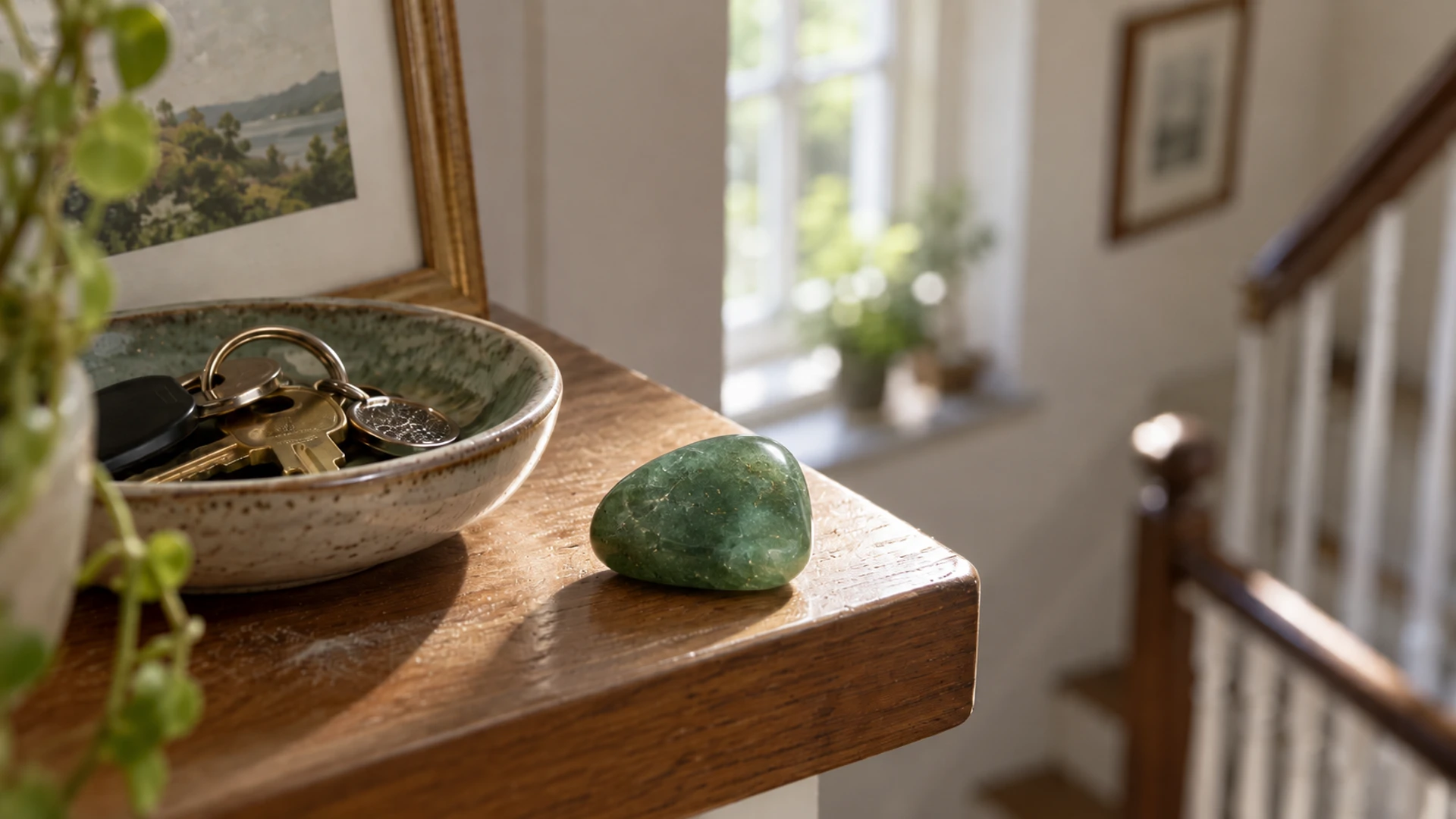
Green aventurine works by positioning you in the path of luck, not by generating wealth or building it steadily. Its job is to open the door — what you do once you walk through it is entirely up to you.
The Stone Named After Luck Itself: Why Green Aventurine Belongs in Abundance
Most people encounter green aventurine early in their crystal practice, usually as a tumbled stone in a beginner's set, labeled something like "prosperity" or "good luck" and left at that. The label is accurate, but it undersells the specificity. Green aventurine doesn't work the way most other abundance stones do. Its mechanism is luck and chance-based opportunity — it positions you to catch a break that's already moving through the world, rather than generating or accumulating wealth through effort or intention alone. That distinction matters when you're choosing tools for a working.
Compare it to two neighbors in the abundance category. Moss agate's mechanism is growth from a new planting — patient tending of a venture at its earliest stage, not abundance already in flow. Pyrite works through protective, disciplined wealth-building — abundance through willpower, resolve, and safeguarding what's already been built, not spontaneous luck. Green aventurine is neither of those things. It isn't asking you to tend anything carefully, and it isn't hardening your resolve. It's tuning you to be in the right place at the right time and receptive enough to notice when that moment arrives.
That function maps directly onto its heart chakra correspondence, which is easy to overlook when the stone gets filed under money magic. The heart chakra governs receptivity — the openness to receive, to say yes, to recognize an opportunity as an opportunity rather than a risk. A closed or defended heart doesn't catch lucky breaks. It analyzes them to death or waves them off. Green aventurine, with its Earth energy, keeps you grounded enough to act but open enough to receive. That pairing — Earth's steadiness with the heart's openness — is exactly what you need when chance presents itself.
Mineralogically, green aventurine is a quartzite, not a single quartz crystal. That's an important distinction. Quartzite is a metamorphic rock formed when quartz-rich sandstone is subjected to heat and pressure, causing its grains to recrystallize into a tightly interlocked mass. What makes green aventurine specific within that category is the presence of fuchsite — a chromium-rich variety of muscovite mica — distributed as tiny platelets throughout the stone. When light enters the stone and reflects off those platelets, it produces the soft, moving, internal shimmer you'll see in a good specimen. That optical effect has a technical name: aventurescence. The fuchsite also accounts for the range in green aventurine's color, from pale jade-like greens when fuchsite is sparse to a deeper, more saturated green when it's dense.
Not Jade, Not Glass: Choosing Green Aventurine
Two genuine points of confusion follow green aventurine around the market, and clearing them up will save you from paying for something you didn't intend to buy. The first is that green aventurine is sometimes traded under the name "Indian jade." It is not jade. True jade is one of two specific minerals: nephrite (a calcium-magnesium silicate) or jadeite (a sodium-aluminum silicate). Green jade carries its own correspondences and its own long history as a symbol of wealth and virtue — a history that green aventurine, a quartzite, does not share. "Indian jade" is a trade name designed to sound valuable, not a mineralogical description, and the two stones work differently.
The second confusion involves goldstone — a man-made glass product, not a mineral at all. Goldstone is produced by suspending copper or chromite flecks in molten glass under controlled conditions, creating a sparkle that reads as similar to aventurescence at a glance. The differences become clear once you know what you're looking for. Goldstone's sparkle is smooth and uniform, more like glitter distributed through glass, with a distinctly hard, glossy surface. Green aventurine's shimmer is granular and moves more subtly as the stone shifts in the light, because you're seeing mica platelets inside a rock rather than metal particles suspended in glass. When you hold a good green aventurine specimen at an angle to a light source and rotate it slowly, the shimmer will roll through it like light through water rather than flash all at once like a mirror.
On the care side, green aventurine is straightforwardly durable. It sits at Mohs 6.5 to 7 — hard enough for everyday carry, hard enough to wear as jewelry without worrying about surface damage from normal contact. It is water-safe and presents no toxicity concerns for handling. Brief rinses are fine. For energetic cleansing, moonlight, sound, or smoke all work well, and unlike softer stones such as selenite or celestite, you don't need to be precious about how you store it. Keep it away from harder stones (sapphire, diamond, topaz) that could scratch it if they knock together in a bag, and you're in good shape. This is a stone that's genuinely easy to live with, which makes it a practical first choice for those who want to carry their crystal work into daily life rather than keep it on an altar.
Three Practices for Positioning Yourself for Luck
The Lucky Pocket
Use this before a specific chance-based moment — a job interview, a first pitch, a negotiation you didn't initiate and can't fully control — when your role is to show up well and let the opening do its work.
The morning of the event, hold your green aventurine in your dominant hand for two to three minutes. Don't construct a complex visualization or run through outcomes. Instead, hold one simple awareness: you are available. You are open to what this moment can offer. Feel the stone's weight, notice its temperature warming against your palm, and let the intention settle into your body rather than your mind. Then put it in your pocket — specifically the pocket closest to your dominant hand — and leave it there throughout the event. You're not casting a luck spell at the person across the table. You're carrying a physical reminder that your role is to be present and receptive rather than tightly controlled.
The Chance Taken
Use this at the moment of decision — when an opportunity has already appeared in front of you and the only thing in the way is hesitation.
Sit with the stone in both hands. Name the opportunity aloud, in plain language, without dressing it up or hedging. "This job offer appeared. This conversation is possible. This door is open." Then say what the hesitation actually is — also in plain language, without excusing it. Hold both of those things at once: the open door, and the thing making you slow down in front of it. Green aventurine's heart-chakra energy doesn't dissolve fear, but it does soften the defended quality that turns hesitation into permanent avoidance. Sit there until you feel the balance tip — until the opportunity feels larger than the reluctance. Then set the stone down and make the move. The stone's job was to keep you open long enough for your own clarity to surface. A green candle lit on the surface in front of you, if you have one, reinforces the working's outward-reaching quality without overcomplicating the practice.
The Open Door
Use this as an ongoing practice for periods when you're not pursuing one specific goal but want to stay receptive to opportunity that you haven't yet imagined or identified.
Place the stone somewhere you pass every day — a windowsill, a desk corner, the shelf where you keep your keys. This is a placement practice, not a seated ritual, and that's intentional. The Venus hour on a Friday is a natural time to set the stone in its spot for the first time, since Venus governs receptivity and abundance both. Each time you pass it, you don't need to stop and meditate — a glance, a moment of awareness, is enough. The physical presence of the stone works as a recurring prompt: you are not fixed on one outcome. You are available to what arrives. This kind of broad, open intention is actually where green aventurine's luck-and-chance mechanism shines most naturally, because it works best when you're not too tightly attached to a single specific form of success.
Named After Its Own Imitation
Most gemstones are named for their own characteristics — their color, their origin, their discoverer. Green aventurine is named after a man-made material. At the Murano glassworks near Venice, likely in the seventeenth century, a workman accidentally let copper filings fall into a batch of molten glass. The result was a glittering, shimmering material the Venetians called avventurina, from the Italian phrase a ventura — "by chance." It was, the name acknowledged, a lucky accident.
When naturalists and mineralogists later needed a term for the naturally occurring quartz mineral that produced a similar shimmering optical effect, they borrowed the glassmakers' word. The natural stone took its name from its artificial predecessor, which is an odd reversal of how naming usually works. The nicknames that followed — "Gambler's Stone" and "Stone of Opportunity" — are modern folk tradition rather than ancient record. But they grew honestly from the name itself, which already contained the idea of luck before anyone attached it to an intention-setting practice. A stone named for a fortunate accident seems like a reasonable tool to carry when you're hoping for one.
What's worth noting for magical practice is that the name's etymology became part of the stone's identity. Aventurescence — the technical term for the optical phenomenon — uses the same root. Every time someone names what makes green aventurine shimmer, they're invoking the same Italian word for chance. That kind of etymological coherence is rare in crystal work, where names often drift far from their origins. Here, the geology, the optics, the history, and the magical function all point back to the same idea: a lucky break, arrived at by chance.
Abundance Through the Door Left Open
Green aventurine's contribution to abundance work isn't force — it's positioning. It doesn't generate wealth the way citrine works through spontaneous manifestation, and it doesn't build it steadily over time. What it does is keep the heart open and the awareness alert so that when a lucky break passes through, you're in a state to receive it rather than miss it or refuse it out of fear.
If you want to see where green aventurine sits among the other abundance stones — and how all seven of the stone magic categories relate to each other — The Crystal Compendium: Seven Paths to Stone Magic is where those threads come together.