Yarrow Tea Ceremony for Banishment: The Clean Cut of Mars
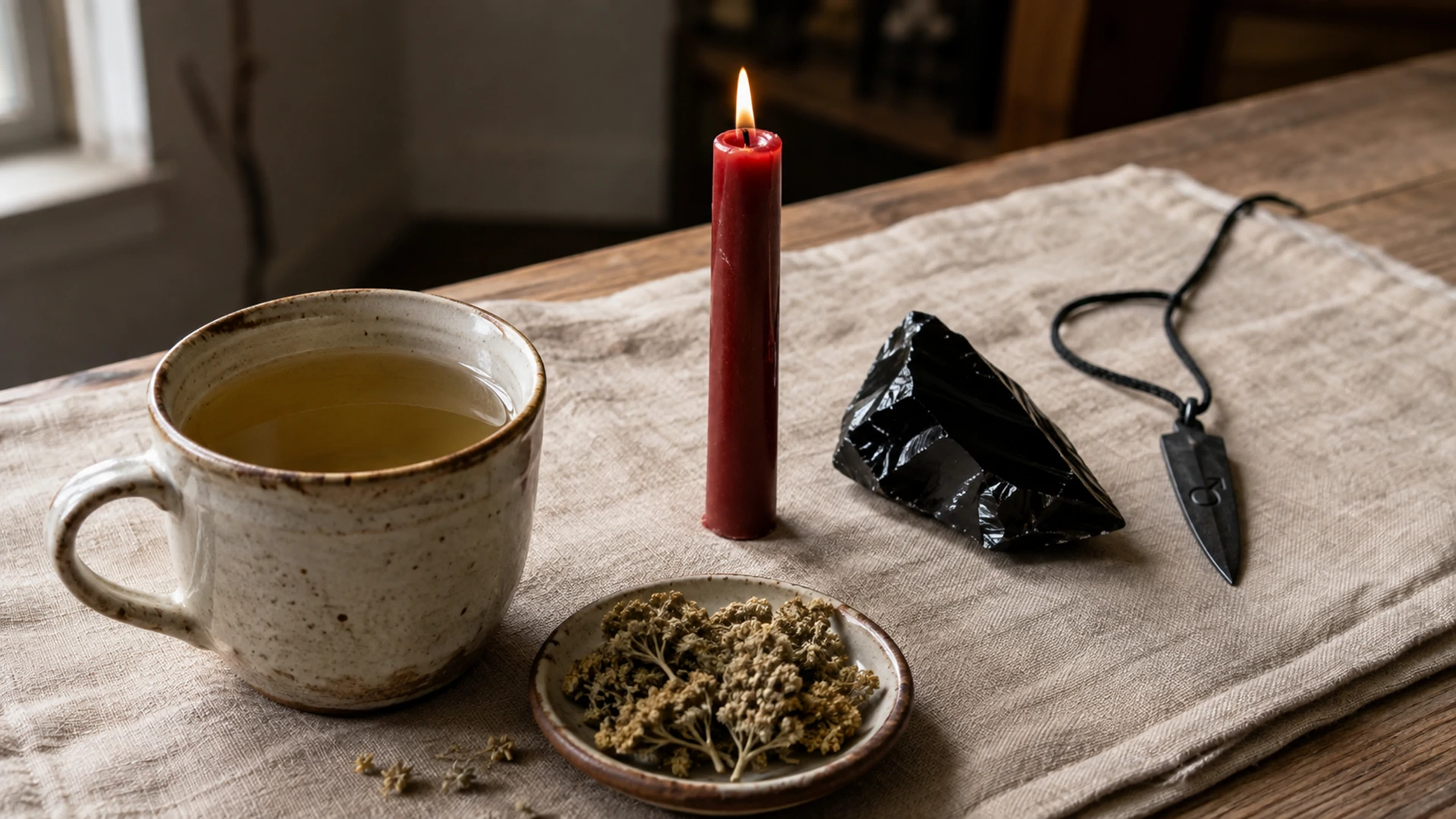
Yarrow has been clearing the way for people for a very long time. Long before it sat in a tea blend, it was packed into wounds on battlefields, hung over doorways to repel harm, and called upon to sever what needed cutting. That history matters, because banishment magic is not passive — it requires the same decisive energy. This spiritual tea ceremony uses yarrow specifically for banishment, guiding you through the full ritual from preparation to closing so that you can work with this herb in one of its most direct and embodied forms. If you've been searching for yarrow tea for banishment as a practical magical working rather than a vague concept, this is the guide you need.
Why Yarrow Is Suited to a Banishment Tea Ceremony
Yarrow (Achillea millefolium) is a Mars-ruled herb with a long, specific history of severing, protecting, and clearing. Mars governs force, will, and decisive action — exactly the energies you need when you're pushing something out of your life. This isn't ambient, gentle plant energy. Yarrow has an edge to it, and that edge is the point. You can explore the full range of yarrow's magical correspondences and uses in depth, but for banishment specifically, the Mars connection is the primary driver.
Beyond planetary attribution, yarrow has documented folk use as a boundary herb. In European traditions, it was hung at entrances to prevent the entry of hostile forces, used in soldier's wound dressings (the genus name Achillea references the myth that Achilles used it to treat his men), and called upon in old Scottish and Irish folk charms to repel ill will. The pattern across cultures is consistent: yarrow cuts, seals, and removes. Banishment fits this herb not because someone decided it should, but because the evidence of use points directly to it.
Yarrow also has a sensory profile that reinforces the intent. The taste of yarrow tea is noticeably bitter with a slightly medicinal, camphor-like sharpness. That bitterness is not a flaw in the cup — it is the herb communicating its nature. In sympathetic magic, bitter, sharp, and astringent qualities correspond to cutting away and expelling. Drinking something that tastes like a clear boundary is part of the working. Your body registers the bitterness as a signal, and that physical experience helps anchor the intention in something real rather than purely symbolic.
Drinking yarrow as tea, rather than burning it or carrying it, makes this an internal working. When you burn an herb or place it at a threshold, the magic acts outward — it affects the space around you. When you drink it, you are taking the plant's energy inside your own body. For banishment, this means you're not just pushing something out of your environment, you're reinforcing your own energetic boundaries from within. The will behind this ceremony lives in you, and the yarrow is giving it a clear, Mars-flavored channel through which to move.
Preparing for Your Yarrow Tea Ceremony
Space
The space you work in shapes the working. For a banishment ceremony, you want a clean, cleared space — physically and energetically. Before you begin, remove clutter from the area where you'll sit, wipe down your surface, and if you have a practice of space cleansing, do a light pass with sound, smoke, or a salt sweep. You are about to do deliberate expulsive work, so starting in a clean container matters. Sit where you won't be interrupted for at least 30 minutes.
Timing
Timing strengthens the working. For banishment, the waning moon is your clearest ally — specifically the period between the full moon and the new moon, when lunar energy is naturally oriented toward decrease and release. If you want to be more precise, perform this ceremony on a Tuesday, which is Mars's day. A Tuesday during the waning moon phase is about as aligned as you can get for this kind of work. You can find Mars's hour for your location and date using our Mars's hour finder to time your ceremony with even more precision. Early morning or late night both work well; what you want to avoid is performing banishment during a time when you feel scattered or distracted, because your clarity is the most important ingredient.
Auxiliary Tools
Two auxiliary tools will reinforce the intent during this ceremony. Place them on your surface before you begin.
- A red candle: Red candle magic is directly tied to Mars — the same planetary force that governs yarrow itself. Burning a red candle during this ceremony creates a coherent energetic environment where the herb's martial current and the candle's fire are pulling in exactly the same direction. It also activates will and forward momentum, which is precisely what you need to push something out of your life rather than simply wishing it gone. Light it before you begin brewing and let it burn through the close of the ceremony.
- Black obsidian: Black obsidian is a volcanic glass formed when lava meets water and cools almost instantly — that origin is written into its nature. It cuts cleanly, exposes what is hidden, and has been used across Mesoamerican, Mediterranean, and European traditions as a blade-like tool for severing attachments and clearing energetic residue. Placed beside your cup during the ceremony, it holds the intent of clean, final severance in physical form — reinforcing the same action the yarrow is doing from the inside.
Light the candle before you start brewing and let it burn throughout the ceremony. Hold the black obsidian in your non-dominant hand briefly when you sit down, feel its weight, and set a clear internal statement of what you are banishing before you even touch the water.
Safety Note
A brief safety note: yarrow is generally well-tolerated as a tea in normal culinary quantities, but it does carry a few known contraindications. If you are pregnant, yarrow tea is contraindicated and should be avoided. Yarrow is in the Asteraceae family, so if you have ragweed or related plant allergies, you may react to it. It can also interact with blood-thinning medications. If any of these apply to you, consult a doctor or qualified herbalist before drinking it. You can still perform this ceremony with yarrow in another form, such as holding a sprig or using it as an external focal point, while drinking a substitute herb you tolerate well.
Brewing Yarrow With Intention
The brewing itself, in a spiritual tea ceremony, is not separate from the ritual — it is the ritual's first active movement. Every step from the moment you fill your kettle is part of the working. Approach it that way from the start.
Heating the Water
Fill your kettle with clean, cold water. As you do, think about what you are banishing. Not in a vague, circular way — be specific and direct. Name it clearly in your mind: the relationship, the pattern, the fear, the person's influence, whatever it is. Hold that clarity as you set the kettle to heat. You want water that reaches just under boiling — around 90 to 95°C (195 to 205°F). Fully boiling water can make yarrow more bitter than necessary and may degrade some of its more delicate aromatic compounds. The goal is a sharp, clear infusion, not a scorched one.
Preparing the Yarrow
While the water heats, prepare your yarrow. Use approximately one heaped teaspoon of dried yarrow flowers and leaves per 250ml (8oz) of water. Place the herb into your cup, a teapot, or a strainer — whatever you use for loose-leaf tea. As you measure the yarrow, hold your focus on its Mars nature. This herb cuts. It severs. It has been used to close wounds and repel harm for thousands of years. You are asking it to do precisely what it has always done.
Pouring and Speaking Your Intention
When the water reaches temperature, pour it slowly and deliberately over the yarrow. Watch the herb move as the water hits it. Yarrow flowers are small and feathery, and they disperse beautifully in hot water. As the infusion begins, say aloud or firmly in your mind something like: "What no longer belongs in my life is being severed now. This is done by my will and yarrow's edge." The exact words don't need to be scripted — what matters is that you speak from a place of settled authority, not pleading or hoping. You are not asking for banishment. You are enacting it.
Steeping
Steep the yarrow for 10 to 15 minutes. A shorter steep produces a milder, more floral cup. A longer steep pulls more of the bitter, astringent compounds forward — and for banishment work, the sharper cup is more appropriate. Let it steep for the full 15 minutes. While it steeps, sit quietly with the black obsidian in your hand or resting near the cup. Keep the red candle burning. Let your mind rest on the clarity of what you're releasing, not the story around it. You don't need to rehearse why — you already know why. Just hold the fact of it, cleanly, while the yarrow does its work in the water.
After 15 minutes, strain the herb from the liquid. Do this with a single, purposeful movement. The spent yarrow will be dealt with at the end of the ceremony — set it aside for now. Your cup should be a pale golden-green color, and when you bring it close, you'll catch the slightly medicinal, herbaceous scent that is distinctly yarrow. Take a moment before you drink. Look at the cup. You brewed this with intention. What's inside it is ready to work.
Drinking and Closing the Ceremony
Before you take the first sip, hold the cup in both hands and breathe slowly. Feel the warmth through the ceramic. Let that warmth remind you that this working is already in motion. Take three slow breaths, each exhale deliberate and complete. On the last exhale, set down anything that has felt uncertain about this banishment. You have been clear, you have prepared, and you are ready to receive what you brewed.
Take each sip with purpose. This cup has Mars's edge in it — the camphor sharpness, the bitterness that lands at the back of the throat like a decision being made. Let each mouthful settle before the next. When you taste that bitterness — and you will — don't resist it. Let it register fully. That taste is the herb's signal. In each sip, hold the awareness that you are taking yarrow's Mars energy into your body, strengthening the boundary that separates you from what you are expelling. You are not just thinking about banishment. You are physically enacting it, sip by sip, from the inside out.
If your mind wanders during drinking, bring it back with a short internal phrase: "I release this. It is gone." Keep it simple. You don't need elaborate visualization — a clear, steady sense of finality is more powerful than elaborate mental imagery you have to strain to maintain. By the time you reach the bottom of the cup, you should feel something settle. That shift — even subtle — is worth noting.
When the cup is empty, the ceremony moves into its closing phase. Snuff (don't blow) the red candle. Blowing a candle out is traditionally associated with dispersing the energy you've built, so use a snuffer or your fingers to extinguish it. Thank the yarrow plainly — a simple acknowledgment works: "Thank you for your edge and your clarity." You don't need elaborate gratitude, just genuine recognition.
Now dispose of the spent yarrow intentionally. For banishment work, you want the herb to leave your space entirely. Wrap the spent leaves and flowers in a small piece of paper or cloth and take them out of your home — into a bin outside, or if you prefer a more traditional approach, bury them away from your property or leave them at a crossroads. The principle is the same in each case: the spent herb carries the energetic residue of what you expelled, and it shouldn't sit in your kitchen bin overnight.
Ground yourself after the ceremony. Eat something small — a piece of bread, some fruit, anything simple and physical. Banishment work can leave you feeling lighter but also slightly unmoored, especially if what you released was something you'd been carrying for a long time. Grounding brings you back into your body and the present moment. Then, before you move on with your day, write a few lines in your journal. Record the date, the moon phase, what you banished, and how you felt at the end. This record matters more than you might think — it gives you a reference point to look back on and track whether the working held.
Yarrow's Edge: What You're Carrying Forward
What makes this ceremony specific to yarrow is not just that it's a banishment herb — it's that yarrow works through the principle of clean severance. The Mars rulership, the warrior plant history, the bitter and astringent taste: all of it points to the same action. Cut, seal, and expel. When you drink yarrow with that intention, you're not adding magical properties to a neutral liquid. You're working with a plant that has been recognized across cultures and centuries as something that severs and protects. You are using it precisely as it has always been used, but from the inside.
This ceremony is repeatable. You don't need to reserve it for dramatic situations. Any time something persists in your life that has overstayed its welcome — a thought pattern, a dynamic, a residual attachment — this practice is available to you. Set up the space, light the candle, brew the cup with the same focused clarity, and drink with the same deliberate intention. Each time you return to this ceremony, you are reinforcing your own capacity to act decisively on your own behalf. That's what Mars-ruled magic builds: not just a single expulsion, but an ongoing relationship with your own will.
Yarrow isn't the only herb suited to this kind of ceremonial banishment work. If you want to explore how other plants approach the same intent, hyssop brings a purification angle — it clears and cleanses what yarrow severs, making it a strong companion practice. Agrimony works through pulling and removal — Jupiter-ruled and historically used to draw out harm that has already taken hold, rather than a return-to-sender working. Each herb works a little differently, and knowing which one fits your situation is part of building a mature banishment practice.
If you want to place this practice within a broader framework of herbal ritual, Spiritual Tea Ceremonies: A Complete Guide by Intent maps out how different herbs and intents work together across the full spectrum of ceremonial tea practice. Yarrow for banishment is one of the most direct entries in that tradition — and now you know exactly how to use it.