Lavender Tea Ceremony for Harmony: Steadying the Mind Before the Heart Can Soften
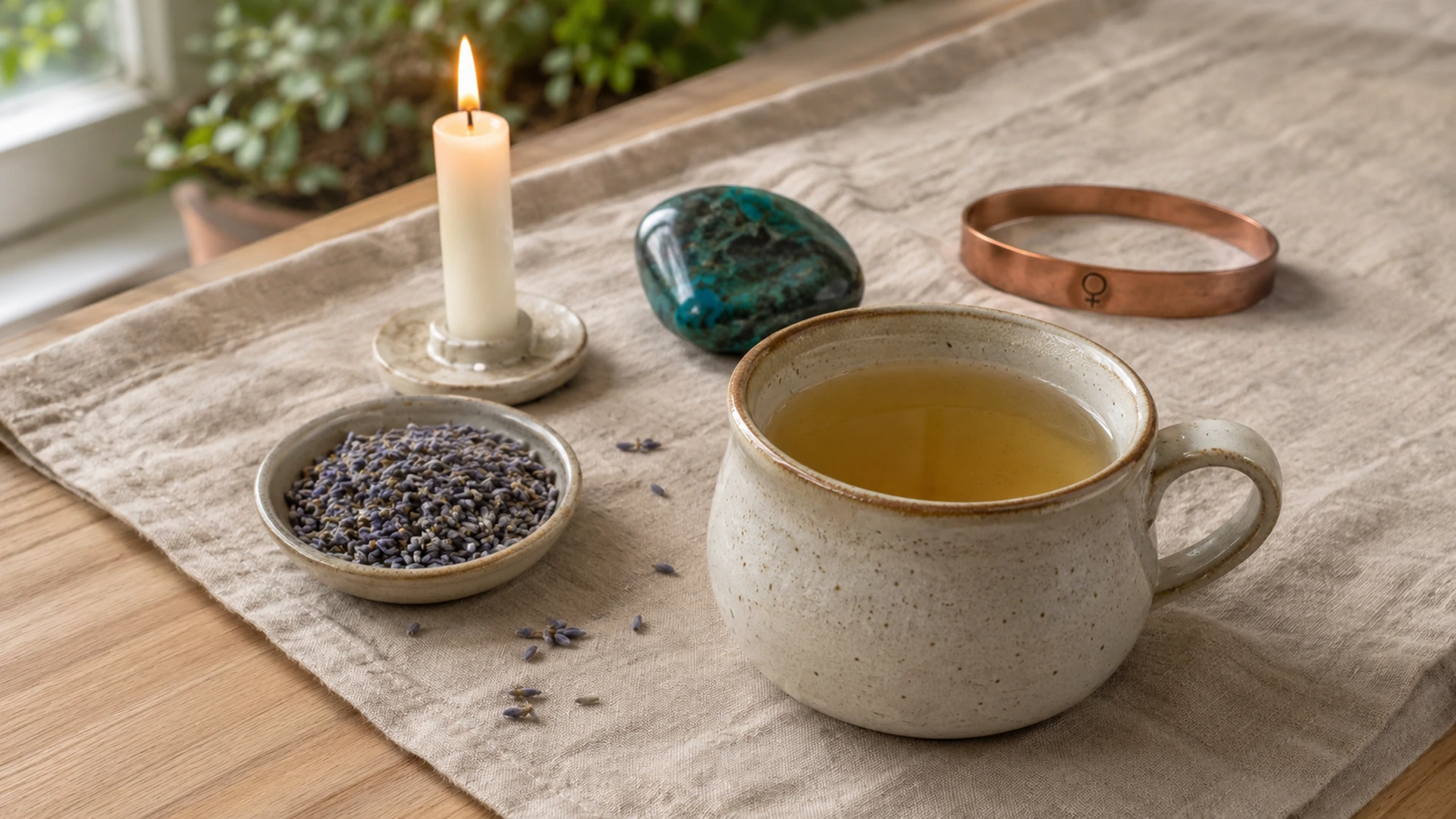
A lavender tea ceremony for harmony isn't just a calming cup before bed. It's a deliberate ritual act — one that draws on lavender's Venusian planetary current, its deep folk history as a peacemaker herb, and the unique intimacy of bringing a plant's properties into your own body. If you've been sitting with tension in a relationship, friction in your household, or an inner dissonance you can't quite name, this ceremony gives that longing for harmony a clear, focused direction. You're not just hoping things soften. You're doing something specific and real to make it so.
Why Lavender Is Suited to a Harmony Tea Ceremony
Lavender's harmony correspondence isn't a modern wellness invention. It runs through the herb's traditional magical and folk identity at a foundational level. Lavender's full magical correspondences reach back through centuries of practice, and the harmony association is one of the most consistent threads across traditions. The connection is planetary: lavender is governed by Venus, the planet that rules love, beauty, reconciliation, and relational ease. Venusian herbs share a quality of drawing things into pleasing accord, smoothing friction, and fostering goodwill between people. Lavender is one of the most purely Venusian herbs in the European tradition — its floral sweetness, its gentle action on the nervous system, and its historical use in domestic and relational contexts all point in the same direction.
The folk history confirms this. In medieval and early modern Europe, lavender was used not just for fragrance but as a deliberate tool for keeping peace in the home. Bundles were placed in rooms where arguments happened frequently, tucked into linens, and given as gifts to smooth over disputes. The word itself comes from the Latin lavare, to wash — and lavender was understood as something that cleaned not just surfaces and cloth but the emotional atmosphere of a space. That historical use as a domestic peacekeeper maps directly onto what harmony workings are trying to accomplish: not dramatic transformation, but a restoration of ease between people, or within yourself.
There's also a sensory quality worth naming. Lavender's scent — released even before you taste it, as the hot water hits the dried flowers — is not neutral. It's chemically calming. Linalool, the primary aromatic compound in lavender, has documented effects on the nervous system that reduce physiological stress markers. In magical terms, this matters because you cannot hold a harmony intention clearly while your body is tense and braced. The scent of lavender primes your nervous system to actually receive the working. By the time you bring the cup to your lips, your body is already moving into the state you're trying to cultivate. The plant is doing some of the preparatory work for you.
Drinking lavender as tea, rather than burning it, carrying it, or placing it in your space, is a meaningfully different form of this working. When you burn lavender, you're sending the intent outward — into a room, into the atmosphere. When you drink it, you're taking the herb's virtue inside your body. Harmony becomes something you are carrying and generating from within, not something you're trying to create in your environment. For workings where the friction lives in your own nervous system, your own reactivity, or your own capacity to soften toward someone else, this embodied route is often more direct. The ceremony asks you to become the vessel for harmony before you try to bring it anywhere else.
Preparing for Your Lavender Tea Ceremony
Space
The space you perform this ceremony in should feel settled before you begin. Lavender's Venusian quality is associated with beauty and sensory ease, so the environment genuinely matters here — not as decoration, but as a signal to your own attention. Tidy the area where you'll sit. Remove clutter. If there's ambient noise that feels grating rather than neutral, address it. You're creating a small pocket of order that mirrors what you're about to ask your inner life to step into.
Timing
Timing supports this working most strongly when Venus is active. Friday is Venus's day, making it the natural choice for a harmony ceremony. You can find Venus's hour for your location and date using our Venus's hour finder to time your ceremony with even more precision. If you want to layer in lunar support, a waxing moon favors drawing harmony toward you, while a full moon amplifies whatever relational intention you're holding. Morning or early evening both work — morning if you want to carry the harmony quality into a day where you'll need it, evening if you're closing out a day that frayed and you need to restore your own equilibrium before sleep.
Auxiliary Tools
Two supporting tools strengthen this ceremony significantly:
- A white candle: White candle magic carries a long correspondence to purification and the clearing of energetic residue — the kind of lingering static that builds up after conflict or sustained tension. Where a pink candle leans into emotional warmth, white works upstream of that, clearing the space in you where harmony needs to take root. Light it before you brew and let it burn through the full ceremony; the steady, clean flame keeps the working oriented toward clarity rather than sentimentality.
- Chrysocolla: Chrysocolla is one of the most specifically peace-oriented stones in Western crystal magic — its correspondence runs toward communication, de-escalation, and the softening of charged emotional atmospheres rather than love in a broad sense. That specificity makes it a stronger fit for harmony work than a more general Venusian stone. Holding it while you drink gives your intention a very direct anchor: this stone has been used in traditions reaching back to ancient Egypt as a stone of reconciliation, and that accumulated correspondence is what you're drawing on. Keep it in your non-dominant hand while you drink, or rest it against the base of your cup so its virtue stays present at the point of contact with the herb.
Place the candle where it will be in your field of vision throughout the ceremony. Hold the chrysocolla in your non-dominant hand while you drink, or set it beside your cup on the table. Neither tool is there for show — each one is giving your attention another anchor point for the intention you're building.
Safety Note
One brief but important note: lavender is generally well-tolerated, but it can interact with sedative medications and central nervous system depressants due to its calming compounds. If you're pregnant, breastfeeding, or managing a health condition, check with a doctor or qualified herbalist before drinking lavender tea regularly. This guide is not medical advice, and a single ceremonial cup is not a health regimen — but it's worth being informed.
Brewing Lavender With Intention
Handling the Buds
Start with dried culinary-grade lavender buds — specifically Lavandula angustifolia, English lavender, which has the mildest flavor and the most balanced aromatic profile for drinking. Use about one teaspoon of dried buds per cup of water. More than that and the floral quality tips into something soapy, which works against the sensory ease you're trying to cultivate. If you're new to lavender tea, start with three-quarters of a teaspoon and adjust to your taste from there.
As you measure the buds into your infuser or teapot, hold them in your palm for a moment first. Lavender's scent is already present in the dried flowers — just the warmth of your hand is enough to release it slightly. This is your first point of contact with the herb's Venusian current. Breathe it in deliberately. Let your body begin to respond. You don't need to say anything here, but if words help anchor your intention, something simple works: I am calling harmony into myself. Not a demand, not a plea — a statement of direction.
Heating the Water
Heat your water to just below boiling, around 90°C to 95°C (195°F to 200°F). Boiling water can make lavender tea bitter and harsh — it volatilizes the aromatics too aggressively, which runs against the ceremony's tone. While the water heats, light your white candle. Watch the flame settle. Let the act of lighting it be a signal to your attention that the ritual space is now open and the working has begun.
Pouring and Steeping
Pour the hot water over the lavender buds slowly and deliberately — not as a mechanical step, but as an act of introduction. You're asking the plant to release its virtue into the water that you'll then take into your body. Steep for five to seven minutes. Shorter than five and the infusion is thin; longer than seven and bitterness starts to build. While the lavender steeps, sit with your hands wrapped around the outside of the cup or pot. Feel the warmth moving into your palms.
This is the most meditative part of the ceremony. While you wait, bring to mind whatever relationship or situation the harmony working is directed toward. Don't rehearse the conflict or replay what went wrong. Instead, picture the state you want to arrive at — the quality of ease, the softened edges, the sense of two things or two people no longer grinding against each other. Hold your chrysocolla in your non-dominant hand if you have it, and let that image stay present without forcing it. The lavender is steeping. Something is being prepared. You're simply being present to that.
Before You Drink
When the steep time is done, remove the infuser or strain the buds out. The liquid should be pale gold with a distinctly floral aroma — not purple, not cloudy. If you want to add a small amount of raw honey to sweeten it, that's entirely appropriate: honey has its own long Venusian and harmony-adjacent correspondence in folk magic, and its sweetness reinforces the intent rather than diluting it. Avoid adding anything sharp or astringent here, like lemon, which would introduce a discordant note into what you're building.
Drinking and Closing the Ceremony
Don't rush the drinking — this is about receiving the tea, not just getting it into your body as efficiently as possible. Take the first sip slowly, noticing the warmth as it moves down your throat and settles in your chest. Lavender's flavor is floral and slightly sweet, with an herbal quality underneath. Let yourself actually taste it rather than drinking through it.
As you drink, keep your attention on the intention you set during steeping. The visual you built — the ease, the softened quality of the situation you're working on — is still available to you. Each sip is an act of drawing that quality inward. You're not just consuming a beverage; you're taking the Venusian current of the herb into your own body and making yourself its carrier. The harmony you want to bring to a relationship or a situation begins here, inside you, as a quality you're actively generating.
If thoughts about the conflict or tension come up while you drink — and they likely will — don't fight them. Notice them, let them pass, and return your attention to the warmth of the cup and the intention behind it. This is part of why the ceremony takes time rather than rushing. You're practicing the quality of harmony, not just wishing for it. The repeated act of redirecting your attention from the problem to the desired state is itself the working.
When the cup is finished, take a few slow breaths before you move. Let the warmth settle. If you're using chrysocolla, hold it in both hands for a moment and imagine the intention transferred — the stone carrying a trace of what you've built, which you can keep near you or place in a relevant space afterward.
To close the ceremony, extinguish the white candle with intention rather than blowing it out carelessly. A snuffer or your fingertips work well here. As you extinguish it, acknowledge that the working is complete and moving forward on its own — you don't need to keep pushing it. Some practitioners like to say something simple to mark the close: The work is done. Harmony moves through me and outward. Again, say it or don't — the words matter less than the deliberate act of closure.
Dispose of the spent lavender buds by returning them to the earth if you can — scatter them outside, add them to soil, or compost them. This is consistent with lavender's nature as an earth-adjacent, Venusian plant. Washing them down a drain is fine if outdoor disposal isn't available, but returning them to the ground honors the reciprocal quality of the working: the plant gave something to you, and you return it to where it came from.
Journaling immediately after the ceremony is worth doing, even briefly. Note the date, the moon phase, what you focused on, and how you felt by the end of the cup compared to the beginning. Over time, these records become genuinely useful — you'll start to see which conditions produce the clearest experiences and which situations respond most quickly to this kind of working.
Lavender, Venus, and the Practice of Cultivating Peace
What you've built in this ceremony isn't complicated, but it is real. Lavender's Venusian planetary correspondence isn't an arbitrary label — it's the distillation of centuries of consistent observational practice across European folk and magical traditions. The herb has been used to smooth conflict, soften domestic friction, and restore relational ease for as long as people have been writing down what plants do in ritual contexts. You worked with that current directly, and you did it through the most embodied route available: drinking the herb, taking its virtue inside your body, making yourself the site where harmony is first generated.
This ceremony is repeatable whenever you need it. You don't have to wait for a crisis. A Friday morning lavender tea on a waxing moon, performed with the same quiet attention every week, builds a relationship between you and this herb's current that compounds over time. The first ceremony plants something. The tenth ceremony is something you're tending. The deeper you go with a single plant and a single intention, the clearer your ability to call that quality forward on demand — not just in ritual, but in the moments when you need it most.
If you want to work with harmony as a sustained focus, lavender isn't the only herb suited to this kind of ceremonial approach. The violet tea ceremony for harmony draws on a softer, more inward current — violet governs emotional gentleness and the kind of peace that starts with self-acceptance rather than external reconciliation. The passionflower tea ceremony for harmony works differently still, addressing the nervous system agitation that keeps conflict alive even after you've decided to let something go. Each plant brings a distinct angle to the same intention.
For a broader view of how herbs serve different intentions in the same ceremonial format, the Spiritual Tea Ceremonies: A Complete Guide by Intent is the place to go next. Every ceremony follows the same principle: the right plant, the right intention, and your own will directing both.