Yew: The Churchyard Tree of Death and Rebirth
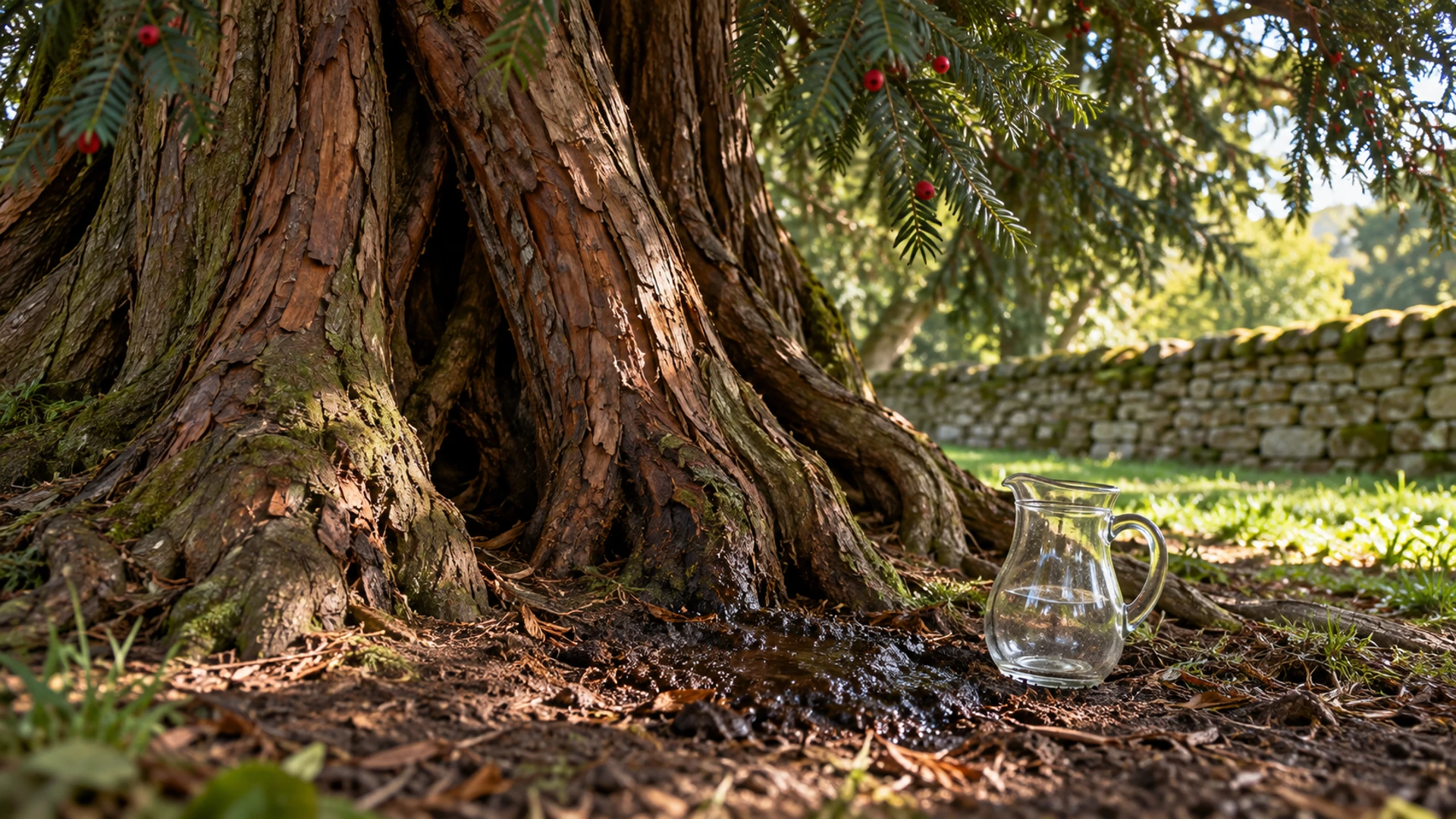
Yew (Taxus baccata) is the ancient evergreen of European churchyards, worked with as a living tree or a sealed piece of seasoned wood for death, rebirth, and ancestor work — not as an ingredient in any brew, bath, or blend.
Death and Rebirth: Yew's Place in Spirit Work
Yew belongs to the Divination and Spirit Work category, and its angle within that category is specific: death and rebirth, the ancient churchyard tree of ancestral continuity. This is not the same as grief or mourning, and it is not about summoning. It is about standing at the threshold where one state ends and another begins, and acknowledging that this threshold has always existed. The practitioner who works with yew is not trying to escape death or contact a particular person who has died. They are working with the oldest ongoing cycle there is.
Among the plants that attend the dead, each holds a different office. Myrrh honors the dead — it descends, preserves, and welcomes the ancestors with the gravity of ancient ritual. Tobacco carries the gift — it is the offering herb, the prayer-carrier that moves between the living and the dead. Yew stands for the cycle itself. It does not mourn and it does not carry messages. It is the fact of death and return made material, rooted in the same ground for centuries before the church was built around it. Among the churchyard evergreens, it stands with cypress: yew for death and renewal, cypress for mourning and consolation.
Yew's correspondences, as Cunningham records them, are Saturn, water, and Saturday. Saturn is the planet of time, limits, endings, and deep structure — the planet that governs what does not change quickly and what outlasts everything else. Water carries memory and the unconscious, the realm below the surface. Saturday is its day. These correspondences fit not because someone assigned them to make yew sound impressive, but because they describe what yew actually is: a slow-growing, ancient, toxic tree that outlives everything around it and keeps growing after the wood has rotted at its core. It has no secondary category. It does not soften into healing or luck. It is exactly what it is.
Churchyard Elders and the Yew Rune
Ancient yews stand in British churchyards, some of them estimated at well over a thousand years old. The Fortingall Yew in Perthshire, Scotland, is the most famous example. Estimates of its age vary widely — and none can be confirmed with precision. What is not in doubt is that it is extraordinarily old and still alive.
The Elder Futhark rune eihwaz is the yew rune, and it carries meanings of endurance, defense, and the link between the living and the dead. Some scholars have argued that the world tree Yggdrasil, the great evergreen axis of Norse cosmology, was a yew rather than an ash — the argument rests partly on the yew's immortality associations. It is a debated reading, not a settled one, and it is worth holding it that way. What the rune itself preserves is the older, quieter truth: that yew was already a tree of deep significance before anyone wrote anything about it.
The tree's toxicity has left its mark on history and literature alike. Julius Caesar records that a Gaulish king, Catuvolcus, poisoned himself with yew rather than submit. In Macbeth, the witches add "slips of yew, sliver'd in the moon's eclipse" to their cauldron — Shakespeare reaching for exactly the ingredient that would signal the darkest possible work. The Pacific yew (Taxus brevifolia) later became the source of paclitaxel, a drug used in cancer treatment, isolated in the second half of the twentieth century. Each of these facts points to the same tree: one that holds both death and a strange continuation of life inside itself at the same time.
A Tree You Visit, Not Harvest
Yew belongs to its own family, Taxaceae — it is a conifer, but not a pine and not a cypress. In practice, it is worked with only as a living tree or as a piece of seasoned, sealed wood. Every part of the plant except the red flesh of the berry is highly toxic, including the seed inside the berry, and this means there are no preparations to make: no tea, no bath, no smoke, no oil. Yew is not eaten, brewed, or burned. Hands are washed after handling it. It is kept well away from children, pets, horses, and livestock, all of whom are vulnerable to even small amounts of the leaves. This is not a reason to avoid working with yew — it is simply the shape of the practice. A living yew in a churchyard or garden, a sealed wooden rune held on the altar: these are the forms yew takes in magic, and they are sufficient.
Three Ways to Work With the Yew
Sitting With a Living Yew
This practice suits anyone who wants to deepen their connection to the ancestor current or who is working through a significant ending — a death, a major transition, or a period that calls for honest reckoning with time and impermanence.
Find a yew in a churchyard or old garden and go to it with intention rather than curiosity. Sit beside the trunk. Bring nothing with you except quiet attention. Saturn hour on a Saturday is the natural timing for this kind of work, though any visit made with full attention counts. Spend at least twenty minutes sitting beside the tree without an agenda. You are not asking the tree anything. You are spending time with something that was old before you were born and will outlast you entirely, and letting that fact do its work. When you leave, that is the whole practice.
An Offering at the Roots
This practice is for ancestor work specifically — for those who want to make a simple, honest gesture of acknowledgment toward the dead without building an elaborate ritual around it.
Bring a small amount of clean water with you to the yew. Stand or kneel at the roots — the base of the trunk, not the tips of the roots — and pour the water slowly onto the ground there. As you pour, speak the names of your dead aloud. These can be family members, people you have lost, or any of the dead you carry. You do not need to address anyone in particular or ask for anything. Speaking the names is the act; the water is the offering; the yew is the witness. If you do not know the names of the dead you want to honor, you can say something as simple as "all those who came before me." The practice is complete when the water is poured and the names are spoken.
A Sealed Yew Rune
This practice is for those who want a permanent physical presence of yew's current on their altar without working with the living tree directly.
Buy a finished, sealed piece of yew wood bearing the rune eihwaz, made by someone who works with the wood properly. Place it on your ancestor altar as a fixed object, not a tool you handle frequently. Its role is to mark the altar as a space that acknowledges the full cycle — not just the warmth of memory, but the fact of death and what follows it. It does not need to be large. It needs to be genuine yew, properly finished, and placed with intention.
The Tree That Outlives the Church
Yew's position in the Divination and Spirit Work category is not incidental. The herbs and plants in that category each hold a specific angle on sight, contact, dreaming, or the spaces between worlds. Yew holds the angle that none of the others do: it is not about seeing the future or calling information, it is about the structure of death and return itself. That makes it the heaviest and the most grounded of the twelve. It holds the fact.
If you want to see where yew sits alongside mugwort, wormwood, yarrow, and the rest of the spirit-work herbs — and how all seven categories of plant magic fit together — the place to look is seven paths through plant magic.