Myrrh: The Resin That Honors the Dead
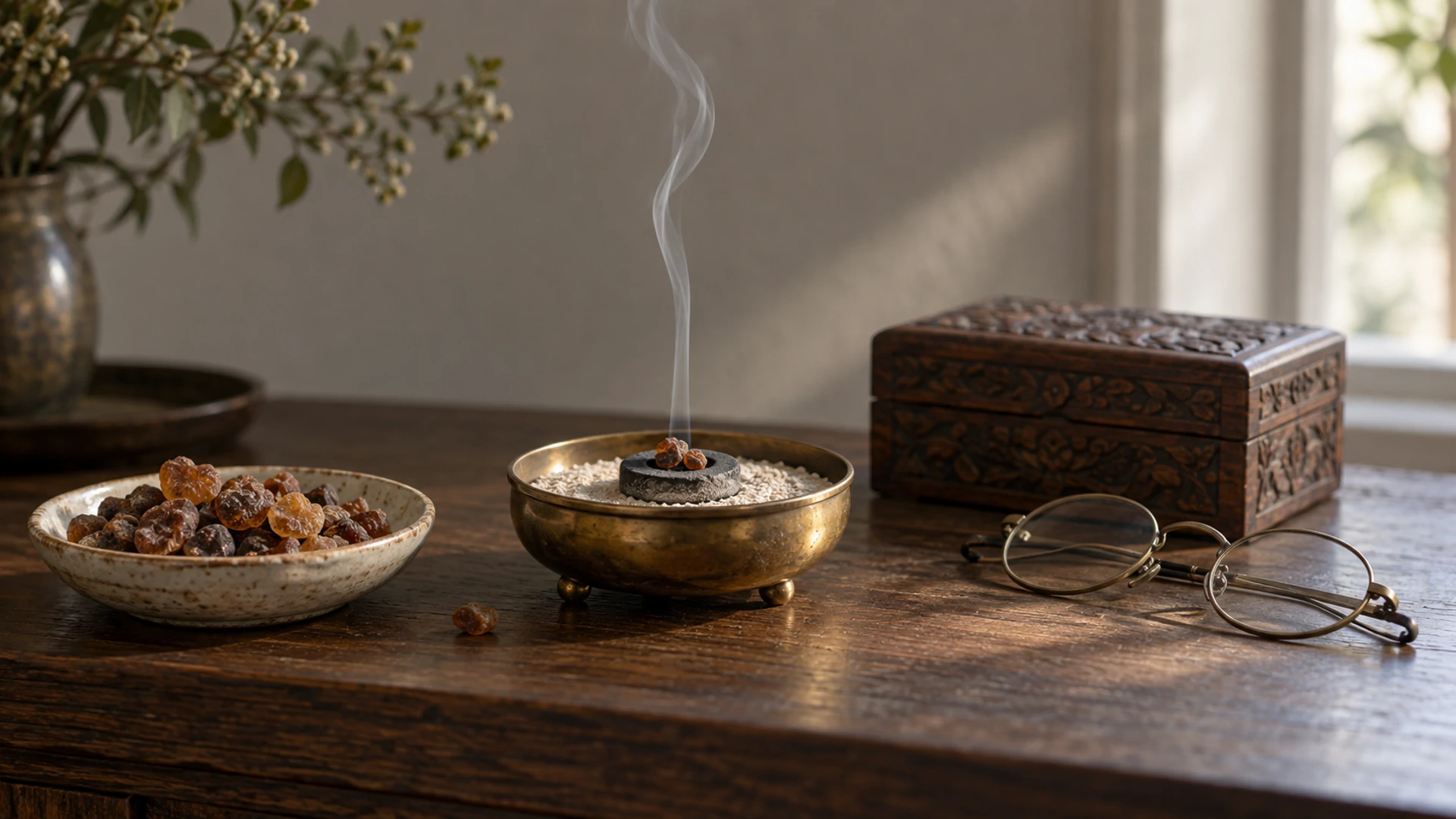
Myrrh is a bitter resin burned on charcoal, often paired with frankincense, to honor the dead and mark an ancestor altar. Cleansing is its second face — a work of preservation and welcome rather than erasure.
Honoring the Dead: Myrrh's Place in Spirit Work
Within the Divination & Spirit Work category, myrrh holds a specific office: honoring the dead. Where tobacco carries prayers and gifts to spirits, ancestors, and the land, and yew stands for death and rebirth as the ancient churchyard tree of ancestral continuity, myrrh descends, preserves, and welcomes the ancestors. It does not summon or command. It creates the right kind of atmosphere — heavy, sweet, a little somber — for the dead to feel acknowledged. That quality is not accidental. The resin itself is produced when the bark of the Commiphora myrrha tree is wounded; what you burn is the tree's response to being cut open. There is something fitting about that.
Myrrh belongs to the Burseraceae family, which places it alongside two other resins with distinct offices. Frankincense rises — it lifts a working toward the divine, consecrates a space, and elevates prayer. Palo santo clears lightly, a sweeter and gentler smoke for everyday cleansing. Myrrh, by contrast, descends. It preserves and honors. Burned together, frankincense and myrrh form the classic resin pair: one reaching up, the other settling in. They have been burned side by side since antiquity, and the pairing works because the two resins pull in complementary directions. Myrrh's secondary category is Cleansing & Purification, though its cleansing is not the sharp, cutting kind. It honors rather than erases.
The correspondences for myrrh are the Moon, water, and Monday — Cunningham's attributions, which fit the resin's nocturnal, inward, and lunar quality. Some modern practitioners assign Saturn instead, reading the funerary associations as Saturnine rather than lunar, and both make sense depending on how you approach it. If your ancestor work feels heavy and long-term, Saturn's discipline and boundary-keeping feel right. If it feels more like emotional tending — keeping the connection alive, honoring cycles of death and return — the Moon holds it better. Neither attribution is wrong; they reflect different aspects of the same work.
Anointing Oil, the Magi, and the Tomb
Myrrh appears in the instructions for the holy anointing oil in Exodus 30:23, listed among its primary ingredients. It is also one of the three gifts the Magi bring in the Gospel of Matthew, and early Christian commentators read it as foreshadowing death and burial — gold for kingship, frankincense for divinity, myrrh for mortality. That reading shaped how myrrh was understood for centuries. The Gospel of John records Nicodemus bringing myrrh and aloes to prepare Jesus's body for burial, myrrh's association with the dead was fully established in the tradition.
Egyptian embalmers used myrrh as part of their preparations, which fits its correspondence with preservation. The resin resists decay — that is part of what made it valuable, practically and symbolically. Greek myth gives it a different origin entirely. Myrrha, the daughter of a Cypriot king, was transformed into the myrrh tree after a transgression she was driven to by divine punishment. From the bark of that tree, Adonis was born. So the resin carries in myth both the weight of grief and the possibility of something new emerging from it — which is not a bad description of what ancestor work asks you to hold.
Tears From Somalia, Ethiopia, and Yemen
Most of the world's myrrh comes from Somalia, Ethiopia, and Yemen, harvested from wild Commiphora trees by tapping or wounding the bark and collecting the hardened resin that bleeds out. It is less studied and less regulated than frankincense, and the supply chain is less transparent, so traceable sources — from suppliers who can name their region and harvester — are worth the extra effort to find.
The working forms are resin tears, oil, and tincture. For most ancestor and spirit work, tears burned on a charcoal disc are the standard approach, usually with frankincense added to balance the heaviness of the smoke. Myrrh oil and tincture appear in anointing work. Myrrh is avoided internally during pregnancy.
Three Myrrh Workings for the Ancestors
The Magi's Pair on the Charcoal
Use this when opening a session of ancestor work — any sitting where you intend to spend time with the dead, whether through prayer, meditation, photographs, or simply quiet attention.
Light a charcoal disc and let it ash over until it is evenly gray. Place one or two myrrh tears on the charcoal first, then add a piece of frankincense beside it. The frankincense will rise immediately, bright and clean. The myrrh will follow more slowly, its smoke thicker and lower, settling into the room rather than lifting out of it. Let both burn without interference. Work in a Moon hour on a Monday for the strongest alignment with myrrh's correspondences. The frankincense opens the space upward; the myrrh anchors it downward, toward the dead. This is not a working that requires words. Sitting within the smoke, with your ancestors in mind, is the practice.
Myrrh on the Ancestor Altar
Use this as an ongoing, low-maintenance way to keep the channel to your ancestors open between more formal workings.
Keep a small fireproof dish of myrrh tears on your ancestor altar, beside photographs, written names, or whatever objects represent your dead. The resin does not need to be burned constantly — its presence on the altar is enough between occasions. On the anniversaries of deaths in your line, or on nights when you feel pulled toward that connection, burn a single tear on a charcoal disc as a mark of remembrance. There is no elaborate preparation required. The gesture is the thing: taking one tear from the dish, placing it on the charcoal, and letting the smoke rise while you hold the name of the dead in mind. This kind of quiet consistency is what ancestor work is actually made of.
A Quiet Smoke After a Loss
Use this in the days after a funeral, when a space needs tending that honors the person who has left without rushing them out.
Burn myrrh tears on a charcoal disc and carry the censer slowly through the rooms of the house, letting the smoke reach into corners. This is myrrh working from its Cleansing & Purification secondary — not the sharp clearing of a banishing smoke, but a settling. The intention is not to remove the presence of the dead, but to acknowledge it and ease the transition. Move without haste. The smoke does the work; your role is to carry it and stay present.
A Welcome for the Dead
Myrrh's angle — honoring the dead, descending toward the ancestors rather than rising past them — places it at a particular point within the broader work of Divination & Spirit Work. That category holds herbs for dreaming, for clear sight, for formal divination, for calling spirits and carrying offerings. Myrrh does none of those things directly. It creates the conditions in which ancestor work becomes possible: a space that feels acknowledged, weighted, and open to the dead in a way that welcomes rather than disturbs.
If you want to see how myrrh sits alongside the other eleven herbs in that category — and the six other paths through plant magic — the Witch's Herbarium is the place to go.