White Candle Magic: Purification, Protection, and the Universal Stand-In
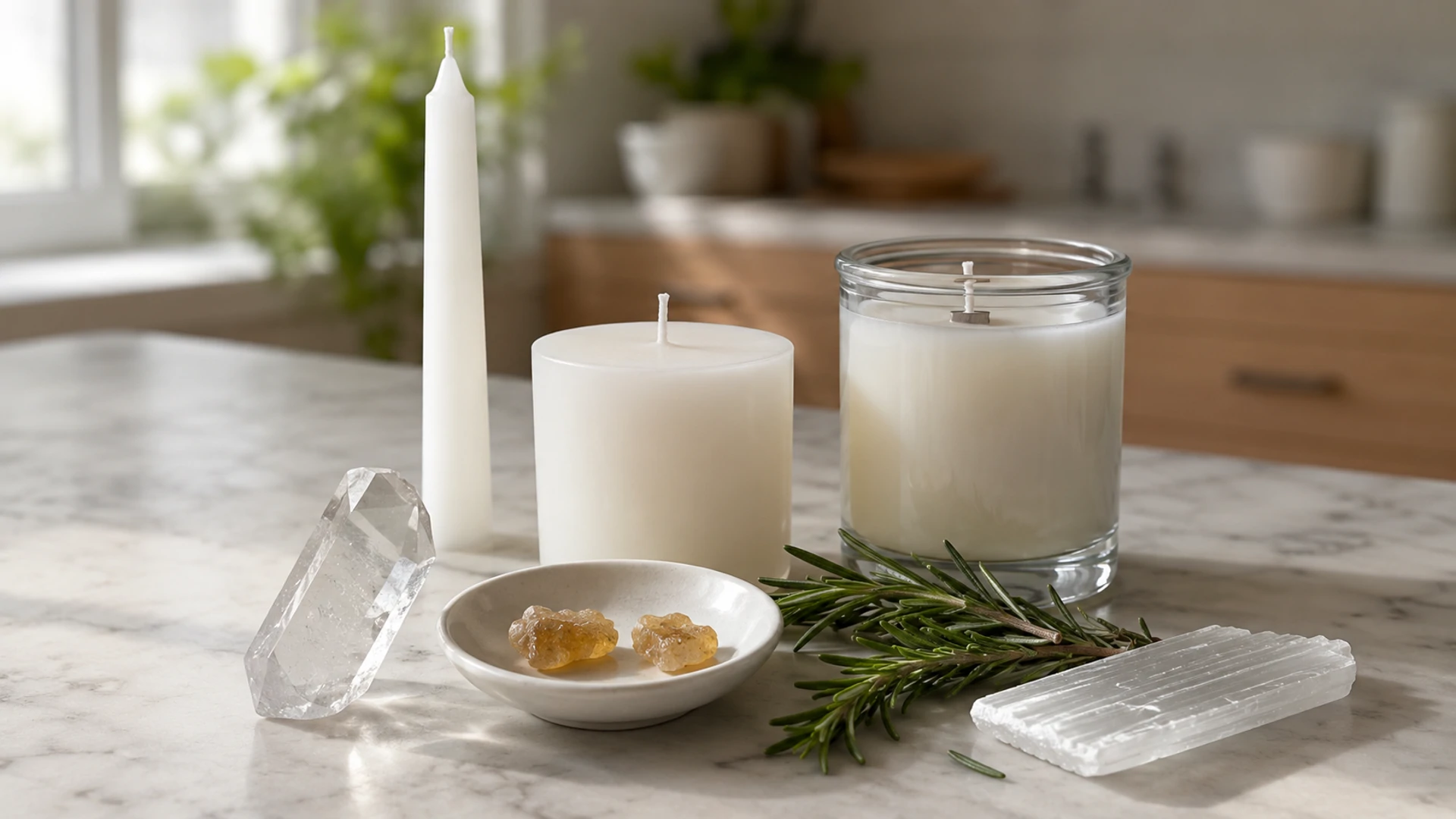
If you could only keep one candle, white is the one. It contains the full visible spectrum of light, which means magically it carries the energy of pure, undirected potential — every color before it becomes specific. That quality gives white a dual nature most colors don't have: it works powerfully as itself, and it can stand in for any other candle when you're without the right color for a working.
The Full Spectrum in a Single Flame
White light holds all color within it. In magical terms, that makes a white candle a vessel for wholeness — not the wholeness of completion, but the wholeness of pure potential before intent has narrowed it into a specific direction. When you light white with no further modification, you're working with that raw capacity. When you direct it, you're choosing which part of that spectrum to call forward.
Purification Across Cultures
White's association with purification isn't modern or invented. In ancient Rome, the flamines — specialized priests of the state religion — wore white wool togas during sacred rites, and white animals were the standard sacrifice for celestial deities. The color marked something as set apart, consecrated, fit for divine contact. Contamination and white couldn't coexist.
In African diaspora traditions, including Lucumí and Candomblé, white is the color of the orishas in their highest, most undifferentiated aspect. It's the color of the ancestors and of Obatalá, the orisha of creation and purity. White cloth, white offerings, and white candles appear at ancestral altars not as decoration but as a direct signal to the spirits that the space is prepared and the practitioner is approaching with clean hands.
In ceremonial magic, white represents the light of the divine before it refracts into the planetary and elemental currents. Working with white in this context means working as close to the source as the visible spectrum allows — before Mars, before Venus, before Saturn, before any specific office takes over.
Truth, Clarity, and Nothing Hidden
White is the color with nothing concealed in it. Shadows require something to cast them, and white has no shadow. This makes it particularly strong for workings around truth — drawing honest communication out of a confusing situation, clearing self-deception before a major decision, or simply asking for clarity when you can't see what's actually happening. It's not a color that reveals hidden things by hunting them down (that's more indigo's territory). White reveals things by removing what was obscuring them.
The Substitute Principle
Because white holds all color within it, you can use it in place of any specific color without losing the core intent of your working. Burning white in a love working — where you'd normally reach for pink — calls in the full love spectrum rather than pink's specific focus on romantic tenderness and emotional healing. Burning white in a prosperity working — where green would usually be the choice — brings abundance potential without the specifically Venusian, earth-energy flavor of green. It works. But it's not the same working. Using white as a substitute draws on the unspecified whole rather than the precise virtue of the original color. For many purposes that's exactly what you need; for others, the specificity of the original color does matter, and white is a practical solution rather than a perfect one.
Divine Connection and Spiritual Opening
White is the candle to light when you're praying, when you're sitting with your ancestors, or when a working needs to align with something much larger than the immediate situation. It's not aspirational — it's relational. Lighting a white candle at an ancestral altar before asking for guidance signals that you're approaching with clarity and respect. Lighting it before a significant ritual signals that you're opening to spiritual influence before directing any specific intent.
This is where purple becomes a meaningful companion to white. Purple carries Jupiterian spiritual authority and third-eye wisdom. Pairing white and purple in a working means the space gets cleared and opened (white), and then higher wisdom is actively invoked into that open space (purple). They're doing genuinely different things — white prepares the field, purple calls in a specific current.
White's Correspondence Profile
White's correspondences root it firmly in lunar and spirit current, which shapes everything from timing to crystal choice to the oils that work best with it. Here's the full correspondence profile at a glance:
- Planet: Moon
- Element: Spirit (Aether), secondarily Water
- Gender: Feminine
- Deities: Hecate, Selene, Artemis, Isis, Brigid, the Ancestors
- Magical properties: Purification, protection, spiritual clarity, truth, new beginnings, universal substitute for any other color
- Associated crystals: Clear quartz, selenite, moonstone, white howlite
- Chakra: Crown (Sahasrara)
The Moon as Ruling Planet
The Moon governs cycles, and that matters practically for how you work with white. A white candle lit on a new moon carries the energy of beginnings — a clean slate, fresh intent, something being called into existence from nothing. The same candle lit on a full moon leans into amplification and culmination, making it better suited for workings where you're drawing something to a peak rather than initiating it. A waning moon is the right time for white's purification and release properties: clearing old energy, cutting what no longer belongs in a space or situation, letting something complete itself. Lunar timing doesn't change what white means, but it does change which of white's virtues you're emphasizing. You can use a silver candle alongside white when you want to draw the lunar connection even more explicitly, since silver is white's more specifically lunar sibling in candle work.
The Crown Chakra Connection
The Crown chakra — Sahasrara — sits at the top of the head and governs connection to the divine, to higher consciousness, and to the awareness that exists beyond individual perspective. White candles activated for Crown work are not about self-improvement in a practical sense. They're about the moments when you need to step outside your own thinking: deep meditation, receiving guidance, working with spiritual allies, or approaching a crossroads that requires more than your current vantage point. If your working has a component of surrender — asking for clarity rather than imposing a direction — white at the Crown is exactly right.
The Four Crystals, Each Doing Different Work
Clear quartz amplifies and clarifies. Place it with a white candle when the issue is confusion — mental or energetic — and you need something cut through cleanly. It doesn't add new energy so much as intensify whatever you're already directing.
Selenite clears residue. Its specific virtue is dissolving stuck or stagnant energy that has built up in a space, object, or person over time. Pair it with white for purification workings where the goal isn't just clarity but actual removal of something that has accumulated.
Moonstone adds emotional and intuitive depth to white's cooler, clearer nature. It's particularly useful when a working touches grief, longing, or anything where the emotional body needs attention alongside the spiritual or mental layers.
White howlite is the patience stone. Its correspondence with calm and with slowing reactive patterns makes it the right crystal when a working requires you to wait, to receive, or to resist the urge to force an outcome before it's ready. Howlite anchors white's energy in stillness rather than movement.
Working With White
The Simplest Working
Lighting a plain white candle with a clearly formed intention is a complete working. Not a placeholder for something more elaborate — a complete working. The candle serves as a focal point for your will, the flame as a transmitter, and the white of the wax as an amplifier of spiritual clarity. Many experienced practitioners return to this form regularly precisely because there's nothing to hide behind. You state your intention, you light the candle, and the work is exactly as focused as your mind is in that moment.
Dressing, Inscribing, and Charging
When you want to build more intentional structure into a white candle working, the three core preparation techniques each offer something specific.
For dressing a white candle, the oils that match its nature most cleanly are frankincense for spiritual elevation and divine contact, sandalwood for purification and sacred space, rosemary for protection and mental clarity, and myrrh for ancestral connection and deep cleansing. For a purification working, apply oil from the wick down to the base to draw energy out. For a protection or new beginnings working, apply from the base up to the wick to draw energy in. The direction carries the intent.
When inscribing a white candle, stick to what's actually meaningful for the working rather than decorating for decoration's sake. For purification, carving a simple spiral or downward-pointing chevron tells the working which direction energy should move. For protection, a circle enclosing the target name (yours, your home's address, someone you're shielding) focuses the boundary clearly. For truth workings, inscribing a single word — the quality you're calling in or the question you're bringing to the flame — works better than a lengthy petition, because white's nature is clarity, not elaboration.
Charging a white candle under moonlight is one of the most direct alignments you can make between the tool and its planetary ruler. Leave the dressed and inscribed candle on a windowsill or outdoors during the relevant moon phase — new moon for new beginnings, full moon for amplification, waning moon for releasing and clearing — and let the lunar current set into the wax before you burn it. Even a few hours of moonlight contact before the working makes a tangible difference in how the candle performs.
Space Clearing and Home Protection
A room that has held illness, conflict, grief, or sustained stress holds that energetically long after the immediate event passes. The air feels thick. People who walk in feel it without knowing why. White candles are one of the most effective tools for moving that stuck energy out.
For a thorough space clearing, work with a dressed white candle — frankincense or rosemary oil — and place pieces of selenite in the corners of the room before you begin. Selenite in the corners creates a boundary that draws stagnant energy toward it while the candle burns at the center. If you have a smudge or smoke practice, lighting a bundle of white sage or ringing a bell at the room's edges before you light the candle opens the energy for clearing before the candle seals it. Speak aloud what you want gone and what you're calling in to replace it. White's nature as light means it doesn't just clear — it fills the vacuum with something clean.
For ongoing home protection, a simple white candle burned briefly at the threshold — front door, main entrance — once a week or at each new moon maintains a layer of energetic cleanliness that prevents accumulation. This doesn't require elaborate ritual; the intention and consistency are what sustain it.
Ancestor Work and New Beginnings
Ancestor work and new beginnings work are both white's domain, but they're pulling on completely different aspects of the color, and they shouldn't be conflated.
White at an ancestral altar is about maintaining an open, clean channel to the dead — specifically the beloved dead, those who came before you and have an interest in your wellbeing. The white candle signals that the line is open and the space is prepared. Offerings left at a white-lit altar — water, food, objects meaningful to the ancestor — carry more clearly through that channel. Hecate and Isis appear in white's deity list precisely because both govern the boundary between the living and the dead and the communication that crosses it. White at this altar is not ambiguous. It says: this space is set apart for you, and I am listening.
New beginnings work with white is different in quality. It faces forward rather than backward. Lighting a white candle at a new moon with the explicit intention of clearing the slate for something new — a relationship, a project, a phase of life — uses white's Spirit element correspondence to call in potential before it has a specific form. You're not invoking an established current; you're opening space for something that doesn't exist yet. That forward-facing openness is one of white's most powerful but least discussed properties. Most colors are specific attractors. White is an opener.
Understand what your working is actually doing before you light the candle, because these two applications — one rooted in the past, one facing the future — require different inner postures even if the candle looks the same.
White is the candle that every other color gets measured against. Learning it deeply — not just its substitute function, but its specific power as a purifier, a truth-bringer, and a spiritual opener — sharpens your understanding of what each other color is actually doing differently. For a full comparison of white alongside every other color in the spectrum, the complete candle color guide maps each one's distinct character and where white converges with or diverges from them.