Jet: The Warm Stone Carried Through Loss
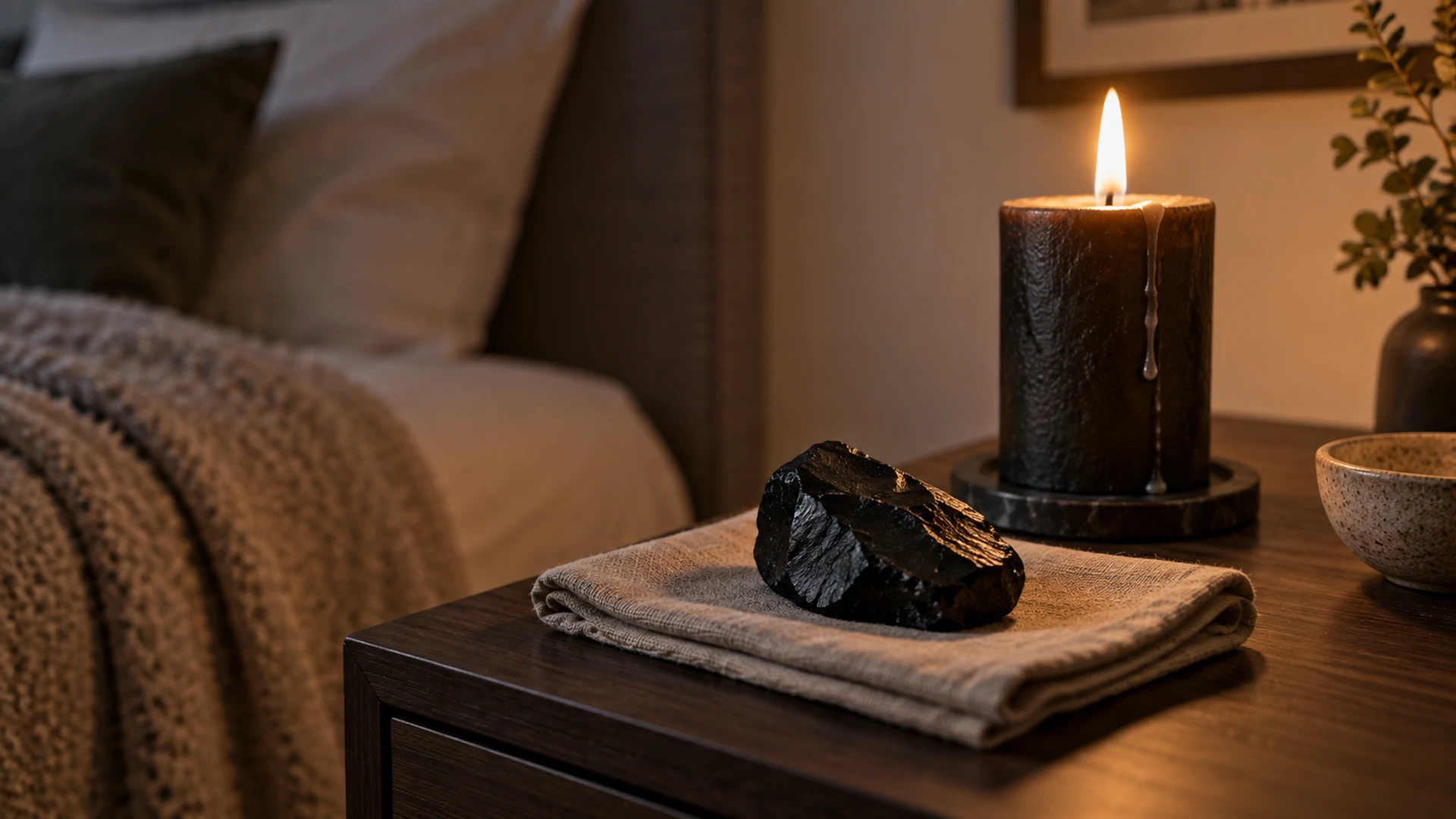
Jet has been worn against the skin during the hardest moments in human life for longer than most protective stones have been named. It is not cold, hard, or distancing — it warms in the hand, it wears easily into jewelry, and it has spent centuries accompanying the grieving.
Warm to the Touch: Why Jet Belongs in Protection
Most people expect a protective stone to feel hard, cold, and dense — something that holds the line through sheer mineral weight. Jet doesn't work that way, and it's worth being specific about why. Jet is not a mineral at all. It's organic in origin: fossilized, compressed driftwood that spent millions of years under sediment pressure until it became a deep, coal-like material. That organic origin is why it feels warm in your hand rather than cold, lighter than it looks, and slightly soft to the touch compared to anything crystalline.
That warmth is not just a pleasant tactile detail. It's the clearest physical expression of what Jet actually does in protection work. Where black tourmaline grounds first, then holds a boundary, and black obsidian reflects and reveals like a mirror, Jet's protection is oriented toward the interior experience of vulnerability. It doesn't deflect. It accompanies. Its category is Protection, but the specific mechanism is protection within grief, ancestor work, and liminal or transitional states — the moments when a person is genuinely open, exposed, and not yet through to the other side of something.
That is a distinct protective function. Grief, death, major endings, and the uncertain long stretch of serious illness all share a quality of threshold: you're no longer fully in one place, but you haven't arrived at the next. Jet is the stone that sits with you in that in-between. The Mohs hardness runs only 2.5 to 4 — genuinely soft by stone standards — and that softness is not a flaw. It's part of the same character. This is not a stone for armoring. It's a stone for accompanying.
Its correspondences follow directly from that role. Jet sits with the root chakra, which governs physical safety, belonging, and survival — exactly the registers that grief and life transition disrupt most acutely. Its element is Earth, grounding rather than energizing. Its planet is Saturn, the ruler of endings, discipline, and the boundary between the living and the dead, which is why Saturn governs both severance and ancestor work in most Western magical traditions. Its sign is Capricorn, ruled by Saturn, associated with long-haul endurance rather than sharp, quick protection. These correspondences form a coherent portrait: Jet is Saturn's stone for the moment after the loss, not for defending against it before it arrives.
Real Jet or French Jet? Choosing and Keeping This Stone
The Victorian mourning industry turned Jet into one of the most widely imitated stones in jewelry history. When demand for Whitby jet outpaced what the Yorkshire coast could supply, a range of substitutes flooded the market: black glass sold under the name "French jet," vulcanite (hardened rubber), and bog oak were all common, and all passed off as genuine jet to grieving buyers who didn't know the difference. The same imitations circulate today, often sold cheaply and without disclosure. If you're sourcing jet for magical or personal use, knowing how to tell them apart matters.
The most reliable simple test is one Jet shares with amber: both are organic, carbon-rich materials, and both build a faint electrostatic charge when rubbed briskly against cloth. Rub your piece on the inside of your sleeve for thirty seconds, then hold it near small bits of paper, lint, or fine hair. Genuine jet will attract and pick them up. Black glass — the most common imitation — will not. You can also pay attention to weight and temperature before you rub it. Real jet feels noticeably lighter than glass of the same size, and it will feel warmer in your hand more quickly, because organic material transfers and holds warmth differently than silicate glass or plastic. A piece that feels cool and heavy is almost certainly not jet.
Whitby jet, the finest quality and the historic standard, comes from a very specific geological deposit on England's Yorkshire coast. You'll also find jet from Spain and the United States, with varying quality. If you're purchasing from a reputable lapidary or gemstone dealer, genuine jet should be disclosed as such, with provenance ideally noted. The price difference between genuine jet and its imitations is significant — if a piece is very cheap, it is almost certainly glass or vulcanite.
Once you have a genuine piece, care is more demanding than for any true mineral in the protection category. Jet's softness makes it genuinely fragile: it chips and scratches easily, so store it away from harder stones. It is flammable and heat-sensitive — keep it away from open flames, direct heat, and prolonged sunlight. It's porous, which means prolonged soaking will damage it, and the organic structure makes it reactive to perfume, hairspray, and household chemicals. Apply any cosmetics or fragrances before putting on jet jewelry, never after. Wipe it down with a dry, soft cloth rather than rinsing it. If it's been worn during a heavy working or a prolonged period of grief, cleanse energetically with smoke or sound rather than water.
Three Practices for Grief, Ancestors, and Thresholds
The Mourner's Hold
This practice is for the acute period of active grief — the days and weeks immediately following a significant loss, when the weight of what happened hasn't yet settled into anything that feels like bearable.
Carry or wear the jet piece continuously during this period. The historical precedent is direct: Victorian mourning jewelry was not decorative in any ordinary sense. It was worn against the skin as a sustained, physical companion — a way of making grief legible to the body without needing to articulate it to the mind. Jet's warmth is the point here. When you find the stone warm in your pocket or at your throat, let that warmth be a straightforward acknowledgment of where you are. You're not trying to move through the grief faster or channel it into anything productive. The stone simply stays with you. If you want to layer in a candle, a black candle held for the duration of a quiet evening is a natural pairing — Saturn's color, for Saturn's work.
The Ancestor's Ember
This practice is for ancestor veneration or contact work — deliberate, intentional communication with or remembrance of someone who has died, rather than grief in its raw, immediate form.
Place the jet piece at the center of an ancestor altar, or hold it in both hands while you speak to, write to, or simply remember the person. Jet's organic origin gives it a particular relevance here: it is literally material that was once living — ancient wood, transformed over vast time — and that continuity across states of being is the exact energy ancestor work draws on. The warmth the stone develops in your hands becomes the felt anchor for the connection. You're not summoning or invoking in any formal sense; you're simply holding something that has always been associated with the boundary between the living and the dead, and letting that association do quiet work. If you work with a Saturn hour, Saturday evenings are the most naturally aligned time for this practice.
The Quiet Passage
This practice is for liminal life transitions that aren't specifically about death — a major ending, the final stretch of a long illness, a period of genuine unknowing when you are between one version of your life and the next.
Carry the jet piece on your person for the entire duration of the transition, rather than placing it as a fixed point on an altar. The distinction matters: a fixed placement implies a destination already known. Carrying it means it moves with you through the unknowing. This is a sustained practice measured in weeks or months, not a single ritual night. Jet's Saturn correspondence aligns it with the long arc of serious endings — the kind where there's no clean closing moment, just a slow passage through difficulty toward something that isn't yet visible. You don't need to speak to it or direct intention at it deliberately. Wearing or pocketing it is the practice. Let the stone's warmth, returning to you each time you reach for it, be enough.
The Ornament Shall Be Jet: Whitby's Mourning Industry
In 1830, the Lord Chamberlain's office issued the formal English royal mourning dress code, and the relevant line was unambiguous: "the ornament shall be jet." That single sentence had consequences measured in livelihoods. Whitby, a fishing and whaling town on the Yorkshire coast, sat directly above the geological deposits that produced the finest jet in the world — a specific variety of fossilized Jurassic-era wood from the cliffs and beaches of the North Yorkshire coast — and for the better part of the nineteenth century, the town's economy pivoted around harvesting and crafting it.
The industry existed before 1830, but it was modest. The scale changed dramatically after Prince Albert's death in 1861. Queen Victoria's decision to wear jet for the decades of mourning that followed made it the defining material of Victorian grief culture. Roughly 50 jet workshops operated in Whitby before Albert's death. Within two decades, that number had grown to more than 200, employing somewhere in the region of 1,500 people at the industry's height — jet turners, carvers, polishers, and dealers whose entire livelihoods depended on the intersection of royal fashion and national mourning custom.
What this history makes plain is that jet was not chosen for Victorian mourning jewelry because it happened to be dark. It was chosen because it had already been associated with protection during grief for long enough that it was the obvious and authoritative answer. The royal dress code didn't invent that association — it codified and industrialized it. The imitations — French jet, vulcanite, bog oak — flooded the market not because they were equivalent but because genuine jet couldn't be extracted fast enough. That flood of imitation is itself evidence of how strong the cultural demand was: people wanted to carry the real thing specifically because the real thing was understood to carry specific meaning, not just a matching color.
A Companion for the Hardest Passages
Jet's place in the Protection category is not the most obvious fit at first glance. It's soft, organic, warm, and associated with loss rather than with the image of a guardian or a ward. But the protection category is broader than warding off external threat — it includes the kind of support that holds you steady when you are genuinely vulnerable, not because something is attacking you from outside but because life has opened you up in some unavoidable way. That is Jet's specific territory, and nothing else in the Protection cluster covers it in the same way.
If you want to see how Jet sits alongside the other protection stones — and how protection itself relates to the six other categories of stone magic — The Crystal Compendium: Seven Paths to Stone Magic is the place to start.