Frankincense: The Resin That Raises a Room
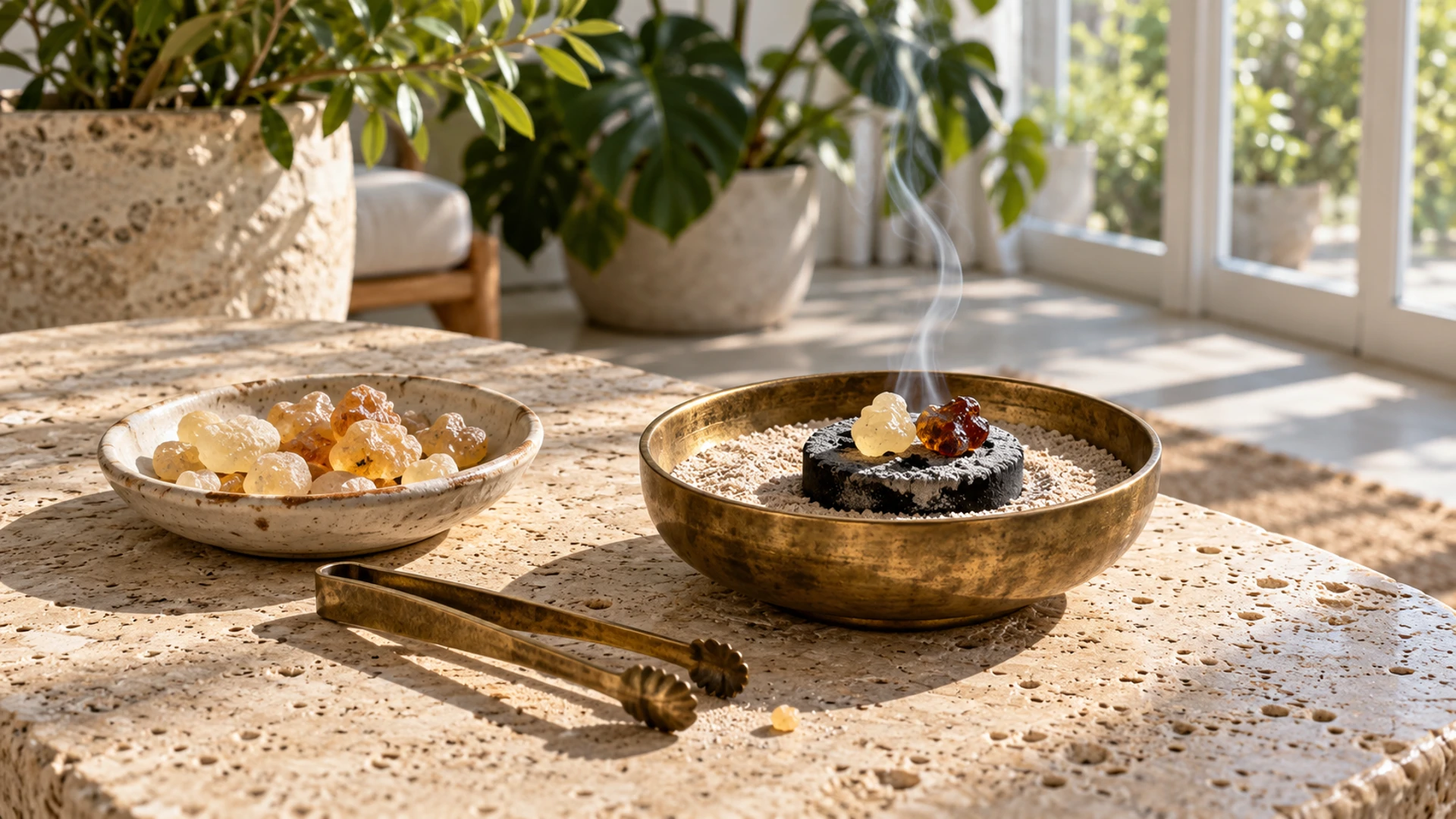
Frankincense is a dried tree resin burned on charcoal to consecrate a space before ceremonial work — one of the oldest continuously used incenses in the world, present in Egyptian temples, Catholic censers, and home altars alike.
Consecration by Lifting: Frankincense's Place in Cleansing
Frankincense's specific role in cleansing practice is consecration by lifting. It doesn't sweep a space clean the way white sage does its forceful clearing, and it isn't about settling or stilling. It raises the atmosphere of a space toward something higher before you begin ceremonial work. That distinction matters in practice. When you burn frankincense at the start of a ritual, you're not just removing stagnation — you're marking the space as sacred, deliberately different from ordinary air. That quality is why it opens ceremony rather than closing it, and why traditions as different as Catholic Mass and Western ceremonial magic reach for the same resin.
The contrast with sandalwood is the clearest way to understand frankincense's angle. Both are consecrating smokes, but sandalwood consecrates by quieting — it settles and stills a space, making it suitable for meditation and altar work. Frankincense consecrates by lifting — it actively elevates a room toward the sacred rather than drawing the atmosphere inward. One moves down into stillness, the other moves upward into ceremony. In practice, this makes frankincense the better choice when you need a space to feel formally opened rather than simply calm.
Its correspondences are the Sun, fire (Cunningham), and Sunday. A solar incense isn't just warm or bright in a vague sense — solar correspondence means vitality, clarity, and direct connection to a source of power. Its secondary category is Divination and Spirit Work, not because frankincense unlocks psychic abilities in any direct way, but because its entire history is inseparable from prayer and devotional practice. Burning it in temples and censers is an act of communication upward, an offering to whatever sits above the worshipper. That's the mechanism: the smoke carries intention in a tradition so old it predates any single religion's claim to it. Botanically, frankincense is the dried resin of Boswellia trees — primarily Boswellia sacra from Oman, Yemen, and Somalia, but also B. papyrifera from Ethiopia, Eritrea, and Sudan, and B. serrata from India. All of these belong to the Burseraceae family, the torchwood family it shares with myrrh and with palo santo.
From the Holy Incense of Exodus to Today's Censer
Frankincense appears by name in Exodus 30:34, listed as one of the four ingredients of the holy incense burned in the Tabernacle. By the time the Magi bring it as one of their gifts in Matthew 2:11, it already carries centuries of association with worship and offering — its presence among the gifts reads as fitting precisely because it was already the smell of sacred space in the ancient Near East. Egyptian temples burned it. So did Greek and Roman ones. The Catholic and Orthodox churches still do, in the same swinging censers used for more than a thousand years. Frankincense is not a practice borrowed from one tradition by another — it is one of those rare substances that civilization after civilization took up and kept.
One of the most significant frankincense landscapes in the world is the Dhofar region of Oman, recognized by UNESCO as the "Land of Frankincense" and listed as a World Heritage Site because of both its ancient trade routes and its living Boswellia sacra groves. In Oman, the resin is not only burned — it is also traditionally chewed, a practice that gives it a domestic, everyday dimension quite different from the ceremonial distance it carries in European religious use. The same resin that rose in Catholic cathedrals was also something a person chewed while going about their day. That kind of double life, both sacred and ordinary, is part of what makes frankincense such a persistent presence across human history.
A Resin Running Short
A 2019 study published in Nature Sustainability by Bongers and colleagues looked at Boswellia papyrifera populations across their range in Ethiopia, Eritrea, and Sudan and found them in serious decline. The study projected that frankincense production from these trees could halve within approximately twenty years, driven by overexploitation, insects, cattle grazing, and fire. Boswellia sacra — the species from Oman, Yemen, and Somalia most associated with premium "sacred frankincense" — is assessed by the IUCN as Near Threatened. Neither species is labeled endangered, but the direction of the data is clear enough to take seriously.
For practitioners, this has a practical implication. When you buy frankincense resin, look for a label that names the species and the country of origin. A seller who can tell you whether they're offering B. sacra, B. papyrifera, or B. serrata, and where it came from, is more likely sourcing responsibly than one selling unlabeled "frankincense tears" in bulk. Beyond sourcing, the simplest thing you can do is use it intentionally rather than abundantly. A few small tears on a hot charcoal disc is a full working. You do not need a thick cloud of smoke to feel the effect — frankincense is potent at a small quantity, and restraint here is both practically sound and ecologically sensible.
Charcoal, Tears, and What the Oil Is For
Burning frankincense resin requires a charcoal disc made for incense use — not barbecue charcoal. Hold the disc with tongs, light its edge, and set it in a heatproof dish on a layer of sand or a bed of ash, which insulates the dish from the heat underneath. Wait until the disc glows and greys over across the surface, which takes a couple of minutes. Then place two or three small tears of resin directly on the disc. The smoke will rise almost immediately. If the tears are placed on a charcoal that isn't fully lit, they melt and run before they vaporize, producing an unpleasant smell. Patience on the charcoal is the whole technique. The frankincense essential oil is for a different application entirely — it is diluted and used for anointing, not placed on charcoal. Oil applied to a hot disc doesn't produce the same smoke and can spit.
The safety notes for burning resin are mostly common sense: work in a ventilated room, keep smoke away from birds and small pets, and be careful around anyone with asthma or reactive airways. The less obvious hazard is the charcoal disc itself, which retains heat long after the visible smoke stops — sometimes for an hour or more. Set it only on a non-flammable surface, never leave it unattended on something combustible, and let it cool completely before disposing of it. A thin layer of sand in the dish serves double duty: it insulates the surface below and makes cleanup easier after the disc cools.
Three Workings for Setting Sacred Space
Opening a Ceremony on a Sunday
Use this at the start of any formal working when you want to mark a clear shift from ordinary time into sacred space, especially on a Sunday or during a Sun planetary hour.
Light your charcoal disc and let it grey over fully. Set it in the center of your workspace or at the head of your altar. Place two or three tears of frankincense resin on the disc and let the smoke build for a moment before you do anything else. Stand or sit in the smoke briefly — not to fumigate yourself, but to register the change. Speak aloud or internally what you are opening: the space, the working, the attention you're bringing. Frankincense doesn't do this for you — it gives your intention a sensory anchor, a signal to the mind that ordinary space has ended and ceremonial space has begun. Let the resin burn down before you begin your main working, so the smoke is part of the opening rather than background noise throughout.
The Solar and Lunar Resin Pair
Use this for prayer, sustained meditation, or any working with a devotional or divinatory quality, where you want both solar clarity and lunar depth present at once.
Burn frankincense and myrrh together on a single charcoal disc, placing a tear of each side by side. These two resins have been burned together since antiquity — frankincense solar, myrrh lunar — and this is exactly where frankincense's secondary Divination and Spirit Work quality lives. The combination doesn't require elaborate ritual framing. Place the disc, add the resins, and sit with what you're bringing into the space: a question, a prayer, an ancestor you want to acknowledge, a meditation you want to deepen. The paired smoke creates an atmosphere of both clarity and receptivity. If you are working with cards, a scrying surface, or simply sitting in contemplative stillness, this is the pairing that supports that kind of attention. Frankincense carries the intention upward; myrrh holds the contact with what is below and behind.
Anointing a Gold Candle
Use this when you want to consecrate a new altar space or formally open a working that will be carried forward over time.
Dilute frankincense essential oil in a carrier oil — a few drops per teaspoon is enough — and dress a gold candle from base to tip, which draws energy toward the candle and into the working. Hold the candle for a moment with clear intention before you set it in its holder. Gold carries solar correspondence, which aligns directly with frankincense's Sun rulership, making this one of the cleaner correspondence pairings in candle work. Light the candle as the formal opening act of the new space or working. The anointed candle isn't decorative — it's the marker that the space has been consecrated and is now in use.
The Smoke That Points Upward
Frankincense sits at the edge of the Cleansing and Purification category where clearing turns into consecration. Other herbs in this category clear what's present — they move stagnation out, reset atmosphere, or establish a boundary. Frankincense does something slightly different: it lifts what's already there toward something sacred, which is why its use survives intact across thousands of years and dozens of traditions. That specificity is what makes it worth understanding on its own terms rather than as a generic incense.
If you want to see how frankincense sits alongside the other cleansing and purification herbs — and the six other categories of plant magic — the full witch's herbarium guide is where those threads come together.