Black Onyx: The Stone That Protects by Outlasting
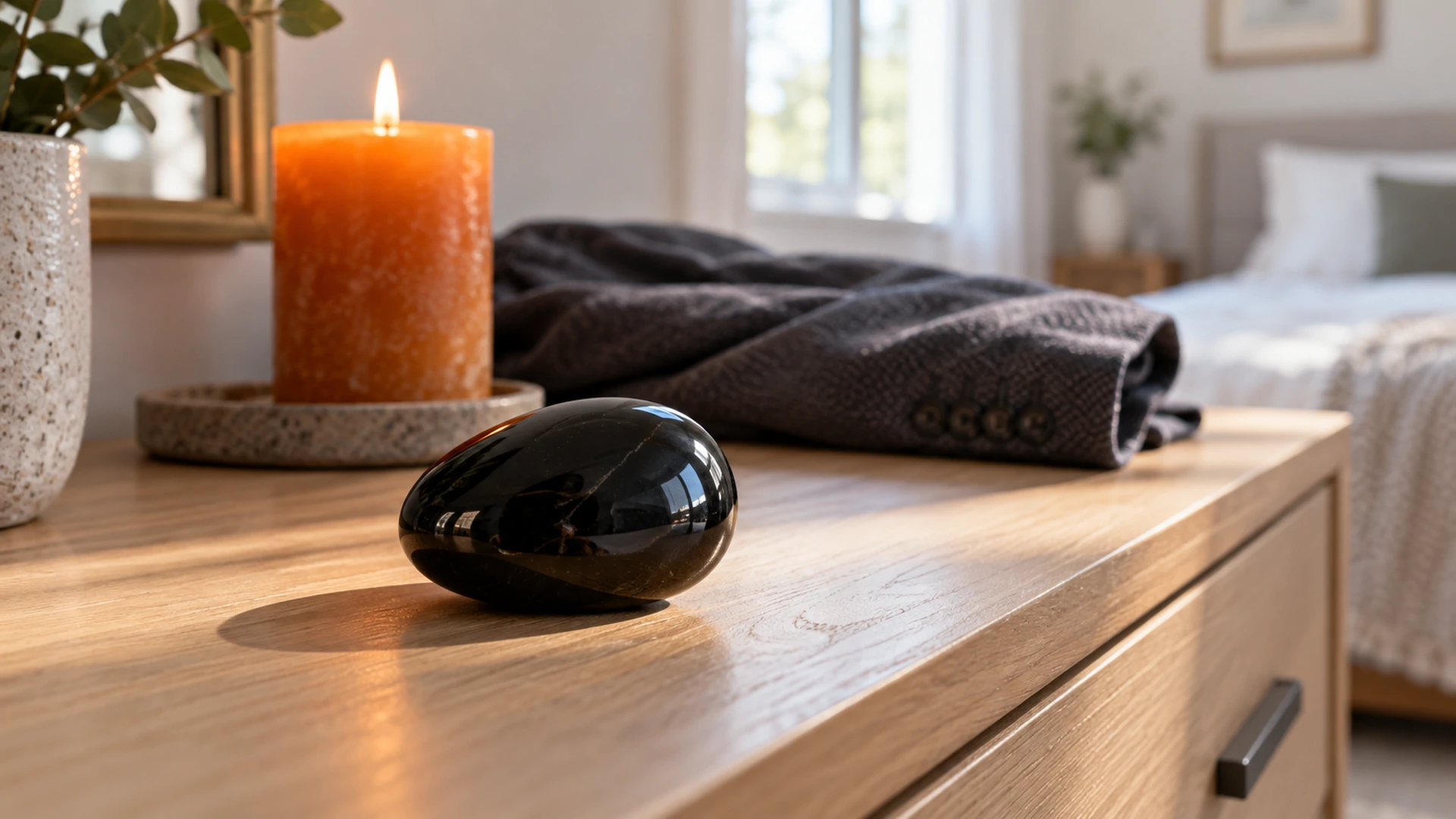
Black onyx is a Saturn-ruled chalcedony whose protection works through sustained fortitude rather than a single dramatic block — it's built for the long game, not the ambush.
Endurance, Not Deflection: Why Black Onyx Belongs in Protection
Most people reach for black onyx the way they'd reach for any dark, dense stone — for general shielding, for warding, for keeping something out. And it will do that. But that framing misses what makes this stone specific. Black onyx doesn't deflect in the way that black obsidian does, functioning as a mirror that reflects unwanted energy back at its source. It doesn't transmute the way smoky quartz does. What black onyx does is build endurance from the inside out, giving you the steady ground to keep standing when a situation doesn't resolve quickly.
That distinction matters practically. Acute threats — a sudden psychic attack, a confrontational person entering your space — suit tools with an immediate, reactive edge. Black onyx isn't that. Its mechanism is closer to discipline and staying power: the ability to move through a hostile workplace without being hollowed by it, to carry yourself through a drawn-out legal process without losing your footing, to remain present and functional through months of caregiving without your sense of self dissolving. It's a stone for situations that demand you show up, repeatedly, over time, without a clear end date.
This is where its Saturn correspondence becomes central rather than incidental. Saturn governs endurance, structure, and the kind of earned strength that comes through sustained difficulty — not the kind granted by an easy victory. Its root chakra alignment grounds this endurance physically: Saturn's discipline operates through the body, through the nervous system's capacity to stay regulated under pressure, through the felt sense of being rooted rather than braced. Leo and Capricorn are the two signs most consistently paired with black onyx. Leo speaks to the confidence required for visible steadiness — the ability to be seen, to hold authority, to not collapse under scrutiny. Capricorn speaks to the longer arc: the slow, cumulative build of achievement, the willingness to endure without immediate reward. Together, these two signatures describe the full range of what black onyx supports.
Earth is its element, and that's not incidental either. Where fire-element stones push outward and water-element stones absorb or flow, Earth holds. Black onyx holds. It doesn't amplify your energy or redirect an attacker's — it gives you the stability to not be moved by what wants to move you. Among the protection stones, black tourmaline grounds first and then holds a boundary, and hematite works through physical density and weight. Black onyx operates differently: it builds its protection over time, through repeated wear and consistent intention, becoming more attuned to your field the longer you carry it. It's one of the few protection stones that genuinely rewards patience.
Only 2 Percent Natural: Choosing Real Black Onyx
Genuinely uniform natural black onyx is rare. Most onyx is banded — alternating layers of black, white, grey, or reddish-brown chalcedony — and the solid, even black material that commands the protective stone market makes up only a small fraction of what's actually excavated. The overwhelming majority of commercial black onyx is dyed chalcedony, typically grey or lightly banded material that has been treated with a sugar solution and then acid to fix a deep, stable black color throughout the stone. This is a long-standing, industry-standard practice, documented in gem trade literature for well over a century. It isn't a scam — it's an accepted method, and virtually no seller is misrepresenting the material type when they call the result black onyx. What it means is that your piece is almost certainly dyed, and knowing this before you buy will save you surprises later.
The practical implication for care is specific: dyed material can fade or bleed color with prolonged soaking or exposure to household chemicals. Brief water contact — a quick rinse — is generally fine and won't damage the stone, but don't leave it submerged, don't clean it with anything acid-based, and keep it away from perfumes, cleaning sprays, and similar chemicals that could interact with the dye. Polished black onyx is stable and durable under normal wear conditions. Its Mohs hardness sits at 6.5 to 7, which means it handles daily contact well without scratching easily, but you'd still do well to store it away from stones harder than itself to avoid surface wear on the polish.
When choosing a piece, look for a surface that reads as genuinely opaque and even under direct light. Very cheap material that shows a slightly uneven or patchy black — or that bleeds onto a damp cloth when wiped — is likely a lower-quality dye job. Better-treated material will hold its color firmly. Natural, undyed black onyx does exist, but it commands a significant premium and should be disclosed as such by any reputable seller. For protection work, the metaphysical community widely holds that the treatment doesn't undermine the stone's energetic function — it's still chalcedony, still structurally dense, still Earth-element and Saturn-aligned. The intention you bring to it is doing the primary work regardless of whether the black comes from nature or from a sugar-acid treatment that's been standard since antiquity.
Three Practices for Protection That Outlasts
The Long Vigil
This practice is for situations without a clear resolution date — a hostile workplace, a drawn-out medical or legal process, an extended caregiving burden that has no near end in sight.
Begin on a Saturday, or during a Saturn hour, to open the working under the planet that rules this stone and governs long endurance. Hold the piece in both hands and name the situation plainly — not what you want from it eventually, but what you are being asked to carry right now. Set the stone on a dark cloth or a small dish of dry earth overnight. The following morning, place it in your left pocket or on your body, and commit to carrying it continuously until the situation resolves or a natural break point arrives. Cleanse it by smoke or dry moonlight every full moon during that period, not more frequently — the point is not to constantly reset it, but to let it build continuity with your field across time. When the situation ends, formally thank the stone and give it a final cleanse before putting it away or passing it on.
The Soldier's Resolve
This practice draws on the Roman tradition of carrying onyx engraved with Mars as a source of courage and visible steadiness — suited to Leo's register, for moments that require you to hold your presence in public, under pressure, in front of others.
Choose a piece small enough to hold in a closed fist. Light an orange candle for Leo's confidence register, and hold the stone at your sternum — not your heart, your breastbone — for the duration of a single slow breath in and out. Name the specific moment you are preparing for: a confrontational meeting, a public presentation, a situation in which you will need to be seen as steadfast rather than shaken. Press the stone firmly in your palm three times, then carry it into the situation in your dominant hand's pocket. This is not about invisibility or retreat. It's about being present enough to hold ground under scrutiny. A small piece of carnelian alongside it deepens the fire-element charge if you find the situation calls for more active confidence rather than quiet endurance.
The Sealing
This ritual uses onyx's deep historical identity as a carved signet material — the stone literally used to press official decisions into wax — to formally close a chapter or commit to a course of action that you've been circling.
Perform this at the end of a Saturn hour, ideally on the dark moon. Write the thing you are sealing — the decision made, the chapter ended, the situation you are choosing to walk away from — on a small piece of paper. Fold it once away from your body. Place your black onyx piece on top of it, pressing down firmly with the heel of your hand as you would press a seal into wax. Hold the pressure for the count of seven, which is Saturn's number. Leave the stone resting on the paper until sunrise. Then burn or bury the paper, and cleanse the stone. Unlike the Long Vigil, this is a single act, not an ongoing carry — it closes something rather than sustaining it. If you have been using a black candle for any clearing or banishment work leading up to this decision, burn the last inch of it during this ritual to complete that arc before the sealing.
The Gemma Augustea: Onyx Carved for an Emperor
The most complete surviving example of what onyx can be made to carry is the Gemma Augustea, a two-layered sardonyx cameo measuring roughly 19 by 23 centimeters, carved between 9 and 12 CE to commemorate the Roman emperor Augustus. It survives today in the Kunsthistorisches Museum in Vienna, one of the most technically accomplished carved gems of the ancient world. On its upper register, Augustus sits enthroned alongside the goddess Roma, holding a lituus — the augural staff used to read divine signs — while a victory figure crowns him. Below, Roman soldiers erect a victory trophy over defeated enemies. The piece isn't decorative. It's political and religious at once: a layered statement of divine authority, military power, and imperial permanence, pressed into a stone whose layers allow the carver to sculpt in contrasting relief.
The choice of sardonyx — a banded variety that combines reddish-brown sard and white or black onyx layers — rather than any other gem is deliberate. Cameo carving exploits the stone's natural layering, cutting away the upper white layer to reveal the darker ground beneath, creating a standing figure in light against a dark field. Onyx and sardonyx were the prestige materials for this work precisely because of their layered structure and their hardness, which holds carved detail over centuries. The Gemma Augustea has held its carving with extraordinary fidelity for over two thousand years.
Roman soldiers operated in a related but more direct tradition. Carrying onyx amulets engraved with the god Mars was common military practice, with the belief that the stone channeled Mars's courage and martial endurance into the wearer. Where the imperial cameo speaks to dynastic permanence and divine legitimacy, the soldier's amulet speaks to something simpler: staying power under conditions that should, by rights, break a person. The two uses are more continuous than they appear. Both treat onyx as a stone of endurance rather than aggression — a material that carries the weight of what's being asked of you, and holds it steady.
The Long Game of Protection
What black onyx contributes to any protection practice is the thing that's easiest to undervalue and hardest to fake: the capacity to keep going when the threat isn't a single event but a sustained condition. That's a real need, and it's one that a sharper, more reactive stone doesn't always serve. Not every situation calls for a mirror or a blade. Some situations call for a foundation.
If you want to see how black onyx sits alongside the rest of the protection stones — and how protection relates to the other six categories of stone magic — The Crystal Compendium: Seven Paths to Stone Magic is the place to go next.