Grey Candle Magic: The Deliberate Art of Not Choosing a Side
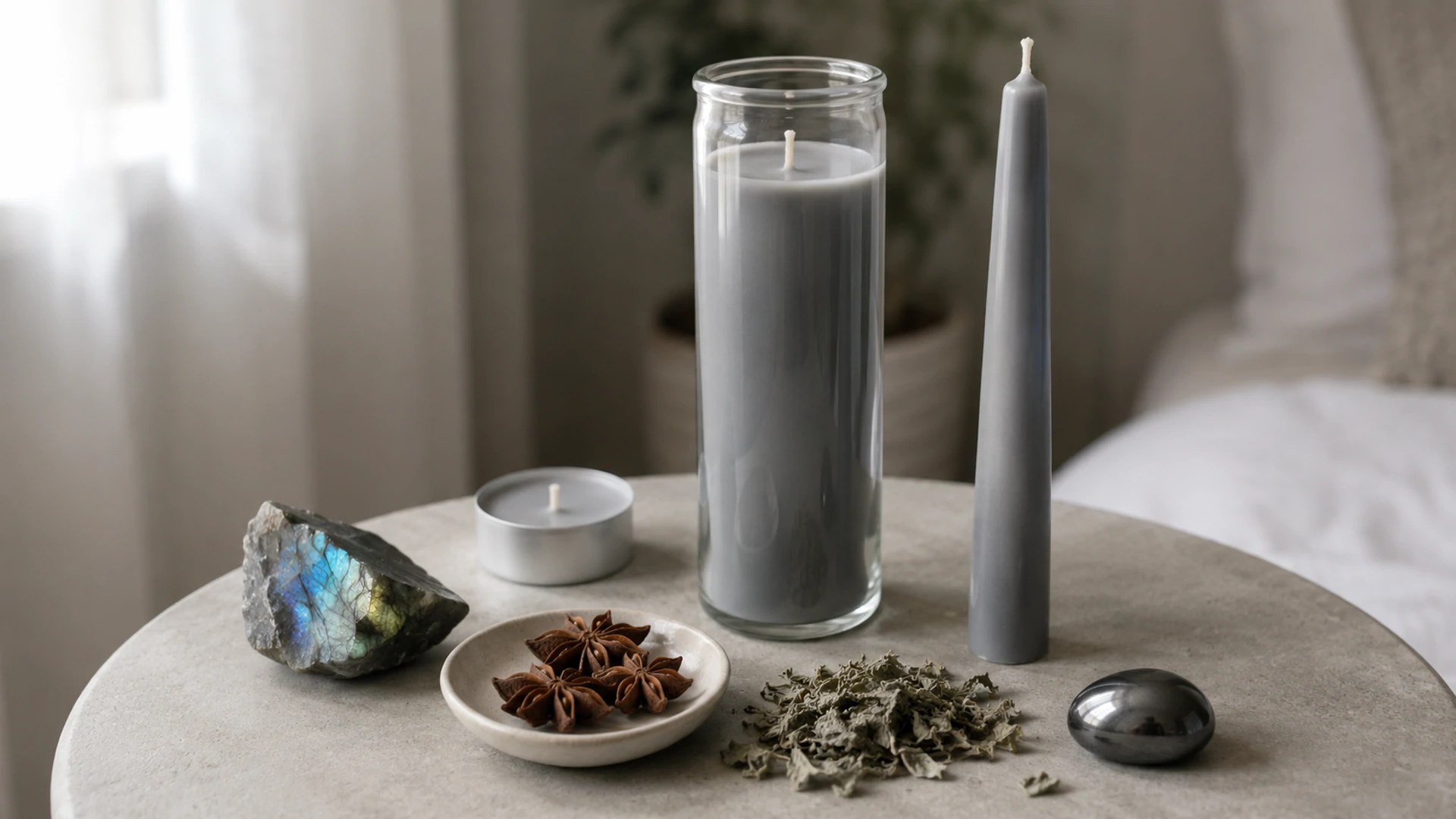
Most people reach for white when they want clarity, for red when they want force, for black when they want protection. Grey doesn't show up in those obvious associations, and that's exactly what makes it valuable. Burning grey isn't a hedge or a compromise — it's the deliberate choice you make when taking a side would compromise the working itself. Grey candle magic is built for situations that require you to hold a space, see clearly without tipping the scales, or move through a situation without being detected. That's a specific skill, and grey is the tool for it.
The Power of the In-Between
Neutrality as an Active Skill
There's a common assumption that not choosing a side means not doing anything. In magical practice, that reading is exactly backwards. Holding a neutral space — genuinely suspending the pull toward a preferred outcome — takes more focused will than simply pushing hard in one direction. It means your intention is trained on stillness itself, on creating a field where no force currently dominant gets to win by default. That's an act, not an absence of one.
When you burn grey for neutralization, you're not waiting for something to resolve on its own. You're actively placing your will between competing pressures and refusing to let either one consolidate. In conflict situations especially, that refusal to amplify is often the most powerful thing you can do.
The Connection to the Unseen: Mist, Smoke, and Seeing Through Illusion
Mist doesn't obscure randomly — it softens the hard edges of things so you can see their outlines rather than their surfaces. Smoke rises through layers without belonging to any of them. These are grey phenomena, and they map directly onto what grey does in divination and perception work. Grey doesn't confront illusion head-on; it dissolves the contrast that illusion relies on, making what was hidden easier to read.
This is why grey candles are suited to scrying, pendulum work, and any working where you're trying to receive information accurately rather than confirm something you already believe. The neutral quality isn't a limitation — it's what keeps your own projections from contaminating the signal.
Protection Through Concealment
Grey's protective quality works through invisibility rather than armor. Where black candles protect by absorbing hostile energy — actively drawing it in and neutralizing it — grey protects by making you or a situation harder to locate in the first place. Black is a boundary; grey is a fog. Both are Saturn-ruled, which is why both carry protective force, but the mechanism is completely different.
Psychic camouflage is probably the clearest way to understand grey's protective work. You're not building a wall between yourself and something threatening. You're reducing your energetic profile so there's less to target. This is particularly useful in situations involving ongoing conflict, surveillance, or unwanted attention — circumstances where a confrontational defense would escalate rather than resolve.
Shadow Work Through Grey's Lens
Shadow work with grey candles is not about confrontation or release. That's black's territory — active excavation, pulling something difficult into the light and burning through it. Grey's version is quieter and, in some ways, harder. It's about witnessing without forcing a direction. Sitting with what's uncomfortable without immediately trying to categorize it as something to fix or expel.
When you use grey for this kind of inner work, the aim is clear-eyed observation without the urgency to resolve. Sometimes the most honest thing you can do with a difficult part of yourself is look at it steadily for a while before deciding what it needs. Grey holds that space.
Grey's Correspondence Profile
Grey's correspondences run consistently through themes of perception, boundaries, concealment, and the space between defined states. Here's the full correspondence profile at a glance:
- Planet: Saturn (primary); some traditions also link grey to the Moon as a muted lunar substitute, similar to silver
- Element: Air
- Gender: Neutral
- Deities: Hecate, Odin, Hermes, the Morrigan
- Magical properties: Neutralization, psychic development, concealment and camouflage, shadow work, decision-making, stalemate-breaking
- Associated crystals: Labradorite, grey moonstone, smoky quartz, hematite
- Chakra: Crown (Sahasrara)
Saturn as Ruling Planet
Saturn governs time, limits, discipline, and the hidden architecture underlying visible events. In older magical traditions, Saturn was understood as the planet of obstacles — and crucially, of their removal. Saturnine workings don't ask for something to open up; they ask for what's blocking movement to be identified and dealt with. That's precisely why grey is effective for breaking stalemates. A stalemate isn't just two competing forces — it's a structure of mutual obstruction. Saturn sees and addresses structure, and grey carries that quality directly.
Timing grey workings to Saturday or the Saturn hour sharpens this. Saturn's hour falls multiple times each day and night, and working within it aligns the ambient planetary current with grey's own Saturnine nature, giving neutralization and concealment workings an added edge.
Air as the Elemental Correspondence
Grey's Air correspondence isn't the fresh, moving air of a spring breeze — it's the still, heavy air of a foggy morning or an overcast sky. Air governs thought, communication, and perception, and in its grey expression, it governs those faculties specifically in conditions of low visibility, ambiguity, and the threshold between knowing and not knowing yet.
This elemental quality supports divination work in a practical way. Air carries information across boundaries; grey's Air is the version that does this quietly, without announcing itself. It's also why grey suits decision-making workings — not to force a choice, but to clear the mental static that makes the real choice hard to see.
The Deities
Hecate, Odin, Hermes, and the Morrigan don't share a tradition, but they share a quality: they each see what others can't, and they operate between states rather than being fixed to one. Hecate holds the crossroads — the point between directions, between worlds, between outcomes — and her connection to hidden knowledge makes her a natural ally for grey's concealment and perception work. Odin's sight was purchased through sacrifice; he traded comfort for clarity, which maps onto grey's demand that you stop projecting long enough to actually receive. Hermes moves across veils — between the living and the dead, between ordinary and divine — and governs communication that crosses thresholds most can't perceive. The Morrigan works through unseen forces shaping outcomes. She doesn't intervene obviously; she moves through the fog.
Invoking any of these within a grey candle working is an invitation to that same quality of liminal perception. You're not asking for the outcome you want. You're asking to see accurately.
Crown Chakra Connection
Grey's Crown chakra resonance is about wide, receptive perception rather than the grounded energy of the lower centers. The Crown, at its most open, receives rather than generates — it's the intake point for information that doesn't arrive through ordinary sensory channels. For grey candle work specifically, this means channeling, meditation, and divination are the Crown's most relevant functions here, not the spiritual unity or transcendence that gets associated with violet and white Crown work.
Grey's Crown connection is cooler and more perceptual than the warmer spiritual-expansion energy of purple. It's about making yourself receptive enough to receive accurate information, not about expanding into something larger.
The Crystals
Each of grey's four associated crystals does distinct work. Labradorite opens the psychic channel — and its appearance makes the reason obvious. The stone looks uniformly grey until light hits it from the right angle, at which point it flashes sudden iridescent color: blue, gold, violet. That held-in-potential quality mirrors exactly what grey itself does. The flash of knowing beneath the surface of apparent neutrality. Labradorite at the base of a grey candle enhances receptive psychic work and divination.
Grey moonstone is a softer, more muted lunar variant than its white or rainbow counterparts. Where white moonstone amplifies intuition with a bright emotional charge, grey moonstone quiets that charge and makes room for subtler readings. Smoky quartz grounds and purifies without pulling the working toward any specific outcome — it clears interference without taking sides, which makes it a natural companion for neutralization work. Hematite is the most overtly protective of the four: grounding, shielding, and commonly used for psychic protection specifically. Placing hematite at the base of a grey candle during concealment workings adds a stabilizing layer that keeps the practitioner grounded while the concealment energy radiates outward.
Working With Grey
Plain Burning for Neutralization and Stillness
The most direct use of a grey candle is also the one that requires the clearest intention: you light it to call for stillness. Not to make something happen, but to make a space where what's happening can be perceived without distortion. This is the right working for conflicts that are spinning out of control and feeding on their own momentum, for decisions where so many competing pressures are operating that clarity has become impossible, or for mental noise that's drowning out your own judgment.
The intention isn't "let things be calm" — it's "let me perceive this accurately." That distinction matters because the first is passive wishful thinking and the second is a direct act of will. You're asking for the conditions in which you can see clearly, not asking for someone else to fix the situation. If you're working a conflict between people, the harmony candle preparation guide covers complementary grounding steps that pair well with grey's neutral field.
Dressing, Inscribing, and Charging
For dressing a grey candle, mugwort oil is the most direct choice for any working involving psychic receptivity or divination — mugwort has a long history of sharpening perception and thinning the veil. Star anise oil works well for clarity and truth-seeking. A dedicated divination blend, if you use one, sits naturally here too. For directional logic: wick to base (drawing toward you) when the intention is pulling in clarity or psychic receptivity. Base to wick (pushing outward) when you're grounding a vision already received or sending neutralizing energy into a situation.
For divination-focused dressings specifically, pairing grey with indigo is worth considering — grey's neutral receptivity creates the quiet space, and indigo's third-eye focus sharpens what comes through it. You can burn them simultaneously or use indigo to open a session before lighting grey for the actual reading.
When inscribing, carve the name of the person or situation alongside a single governing word: CLARITY, NEUTRALIZE, REVEAL, or UNSEEN. Keep it specific. One situation, one word. The more precisely you can name what you're working on, the less diffuse the working becomes. For concealment specifically, UNSEEN carved around a name creates a tight symbolic container for that intention.
Charging a grey candle for shadow work or inner perception uses a different method than charging for an external working. Hold the candle, let an uncomfortable question or a self-examination you've been avoiding fully form in your mind — don't soften it or redirect it. Let it sit at full weight. Then breathe that intention deliberately into the wax, visualizing grey light moving from your breath into the candle as you do. You're not trying to resolve the question during the charge. You're just putting it in. The burning does the work. Full details on the candle charging process are covered in the dedicated guide.
A Concealment and Psychic Protection Ritual
For a grey concealment working, set a piece of smoky quartz or hematite directly at the candle's base — smoky quartz if you want the working to clear energetic interference while it runs, hematite if the emphasis is on shielding a specific person or situation. Dress the candle with a protection or confusion oil rather than a divination blend; the goal here is to make something harder to find, not to receive information clearly.
Inscribe a symbol of concealment on the candle — a closed eye, a spiral ending inward, or a sigil you've built for the purpose — alongside the name of who or what you're protecting. As the candle burns, hold the visualization of grey mist rising around the person or situation. Not a wall, not armor. A gradual thickening of the air around them until they simply become less distinct, less visible to whatever is looking. You're not asking for protection through strength. You're asking for strategic invisibility. Let the candle burn fully in one sitting if possible — a chime candle works well here for the contained timeframe.
Ceremonial and Altar Use
Grey candles are quiet and steady as flanking candles, which makes them useful in compound workings. Placed on either side of a primary working candle, they create a neutral, stabilizing field around the central intention — particularly helpful when the primary candle is doing something volatile or high-charge, like a red or magenta working. The grey doesn't dilute the working; it provides a container that keeps competing energies from bleeding in.
In planetary magic, grey is a natural representative for Saturn on a Saturday altar. Place it alongside a small dish of salt or ash — both reinforce Saturn's boundary and dissolution energies — and set labradorite at the base to keep the psychic channel open during any accompanying meditation or divination. If you're timing the working precisely, the planetary hour calculator can help you find the Saturn hour for your location. The combination of grey candle, Saturnine timing, and labradorite is a compact but effective setup for any working that involves identifying hidden obstacles, perceiving what's actually driving a stagnant situation, or asking Saturn to lift what's blocking movement.
Grey is also a strong choice as a representation candle in multi-candle layouts built around a central issue rather than a central deity. If you're mapping a conflict with multiple parties, grey can represent the situation itself — the field in which the conflict is occurring — while other colored candles represent the forces at play within it. That use is uncommon but precise, and it suits grey's nature as the color that governs space rather than force.
Neutrality is a genuine skill, and grey is the candle for the moments that call for it. Not every working benefits from a clear position. Sometimes the most powerful thing you can do is refuse to tip the scales while you learn what's actually there. If you want to see how grey fits alongside the full candle color spectrum, the complete candle color guide covers every color's meaning, correspondences, and practical application in one place.